
Build an AI Customer Support Service Your Team Can Actually Run
A working assistant needs more than a model and a knowledge upload. Connect task ownership, approved evidence, permissions, evaluation and human recovery into one practical operating method.

7 years of experience building and operating brand websites, specializing in website development, paid advertising and SEO. Built a brand website from launch to US$10 million in annual sales.
The Short Answer
Define one customer task and its acceptance standard, then connect approved sources, permitted capability and a staffed recovery route. Evaluate the complete service and expand only when the new task has evidence and an accountable owner.
Key takeaways
- Start with a task contract rather than an unlimited support promise.
- Truth, system access and permission to disclose are separate decisions.
- Drafting, public answers, private lookups and actions need different controls.
- A real handoff has a receiving owner and usable context.
- Separate immediate customer recovery from reviewed system changes.
- Expansion requires evidence about the new task, not just a successful earlier pilot.

The hardest part of introducing AI customer service is deciding what the business is prepared to let the system do. Buying a model, importing documents and placing a chat bubble on the website are visible tasks. They do not establish which answers are trustworthy, which customer records may be used, who owns a disputed policy or how an unresolved customer reaches a person.
I would build the service around an operating agreement for each customer task. That agreement connects the approved evidence, permitted actions, acceptance standard, owner and recovery route. The model then works inside a service the business can explain. Without that agreement, every new feature expands a set of assumptions that nobody has explicitly accepted.
This article brings the support series into one implementation method. It is not a replacement for the detailed guides on knowledge, retrieval, evaluation or authorization. It explains their dependencies and how to choose what to do next. The fictional examples are planning exercises, not customer results or a claim that every workflow described already exists in DTCUP Customer Care.
Start with a customer task that has a verifiable ending
“Automate support” is too broad to implement responsibly. “Help a visitor find the approved assembly instructions for the product they own” is a task with a clearer beginning, evidence requirement and outcome. The customer supplies enough product context, the system retrieves the correct approved instructions, and the customer can continue or reach a person when the product cannot be identified.
Choose the first task by combining customer frequency with consequence and evidence readiness. A common question is not necessarily easy. A delivery question may depend on a live order, identity verification, carrier events and a promise policy. A less frequent question about a stable published document may be a better first release because the business can verify the answer and observe whether it helped.
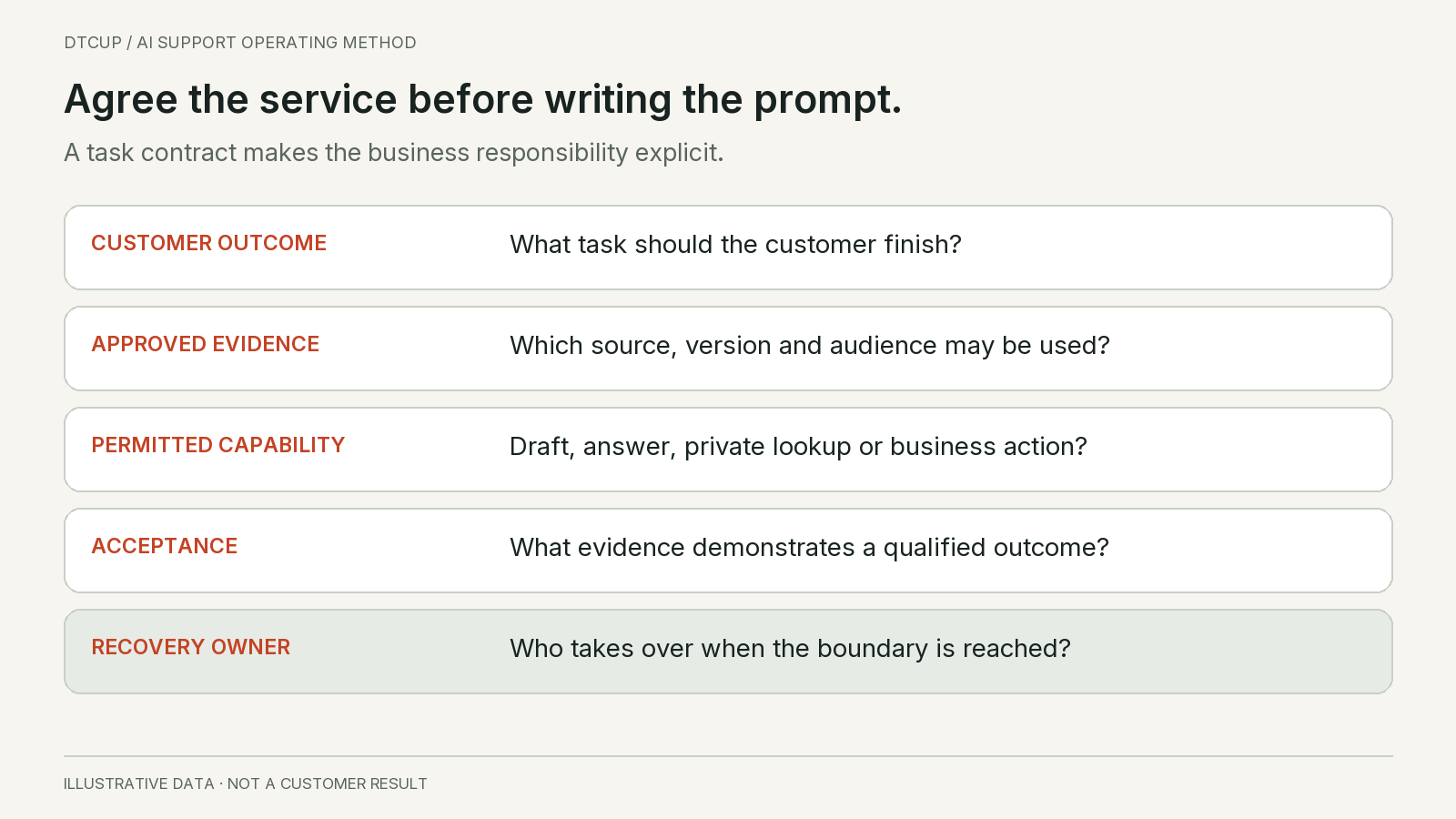
Write an acceptance sentence before designing the conversation. It should describe the customer result, the required evidence and the boundary. For example: the assistant may direct a visitor to the published guide for a confirmed model and revision; it must clarify an ambiguous model and route unsupported compatibility or safety questions to the approved human process.
Then identify what the task does not include. Finding an instruction document does not authorize diagnosing every product fault. Explaining a return policy does not authorize approving a return. Reading an order does not authorize changing an address. These distinctions let the team expand deliberately rather than discovering after launch that customers interpret a general chat interface as an unlimited service promise.
The first deliverable is therefore a task contract, not a long prompt. A useful contract contains the user need, starting context, permitted sources, allowed responses or actions, evidence of completion, escalation conditions and accountable owner. Keep it readable by support and operations as well as engineering. If only the developer understands the contract, the business has not yet agreed to it.
Separate what is true, what is accessible and what may be disclosed
A document can be accurate without being suitable for public answers. An internal troubleshooting note may contain an unapproved workaround. A customer record may be available to a support employee but inappropriate for an anonymous visitor. A current warehouse field may describe physical quantity while the website promise depends on reservations and location. Access alone does not settle meaning or permission.
Build a small source map for the chosen task. Identify the authoritative policy or product record, its owner, its scope and its freshness requirement. Distinguish stable published knowledge from live operational state. A policy can be reviewed on an agreed schedule; an order status may need a fresh authorized lookup at the time of the conversation.
Next, define the disclosure audience. Public approved knowledge can support visitor questions. Internal notes may support an employee draft without being quoted externally. Customer-specific information requires the appropriate identity and permission boundary. Do not solve these differences by placing everything in one search index and asking the model to be careful.
The shared knowledge and audience guide explains the detailed content controls. At the operating level, the critical decision is who is authorized to publish a fact for each audience and how that authorization is withdrawn. A document upload should not silently become permission for every assistant to expose its contents.
For DTCUP’s currently documented website-assistant arrangement, the public assistant uses approved, published, AI-ready knowledge authorized for public use, with source references. That should not be described as live catalog, pricing, inventory or cart capability when those connections are unavailable. The same discipline applies to any brand: explain the verified current scope, and label proposed extensions as proposals.
Design the minimum complete system, not the smallest demo
A demo can answer a question from a document. A complete service must also handle an ambiguous question, missing evidence, an unavailable dependency, an unsuitable request and a customer who wants a person. Those paths do not need elaborate technology, but they need deliberate behavior and an owner.
For a narrow public-information task, the minimum system may include approved knowledge, a retrieval step, answer instructions, a visible source, a handoff route and a record for quality review. For a customer-specific task, add identity, access checks, an authorized tool and a clear distinction between retrieved information and completed actions. The architecture should follow the task contract rather than a fashionable list of components.
Keep the parts replaceable. A business fact should not exist only inside a prompt. A permission rule should not depend only on the model remembering it. A human queue should not require the same provider that just failed. These separations make the service easier to repair because the team can identify which part changed and which responsibility remains stable.
That is also why a custom support system does not automatically mean training a proprietary foundation model. Many useful systems combine existing models with governed knowledge and restricted tools. The custom support architecture guide discusses the options. The operating question is whether the chosen combination can meet the task contract at an acceptable cost.
Do not postpone the recovery path until after the attractive answer flow is finished. If a lookup times out, the system needs a truthful response and a route that preserves the customer’s issue. If it cannot confirm an action, it should not claim completion. A minimum complete service is defined by recoverable behavior, not by the fewest screens or the shortest implementation estimate.
Expand capability through distinct permission levels
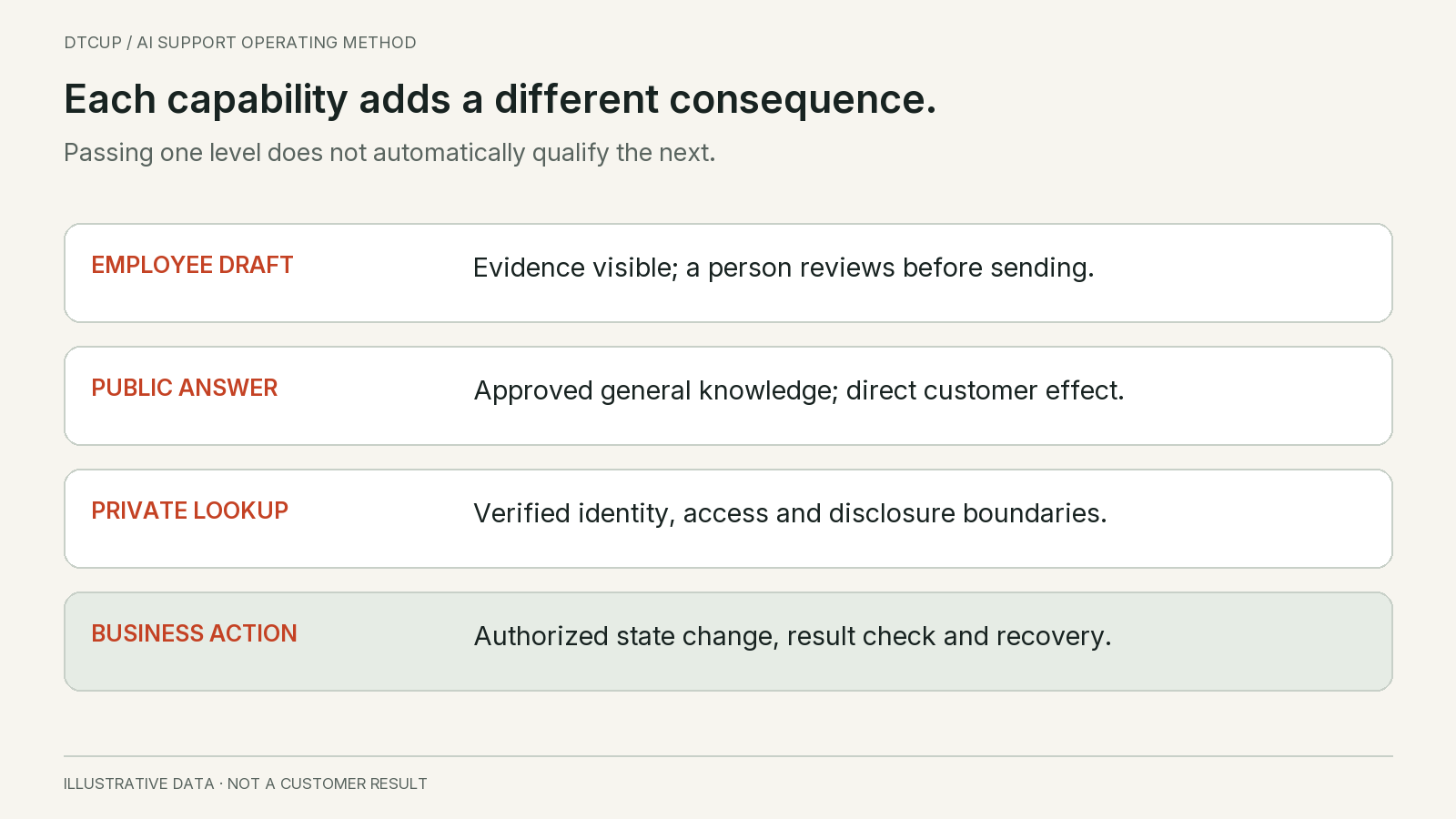
Use separate levels for drafting, public answering, private reading and business actions. An employee-reviewed draft allows a person to inspect evidence before sending. A public answer speaks directly to the customer but can remain limited to approved general information. A private lookup adds identity and disclosure obligations. An action adds the possibility of changing money, orders or customer records.
Success at one level does not automatically qualify the next. A system may reliably explain a cancellation policy while being unready to cancel an order. The latter requires checking the correct order, current fulfillment state, customer authority, applicable rules, duplicate execution and the result returned by the order system.
At each transition, ask what new failure becomes possible and which control prevents or recovers it. Moving from draft to direct answer removes the human review step. Moving to private data introduces unauthorized disclosure risk. Moving to actions introduces business-state change and partial completion. The release evidence must address the new consequence rather than merely repeating the earlier accuracy test.
A brand can also choose to stay at a lower level for some tasks permanently. That is not necessarily a temporary limitation. Complex complaints, disputed exceptions or decisions requiring judgment may be better served by a person with a well-prepared draft. The relevant measure is the complete customer and operating outcome, not how many steps have been labeled autonomous.
Document the capability level beside each supported task, market and channel. A website visitor and an authenticated customer may have different permissions. A support employee may receive an internal draft that the public assistant is not allowed to produce. Keeping those differences visible prevents a successful pilot in one context from being copied into a more sensitive context without review.
Follow one fictional brand through a bounded rollout
Imagine Alder Home, a fictional brand with several generations of compact home-office products. Its support team receives repeated requests for manuals, compatibility advice and delivery information. The founder initially wants one assistant to answer all three. The team instead examines the evidence and discovers that the three tasks have very different readiness.
Manuals are published and can be mapped to model numbers, but some older files use confusing names. Compatibility information is split between approved product pages and internal notes. Delivery information requires an authenticated order lookup and a current operational source. The first release therefore focuses on finding approved manuals for clearly identified models.
The knowledge owner resolves the file mapping and identifies unsupported models. Support writes examples of how customers describe products without using the exact model code. Engineering ensures the retrieval result includes the model and revision. The assistant is instructed to clarify when those facts are ambiguous and to offer a human route rather than selecting the most similar-looking document.
The team tests a bounded set of representative requests, including older model names, typos, missing context and a request for an internal service workaround. It keeps a separate set of examples for evaluating changes rather than continuously tuning on the same cases. The release decision depends on the task-specific results and the severity of failures, not a single blended score.
Only after the manual task works in the intended environment does the team consider compatibility. That expansion requires publishing an approved compatibility record with explicit product generations and exclusions. The team does not treat successful manual retrieval as evidence that undocumented compatibility can be inferred safely. Delivery remains a separate project until identity and lookup permissions are ready.
Create an acceptance matrix that exposes the weak boundary
A general accuracy percentage can hide the very cases that make a release unsuitable. Build the evaluation around task categories and failure consequences. For Alder Home, the categories include exact model match, ambiguous model, obsolete model, unavailable document, conflicting source and a request outside the allowed scope.
For each category, define the expected behavior and the evidence required to judge it. A correct answer might be a link to the approved manual. In an ambiguous case, the correct behavior may be a targeted clarification. In an unsupported case, a useful handoff can be the successful outcome. Treating every non-answer as failure would pressure the system to guess precisely where it should stop.
Separate finding the right source from accurately communicating it. A retrieval system can return the correct document while the answer adds an unsupported claim. An answer can also sound plausible while relying on the wrong product generation. The claim-and-evidence audit gives a method for examining that distinction.
Include the end-to-end experience. Does the source link work? Does the customer understand the clarification? Can a keyboard user reach the handoff control? Does the human receive the relevant context? A response that is factually correct but unusable on the actual website has not met the service contract.
Define how serious failures affect the release decision before looking at the results. A small improvement in ordinary answers should not offset a new unauthorized disclosure. The business needs an explicit severity policy and the authority to reduce scope. Numerical thresholds can support that policy, but a universal pass rate from another company is not a substitute for judging the consequences in this service.
Make the human route operationally real
A handoff button does not prove a handoff service exists. Identify the receiving team, opening hours, expected response process and the information they need. Explain to customers what happens after escalation without promising a response time the business cannot meet. If the queue is unavailable, the assistant should offer the actual alternative rather than imply a person is already handling the issue.
The transferred record should preserve the customer’s question, relevant confirmed context, sources consulted, failed steps and the reason for escalation. It should distinguish the customer’s statements from the assistant’s interpretation. An agent should not need to repeat the entire conversation simply to discover that the system guessed a product model.
Keep unnecessary personal information out of public transcripts and broader quality exports. The receiving team may need private details that a training or analysis dataset does not. Permission boundaries should continue after handoff; moving a conversation into another tool does not automatically make every field appropriate for every employee or vendor.
Capacity matters. If a release increases the number of escalations or changes their complexity, the human team needs to plan for that workload. A high containment rate can coexist with a smaller but much harder queue. Measure handling effort and correction work as well as conversation counts before declaring that the assistant has reduced the staffing requirement.
The detailed answer, clarify or hand off guide helps define routing behavior. In the overall operating method, the key requirement is ownership: somebody remains responsible for the unresolved customer task after the model has stopped answering.
Approve a release packet instead of a promising demonstration
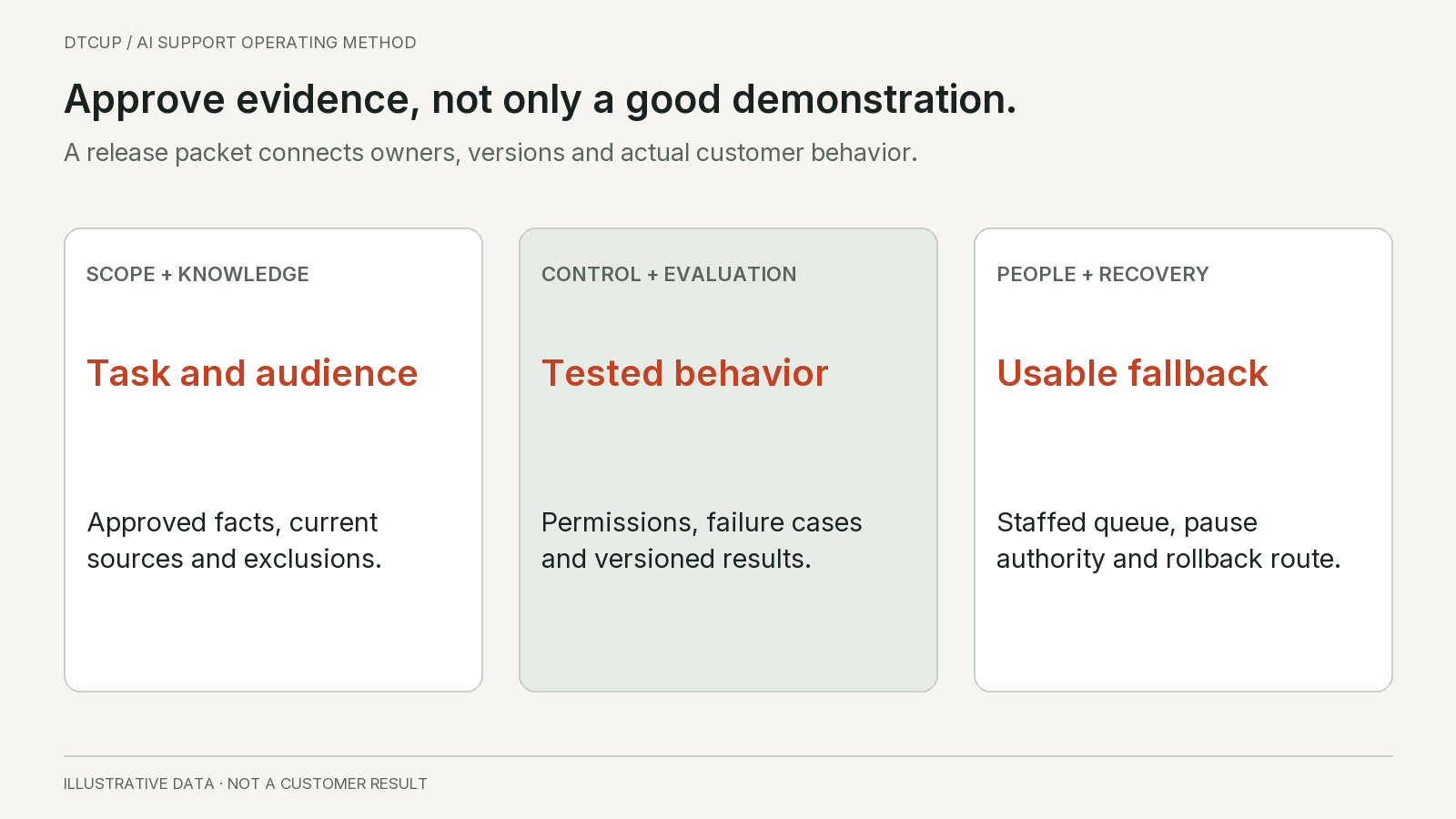
The release packet should be concise enough to review and complete enough to reproduce. It contains the task contract, supported scope, knowledge version, system configuration, evaluation results, known limitations, human route, monitoring plan and rollback owner. Link detailed evidence rather than copying every test transcript into the approval note.
Record the versions that can affect behavior: model, instructions, retrieval settings, knowledge collection, tools and permission rules. A later failure may come from a content change rather than a model change. Without this record, the team may blame the most visible component and repeat the problem after an ineffective rollback.
Use a limited release when the consequence or uncertainty warrants it. That could mean one task, one market, an employee-reviewed mode or a controlled audience. The release should create useful evidence without exposing the whole customer base to an unproven capability. The restriction must be implemented in the system, not merely described in the project plan.
Decide the pause conditions and who can activate them. A source conflict, unauthorized disclosure, broken handoff or repeated unsupported claim may require reducing a specific capability. Preserve a workable customer route during the pause. “Turn everything off” is sometimes necessary, but a well-separated system can often keep verified public information available while disabling a risky action path.
For technical change management, the model-change and regression guide covers comparison and recovery. The operating lesson is broader: an impressive demonstration is evidence that one interaction worked, while a release packet explains why the defined service is ready for its actual users.
Run a service loop and a change loop separately
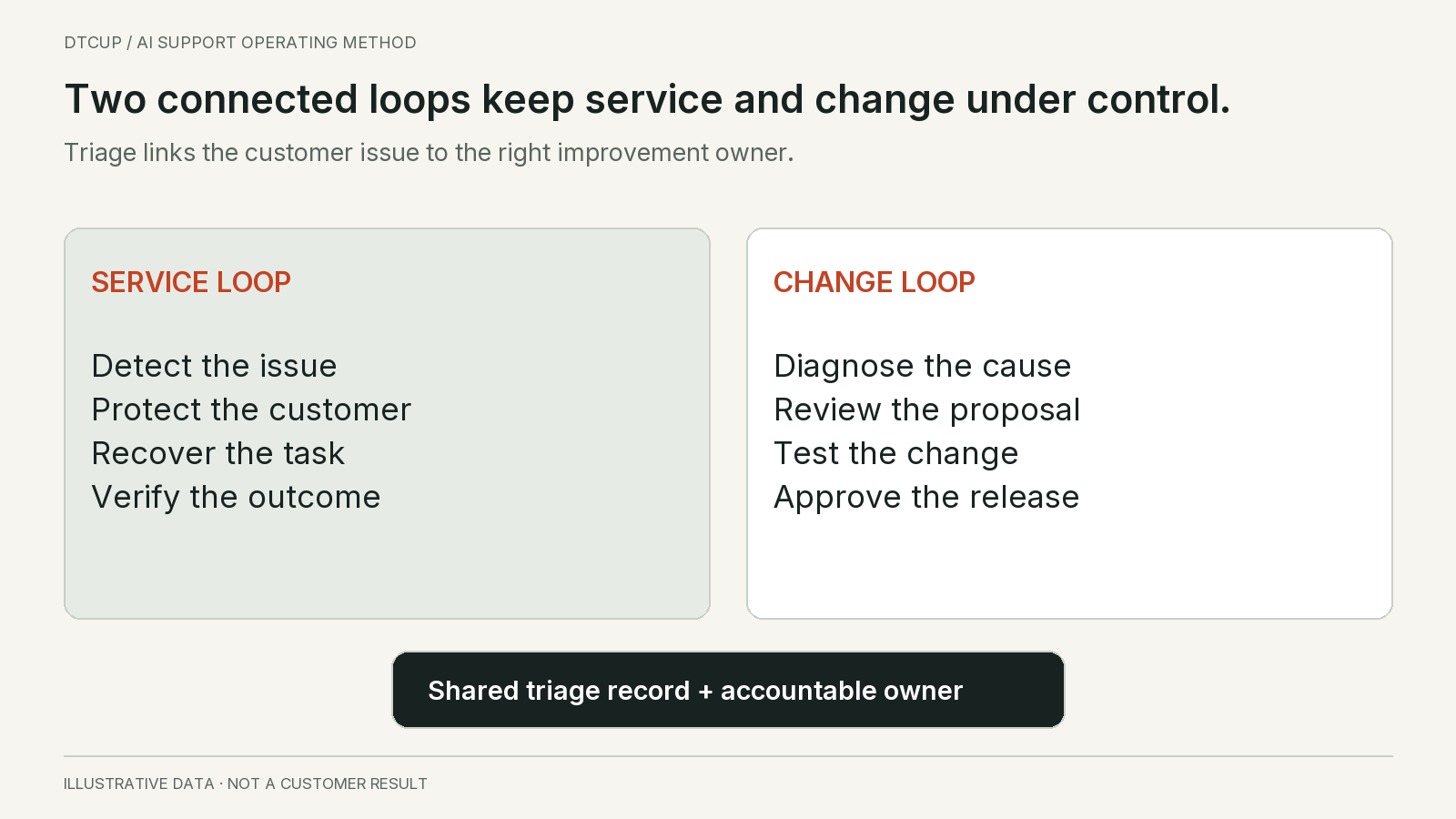
The service loop watches whether today’s customers are getting the intended outcome. It looks for unresolved issues, repeat contact, unsupported claims, failed lookups, queue problems and source outages. Its job is to identify and recover current customer harm promptly.
The change loop decides how the system should improve. It reviews recurring failure patterns, knowledge gaps, proposed task expansions, model changes and operating cost. Its job is to make controlled changes and evaluate them. If every urgent conversation directly edits the shared prompt, the team loses the ability to understand which change improved or damaged the service.
Connect the loops through a triage record. A service issue becomes a candidate change with a reason, evidence and owner. A serious issue may require an immediate containment action, followed by a reviewed permanent fix. A routine gap may enter the knowledge backlog. Not every dissatisfied customer requires a model change, and not every model failure should be solved by adding another paragraph to the knowledge base.
Use the wrong-answer diagnosis guide to locate the failure layer. Was the source wrong, the retrieval incomplete, the claim unsupported, the permission missing or the recovery route ineffective? Different causes require different owners. A single “AI quality” queue can hide these distinctions and slow down the actual repair.
Keep a small regular change review with explicit outcomes: publish a knowledge correction, improve retrieval, narrow a task, test a model update, repair an integration or leave the current behavior unchanged pending evidence. The decision should identify what would count as improvement and how the customer-facing service remains usable during the work.
Follow an incident through the whole system
Suppose Alder Home’s assistant begins linking customers with an older lamp to the newer lamp’s manual. The first response is to protect the affected task: stop automatically selecting between those two models and ask for a clarifying identifier or hand off. That action limits the immediate error while the team investigates; it does not yet establish the cause.
The review finds that an approved manual was renamed and an alias mapping now points both generations to the same entry. The model followed the supplied evidence, so changing model temperature would not repair the mapping. The knowledge owner corrects the alias, the retrieval owner verifies generation-specific results, and support identifies conversations that may need a correction.
The team adds regression cases for both generations and for the ambiguous nickname. It checks the public answer and the employee draft because they share the knowledge source. It also checks any cached result that could preserve the wrong mapping. A successful source edit does not prove every serving path has adopted the new version.
Customer recovery is a separate workstream. The business decides which affected conversations require follow-up and how to communicate the correction. The incident is not closed merely because the next test answer looks right. Closure also requires confidence that the faulty version is no longer served and that the relevant customer consequences have been addressed.
The final review asks why the change passed. Perhaps aliases had no generation-level review, or the test set covered only the newest product. The corrective action should change that release control. Blaming an individual for a naming mistake without improving the shared system leaves the next editor exposed to the same failure.
Treat knowledge maintenance as part of the service budget
Knowledge work does not end when the first collection is imported. Policies change, products gain revisions, internal exceptions become obsolete and operational sources fail. Assign owners and review triggers to the records that the assistant actually uses. A large undocumented collection is not automatically a stronger knowledge base than a smaller maintained one.
Prioritize maintenance by consequence and usage. A frequently used return rule with commercial implications may need a stronger change process than a rarely used historical description. A live availability answer requires a different freshness mechanism from a stable care instruction. Avoid a single universal expiry interval that either creates unnecessary work or leaves critical facts stale.
Use support conversations as evidence of a gap, not as automatic truth. A ticket can contain a customer’s misunderstanding, an employee’s provisional suggestion or a one-off goodwill decision. The ticket-to-knowledge workflow explains how to review and promote useful information without turning every past reply into a public policy.
Include maintenance effort in the service economics. If a system saves answer-writing time but requires substantial review, integration repair and content ownership, those costs belong in the evaluation. They may still be worthwhile because service improves, but the conclusion should be based on the complete operating model.
The support economics guide separates cost per qualified resolution, released staff capacity and actual cash savings. Use those distinctions in the expansion decision. A cheaper model response is not sufficient evidence that the whole service has become cheaper or better.
Decide what customer memory should preserve
A CRM can make support more useful by preserving confirmed context across contacts. It can also make an early mistake persistent. Separate stable customer-provided preferences, verified account facts, temporary issue state and uncertain inferences. The assistant should not convert a guess made in one conversation into an authoritative customer attribute in the next.
Give customers and staff a practical correction route. If a product ownership record is wrong, the service should know which source can change it and whether the corrected fact is local to one issue or shared more widely. Explain conflicts rather than silently preferring the most recent message when the fact affects identity, eligibility or an action.
Limit memory to what supports the approved task. More context is not always more helpful; irrelevant history can distract the answer and broaden exposure. Decide retention and access with the responsible privacy and operational owners. Do not copy complete transcripts into every prompt simply because storage makes that easy.
When the system reads private order data, keep authorization outside the model’s discretionary judgment. A persuasive message or an order number should not by itself establish access. The separate identity and permission guide covers that boundary. In the implementation roadmap, it is a prerequisite for private lookup rather than a feature to add after the chat works.
Memory and identity are related but different. Remembering that a visitor prefers concise answers does not authenticate them. Authenticating an account does not authorize every employee or assistant to access every historical detail. Keeping those responsibilities separate makes the CRM useful without making it an uncontrolled source of persistent assumptions.
Treat a new language or market as a scoped expansion
A successful English pilot does not establish that another language or market is ready. Translation can preserve sentence meaning while applying the wrong commercial policy. A customer writing in Spanish may be ordering in one of several markets. Language is evidence about communication preference, not sufficient evidence about jurisdiction, shipping eligibility or return rules.
Before expanding, map the task’s market-specific sources, terminology and escalation route. Evaluate realistic customer expressions and product names with competent reviewers. Test whether the system asks for missing market context when it matters, instead of inferring it from a language or an unverified location signal.
Keep the same underlying service contract but identify the parts that vary: approved policy, product availability, supported channel, human coverage and source freshness. A new market may require a narrower capability level while the team builds the appropriate evidence. That is preferable to presenting an identical interface whose service behind the scenes is materially weaker.
The multilingual support guide goes deeper into evaluation. The broader operating principle is that expansion follows verified task coverage. A model’s ability to produce fluent text in a language is only one component of that coverage.
Give the founder a scorecard that leads to a decision
The founder does not need every model diagnostic in the weekly review. They need to know which tasks are supported, where outcomes are reliable, which risks are open, how much human work remains and whether the next expansion is justified. A concise scorecard should connect those questions rather than celebrate message volume.
Show qualified outcomes by task and relevant segment, with unresolved and repeat-contact cases visible. Include the maturity of the observation window. A conversation closed ten minutes ago has not had the same opportunity to reveal a failure as an issue reviewed after the relevant customer task has completed.
Show serious incidents and recurring causes alongside average quality. Add human queue age, correction effort, knowledge freshness failures and the full scoped cost. A favorable average can otherwise conceal a small group receiving poor service or a hidden workload transferred to experienced staff.
Then present the actual choice: keep the scope, narrow it, fix a dependency, test a change or expand a specific task. Attach the evidence and the next review condition. “The AI handled more conversations” is an observation. “We can safely add authenticated delivery lookup after these permission and outage tests pass” is a decision proposal.
The voluntary NIST AI Risk Management Framework treats governance as a continuing responsibility across mapping, measurement and management. Those functions are not a mandatory linear checklist. The service method here is an independent practical application of ongoing ownership, not a certification or a claim of compliance with a standard.
Sequence the implementation by dependencies
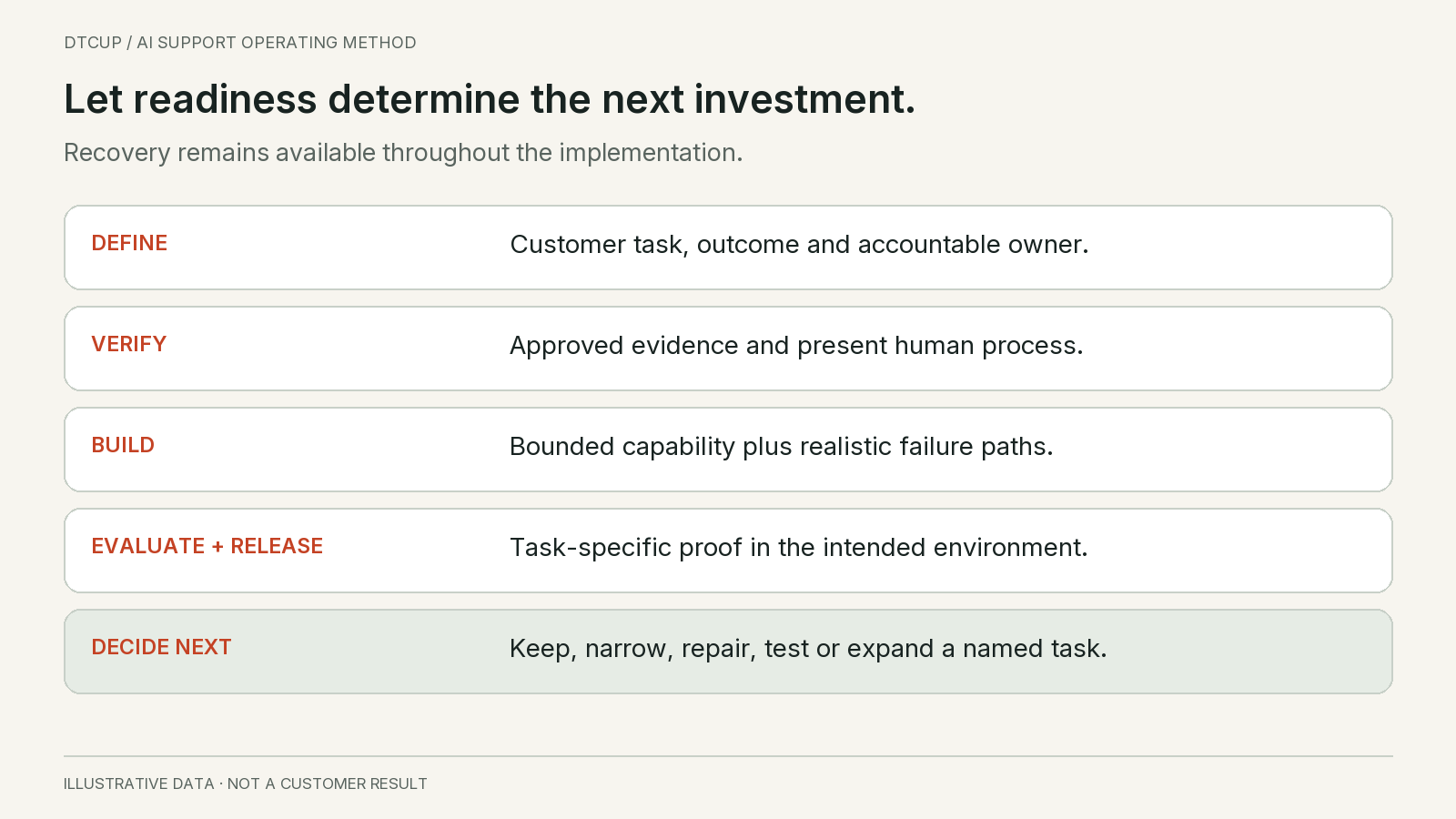
Begin by selecting the task and assigning its owner. Next, verify the sources and the current human process. If the business cannot agree which policy is authoritative, model integration should not be the first priority. Resolve the operating ambiguity that the assistant would otherwise amplify.
Build the narrow answer or draft path together with its failure and recovery behavior. Create the evaluation set before extensive tuning so the team can distinguish improvement from memorizing the examples. Test the complete customer path, then release within the approved boundary and observe the actual workload.
Use the resulting evidence to choose the next investment. Poor retrieval calls for a different intervention from unavailable human coverage. Repeated policy disputes may require management ownership. High model cost may matter less than expensive correction work. The dependency view prevents the team from buying a new component simply because it is easier than resolving a cross-functional responsibility.
Time-box investigations and keep the customer service running. A perfect future architecture is not a reason to abandon the current queue. The implementation should improve one supported task while preserving a reliable human route for everything outside scope. That makes progress visible without pretending the whole service has been automated.
At each expansion, repeat the acceptance decision for the new consequence. The existing knowledge and evaluation foundation can be reused, but the new task still needs its own evidence. This is how a narrow pilot becomes a durable operating system: through explicit responsibility and accumulated proof, rather than an ever-longer prompt.
Read a pilot result before deciding what it permits
Suppose Alder Home reviews one hundred fictional manual requests after enough time for customers to report problems. Seventy involved an exact model identifier. Twenty required clarification, and ten concerned unsupported products. Among the seventy exact-model requests, sixty-eight received the correct approved document and two received the wrong generation. Fifteen of the twenty clarification cases eventually reached the right document; five reached the human queue. All ten unsupported cases were routed to that queue.
The first useful conclusion is not “the assistant succeeded eighty-three percent of the time.” Eighty-three customers received the intended document through the automated path, but the fifteen human-routed cases still need their own outcome review. The two wrong-generation answers are a separate failure requiring correction and cause analysis. A single score obscures both the unresolved work and the difference between a deliberate boundary and an incorrect answer.
Now suppose the human team resolves twelve of the fifteen routed cases, with three still open. The complete issue ledger contains eighty-three automated document outcomes, twelve human-supported outcomes, three unresolved cases and two incorrect-answer cases pending verified recovery. The categories account for the hundred requests. They do not establish a universal success benchmark, and the small sample does not prove that the same rates will persist across all future product generations.
The expansion decision should inspect where the failures occurred. If both wrong answers came from the same alias mapping, fixing and retesting that mapping may support continuing the manual task. If they came from broad unsupported inference across several products, the current scope may need a stronger restriction. Neither result demonstrates that order cancellation or private delivery lookup is ready. The pilot has produced evidence about one defined task.
Also inspect the human workload. Fifteen escalations could be manageable, but only if the receiving team has capacity and the transferred context is useful. A five-minute clarification may prevent a thirty-minute correction later. Conversely, a lengthy automated loop may frustrate customers before generating the same human ticket. Measure the complete path rather than rewarding the system for delaying the moment a person becomes involved.
Design handover and vendor exit while the system is small
The operating agreement should survive a staff change or a vendor change. Keep approved knowledge, source ownership, task definitions and evaluation examples in formats the business can access. Verify what the vendor actually permits you to export, including conversation evidence and configuration. Do not assume a polished administrative interface guarantees a practical exit path.
During handover, ask the replacement owner to trace one customer answer to its approved source and one failed lookup to its recovery route. They should also be able to identify who can pause a task and which version is currently serving customers. If those answers depend on the original implementer’s memory, the service is not yet operationally transferable.
Test a limited outage scenario without disrupting real customers. The exercise should show what happens when the model, knowledge retrieval or business tool is unavailable, and whether the human route remains reachable. A dependency failure should produce a truthful limitation and preserve the issue where appropriate. It should not become an invented answer or a false action confirmation.
Also document responsibility when a knowledge owner leaves the business. Their approved records should not become ownerless facts that remain indefinitely available. Transfer ownership, review the highest-consequence entries and confirm that withdrawal still reaches every serving channel. Staff turnover is a normal operating event, so the service should handle it through a maintained process rather than a hurried search for somebody who remembers why a policy was published.
Exit planning is not an argument against using external services. It is a way to keep the business’s knowledge and customer obligations from becoming inseparable from one implementation. The more clearly those responsibilities are defined, the easier it becomes to change a component for better quality, cost or maintainability without rebuilding the entire service from scratch.
Questions about an AI support operating model
Should we launch a public assistant or an employee copilot first?
Choose based on the task’s evidence and consequence. An employee-reviewed draft can reveal knowledge gaps while retaining review, but it still needs source visibility and clear responsibility. A narrow public-information task may be ready sooner than a complex internal action. Neither format is automatically safer or more valuable without examining what it is allowed to do.
How many tasks should the first release support?
Enough to solve a meaningful customer problem and little enough that the team can verify the full behavior. One well-chosen task can be a valid first release. The count matters less than whether every supported task has an owner, approved evidence, acceptance cases and an operational recovery path.
Can better prompting replace knowledge and permission controls?
No. Instructions can shape how the assistant uses evidence, but they cannot make missing facts available or establish customer authority by themselves. Keep source governance, access enforcement and business-action checks in the appropriate systems. Evaluate prompts as one versioned component within that larger service.
When should we expand the assistant?
Expand when the current task’s outcomes are understood, its unresolved work is owned, its economics are acceptable and the next task’s additional controls have passed review. Growth in conversation volume alone is not enough. A stable narrow service gives the business a stronger foundation than a broad assistant whose failures are difficult to locate or correct.
The goal is a service customers can use and staff can explain. The model matters, but the durable advantage comes from the decisions around it: which facts are approved, which actions are allowed, what counts as resolution and who takes responsibility when the automated path reaches its limit.
Sources
Still have a question?Ask the DTCUP Community ↗