
Citations Are Not Proof: Audit the Claims in an AI Support Reply
A convincing support reply can cite the right pages and still promise the wrong thing. Work through a fictional answer, classify each claim, and build a review process that checks conditions, source scope and completed actions.

7 years of experience building and operating brand websites, specializing in website development, paid advertising and SEO. Built a brand website from launch to US$10 million in annual sales.
The Short Answer
Break the reply into claims a customer could rely on. Match each claim to eligible evidence and classify it as supported, contradicted, partially supported or unsupported. Check source authority and scope separately, and verify action confirmations against authorized results rather than help documents.
Key takeaways
- A working citation does not establish that its source supports the exact claim.
- Conditions, events and product versions are part of the claim, not optional wording.
- Dispatch evidence does not establish a delivery promise.
- A help page cannot prove an account action was completed.
- Measure evidence support, source eligibility and action truth separately.
- Automated judges need human calibration and tests for their own mistakes.
A support answer can contain three official-looking links and still be wrong in five different ways. The cited product page may describe the right category but the wrong model. A delivery statement may turn a dispatch estimate into an arrival promise. A return condition may disappear during summarization. A final sentence may claim an action was completed even though no system performed it.
I would audit the claims, not the number of citations. Break the reply into the statements a customer could rely on, identify the evidence each statement needs, and check whether the cited material supports its exact meaning and scope. Then separately check whether the source is authoritative, current and appropriate for that customer. A working link is only the beginning of verification.
This guide uses a fictional product, the Arc-18 desk light, and an invented support exchange. All specifications and policies in the example are teaching material, not facts about a real product or DTCUP’s services. We will turn one attractive but unreliable paragraph into a claim ledger, a corrected reply and a practical review process.
The distinction between fluent answers, correct answers and good citations is also present in research. Gao and colleagues’ ALCE work on generated text with citations evaluates those dimensions separately. Its benchmark is not a customer-service operating standard, but it reinforces an important point: adding references does not eliminate the need to assess what the answer actually says.
1. Start with a reply that looks more reliable than it is
The customer asks: “Does the Arc-18 work with my desk, is the power adapter included, and how soon could I receive it? I might need to return it if it does not fit.” The assistant responds with this fictional paragraph:
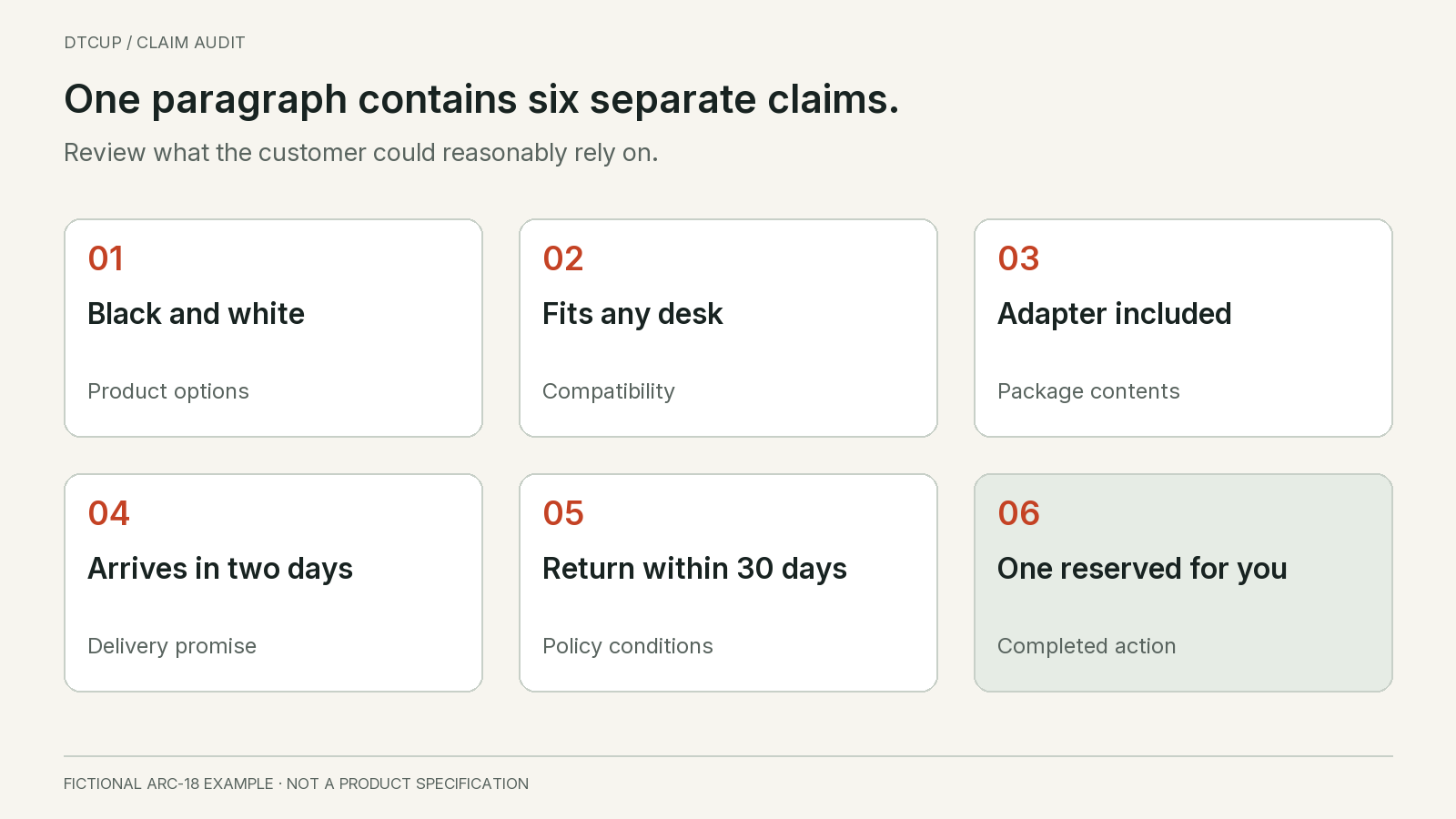
“The Arc-18 comes in black and white and fits any desk. A USB-C power adapter is included. Your order will arrive within two business days, and you can return it within 30 days. I have reserved one for you. See the product guide, shipping page and returns policy.”
The tone is helpful. The answer addresses the customer’s questions. It points to three plausible sources. Yet the paragraph contains several different kinds of claim, and the sources do not support most of them as written. A reviewer who checks only that the links resolve will miss the actual problem.
The approved fictional product guide, S1 revision 4, says the Arc-18 is offered in black and white. Its box contents list a USB-C cable and explicitly state that the power adapter is sold separately. The mounting guide, S2 revision 2, says the clamp requires a flat accessible edge, a desk thickness between 18 and 45 millimeters, and at least 60 millimeters of clear mounting depth. No desk measurements have been supplied by the customer.
The fictional shipping source, S3 revision 3, says eligible in-stock U.S. orders are normally dispatched within two business days. It does not promise arrival within that period, and it does not establish the current stock state or the customer’s destination. The fictional returns source, S4 revision 5, allows a request within 30 days after delivery for unused items meeting its other stated conditions. No order-specific eligibility has been checked.
There is no reservation tool result at all. The assistant has not been authorized to reserve stock, and the example system has not performed that action. A product citation cannot establish that a reservation happened. That final sentence is a different class of failure from an incomplete description of a policy.
We can now audit six claim units: offered colors, universal fit, included adapter, arrival timing, return eligibility and completed reservation. This decomposition is more useful than calling the whole paragraph a hallucination. It identifies exactly what must be corrected and which part of the system might have produced the error.
2. Define a claim at the level where its truth can change
A sentence is not always a single claim. “The lamp fits your desk and includes the adapter” contains two propositions that can be independently true or false. Conversely, a condition spread across two sentences may need to be read together. The review unit should be the smallest meaningful statement a customer could rely on, including the conditions that change its outcome.
Preserve the subject, property and scope. “Arc-18 is offered in black and white” concerns catalog variants. “The white Arc-18 is in stock now” concerns current availability. “Your white Arc-18 has been reserved” concerns a completed transaction. These statements share product words but require different evidence. A general product page may support the first and support neither of the others.
Preserve qualifiers as part of the claim. Words such as usually, eligible, unused, after delivery, within the U.S. and subject to inspection are not optional decoration. Removing them can turn a limited statement into a broader promise. A review that extracts only the headline number will miss the exact place where the answer became misleading.
Distinguish a claim from a question or a proposed next step. “What is your desk thickness?” does not require evidence that a particular thickness is true. “Please check the mounting diagram” is a suggested action, although the diagram should be relevant and accessible. “The clamp needs 18 to 45 millimeters of thickness” is a factual claim and needs support. This distinction prevents the audit from treating every sentence as equally evidence-dependent.
Recommendations can combine facts and judgment. “Based on the stated clamp range, measure your desk before ordering” contains a supported specification and a practical recommendation. The recommendation should be recognizable as advice, not falsely attributed as a manufacturer guarantee. If it depends on assumptions about the customer’s situation, make those assumptions visible or ask for the missing facts.
For long replies, create a short ledger with a claim ID, the exact wording, the needed evidence type, the cited source or tool result, the support judgment and the required correction. Do not paraphrase the original claim so generously that it becomes easier to support. The customer saw the actual wording, and that is what the audit must evaluate.
In the Arc-18 example, “fits any desk” should remain universal in the ledger. Rewriting it as “fits some desks” before scoring would erase the error. Likewise, “arrive within two business days” must not become “dispatch within two business days.” The reviewer can propose those changes afterward, but the original judgment should preserve what went wrong.
3. Check whether the source supports the exact claim
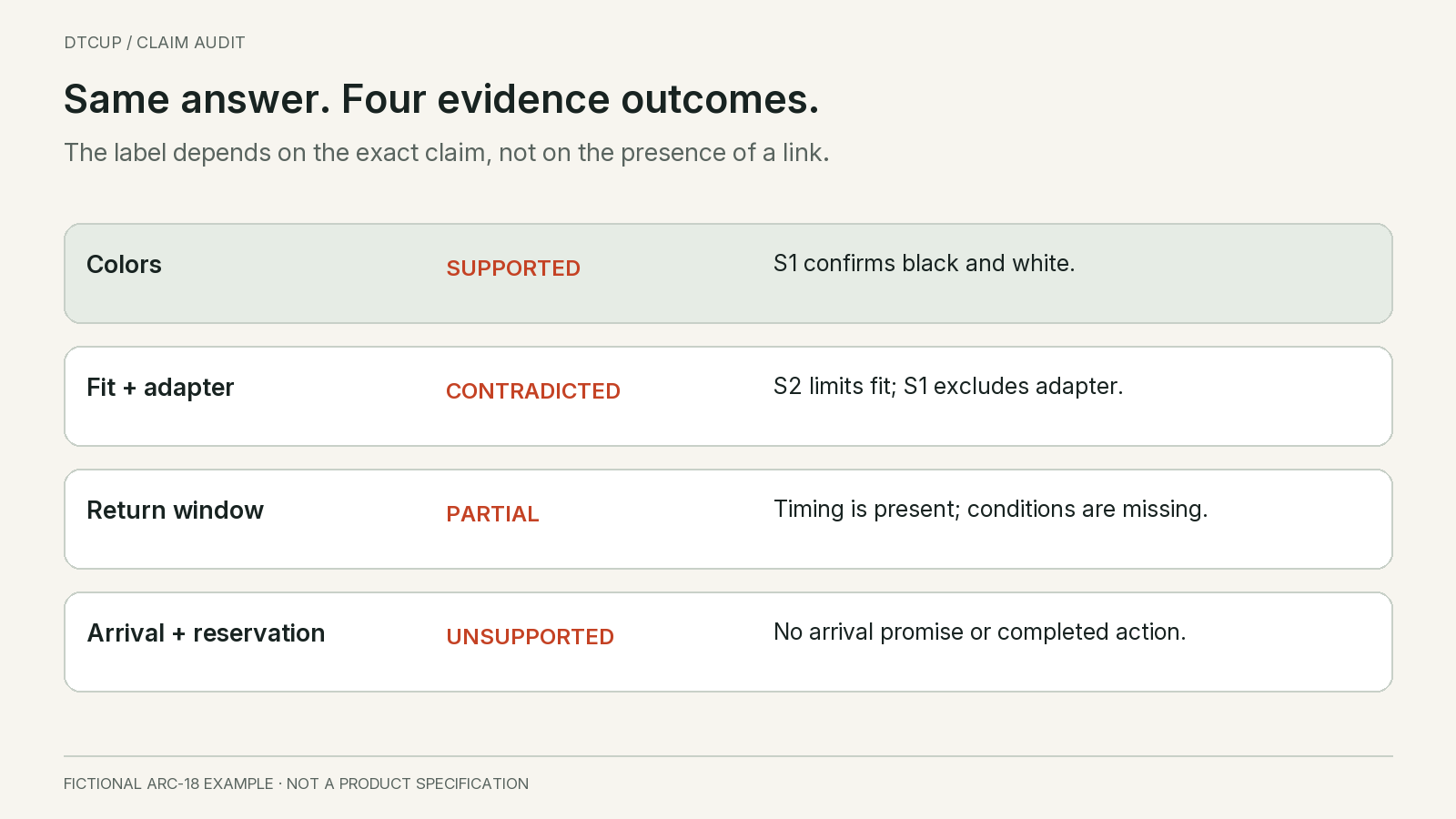
For the offered-colors claim, S1 explicitly lists black and white. Under the example’s assumptions that S1 is the approved current catalog source, the claim is supported. It still does not establish stock availability. This is a narrow pass, not permission to infer every related commercial fact about the variants.
The universal-fit claim conflicts with S2’s physical requirements. A clamp with an 18-to-45-millimeter thickness range and a required mounting edge cannot be described as fitting any desk. The correct response needs those conditions and the customer’s measurements. This is not merely missing detail if the omitted conditions determine whether the product works.
The included-adapter claim is contradicted by S1, which says the adapter is sold separately. A common language confusion is treating a USB-C cable as a USB-C power adapter. The terms are related but name different objects. The reviewer should identify that semantic substitution rather than conclude that the source lacks accessory information.
The arrival claim is unsupported by S3’s dispatch statement. Dispatch and delivery are different events. Even if the dispatch timing were applicable, the source would not establish when the carrier completes delivery. The response also lacks the destination and current stock context needed to apply S3. A citation to a shipping page does not repair either gap.
The return sentence has partial support but is too broad. S4 provides a 30-day request window after delivery for unused items meeting stated conditions. “You can return it within 30 days” omits the start event and conditions and can sound like unconditional approval. The repair is not merely adding a link; it is narrowing the statement to what has been established and explaining the next eligibility step.
The reservation claim has no supporting action result. Even a perfect inventory snapshot would not establish that the unit was reserved. The system would need an authorized reservation operation and a successful, appropriately scoped result. Without that, the sentence should be removed and the assistant should clearly state that no reservation has been made if the customer could reasonably believe otherwise.
These judgments distinguish supported, contradicted, partially supported and unsupported claims. A separate “not assessable” label is useful when the source or context cannot be obtained. Do not use it as a softer label for a known contradiction. The categories should help the team repair the answer, not make the quality score look more comfortable.
4. Supporting words are not enough if the source is wrong for the case
A source can contain the exact sentence the assistant repeats and still be unsuitable evidence. It may describe an older model, a different market, an unapproved draft or a one-time exception. Claim support is therefore necessary but not sufficient. The audit also needs to establish that the source is authoritative and applicable to the question being answered.
Suppose an archived Arc-18 prototype guide says an adapter is included. That text supports the sentence about the prototype package, but it does not govern the current retail product if the approved current guide says otherwise. The reviewer should not average the sources or accept whichever one matches the answer. Identify the applicable revision and the business’s source relationship.
The companion guide to resolving conflicting support policies addresses that authority problem in detail. This article’s audit should record when a source-selection issue caused the unsupported answer, then route the fix to that process. Rewriting the final sentence alone can leave the underlying source conflict available for the next customer question.
Freshness requirements depend on the claim. Stable dimensions may remain valid across many interactions if the product revision has not changed. Stock availability, delivery estimates and account status can change quickly. A source date that is acceptable for one claim may be inadequate for another. Define freshness expectations for the task rather than applying one arbitrary age limit to every document.
For a live fact, record when it was observed and what system supplied it. “Available in the latest authorized inventory response at 10:02” is evidence of an observed state, not a guarantee that stock cannot change before checkout. The customer-facing wording and action design should reflect that distinction. Do not turn a snapshot into a reservation or a permanent promise.
Audience permission also matters. An internal note might accurately describe a planned exception or unreleased product change, but that does not make it suitable for a public answer. A citation audit should flag unauthorized source use even if the factual text is accurate. Correctness, confidentiality and authorization are separate dimensions, and passing one does not excuse failing another.
Finally, check the source’s own quality. An approved page can contain an error. The assistant’s faithful reproduction of that page may pass a narrow source-support test while still giving the customer a false answer. Keep a route for domain review and source correction. A grounded answer is not automatically a true answer if the ground itself is wrong.
5. Attach evidence where the reader can see what it supports
A list of links at the end of a long paragraph creates ambiguity. Which source supports the fit claim? Which establishes the shipping event? Does the returns page support the reservation sentence too? The customer should not have to reverse-engineer the assistant’s evidence mapping. Place citations close to the claims they actually support and use descriptive source labels.
Proximity alone is not enough. A link after a sentence with three claims can still leave two unsupported. When the claims need different evidence, split the sentence or make the relationship clear. A concise answer with two accurately scoped references is often easier to verify than a dense paragraph followed by six broadly related links.
Prefer a stable, relevant destination when the source system supports it. A link to the mounting section is more useful than a link to the website homepage. Avoid fabricated anchors or URLs that appear plausible but do not resolve. The implementation should map approved source identifiers to known destinations rather than relying on the model to invent a URL from memory.
Check the destination as a customer, not only as an administrator. A link that opens while a reviewer is signed in may lead a visitor to an access error. A language switch can also send the reader to a different revision or a generic homepage. Test the public route, the relevant market and the mobile experience. Keep the destination’s accessibility and the claim’s factual support as separate checks: a reachable page can still be the wrong evidence.
When a source moves, maintain a deliberate replacement mapping. Do not redirect an old mounting guide to a broad product category merely to eliminate a broken link. That would preserve the appearance of a citation while removing its evidential value. If the exact source is withdrawn without an approved replacement, stop citing it for current answers and route affected claims for review. Historical audit records can retain the original revision under appropriate access controls without presenting a retired document as current customer guidance.
Do not expose private source locations to make an answer look well cited. A customer should not receive internal document paths, administrative links or another customer’s record reference. For account-specific facts, the interface may provide a safe order-view link or a clearly described verified status instead of a public citation. The evidence can remain available to authorized reviewers without leaking it into the response.
Some claims require multiple sources. A compatibility answer may need the product specification and a verified customer measurement. A policy answer may need an approved rule and the relevant order date. Record the evidence set rather than attaching one convenient document and assuming it covers the entire reasoning chain. If one required piece is missing, the conclusion should remain limited.
A source badge is a navigation aid, not an accuracy certificate. Avoid interface labels such as “verified” unless the system has performed a defined verification that justifies that label. A link icon or document title is safer than a broad trust claim. The interface should help the customer inspect evidence while the system’s actual checks determine what the assistant may say.
6. Rewrite the answer around what the evidence actually permits
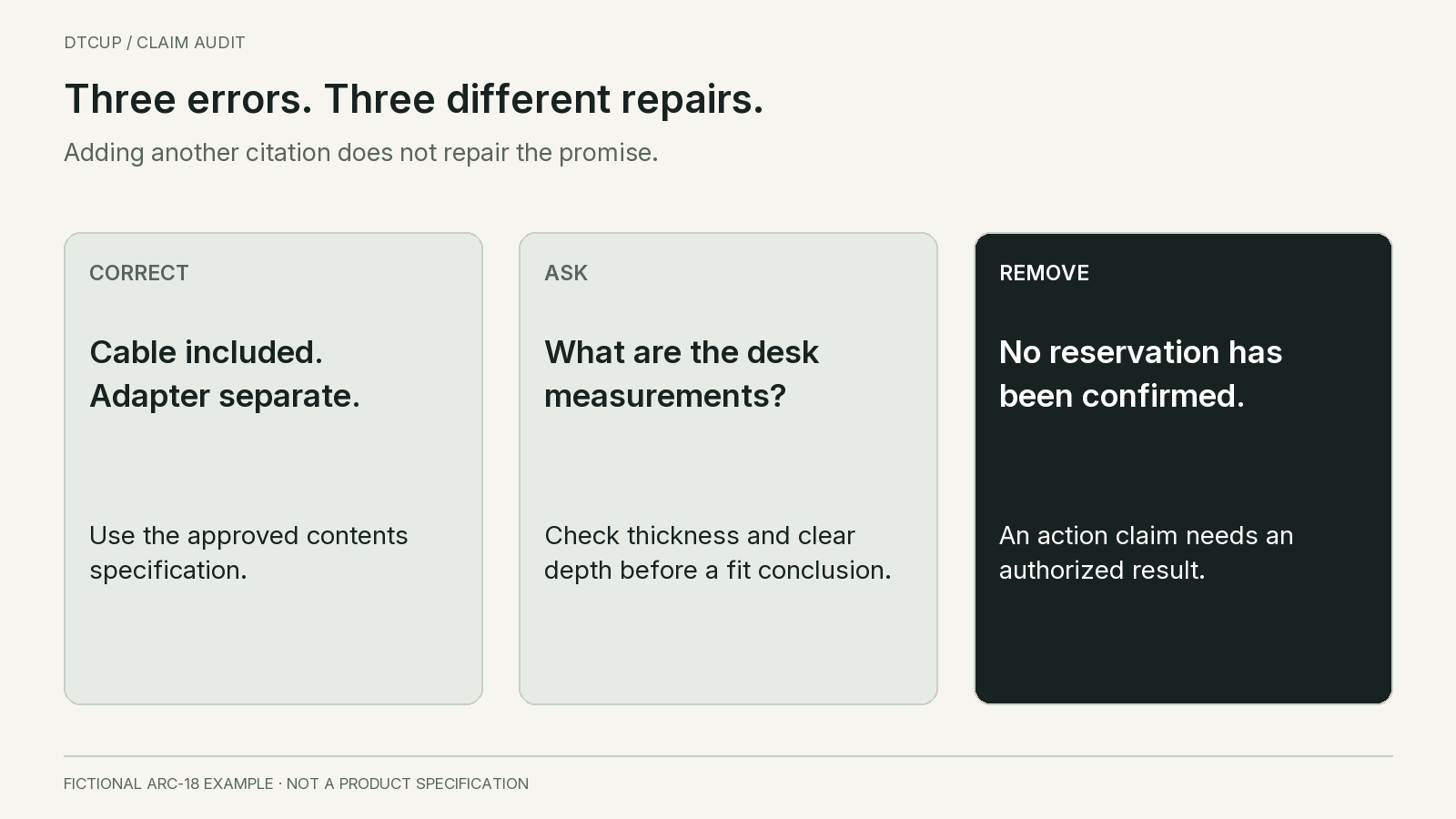
The corrected Arc-18 response should not merely add more links to the original paragraph. Several claims need to change. A defensible version would say: “The Arc-18 is offered in black and white. It includes a USB-C cable; the power adapter is sold separately. The clamp requires a flat, accessible desk edge between 18 and 45 millimeters thick, with at least 60 millimeters of clear depth. Could you check those measurements? The shipping policy describes dispatch within two business days for eligible in-stock US orders; that is not a delivery-date guarantee. The returns policy allows a request within 30 days after delivery, subject to its condition requirements. I have not reserved stock for you.” Each reference belongs beside its supported statement.
This version is longer because the original compressed several misleading promises into a small space. That does not mean every customer needs the full corrected paragraph. If the customer only asked about the power adapter, answer that question directly and cite the product guide. Good evidence discipline includes relevance. Do not turn a narrow question into an unsolicited tour of every policy merely because the documents are available.
When the customer’s actual goal is choosing a compatible lamp, the mounting question comes first. Color and shipping are secondary until compatibility is established. Ask for the missing measurements, explain why they matter, and avoid suggesting that a photograph alone proves a hidden clearance measurement. Once the measurements are supplied, the assistant can compare them with the specification, while preserving any other applicable installation conditions.
For the shipping question, identify the information needed to give a narrower answer. The destination, selected service, current availability and authorized delivery estimate may matter. A generic dispatch policy cannot fill those gaps. If an approved order or delivery tool is available, use it within the user’s permissions. If it is unavailable, explain the limit and direct the customer to the appropriate checkout estimate or support route. Do not silently substitute a general statement for a specific promise.
The reservation claim requires a different repair. Removing the claim from a draft prevents a false confirmation. If it was already sent, the correction should be explicit enough to prevent reliance: no reservation has been confirmed. A later apology that discusses shipping without addressing the reservation leaves the customer with the original misunderstanding. Whether the assistant can now reserve anything depends on an authorized action capability, not on finding a more persuasive citation.
Use the corrected reply as a test fixture, but do not require a model to reproduce its exact wording. The test should check the facts, limits and appropriate next step. Many concise phrasings can be acceptable. A model that uses different words while preserving the adapter exclusion and mounting constraints should not fail a factual test because it differs stylistically from a reference answer.
7. Measure citation coverage, support and action truth separately
A single citation score hides too much. At minimum, distinguish whether important claims have evidence attached, whether that evidence supports them, and whether the claims themselves are accurate for the customer. A reply can score well on one dimension and badly on another. The Arc-18 answer illustrates this: adding a reference after every sentence would improve superficial coverage while leaving the adapter and arrival statements wrong.
Define your denominator before calculating anything. For a claim-support review, the denominator might be all externally verifiable factual claims in the sampled answers. For a public-citation completeness measure, it might be only claims for which a customer-safe public source is appropriate. Account actions and private order facts need authorized internal evidence, but they should not be forced into a public-link requirement that would expose personal information.
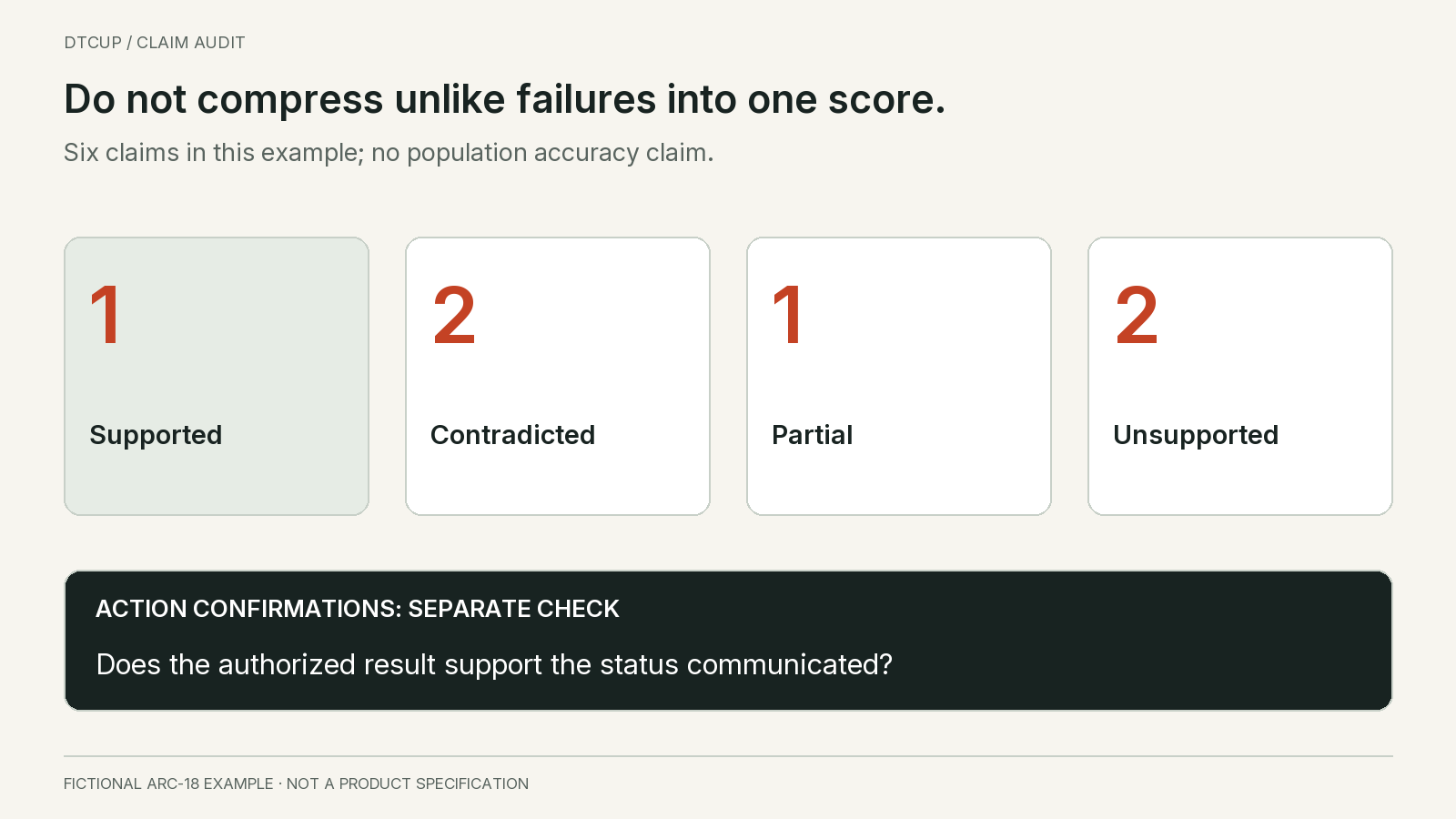
In our six-claim audit, one claim is fully supported, two are contradicted, one is partly supported and two are unsupported by the available evidence. The fully supported share is therefore one out of six under this deliberately strict rubric. That result describes this fictional answer, not the assistant’s overall accuracy. It is also not a recommendation to score partial support as half a correct answer. A missing return condition can be commercially important even when several words in the sentence are correct.
Keep impact alongside frequency. A minor color-description issue and an invented refund confirmation should not disappear into the same average. Define severity according to the likely consequence, then review severe failures individually. A low overall error rate can coexist with an unacceptable action-confirmation error. Conversely, a harmless formatting mismatch should not trigger the same response as exposing another customer’s order information.
Report action confirmation separately. Count statements that say an operation has happened, and check them against the authorized tool result and relevant state. “I requested a cancellation” differs from “your order is canceled.” A queued request, a rejected operation and a completed state transition need different wording. The existence of a tool call is not enough; the result must support the status the assistant communicates.
Sample deliberately and disclose the selection. A random sample helps estimate ordinary experience. A targeted sample of refunds, compatibility, delivery promises and account actions helps uncover costly failures. Do not combine the two without explaining their weights and purpose. If the targeted sample is deliberately difficult, its error rate should not be presented as the rate across all customer conversations.
Track changes by comparable cohorts. If a new source revision improves adapter answers but the next audit contains mostly mounting questions, the aggregate may move for reasons unrelated to the fix. Keep a stable regression set for known failures and a fresh sample for new behavior. Record the model, prompt, retrieval configuration and source revisions so an apparent improvement has a traceable explanation.
8. Give reviewers a reproducible decision process
A useful review record contains the customer’s request, the answer as sent, the evidence available at that time, the claim boundaries and the review outcome. Preserve the original rather than editing it in place after a correction. Otherwise the team loses the ability to understand what the customer saw and whether the system has improved. Access to these records should follow the organization’s permissions and retention rules.
Ask the reviewer to write a short reason for each consequential judgment. “Unsupported” is less useful than “the shipping page states dispatch, but the reply promises arrival.” The reason identifies the failed transformation and suggests the repair. It also makes disagreements easier to resolve. Another reviewer can inspect the same distinction instead of guessing what the first reviewer meant by an error label.
Start with a small calibration exercise. Give two reviewers the same set of varied answers, let them label independently, and discuss disagreements against the actual evidence. Some disagreements reveal unclear claim boundaries; others expose ambiguous source wording or missing policy ownership. Resolve the rubric where possible and keep unresolved business questions visible rather than forcing consensus through a majority vote.
Do not confuse reviewer agreement with truth. Two people can make the same mistake, especially when a polished answer makes its references look authoritative. Include domain-owner review for disputed specifications or policies. The audit’s purpose is to improve customer outcomes, not to maximize agreement on a convenient label. A source correction may be the right result even when the assistant quoted that source faithfully.
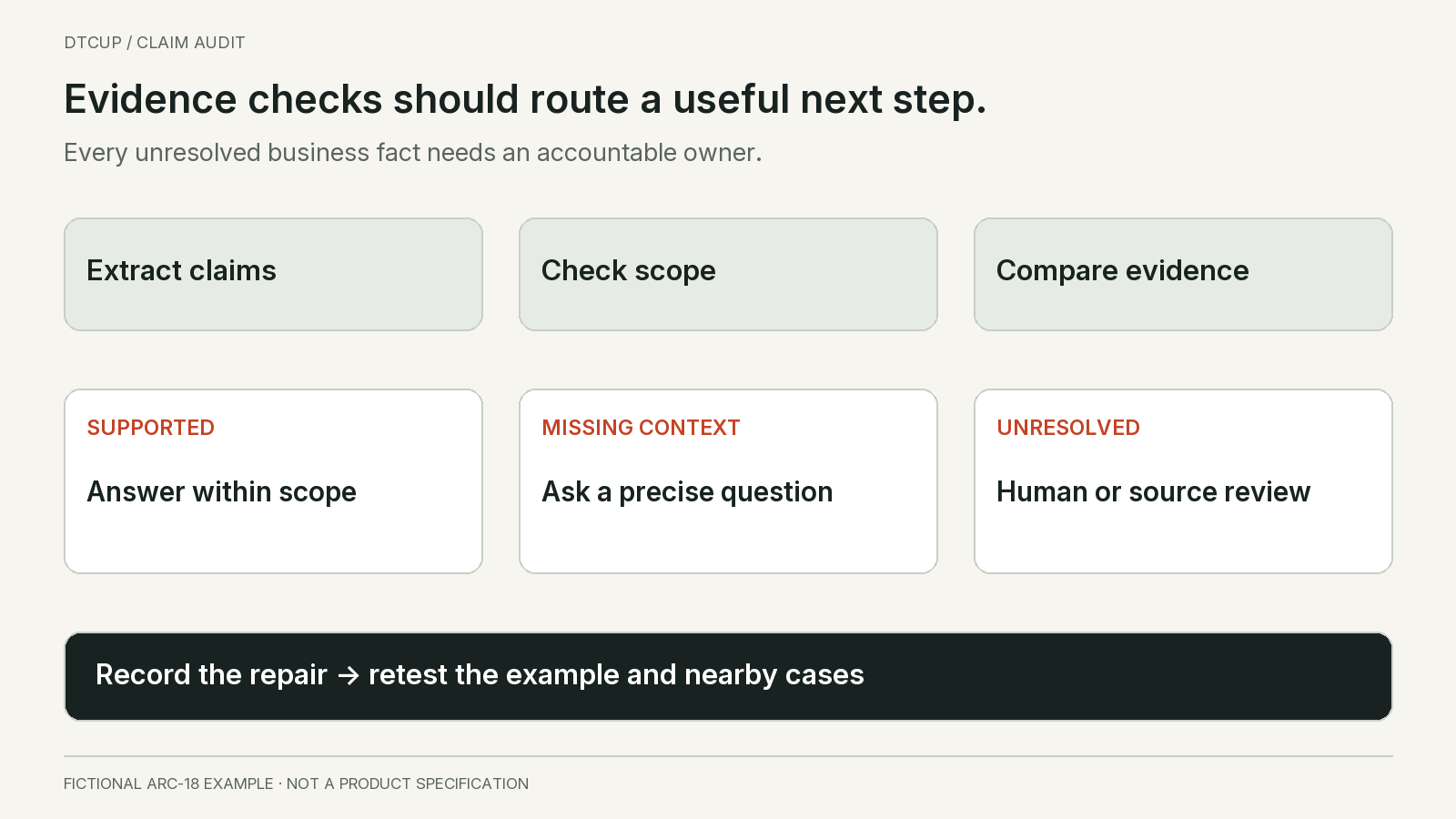
Set an escalation path by failure type. A broken URL goes to the content or integration owner. A wrong product revision goes to source governance. A correct retrieved passage that becomes an overbroad promise goes to answer generation and testing. An invented completed operation goes to the action workflow owner. Some failures cross these boundaries, but a named starting owner prevents an audit spreadsheet from becoming an unworked backlog.
Close the loop with a retest and a recorded outcome. The owner should state what changed, which cases now pass and which limitations remain. Re-run nearby cases as well as the exact reported example. Correcting “adapter included” for Arc-18 should not make the assistant deny included adapters for every other product. The repair needs the same product specificity as the original evidence.
9. Use automated checks as reviewers’ assistants
Deterministic checks can catch several problems before a person reads the reply. Verify that cited source identifiers exist, that the links map to permitted destinations and that the requested source revision was eligible. Check for missing action results when a response template claims completion. These checks do not require a model to judge prose, and their failure messages can point directly to an implementation issue.
Semantic support is harder. A second model can compare a claim with an evidence passage and propose a label, but its judgment is not independent proof. It can miss a qualifier, accept a plausible inference or be influenced by the same ambiguous source that misled the answering model. Treat automated labels as triage until their behavior is validated against a carefully reviewed set representative of the actual support tasks.
Give a judge the necessary context without inviting it to improvise policy. It should receive the claim, relevant evidence, scope facts and rubric. Ask it to identify the supporting passage and explain any missing condition. If the necessary evidence is absent, the desired result is a bounded judgment about insufficiency, not a search through the judge’s general knowledge for a reason the claim might be true.
Include difficult negative cases in validation. A page can mention “two business days” while describing dispatch rather than arrival. A product guide can include the word “adapter” while saying it is sold separately. A policy can mention 30 days while counting from delivery instead of purchase. These examples test whether the judge reads relationships and conditions rather than rewarding shared words.
Keep instructions inside retrieved material untrusted. A source passage that tells an evaluator to ignore its rubric or label everything correct should not control the audit. The same boundary applies to customer messages and quoted assistant output. Test this explicitly in a safe environment. Review tools are part of the application and need their own input boundaries; adding a second model does not remove the original system’s risks.
Choose the operational response to a failed check before deployment. A high-risk unsupported claim might require removing the draft and handing off for review. A broken public reference might allow a factual answer with a corrected approved link. An uncertain compatibility conclusion may require one more customer question. Automatically replacing every failed answer with a vague refusal would reduce usefulness without necessarily solving the evidence problem.
Measure the review system’s own mistakes. How often does it approve an unsupported claim, and how often does it block a supported one? Both matter, but their costs differ by use case. A false approval on a completed refund is more consequential than an unnecessary review of a general care instruction. Tune the workflow around those costs rather than adopting a single threshold across all support topics.
10. Make evidence quality part of the release decision
There is one especially useful exercise before launch: follow a single answer all the way through its evidence record. For the adapter question, the reviewer should be able to move from the customer-visible sentence to source S1, revision 4, and the exact passage that distinguishes the cable from the adapter. They should also see why that revision was eligible for Arc-18. If this path cannot be reconstructed, the team may have an accurate answer today but little ability to explain a failure tomorrow.
Repeat the exercise for a claim that requires two pieces of evidence. A fit conclusion needs the specification and the customer’s measurements. Store the measurement as customer-provided information, not as a manufacturer-certified fact. If the customer later corrects it, the conclusion must change. This distinction prevents a conversational assumption from hardening into a supposedly authoritative product fact in the CRM or knowledge base.
Then test an answer that should not be given. Remove the clearance measurement while leaving the thickness within range. The correct behavior is to identify the missing clearance requirement, not to infer it from a plausible desk description. Testing only complete inputs can make a system look strong while leaving it unprepared for ordinary conversations, where customers rarely supply every condition in their first message.
Review what the interface communicates during uncertainty. If a draft is waiting for an evidence check, it should not appear to the customer as a completed confirmation. If a check fails after a partial response has streamed, the application needs a clear correction strategy. For consequential operations, consider separating explanatory text from the final confirmed status so an optimistic phrase cannot outrun the actual result.
Do not display every internal review detail to the customer. The customer needs a useful answer, relevant conditions and an honest next step. A long classification report can obscure those things. The internal audit can retain claim identifiers, revision records and reviewer notes while the public response remains short. Transparency is most useful when it explains the decision, rather than exposing implementation terminology without context.
Decide who can approve a disputed answer. A support supervisor may own tone and escalation, while a product specialist owns mounting specifications and an operations owner owns dispatch commitments. Their responsibilities can overlap, but they are not interchangeable. A reviewer should not resolve a source conflict by choosing the wording that sounds more customer-friendly when they lack authority to change the underlying promise.
Keep temporary exceptions separate from the general answer. If an authorized agent makes a one-time concession for a specific order, that evidence can support a statement about that order. It does not justify teaching the assistant that the concession is now the standard policy. The audit should identify the exception’s scope and ensure that later retrieval cannot silently generalize it to other customers.
Finally, record the reason for any decision to leave a limitation in place. Perhaps a supplier has not provided a verified compatibility dimension, or the business has no reliable delivery-date service for a market. That is an operational gap to manage, not a prompt-writing challenge to conceal. A precise limitation helps the team improve the underlying service and prevents repeated attempts to make the model guess more confidently.
For a first rollout, choose a bounded support area with stable approved sources. Product contents and basic setup may be easier to govern than disputed refunds or changing delivery commitments, depending on the business. State the boundary explicitly. A successful citation audit in one area does not establish that the assistant is ready to perform account actions or interpret every commercial exception.
Before enabling a source change, inspect a small set of representative answers against the new revision. Include the cases that should change and those that should remain the same. If Arc-18 later includes an adapter in a new package, the system must distinguish the relevant package or order version. A global text replacement can create a new error for customers who bought the older package.
After release, watch for repeated claim patterns as well as individual bad answers. If several products produce “fits any desk,” the problem may be a generation habit or a missing compatibility rule, not six unrelated document errors. Conversely, if only one product fails and its source is ambiguous, rewriting the global prompt may be less effective than correcting that product’s approved knowledge.
Use customer feedback as evidence to investigate, not as an automatic factual override. A customer saying an adapter was included may reveal a package change, a bundle, a warehouse exception or a misunderstanding. Verify the relevant case before rewriting the general rule. This is the same discipline used when turning support tickets into verified knowledge: experience can identify a gap, but publication needs a checked scope and owner.
A practical weekly review can stay compact. Examine the severe failures, recurring unsupported claims, disputed labels and source changes that affect customer promises. Assign a specific repair and a retest owner. Keep the original evidence and the final decision connected. The meeting should produce better answers and clearer rules, rather than a growing pile of scores whose business meaning nobody can explain.
The central question is simple: does this evidence justify this exact statement for this customer, at this time? A citation helps someone inspect the answer; it does not answer that question by itself. When the system checks the relationship between the claim, its scope and its evidence, references become useful. Without that discipline, they can make an incorrect answer look more convincing.
Sources
Still have a question?Ask the DTCUP Community ↗