
What Does an AI Support Resolution Really Cost?
A cheap answer can create expensive follow-up work. Build a complete support cost ledger, then distinguish qualified resolutions, released staff capacity and actual cash savings.

7 years of experience building and operating brand websites, specializing in website development, paid advertising and SEO. Built a brand website from launch to US$10 million in annual sales.
The Short Answer
Divide the complete scoped service cost by evidenced qualified outcomes, keep unresolved work in the cost base and compare similar mature issue cohorts. Report released staff hours, resource value and realized expenditure changes separately.
Key takeaways
- Vendor billing events and qualified customer outcomes need separate ledgers.
- Attach follow-up and correction work to the supported issue identity.
- Include quality review, knowledge maintenance and integration work.
- Saved handling time is not automatically a reduction in payroll.
- Launch investment and recurring cost answer different economic questions.
- Scale by task mix and test failure costs, not only the average model price.

A support tool can be inexpensive per answer and expensive per solved problem. It may produce a quick reply, trigger another customer contact, require an agent to correct the explanation and leave a knowledge owner repairing the source. The invoice captures only part of that chain. If the business measures success by the price of the first response, it can optimize the cheapest step while making the whole service more costly.
I would assess AI support economics at the level of a customer issue that reaches a qualified outcome. That means an outcome supported by the evidence required for the task, with appropriate authorization and no material unsupported promise. The calculation should include the work that happens after the first answer and distinguish released staff capacity from money that actually leaves the budget.
This guide uses a fictional company, Birch Audio, to build that calculation. Every price, workload and result below is invented for explanation, not a vendor quote, industry benchmark or DTCUP customer result. The purpose is to make a buying and operating decision inspectable: what does the service cost, what useful outcome does it produce, and what changes if the next group of requests is harder?
Choose the economic question before calculating ROI
Three questions are often mixed together. The first is whether the support operation uses fewer resources per acceptable outcome. The second is whether automation reduces actual cash expenditure. The third is whether the business can serve more customers or improve service with its existing team. These outcomes can move in different directions.
If an assistant saves twenty hours but the same employees remain on the same salaries, there may be a real capacity benefit without immediate payroll savings. If the team uses those hours to reduce an old backlog, that is useful work. It becomes a cash saving only when an identifiable expenditure changes, such as avoidable overtime, a variable outsourcing invoice or a hiring decision that is actually deferred.
A fourth question is whether better support creates commercial value through retained customers or better buying decisions. That can matter, but it needs its own evidence. Counting every sale after a chat as incremental revenue gives the assistant credit for purchases that may have happened anyway. Keep service economics and causal commercial effects separate until they can be evaluated honestly.
Write the decision in plain language. Birch Audio wants to know whether expanding AI from public product questions to selected order-status questions will reduce operating work while maintaining answer quality and customer access to help. This is more actionable than asking whether AI has a positive ROI in general. It defines the scope, comparison and possible failure.
The same discipline applies when renewing a subscription. A tool may be worth keeping because it improves response coverage outside office hours even if it does not reduce headcount. Say that. A business case becomes stronger when its benefits are described accurately, not when every benefit is forced into a speculative savings number.
Define the outcome that belongs in the denominator
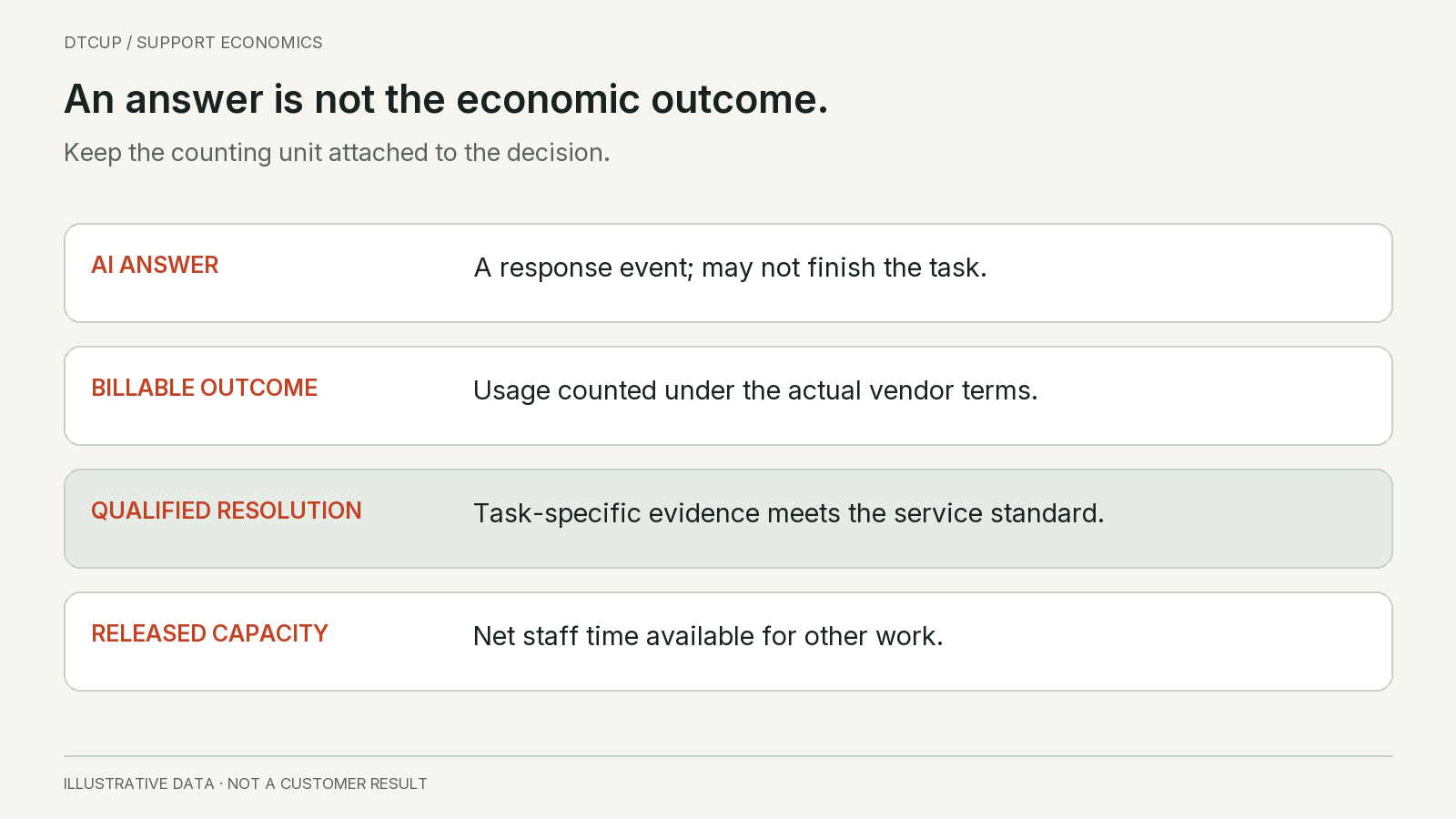
A conversation, an answer, a closed ticket and a resolved issue are different units. A customer may open several conversations about one problem. One conversation may contain two unrelated requests. The denominator should match the service question, and the counting rule should remain stable across the comparison.
For Birch Audio, a qualified resolution means that the defined customer issue has an evidenced satisfactory outcome, the answer follows the applicable policy, any action has the required authorization and the observation window contains no known unresolved continuation. This is an operational definition for the example. It does not imply perfect visibility into what every customer thinks or does afterward.
Some outcomes remain unknown. A customer may leave after a plausible answer without confirming whether it helped. Do not automatically classify silence as either success or failure. Keep confirmed or otherwise evidenced outcomes separate from uncertain ones, and show how the cost measure changes under reasonable bounds. An honest range is more useful than a precise denominator built from assumptions.
Vendor billing rules may use a different unit. Intercom’s Fin outcomes documentation describes its own billing treatment of resolutions and handoffs, including assumed resolutions. Zendesk’s automated resolution tiers distinguish types of AI involvement. Check the current terms and the version applicable to the actual account. A billable vendor outcome should not silently become the company’s independently reviewed customer outcome.
Keep both numbers. Finance needs the billable usage count to reconcile the invoice. The support owner needs qualified outcomes to assess service. The two records can disagree without either being an arithmetic error. The useful investigation is which counting rule, observation period or evidence requirement explains the difference.
Follow the cost of one issue across all its contacts
Suppose a customer asks whether a replacement cable fits their headset. The assistant answers using the wrong product generation. The customer orders the cable, contacts support again and receives a correction. Counting the first answer as a cheap resolution hides the agent time, return handling and avoidable customer effort caused by the mistake.
The cost record should connect the initial conversation, the follow-up and the corrective work where the connection is supported. Do not join unrelated contacts merely because they belong to the same customer. An account can have an order-status question and a separate product problem on the same day. The unit is the issue, not the person.
Assign a review window appropriate to the task. A public instruction question may reveal failure quickly. A promised replacement may need a longer observation period before the outcome is known. Recent cohorts should remain provisional until enough time has passed. Otherwise, this week’s automation looks cheaper simply because its repeat contacts have not arrived yet.
Our guide to measuring support resolution beyond deflection develops the outcome ledger. Here, that ledger becomes the denominator and the route for attaching cost. The economics should inherit the same issue identity, task definition and evidence status, rather than creating a second convenient meaning of resolved.
Where cross-channel matching is incomplete, state the coverage. A system that sees chat but not phone cannot prove that a quiet chat ended the problem. You can still calculate the observed cost, but label the boundary and inspect a sample of downstream work before making a broad claim about total savings.
Build a cost ledger that includes the work around the model
Start with direct service work: agent handling, follow-up, supervisor intervention and correction of wrong answers. Then add the software and infrastructure used for the scope being evaluated. Depending on the implementation, that may include a platform fee, model usage, retrieval, storage, tool calls, monitoring and integration support. Avoid counting the same bundled service twice.
Knowledge maintenance is an operating cost. Someone must verify new policies, remove obsolete instructions, inspect retrieval failures and approve corrections. A team that excludes this work can make a cheap assistant look efficient by leaving its knowledge stale. The cost eventually reappears as poor answers, manual intervention or customer harm.
Quality review also belongs in the ledger. Include representative sampling, difficult-case tests and release checks. Separate recurring review from the initial effort to build the test set. The initial work matters for investment appraisal, while the ongoing work matters for the run rate. Combining them without labels makes a launch month look like the permanent cost of service.
For labor, choose and disclose a valuation basis. A loaded hourly rate can help compare resource use, but it is an allocation of employment cost, not proof that each saved hour removes that amount of cash. Finance should own the basis used for budget decisions. The operational analysis can show hours independently so that the result remains interpretable even if the rate changes.
Keep customer remediation distinct from ordinary commercial policy. A normal return refund is not automatically a cost caused by AI. An extra shipment required because the assistant gave an incorrect compatibility answer may be. Link remediation to the incident evidence and avoid labeling all returns after chatbot use as AI losses.
Work through a complete pilot before reading the headline saving
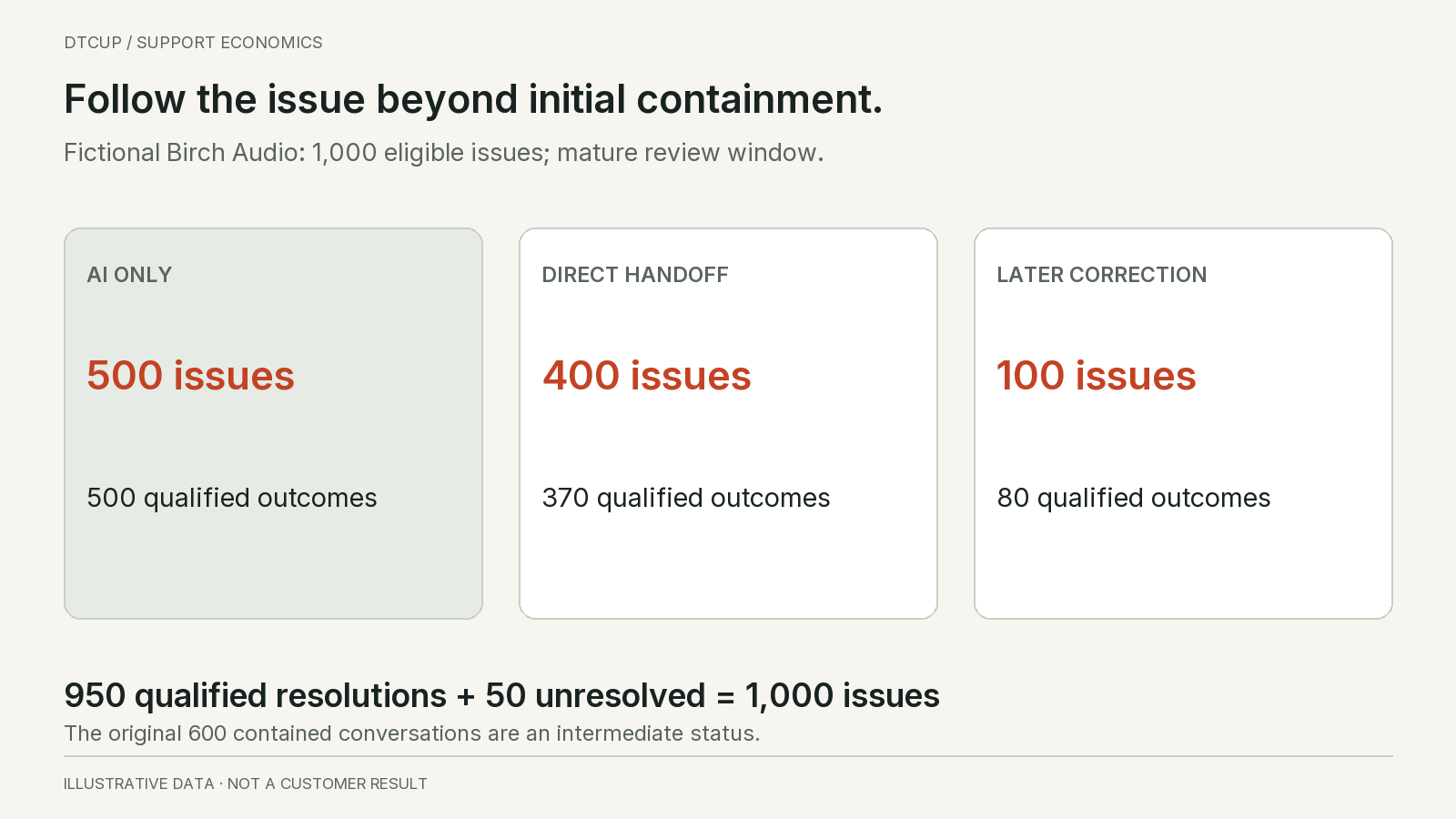
Birch Audio observes one thousand eligible issues during an illustrative pilot period. For this simplified worked ledger, all issues have completed the chosen observation window and have been reviewed. Six hundred appear contained at the first interaction. Later review finds that one hundred of those six hundred need corrective human work. The other four hundred issues move directly to a human route.
The resulting route groups are five hundred qualified AI-only resolutions, four hundred direct human handoffs and one hundred issues with later corrective work. These groups are mutually exclusive. The six hundred initially contained conversations are an intermediate status, not an additional group to add to the thousand issues.
By the end of the observation window, three hundred seventy direct handoffs and eighty corrective-work issues meet the qualified outcome standard. Together with the five hundred AI-only resolutions, the pilot has nine hundred fifty qualified resolutions and fifty unresolved issues. The unresolved fifty stay in the cost numerator because the business still spent resources trying to help them.
For comparison, the illustrative human-only process would require fifteen minutes of direct handling per eligible issue for the same scope and mix. Across one thousand issues, that is two hundred fifty hours. At the assumed loaded rate of thirty dollars per hour, the direct handling resource cost is seven thousand five hundred dollars. This is a constructed comparison, not a measured causal result from a real company.
The pilot’s four hundred direct handoffs take twelve minutes each, totaling eighty hours. The hundred corrective-work issues take twenty four minutes each, totaling forty hours. Direct human work is therefore one hundred twenty hours, valued at three thousand six hundred dollars. Compared with the constructed baseline, direct handling falls by one hundred thirty hours. That is not yet the net labor benefit.
Add the recurring costs before comparing unit economics
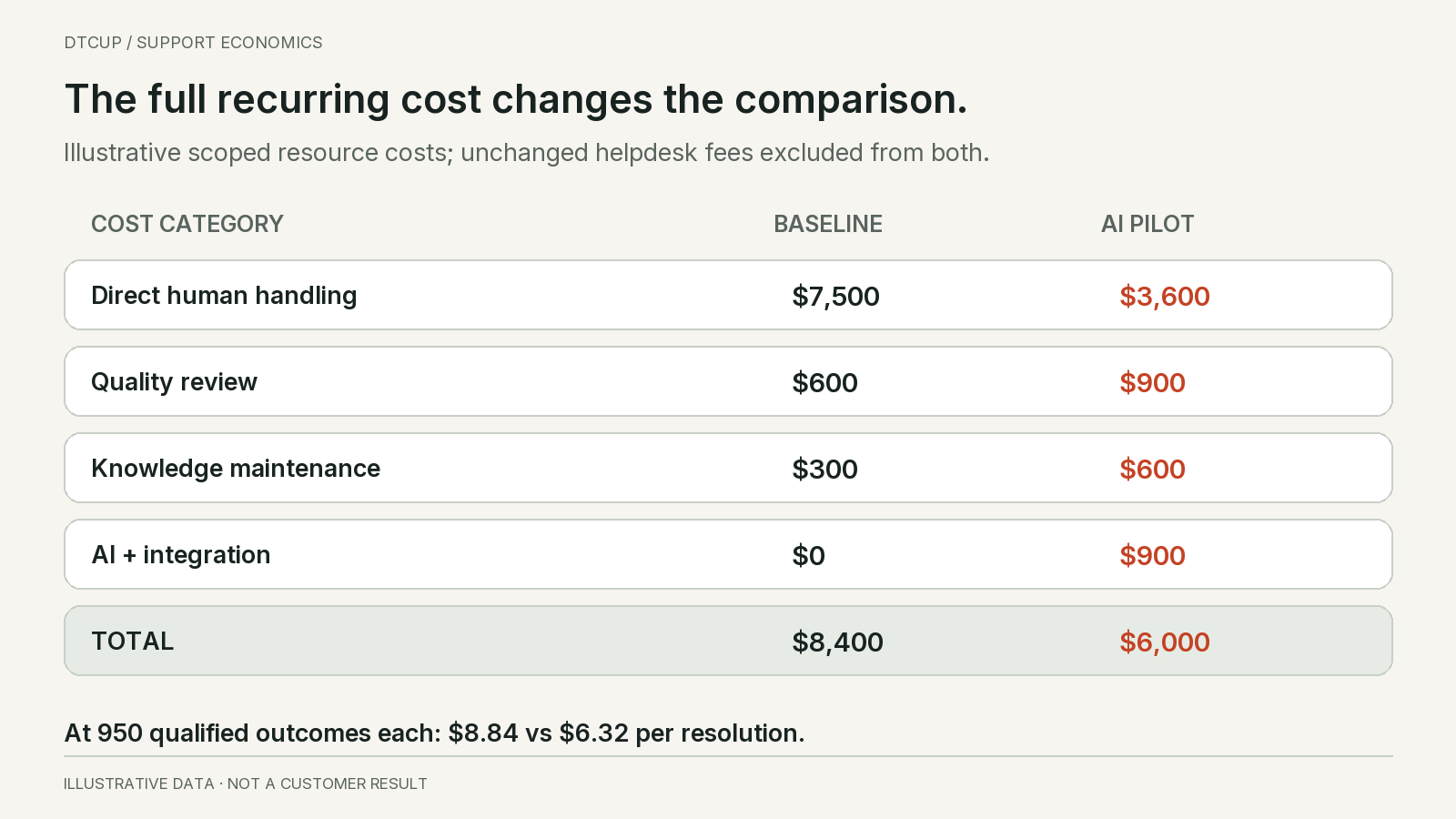
In the same fictional period, Birch Audio spends six hundred dollars on the AI service and related usage. Quality review takes thirty hours at the assumed rate, or nine hundred dollars. Knowledge maintenance takes twenty hours, or six hundred dollars. Integration monitoring and support cost another three hundred dollars. The pilot’s total scoped recurring resource cost is therefore six thousand dollars.
The arithmetic is three thousand six hundred for direct human work, six hundred for AI, nine hundred for review, six hundred for knowledge and three hundred for integration support. These categories are deliberately non-overlapping in the example. A real ledger must check whether a vendor fee already includes some of the monitoring or whether staff time has been allocated to two teams.
The comparable human-only baseline includes seven thousand five hundred dollars of direct handling, six hundred dollars of routine quality review and three hundred dollars of knowledge maintenance. Its scoped resource total is eight thousand four hundred dollars. Existing helpdesk costs that remain identical in both alternatives are excluded from both sides here; they would be included in a fully loaded operation-wide measure.
Assume the baseline also produced nine hundred fifty qualified resolutions from the same thousand eligible issues. Baseline cost per qualified resolution is approximately eight dollars and eighty four cents. The pilot’s six thousand dollars divided by nine hundred fifty is approximately six dollars and thirty two cents. The scoped resource improvement is two thousand four hundred dollars, about twenty nine percent of the baseline.
That comparison has an explicit quality assumption: both alternatives reach the same number of qualified outcomes for comparable issues. If the pilot’s outcome evidence is weaker or its case mix easier, the comparison is not established. The cost calculation can be correct while the conclusion is unsupported. Show the assumptions next to the result, not in a distant footnote.
Separate released capacity from cash savings
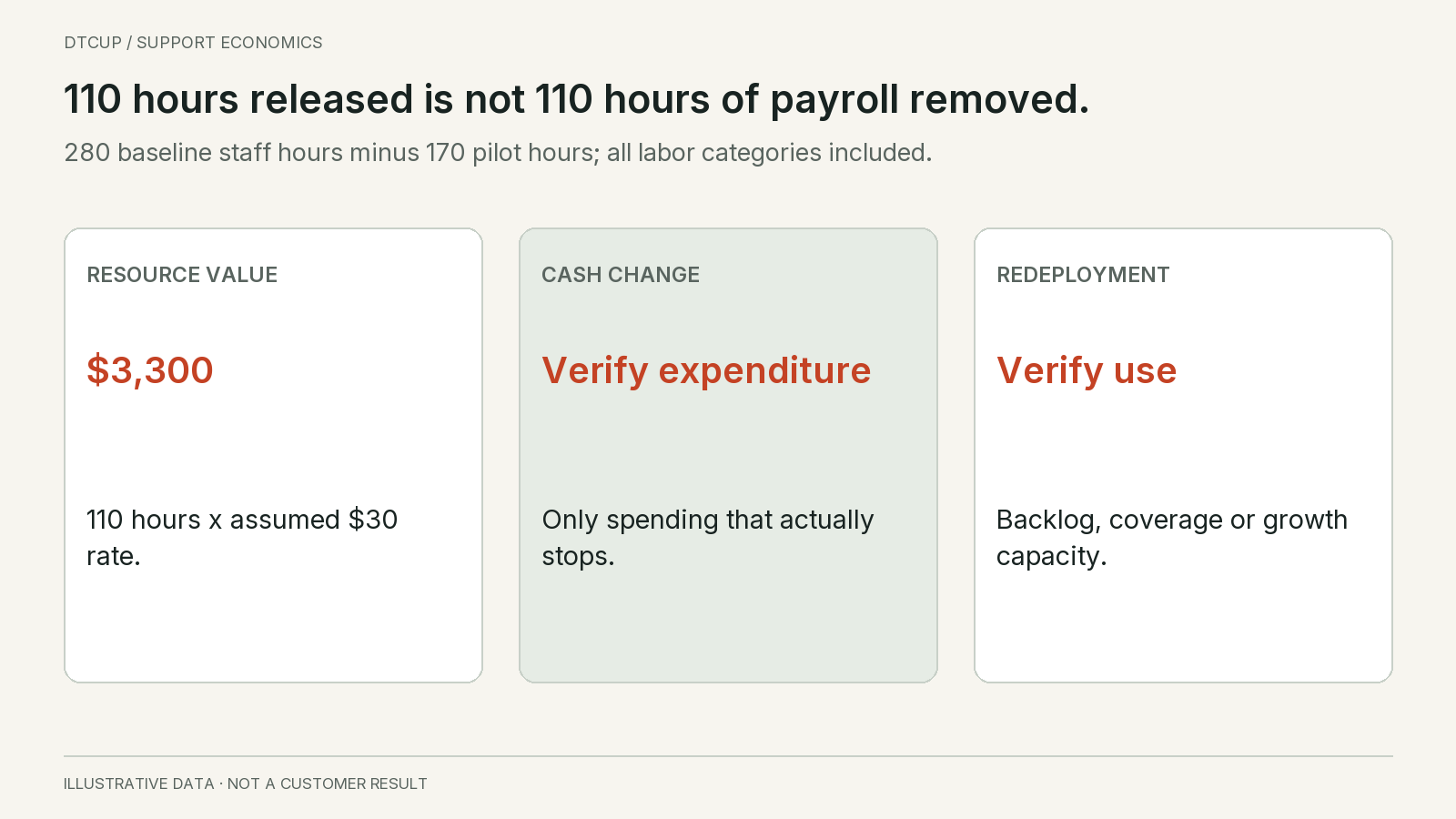
The baseline uses two hundred fifty direct handling hours, twenty quality-review hours and ten knowledge hours, totaling two hundred eighty staff hours. The pilot uses one hundred twenty direct handling hours, thirty review hours and twenty knowledge hours, totaling one hundred seventy. Net released capacity is one hundred ten hours, not the one hundred thirty hours saved in direct handling alone.
At thirty dollars per hour, that capacity difference has a resource value of three thousand three hundred dollars. The pilot adds nine hundred dollars in AI and integration costs, leaving the two thousand four hundred dollar scoped improvement. This reconciles the labor and cost views. It still does not establish a two thousand four hundred dollar reduction in the next payroll payment.
If all staff are salaried and staffing remains unchanged, the immediate incremental cash effect could be an additional nine hundred dollars of software and integration expenditure. The business receives capacity in return. That may be attractive if the capacity reduces backlog, supports growth or avoids future overtime, but the benefit needs a destination and an owner.
Suppose a separate approved staffing plan can actually eliminate fifty hours of variable outsourced work at thirty dollars per hour without harming service. That removes fifteen hundred dollars of cash expenditure. Against nine hundred dollars of new external costs, the illustrative net cash improvement is six hundred dollars. Do not add the fifteen hundred cash saving to the full three thousand three hundred capacity value: the fifty hours are already part of the released capacity.
Track realization. If a planned contractor reduction never occurs, the expected cash saving remains a forecast. If released hours are absorbed by a more complex queue, the benefit may be increased service capacity rather than lower cost. Both can be reported, but they should not be relabeled to preserve the original business case.
Keep launch investment separate from the steady operating period
Before the pilot, Birch Audio spends an illustrative twelve thousand dollars on integration, knowledge preparation, evaluation design and training. If the recurring resource improvement remained two thousand four hundred dollars per comparable month, the simple resource-based payback would be five months. This is a scenario calculation, not a forecast or a financial return guarantee.
If the company uses the six hundred dollar realized cash improvement instead, simple cash payback would be twenty months under the same unchanged assumptions. If no cash expenditure is reduced, there is no cash payback from the capacity benefit alone. The company may still approve the investment for service or growth reasons, but the accounting of the benefit should remain clear.
Initial work is not always entirely incremental. The knowledge cleanup may have been necessary even without AI and may also help human agents or the public help center. Assigning all of that cost to the AI pilot can understate its economics; assigning none can overstate them. Show a reasonable allocation and a sensitivity range rather than selecting whichever treatment makes the project pass.
Do the same for reusable integration work. A connection built for support may serve other approved workflows later, but future reuse is not a realized benefit today. Record the current use and the potential reuse separately. Do not divide the cost across imagined future projects to make the first deployment appear nearly free.
For a renewal decision, sunk launch expenditure should not dominate the choice of what to do next. Compare the future costs and benefits of keeping, changing or stopping the service. For the original investment review, retain the launch costs so the business learns whether its estimate was reasonable. Different decisions need different cost boundaries.
Show how uncertain outcomes change the unit cost
The worked pilot deliberately assumes complete review to make the arithmetic easy to follow. A real operation rarely has that certainty. Consider a separate cohort costing six thousand dollars in which eight hundred issues have qualified outcomes, one hundred have known unresolved outcomes and one hundred remain uncertain. The cost per evidenced qualified resolution is seven dollars and fifty cents. If all uncertain cases eventually qualify, it becomes about six dollars and sixty seven cents.
That range does not mean the true value is automatically its midpoint. The uncertain cases may differ from reviewed cases, and silence can have several meanings. Report the range as a sensitivity analysis, then decide whether the uncertainty could change the investment decision. If the project is attractive under the conservative boundary, there is less reason to force an optimistic classification.
If the conclusion changes across the range, collect more relevant evidence. A representative follow-up sample may help, subject to appropriate contact permissions and customer experience. Operational events can also resolve uncertainty: an authorized change confirmed in the source system is stronger evidence for an action task than an upbeat conversational ending. Avoid burdening customers with repeated surveys solely to improve an internal metric.
Sampling requires care. Reviewing only short, English-language daytime conversations will not establish the outcome rate for long, multilingual or overnight cases. Keep the sampling scope and weighting visible. A set chosen because the cases look suspicious is useful for finding failures but cannot be treated as a representative estimate of overall quality.
Separate uncertainty about outcomes from uncertainty about cost. You may know the vendor invoice exactly while estimating staff time from a small sample. Show both limitations. A detailed invoice does not make an uncertain labor estimate precise, and a precise handling-time measure does not prove that the underlying issue was solved.
I would preserve the first published cohort result and any later revision. If additional repeat contacts reduce the qualified outcome count, explain the change rather than overwriting history silently. The revision teaches the team how long the observation window needs to be and prevents a dashboard from rewarding whichever week has had the least time to reveal problems.
Estimate the cost of the next task family separately
Suppose the proposed expansion covers five hundred additional issues. In a deliberately simplified sensitivity model, each qualified AI-only resolution avoids ten minutes of human work valued at thirty dollars per hour, or five dollars of resource use. Additional fixed review and maintenance are six hundred dollars for the period, and variable AI service cost is forty cents for every eligible issue, totaling two hundred dollars. The added resource cost before any correction work is therefore eight hundred dollars.
Under those assumptions, one hundred sixty qualified AI-only resolutions are needed to offset eight hundred dollars at five dollars each. That is thirty two percent of the five hundred eligible issues. It is a break-even condition for this constructed resource model, not a target resolution rate or a vendor benchmark. It assumes the remaining human work is unchanged and excludes any extra correction burden.
Now add three hundred dollars of expected corrective work. The required avoided resource becomes eleven hundred dollars, corresponding to two hundred twenty qualified AI-only resolutions, or forty four percent. This shows why a small tail of expensive failures can alter the economics even when the headline usage fee is low. The business should test the correction assumption instead of hiding it inside an optimistic average.
A useful handoff can also save time without an AI-only resolution. If that benefit is measured, add it as a separate route-specific term. Do not count the full avoided ten minutes for an issue that still requires eight minutes of human work. Conversely, do not ignore real preparation value simply because the case ends with a person.
Use this model to identify what the pilot must learn: qualified route frequency, actual minutes displaced, added maintenance and the cost of failures. Replace assumptions with observations as they mature. A break-even sheet should expose the uncertain inputs that matter most, not manufacture confidence through extra decimal places.
Calculate economics by task before scaling the blended average
Public care instructions, authenticated order questions and disputed refunds do not have the same operating economics. A public explanation may require little human intervention when the knowledge is current. A sensitive account task may need verification and specialist review even when the assistant writes the message well. Averaging them can make an expansion look safer than it is.
For each task family, compare eligible issue volume, qualified AI-only outcomes, human handling time, repeat work, review effort and infrastructure cost. A task with a modest automation rate can still be valuable if it prepares a difficult case well for the agent. A task with a high containment rate can be costly if it leaves a small but expensive stream of corrections.
The next thousand issues are not necessarily like the first thousand. Early pilots often select easy, well-documented requests. Expanding to ambiguous compatibility questions or account changes may require more tools, more context and more human approval. Apply the pilot’s blended rate only to a similar eligible mix, and keep a separate estimate for new tasks.
When the assistant takes easy work away, the remaining human queue becomes more complex. Average human handling time may rise even though total human hours fall. That is not automatically a productivity failure. Compare like tasks and total workload before concluding that agents became slower after automation.
Seasonality also changes the mix. A launch can generate product questions, a delivery disruption can generate status contacts and a policy change can create exceptions. Annotate those events. A lower monthly cost per contact caused by many simple questions is different from a genuine efficiency improvement within the same task family.
Reduce cost by removing wasted work before weakening quality
The most attractive savings often come from preventing unnecessary work. A clear order-status page can reduce contacts. A corrected knowledge record can prevent repeated clarification. A better handoff can stop customers from retelling the issue. These changes improve the service while reducing the volume or complexity of work the model must perform.
Inspect long conversations. Are they long because the customer has a complex legitimate problem, or because the assistant keeps asking for information already available? Repeated retrieval, irrelevant context and unnecessary tool calls can raise cost without improving the outcome. Fix the sequence before choosing a cheaper model merely because its unit price is lower.
Model routing can help when tested. A simple classification step may use a different configuration from a complex explanation, but the routing itself can make mistakes. Evaluate the complete route, including retries and escalations. A cheap first attempt followed by an expensive second attempt and human correction can cost more than a reliable answer on the first supported route.
Caching also needs a correctness boundary. Reusing a public, versioned care instruction is different from reusing a customer’s order status or account-specific answer. The cache should respect source updates, permissions and the scope of the fact. A lower usage bill does not compensate for returning stale or private information to the wrong person.
The guide to keeping AI support answers current explains the source and freshness side. Treat those controls as part of the cost optimization. Efficient support reuses valid knowledge; it does not simply reuse whatever answer was cheapest to retrieve.
Plan for volume, retries and service interruptions
A monthly cost estimate should show how it changes with issue volume and route mix. Fixed platform fees, per-outcome charges and usage-based infrastructure behave differently. Read the applicable contract and current pricing rather than assuming a published headline covers every feature, seat, channel or minimum commitment.
Build at least a normal, high-volume and degraded-service scenario. In the degraded scenario, a tool outage may cause retries and more human handoffs. The model bill can rise at the same time that the labor benefit falls. Treating usage and savings as independent optimistic inputs misses that relationship.
Set alerts before the budget is exhausted and define the customer experience at the limit. A hard usage cap without a fallback can turn a financial control into a broken support channel. The fallback might route to a queue, provide approved static guidance or narrow the supported tasks. It must preserve a clear way to get help.
Watch for anomalous traffic separately from real support demand. Automated abuse, repeated tests and accidental loops can consume resources without representing customer issues. Exclude them from the service denominator where appropriate, but include their cost in the operating review and fix their cause. Hiding the cost because the traffic is inconvenient does not make it disappear.
Maintain an outage ledger. Record affected tasks, duration, retry behavior, additional human work and recovery steps. A system that is cheap in normal conditions but expensive during routine dependency failures may need a simpler architecture or a better fallback. The full operating pattern matters more than a quiet day’s average.
Compare vendors using the same workload and evidence
A seat price, a per-resolution price and a usage price cannot be compared by placing their headline numbers in one column. Build a common workload: the same issue families, volumes, languages, knowledge scope, integrations and required outcomes. Then ask each option to explain its cost under that workload, including the human work that remains.
Request a billable-event trace for a few sample conversations. What is charged when a customer leaves without replying? When a case transfers to an agent? When an answer is corrected? When a conversation reopens? When the same issue appears in another channel? The point is not to assume a vendor is wrong; it is to understand what the invoice measures.
Test quality independently of the pricing model. Use the same applicable sources and evaluation cases, including missing knowledge and sensitive requests. A vendor that reports a high resolution rate under its own definition may still require more review under the business’s standard. Conversely, a careful handoff may create value even if it does not count as an automated resolution.
Include the cost of ownership. Who maintains integrations, reviews failed retrieval, manages access and exports records if the service is replaced? A low subscription with substantial internal engineering work is not necessarily cheap. A higher subscription may be reasonable if it reduces verified operating work, but that reduction needs evidence rather than a sales claim.
Use a short contract comparison sheet with current terms, dates and assumptions. Pricing and billing definitions can change. Preserve the version used for approval so a later invoice difference can be investigated. Avoid publishing an evergreen claim that a vendor always charges in one particular way when the actual account may have a different agreement.
Test the business case with a comparable release
Where feasible and appropriate, compare similar eligible requests under the existing and proposed workflows during the same period. Keep the customer service standard intact in both routes. The comparison should include outcome quality, total handling, repeat contact and review work, not only the assistant’s reported automation rate.
If a randomized comparison is impractical, use a phased rollout and document the limitations. Compare matched task families and annotate staffing, promotions, incidents and knowledge changes. A before-and-after difference can be informative without proving that AI caused every change. The report should say what is observed and what remains an interpretation.
Do not stop the evaluation as soon as the first favorable cost number appears. Allow the outcome window to mature, then inspect a representative sample of cases and the expensive failure cases. The representative sample estimates ordinary quality; the difficult-case review helps find harms that an average can conceal. They serve different purposes and should not be merged into an unexplained pass rate.
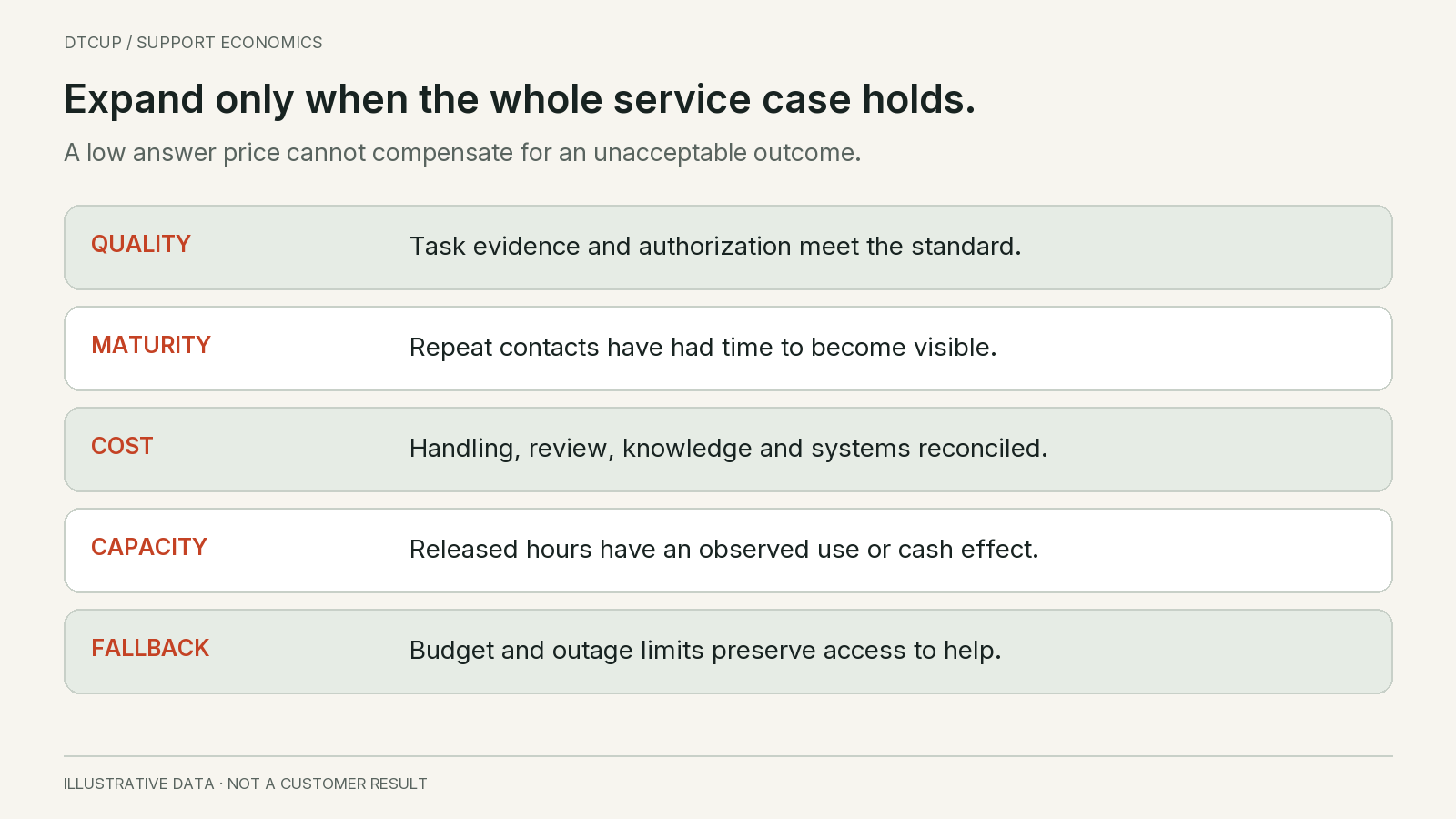
Agree a decision rule before reviewing the result. Birch Audio might expand only if qualified outcomes remain acceptable, unresolved age does not worsen and the additional review burden fits the staffing plan. If the quality boundary fails, a low cost per answer is not a reason to expand. The appropriate next action may be to repair knowledge or narrow scope.
Make the monthly review a decision about work
Bring the support lead, knowledge owner and finance partner to the same short review. Start with the issue cohort and its maturity. Then reconcile vendor usage, human work, recurring maintenance and qualified outcomes. Show which numbers are observed, estimated or not yet available. This avoids a discussion in which each person defends a different denominator.
Review the released capacity next. Where did the hours go? Did the backlog shrink, response coverage improve, overtime fall or a planned hire move? If nobody can identify the destination, the benefit may exist only as a theoretical difference in average handling time. That is a reason to investigate, not to automatically declare the pilot unsuccessful.
Choose one operating improvement tied to the cost evidence. A cluster of corrections may justify rewriting one policy record. Long handoffs may need a better issue summary. Repeated tool retries may need a circuit breaker and a clearer fallback. The action should target the cause of cost rather than pressuring agents to close cases faster.
Keep the commercial value discussion separate. If the business believes improved support helps conversion or retention, design an appropriate comparison with a defined outcome and time horizon. Do not add all chatbot-associated revenue to savings. An attribution label describes a relationship in the observed journey; it does not by itself establish incremental profit.
Questions to ask before approving more AI support spend
Is cost per ticket still useful?
Yes, for a clearly defined operational comparison, especially when ticket creation and task mix remain stable. It becomes misleading when one issue creates several tickets or automation changes which contacts become tickets. Keep cost per eligible issue and cost per qualified resolution alongside it, with unresolved and uncertain outcomes visible.
Should every saved minute be valued as payroll savings?
No. Saved time is capacity. It becomes a cash reduction only when a real expenditure changes, and it may instead be used to improve service or absorb growth. Report the hours, their resource valuation and any realized spending change separately. Do not add the same benefit once as time value and again as cash savings.
Can a more expensive model be cheaper overall?
It can be, if it reliably reduces retries, corrections or human work enough to offset its additional usage cost while meeting the service standard. It can also be unnecessary for simple tasks. Test the complete route on comparable issues rather than inferring total economics from the price of a model call.
What if resolution quality cannot be measured perfectly?
Keep the uncertainty visible. Use confirmed evidence, task-specific checks, representative review and an explicit observation window. Report unknown outcomes separately and show a sensitivity range. Imperfect measurement is a reason to qualify the business case and improve evidence, not a reason to count every quiet conversation as a success.
One final control is to protect access to a person when the task needs one. A team rewarded only for low cost per automated resolution may make escalation harder, which improves the reported ratio by changing who can reach support. Review abandoned attempts and unresolved age alongside cost, and inspect the actual route on a phone. A cheaper process that prevents a customer from reporting failure has changed the measurement boundary rather than solved the economic problem.
AI support becomes economically useful when it removes real work without creating more difficult work elsewhere. The most credible report can follow that claim from a customer issue to its outcome, through the people and systems involved, and into the actual decision about capacity or spending.
Sources
Still have a question?Ask the DTCUP Community ↗