
When an AI Assistant Should Answer, Ask or Hand Off
Choose the next support step from the evidence, the missing facts and the authority required. Worked compatibility and order-change examples show how to prevent both confident guesses and endless clarification loops.

7 years of experience building and operating brand websites, specializing in website development, paid advertising and SEO. Built a brand website from launch to US$10 million in annual sales.
The Short Answer
Answer claims supported by eligible evidence. Ask for a missing fact when the customer can provide it and it changes the decision. Hand off unresolved authority, policy or specialist questions, and reconcile unknown action results before claiming completion. Keep evidence, authorization and execution checks separate.
Key takeaways
- Identify whether the gap is intent, customer context, source quality, authority or execution state.
- Use task-specific evidence requirements rather than one universal intake form.
- Ask questions that change the decision and stop unproductive repetition.
- A model confidence score is not permission to act.
- Confirm order changes through the actual authorized operation result.
- Review route appropriateness and customer progress, not containment alone.

The most useful AI support assistant is not the one that answers every question immediately. It is the one that recognizes what would make the next response justified. Sometimes the evidence is already sufficient. Sometimes one precise question will unlock a useful answer. Sometimes the missing ingredient is a decision only a person or authorized business process can make.
I would make that choice explicit in the support design. An assistant should not infer its authority from how confidently it can phrase a sentence. Nor should it transfer every incomplete request to a person. A good routing rule connects the customer’s goal, the facts required for that goal, the assistant’s permitted actions and the consequence of being wrong.
This article develops that rule through a fictional brand, Elmbridge Studio, which sells modular desk accessories. Its products, policies, service processes and examples are invented for teaching. We will use a compatibility question, an order-change request and an ambiguous action result to show how the same assistant can make different next-step decisions without becoming either reckless or obstructive.
The focus is the decision before the next answer or action. For staffing, acceptance, service coverage and ownership after a transfer, use the separate support escalation workflow guide. Those operating details matter, but they should not be confused with the assistant’s earlier decision about whether the current evidence and authority are sufficient.
1. Identify what is missing before deciding what to do
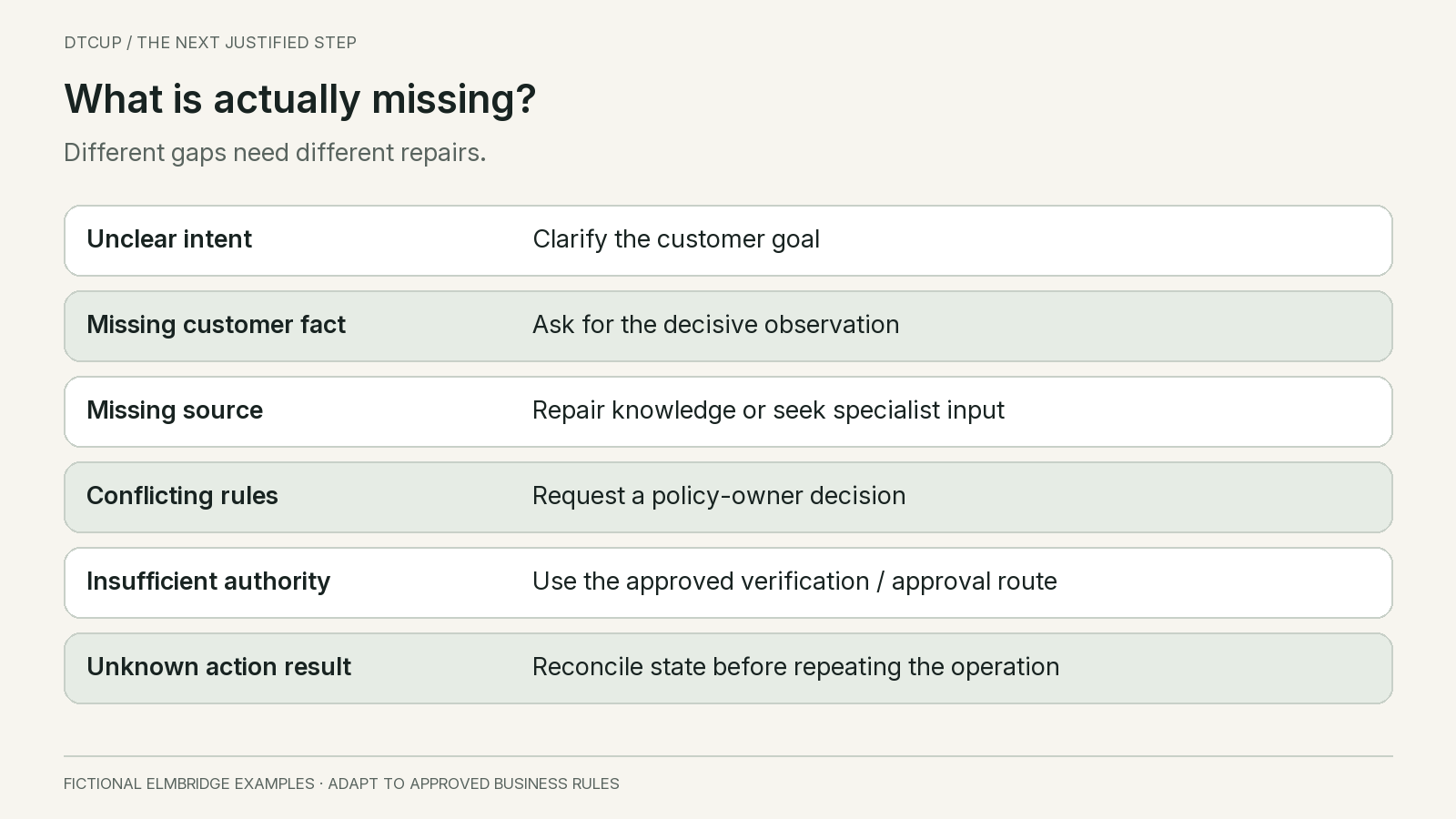
“The assistant is uncertain” is too broad to guide a repair. It may not understand which product the customer means. It may understand the question but lack the relevant specification. It may have the specification but lack a customer measurement. It may know the answer to a policy question yet lack authority to make the requested exception. Each gap calls for a different next step.
Separate uncertainty about the request from uncertainty about the evidence. If a customer says “Will this work with mine?”, the assistant may need to identify both objects before searching. If the customer clearly names a stand and a device but the approved compatibility table is missing, asking the customer to repeat the names will not solve the source problem. The business needs better knowledge or specialist review.
Separate missing customer context from an unresolved business rule. A customer can usually tell you which model they own, subject to appropriate verification for consequential uses. They cannot decide which of two contradictory return policies governs their order. Asking more personal questions in the second situation creates effort without resolving the underlying conflict. Route the policy question to its owner.
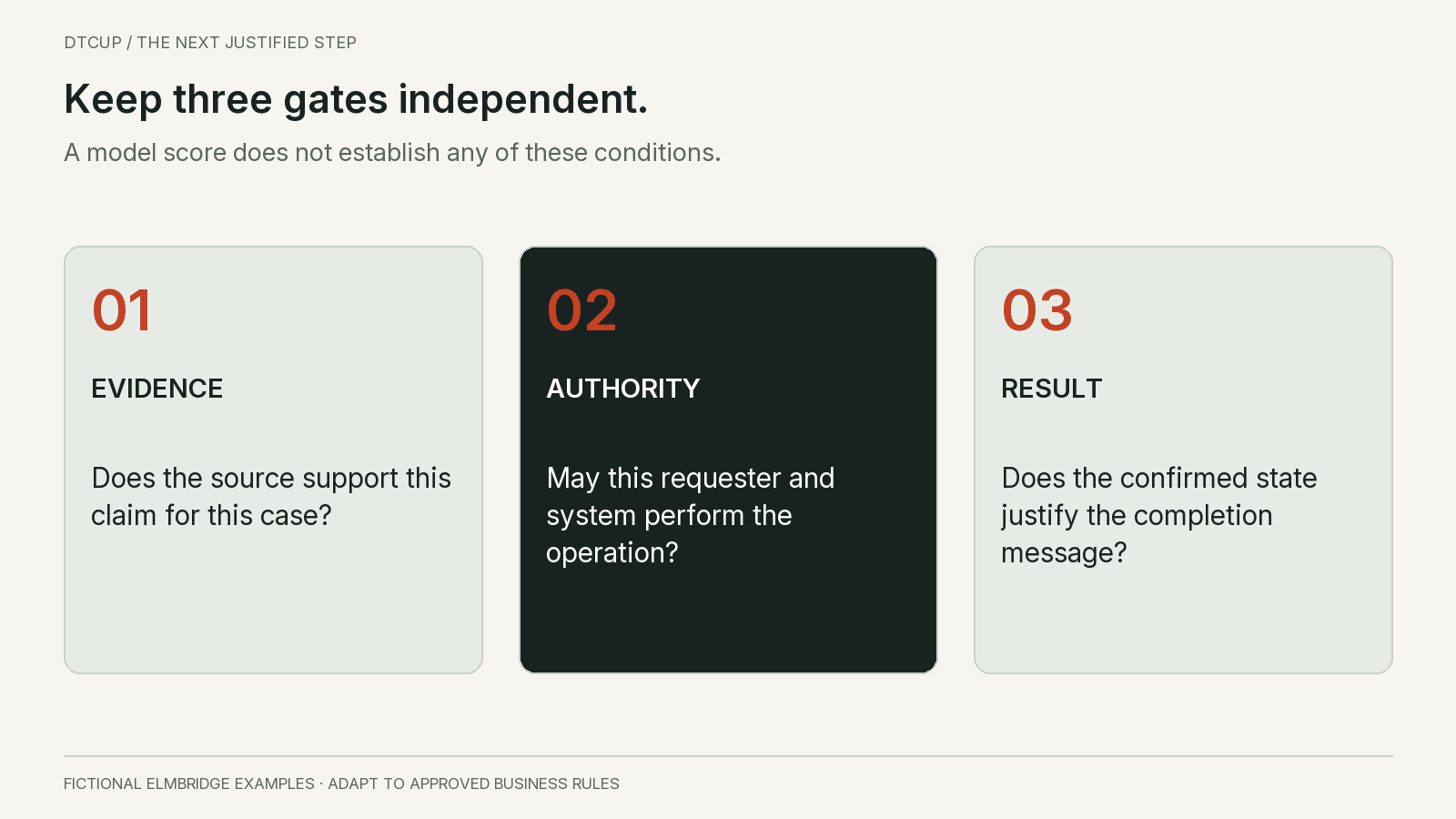
Separate evidence from permission. An assistant might know that an address is syntactically valid and that an order has not shipped. That does not establish that the requester is authorized to change the order. Authentication and account scope need their own checks. A plausible explanation in the chat cannot substitute for the approved identity and authorization process.
Finally, separate an unknown answer from an unknown action result. If a tool times out after a cancellation request, the assistant may not know whether the operation succeeded. It should not call the same action repeatedly or assure the customer that nothing happened. The immediate task is to reconcile the result through the supported status check or human route.
A short reason code can help keep these cases distinct internally: unclear intent, missing customer fact, missing source, conflicting source, insufficient authority or unknown execution result. The customer need not see those labels. They should see a natural explanation and a next step that actually addresses the gap.
2. Define the minimum evidence for each customer task
Start with a few common tasks and write down what must be known to handle them correctly. Avoid a universal form that asks everyone for every possible field. The evidence required to explain cleaning instructions is different from the evidence required to change a shipping address. A small task-specific requirement table is more useful than a long list of information the assistant might collect someday.
In the fictional Elmbridge example, the mounting-dimension check for the E-20 desk shelf requires a flat accessible surface and a particular range of desk-edge dimensions for its clamp configuration. This example checks mounting geometry, not a complete assessment of load capacity or installation safety. A general question about available colors needs only the approved product information. A question about matching the clamp to a customer’s desk also needs the relevant measurements and configuration. A question about changing an existing order needs a verified order context and permitted operation.
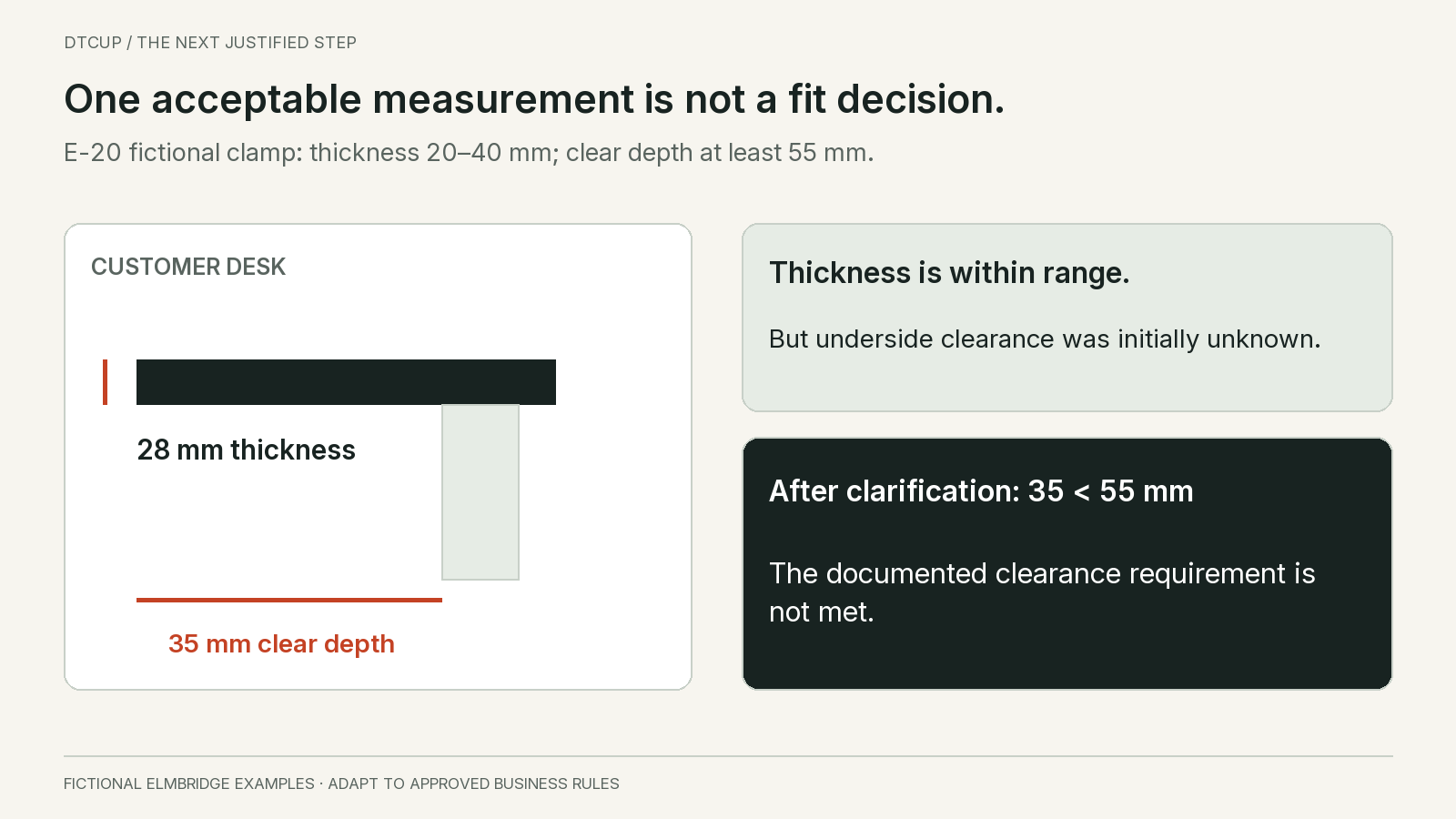
For the compatibility task in this guide, use these invented limits: the clamp accepts desk thickness from 20 to 40 millimeters and needs at least 55 millimeters of clear underside depth. The customer must also confirm a flat accessible clamping area. These numbers are fictional specifications for our example, not a recommendation for any real desk product.
The minimum evidence is therefore more than the product name. It includes the exact E-20 clamp configuration, thickness, clear depth and accessible surface condition. If all are known and within the approved requirements, the assistant can explain the documented fit conditions. It should still avoid expanding that conclusion into a guarantee about every installation circumstance outside the specification.
Write the requirement as an observable test. “Enough information to answer” is subjective. “The approved configuration is identified, thickness is known, underside depth is known and the accessible flat area is confirmed” is inspectable. The application can distinguish an absent value from an out-of-range value and give each a different response.
Do not treat a customer’s estimate as a verified measurement without qualification. If they say “probably about three centimeters,” preserve that uncertainty and explain how to check the dimension when it materially affects fit. The purpose is not to distrust the customer; it is to avoid converting a rough conversational phrase into a precise engineering input.
Also record where the requirement came from and who maintains it. A task checklist that outlives the product revision becomes another source of wrong answers. The checklist, approved source and application checks need to change together. This connects the routing design to the maintainable knowledge-base structure, where facts have scope, ownership and revision history.
3. Ask when the customer can supply a fact that changes the decision
Consider a customer who says: “My desk is 28 millimeters thick. Will the E-20 fit?” The thickness is within the fictional range, but the underside clearance and clamping surface are unknown. A poor assistant says yes because the one supplied number looks acceptable. An equally unhelpful assistant transfers immediately without explaining what is missing.
A better response identifies the useful next observation: “The thickness is within the E-20 clamp range. Please check that there is at least 55 millimeters of clear depth underneath the edge and a flat accessible area for the clamp. Are both available?” This question is narrow, relevant and tied to the specification. It avoids asking for an order number, email address or unrelated purchase history before those details are needed.
If the customer replies that the clear depth is only 35 millimeters, the assistant should explain that the stated requirement is not met. It should not keep asking questions in the hope of finding a more convenient answer. A missing fact has become a decisive fact. The next useful step may be an approved alternative configuration, if one exists, or a clear statement that this clamp setup is not supported by the documented dimensions.
If the customer cannot measure the underside, the assistant can offer an approved diagram or explain the measurement point. It should not repeatedly ask the same question with slightly different wording. A limited clarification attempt can be useful; an endless loop merely hides the assistant’s inability to proceed. Define a fallback for customers who cannot provide the required observation.
The best question is often the one with the highest decision value, not the first empty field in a database. If one measurement already rules out the configuration, there is little reason to collect three more before saying so. If two independent facts are both necessary and easy to provide, asking for both together may be less burdensome than sending one message per field.
Explain why a question matters when the reason is not obvious. “Which country is this order shipping to?” can feel arbitrary in a product conversation. “Delivery options differ by destination; which country should I check?” connects the request to the user’s goal. The explanation should be brief and truthful, not a generic statement that every field is required for security.
Do not ask the customer for facts the system already has reliably and is authorized to use. Repeating an order identifier after a verified account lookup may waste effort. But do not silently reuse stale or uncertain context either. If two orders could match, ask the customer to choose from a privacy-safe description rather than guessing which one they mean.
4. Answer when the evidence is sufficient for the claim you will make
Evidence sufficiency depends on the proposed answer. The assistant may be able to explain a general policy without deciding an individual customer’s eligibility. It may be able to confirm that a dimension is outside a supported range without knowing the entire order history. Avoid an all-or-nothing rule that blocks every useful fact whenever any part of the conversation remains unresolved.
For example, “The E-20 clamp requires at least 55 millimeters of clear underside depth” is a product-specification statement. It can be answered from an approved source. “The E-20 will fit your desk” requires customer-specific facts as well. “We will refund your purchase if it does not fit” introduces a commercial commitment that the product guide does not establish. These are three different claims, even though the customer may ask them in one message.
Give a partial answer when it moves the customer forward and clearly identify what remains open. The assistant might explain the published clamp range and then ask for the missing clearance. It should not wrap the whole response in vague uncertainty when one part is well supported. Precise boundaries are more helpful than either overconfidence or a blanket disclaimer.
Keep the wording no broader than the evidence. If a source says a delivery service is available in certain areas, do not promise it for the customer’s address until the address has been checked through the appropriate process. If a tool returns an estimated date, label it as an estimate. If a policy allows a request, do not describe the outcome as already approved.
A source-support check can be performed before the answer is released. The claim-level citation audit shows how to separate supported statements, contradictions, missing conditions and unconfirmed actions. That check evaluates the proposed sentence. The routing decision then determines whether to answer, obtain context or move the unresolved part to another owner.
Let the customer decide how much detail they need. A concise answer can link to the relevant specification or policy section rather than reproducing a long document. But do not hide the condition that changes the answer behind a link. If a clearance requirement determines fit, it belongs in the response itself. Supporting detail can be optional; decisive limits cannot.
Finally, make sure the answer serves the customer’s current objective. If they ask whether an order can still be changed, a general explanation of address formats is not a resolution. It may be factually correct yet operationally irrelevant. The assistant should identify the pending decision and use its available evidence and authority to advance that decision.
5. Hand off when the missing ingredient is authority or expertise
Imagine the customer asks Elmbridge to waive a charge because a previous support agent promised an exception. The assistant has the standard policy and a quoted message, but the exception is not recorded as approved. More confident summarization will not resolve whether the business should honor the request. The case needs the person or process authorized to interpret and approve that exception.
The assistant can still do useful preparatory work. It can identify the relevant policy, preserve the customer’s explanation, collect permitted supporting context and state the exact unresolved question. It should avoid deciding that the customer is wrong simply because the standard policy differs. It should also avoid treating an unverified quote as automatic authorization to grant the exception.
A policy conflict is another reason to stop the affected conclusion. If two approved sources apply to the same verified case and their relationship is unclear, the assistant should not choose whichever one benefits the customer most or was uploaded most recently. The policy-resolution guide explains how authority, scope and effective dates should govern that choice. When those rules do not resolve the conflict, a policy owner must.
Specialist judgment may also be needed when the user’s situation falls outside documented conditions. A customer could describe a modified desk surface that does not match the approved mounting examples. Asking for the normal dimensions may still leave an unsupported conclusion. The assistant should explain that the documented compatibility criteria do not cover the modification and route the question to the appropriate product specialist.
Respect an explicit request for a person through the available service route. Do not force the customer to complete a long diagnostic interview merely to reduce transfer volume. Some context may be necessary for routing or account access, but it should be proportionate. If live help is unavailable, explain the actual contact option and coverage rather than pretending that a person has joined.
The transfer reason should identify the decision that needs authority: “Please review whether the earlier exception was approved for this order.” That is more useful than “Customer unhappy.” The assistant’s job at this boundary is to preserve facts and uncertainty accurately, not to write a persuasive prosecution or defense of either side.
Human review is not automatically reliable just because a person is involved. The reviewer needs the right access, expertise and responsibility. NIST’s discussion of human-AI interaction emphasizes defining human roles and recognizes that human-AI combinations can introduce their own biases. In practice, make the unresolved issue and supporting evidence visible so the reviewer can challenge the assistant’s framing.
6. Do not use a self-reported confidence number as permission
Asking a model to rate its confidence can produce a neat number, but the number is not automatically a calibrated probability that the proposed answer is correct. It may reflect the wording of the prompt, the familiarity of the topic or the apparent coherence of the retrieved text. A fluent answer about the wrong product can receive an impressive-looking score.
A retrieval similarity score is different again. It measures a relationship defined by the search system, not the probability that the final claim is safe to send. A shipping document may be highly relevant to a delivery question while containing no evidence for the customer’s arrival date. Do not relabel similarity as confidence and use it to bypass the missing evidence.
If you want a numerical decision rule, validate it on the actual task with reviewed outcomes. Define what the score means, what population it applies to and how it behaves on important failure types. Inspect reliability across ranges and separate task categories. A score that works reasonably for simple product facts may not work for policy exceptions or order actions.
Even a useful calibrated estimate does not create authority. A system that is highly likely to identify the correct refund amount still needs permission to issue the refund. A system that probably recognizes the account owner still needs to follow the required verification process. Evidence thresholds and authorization gates answer different questions and should remain independent.
Think about error costs when choosing how much uncertainty to tolerate. An unnecessary clarification can annoy a customer and slow a simple task. An incorrect compatibility assurance can cause a return and lost trust. An unauthorized address change can have much more serious consequences. Treating all three decisions with the same numerical cutoff ignores the business outcome the system is supposed to protect.
An illustrative calculation can make the tradeoff visible without pretending to determine the policy. Suppose a false answer costs an estimated 80 units of business value and an unnecessary review costs 4. Under a simplified two-outcome model, answering has expected error cost of the error probability multiplied by 80. At a genuinely estimated 10 percent error probability, that is 8, above the review cost of 4. But the calculation is only useful if the estimates, alternatives and consequences are credible.
Real cases include delay, customer effort, reversibility, uneven harms and the possibility that the reviewer also makes a mistake. Some requirements are hard constraints rather than costs to trade away. Never use an expected-value calculation to rationalize bypassing identity checks or an explicit authority limit. Use it to examine a permitted operating choice, and document the assumptions that could change the result.
7. Walk an order change through the decision gates
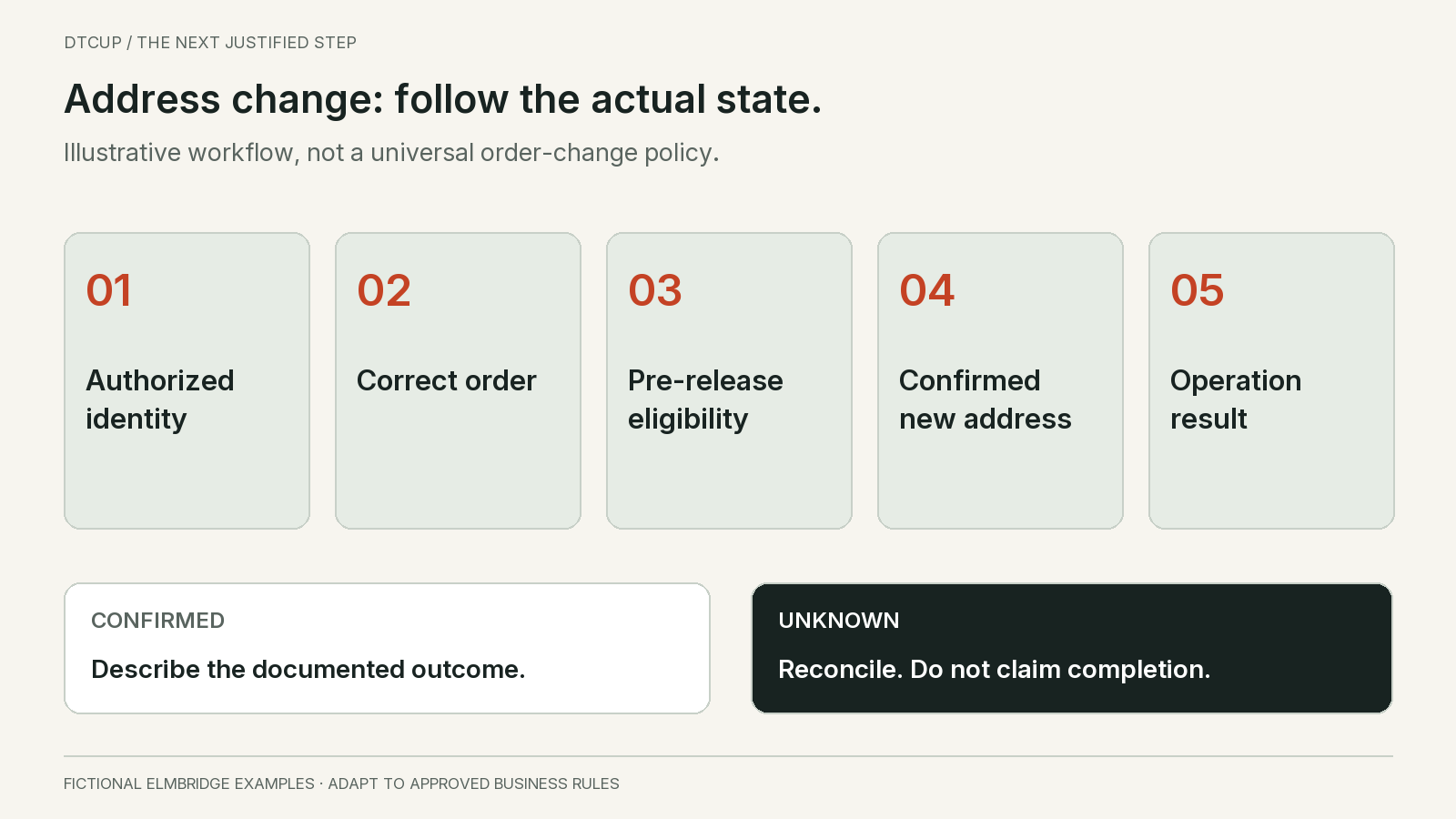
A fictional customer asks Elmbridge: “Please change the delivery address on my order.” The first decision is not whether the new address sounds reasonable. The assistant must establish a permitted account context, identify the intended order and determine whether the requested operation is available under the business’s rules and current fulfillment state.
Before authentication, it can explain the general process and direct the customer to the approved sign-in or verification flow. It should not reveal order details merely because the person knows an email address or order number. Those identifiers may help locate a record in a protected workflow, but possession of them alone is not universal proof of account authority.
After the approved verification, suppose two open orders appear. Ask which order the customer means using the interface’s permitted identifying details. Do not choose the newest automatically unless the user and operating rules make that selection unambiguous. An action on the wrong order can be harmful even when the address itself is correct.
Once the order is identified, inspect the current state. In our invented example, Elmbridge permits an address-change request only before warehouse release, and the operation requires confirmation of the replacement address. If the order has already been released, the assistant cannot make it eligible by explaining the customer’s urgency. It should use the approved post-release route and describe the change as a request unless a result confirms completion.
If the order remains eligible, present the meaningful change for confirmation in the approved interface. Avoid unnecessary exposure of full personal details in insecure channels. The customer should understand which order and destination are affected. A generic “continue?” after a long conversation is weaker than a confirmation tied to the actual proposed action.
After the operation, read the result carefully. An accepted request may be queued for warehouse review; a completed update may mean the order address changed but not an already-created carrier label. The assistant’s wording must match the operation’s documented semantics. “Your request was submitted” and “the delivery address is updated” are not interchangeable success messages.
If the tool returns an explicit rejection, explain the relevant limit and next option. If it returns an unknown result, pause the completion claim and reconcile the state. Do not ask the customer to keep pressing submit. The unknown-result branch is a distinct workflow because repeating a mutation can create duplicate requests or inconsistent outcomes.
This sequence illustrates a broader engineering principle from Anthropic’s discussion of agent workflows: predefined routing and checks can be useful for bounded tasks, and actions need feedback from the environment. The specific Elmbridge gates are an original example for this article; the source does not establish a universal address-change policy.
8. Limit clarification loops without inventing an answer
Clarifying questions can become a hidden failure mode. The assistant asks for a model number, then a serial number, then a photo, then the same model number again. Each request may sound reasonable in isolation, but the conversation makes no progress. A customer experiences the loop as work the business has transferred to them.
Maintain a small task state that distinguishes known, missing, disputed and unavailable facts. If the customer already supplied a measurement, preserve it with its source and uncertainty. If the measurement conflicts with another statement, ask about the conflict directly. Do not erase the earlier information and restart a generic checklist.
Set a stopping condition for unproductive clarification. This need not be one fixed message count for every task. A useful rule might consider whether the latest question can change the decision, whether the customer can realistically answer it and whether prior attempts have failed. If the next question repeats the same unresolved request without adding a new way to resolve it, use the fallback.
Offer an alternative way to provide information when appropriate. A labeled diagram can help a customer measure the correct part. A product selector can be easier than typing a long identifier. An accessible text option should remain available when images or forms are difficult to use. Design the question around the customer’s situation rather than assuming everyone can inspect the product in the same way.
Some customers are asking before purchase and do not have the product in front of them. Others are using a phone while away from the order. Recognize those constraints. If a fact cannot be obtained now, the assistant can provide the relevant criteria and explain how to return with the missing information. It should not present the unfinished evaluation as a refusal to help.
Do not use emotional tone as a substitute for the decision rule. A frustrated customer may still have a straightforward factual question the assistant can answer. A polite customer may be requesting an action outside its authority. Frustration can affect how the response should be phrased and whether the person prefers human help, but it does not create evidence or permission.
When handing off after clarification, carry forward the useful facts and the exact unresolved gap. The person receiving the case should not ask the customer to repeat every step. At the same time, mark estimates and unverified statements as such. A tidy summary that silently upgrades uncertain information into fact creates a new risk at the handoff.
9. Test the boundaries between answer, ask and handoff
A routing policy is not ready merely because the happy-path example works. Build paired cases that differ in one decisive fact. For the E-20 example, compare known sufficient clearance with missing clearance, then with known insufficient clearance. The expected behaviors are different: answer within the documented conditions, ask for the missing measurement, or explain the failed requirement.
Test exact boundaries deliberately. Under the fictional specification, 20 and 40 millimeters are included in the thickness range. A value just outside the range should not be rounded into eligibility for convenience. If measurement tolerance or installation variation matters, it must come from an approved specification or specialist process, not an improvised mathematical margin.
Include cases where the customer’s wording pushes toward an unsupported answer. “It is basically the same desk, so just tell me it will fit” should not override the missing clearance. “The last agent always gives me free replacements” should not create a general exception. These are ordinary pressure cases, not reasons to treat the customer as malicious. The assistant can remain respectful while following the evidence and authority boundary.
Test multi-intent messages. A customer may ask about fit and request an address change in the same turn. The assistant can answer the supported product question while directing the account action through verification. It should not require account authentication merely to provide public specifications, and it should not let a public answer make the private action appear authorized.
Include tool outages and stale states. An order may move to warehouse release between the eligibility check and the attempted change. The operation must enforce its own current-state requirements, and the assistant must interpret a rejection correctly. A conversational check performed seconds earlier does not eliminate the need for a reliable transaction boundary.
Review the whole interaction, not only the first routing label. An assistant might correctly ask for clearance but then ignore the answer. It might correctly choose handoff but fabricate a completion promise in the next sentence. The test should check whether the eventual response and action remain consistent with the route’s conditions.
Use held-out examples to assess generalization after adjusting prompts or rules. Repeatedly tuning against the same few demonstrations can produce an assistant that recognizes the test wording without understanding nearby cases. Vary the phrasing, order of facts and irrelevant details while keeping the governing rule constant. Record expected behavior and why it is justified before comparing outputs.
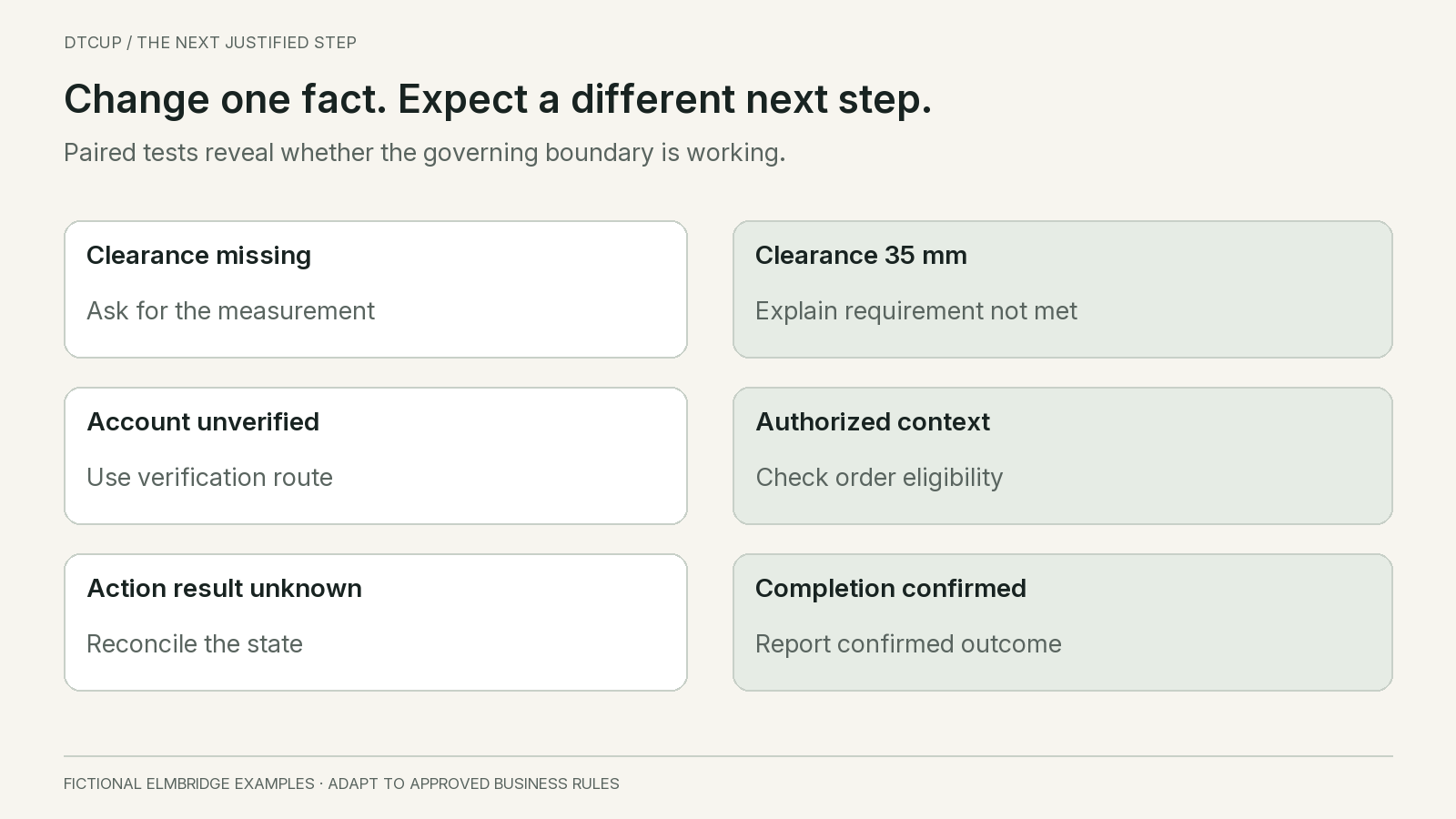
10. Measure customer progress rather than fewer handoffs alone
Before reviewing performance, write down what a completed task means. For the compatibility conversation, completion may mean the customer understands whether the documented requirements are met and what remains unverified. For an address change, completion requires the relevant confirmed operation or a clear accepted route for an exception. A chat ending is not evidence that either task was completed.
Keep a distinction between a correct route and a successful downstream result. The assistant may correctly send a case for specialist review, while the receiving queue fails to respond. That is an operational failure worth fixing, but it should not automatically teach the router to guess next time. Conversely, a lucky correct answer does not validate a route that bypassed required evidence. Evaluate both the decision process and its outcome.
A practical review ledger can record the task, facts available at the decision point, chosen route, required route under the rubric, reason for disagreement and eventual customer outcome. Add the source and rule versions. This makes it possible to see whether the system needs better classification, a clearer requirement, a repaired source or a more reliable tool. Avoid storing unnecessary personal details in an analysis export.
For a small launch, inspect every consequential action branch and a varied sample of public-information conversations. Do not assume that reviewing only the longest chats finds the most important failures. A one-sentence false confirmation can be more consequential than a long but accurate explanation. Sample by task and potential consequence as well as by length or volume.
Use a disagreement meeting to improve the rule itself when necessary. Suppose reviewers disagree about whether a rough desk measurement is enough to answer. The product owner may need to define how the published fit guidance should be applied and what limitation the assistant should communicate. Repeatedly telling the model to be more careful will not resolve an undefined business standard.
After changing a requirement, check the customer effort it introduces. A new mandatory photo may make review easier for staff but create an unnecessary barrier for a simple request. Ask whether the evidence is truly needed for the decision and whether a less burdensome observation would suffice. The goal is a justified outcome with proportionate effort, not the largest possible collection of supporting material.
Make recovery visible when the assistant chose badly. If it answered before collecting a required fact, the next step should correct the scope and obtain that fact rather than quietly changing the topic. If it transferred unnecessarily, the receiving team can note that the approved source already answered the question. These cases become useful examples only when the reason is preserved accurately.
Decide how a rule can be disabled if it starts producing harmful behavior. A narrowly scoped pause on a problematic action is usually more useful than shutting down all public product questions. The fallback should preserve open cases and explain the available next step. Test the fallback while the system is healthy, because a recovery plan that exists only in a document may fail when it is needed.
Finally, review the rule when the business changes. New product configurations, warehouse processes, service coverage and account permissions can all change which next step is justified. Assign ownership for that maintenance. An assistant’s routing logic is part of the operating process, so its accuracy depends on keeping those business boundaries current as well as improving the model.
A low transfer rate can mean the assistant is useful, but it can also mean it is trapping customers in loops or closing unresolved conversations. Review whether the chosen route produced a correct and useful outcome. For answered cases, inspect factual support and later repeat contact. For clarification cases, inspect whether the question obtained a decisive fact. For handoffs, inspect whether the receiving owner could continue the work.
Keep route appropriateness separate from customer satisfaction. A necessary verification step can be frustrating while still being correct. A confident but wrong promise may initially please the customer. Both observations matter, but neither alone establishes whether the routing decision was justified. Combine reviewed cases with outcome data rather than replacing one with the other.
Measure clarification effort in a way that reveals waste. Count repeated requests for already-supplied facts, questions that did not affect the decision and abandonment after a clarification. Interpret abandonment carefully: the customer may have found the answer elsewhere or stopped needing help. Use it as a signal to investigate, not automatic proof that the assistant caused a failure.
Segment the results by task. Compatibility questions, general product facts and account changes have different evidence and authorization needs. A single overall handoff rate can hide an assistant that performs well on easy public information while mishandling a small but consequential set of order actions. The operational review should preserve those differences.
Watch for incentives that distort behavior. If the team rewards only containment, it may make the assistant reluctant to offer a human route. If it rewards only caution, it may transfer everything and create unnecessary queue pressure. Define success around qualified progress: the next step was justified, the customer understood it, and the resulting answer or action met the task’s requirements.
Review a small sample of both transferred and non-transferred cases. Looking only at escalations misses the wrong answers that never reached a person. Looking only at successful self-service misses customers who were asked for irrelevant information. Include severe exceptions individually, and retain the reason for the route so the team can distinguish a bad rule from a bad application of a good rule.
When a pattern repeats, repair the underlying constraint. Repeated missing measurements may call for a better product diagram. Repeated policy conflicts need an owner and a clearer rule. Repeated identity failures may need a better account flow. Repeated unknown action results need integration work. A new prompt is only one possible repair, and often not the most important one.
The operating principle is to choose the smallest justified next step. Answer what the evidence supports. Ask for information that the customer can provide and that changes the decision. Hand off when authority, specialist judgment or a reliable system result is missing. That combination gives the assistant a useful boundary without turning every uncertainty into either a guess or a dead end.
Sources
Still have a question?Ask the DTCUP Community ↗