
Why an Order Number Is Not Permission to Reveal an Order
A correct order answer can still reach the wrong person. Design customer verification, order permissions and action confirmation as separate steps before connecting an AI assistant to private records.

7 years of experience building and operating brand websites, specializing in website development, paid advertising and SEO. Built a brand website from launch to US$10 million in annual sales.
The Short Answer
An order reference locates a record; it does not grant access. Let the application establish the actor and workspace, authorize the exact order and operation, and return only the fields needed for the task. Keep guest verification, recovery and order-changing actions explicitly scoped.
Key takeaways
- Lookup, identity context and record permission answer different questions.
- The server supplies trusted customer and workspace context.
- Read-only tools can still disclose private order information.
- A guest status session should not become general account access.
- Order changes need their own confirmation and current-state checks.
- Test denial, recovery and side outputs alongside successful conversations.

A customer types an order number into your website assistant and asks where the parcel is. The assistant finds a matching record and gives a helpful answer. That looks like successful automation until you ask a different question: how did the system establish that this person was allowed to see that order?
An order reference helps locate a record. It does not, by itself, establish permission to disclose the record. A screenshot, a remembered address or a confident message can make a request sound convincing without proving that the requester should receive the information. The problem is easy to miss because the answer can be factually correct and still be delivered to the wrong person.
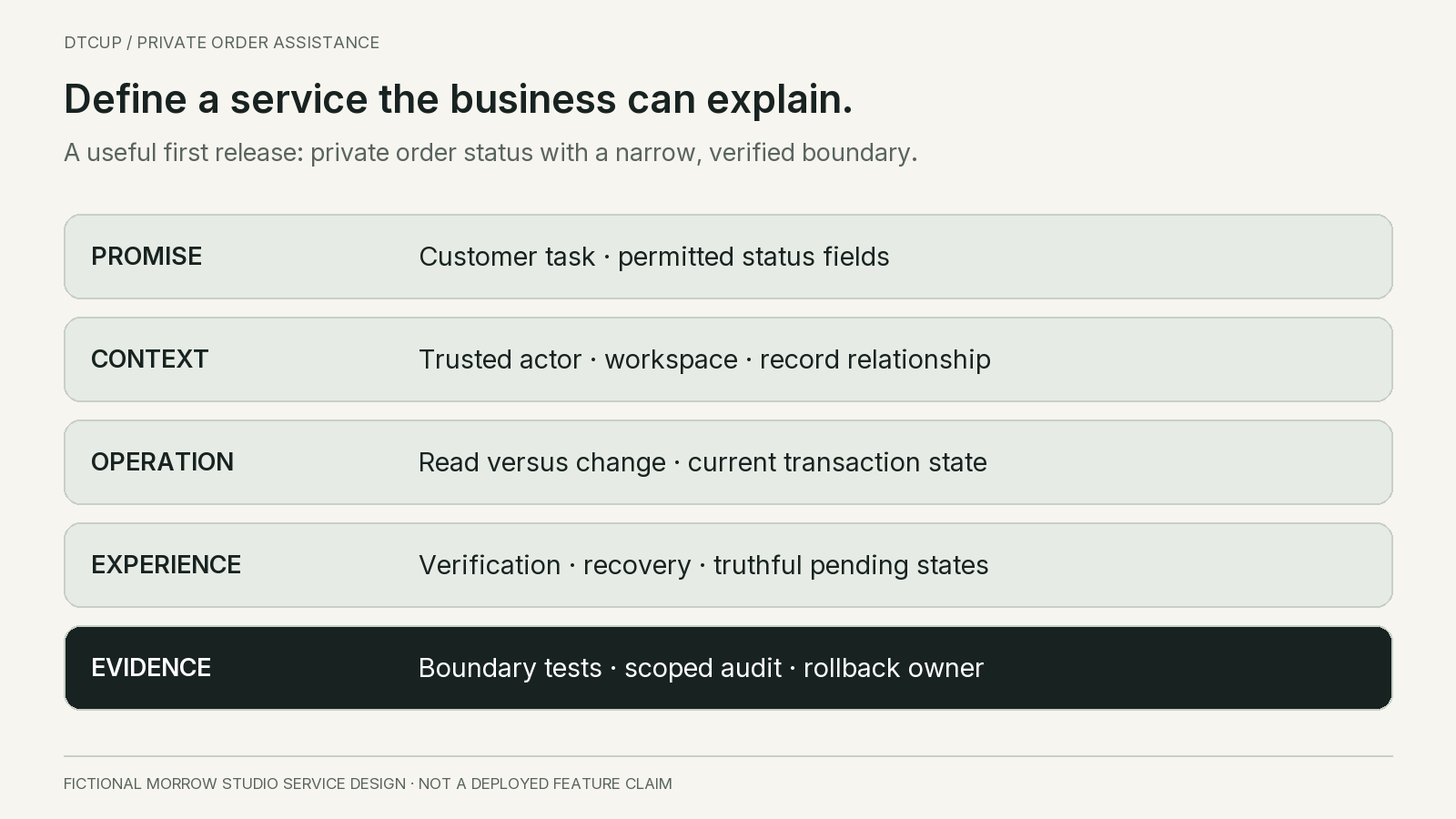
I would design order assistance around a narrow service contract: which person or verified guest may perform which operation on which order, in which business account, under which current conditions? The language model can help understand the question and explain an approved result. It should not manufacture the permission that allows the result to exist.
This article develops a fictional retailer, Morrow Studio, with a website assistant that initially offers read-only delivery status. The records, messages, proposed controls and tests are examples for design review. They are not claims about an existing DTCUP feature or a guarantee that any particular implementation is secure.
Separate finding a record, recognizing a customer and granting access
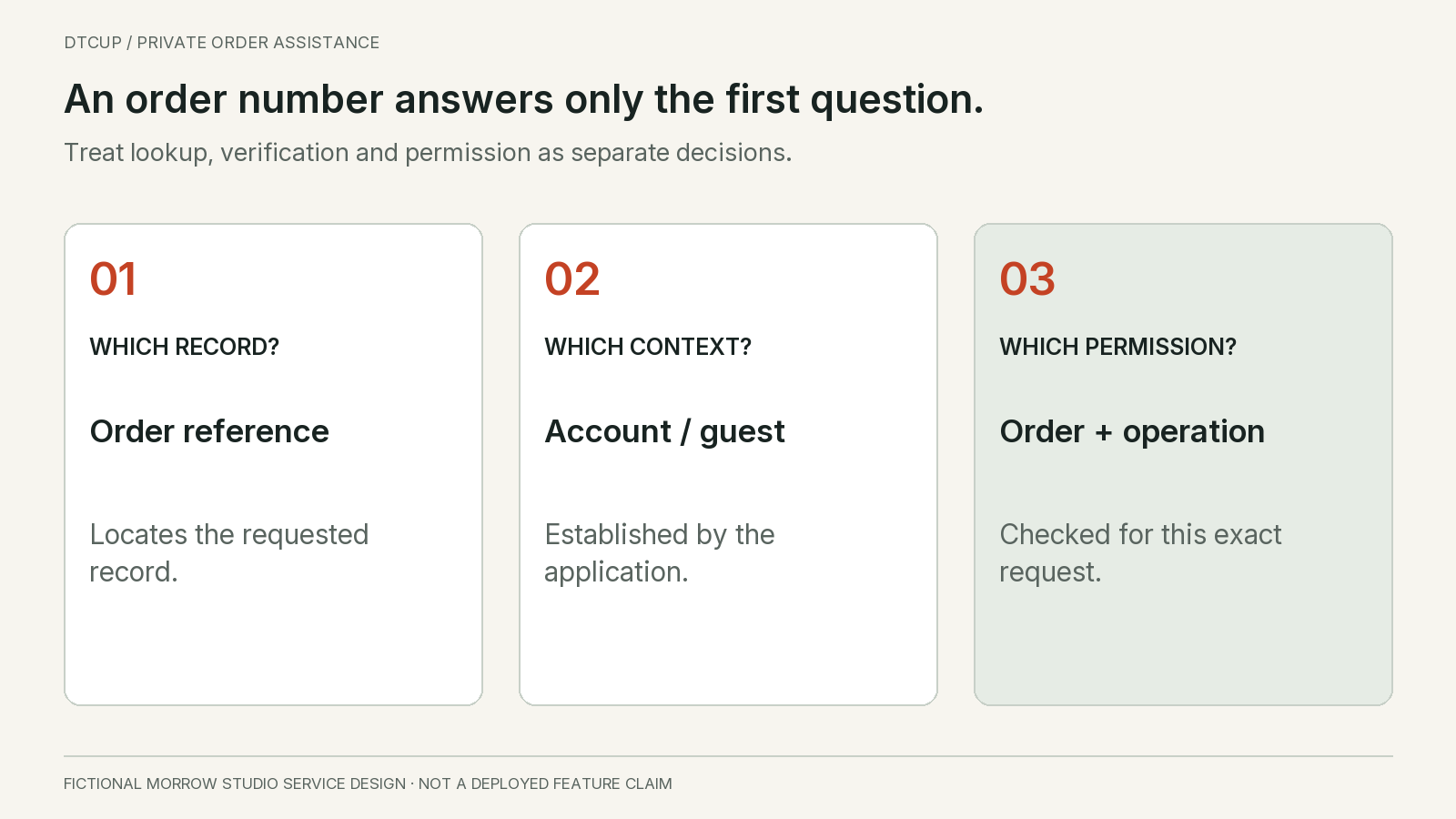
There are three different questions in a private order conversation. Which record is being requested? What trustworthy identity or limited verification context accompanies the request? What may that context do with this particular record? Treating all three as one search operation is where a convenient assistant becomes a disclosure risk.
Finding a record is a lookup. An order reference, a customer-selected order in an account page or another supported identifier may help the application locate it. The fact that the lookup succeeded says nothing about whether the result should be returned to the requester.
Recognizing a customer means using the application’s established authentication process or an approved guest flow. A sentence such as I am the buyer is a claim inside a conversation. It is not the same thing as a server-validated account session. Similarly, an email address typed into chat is an identifier, not proof of control over that address.
Granting access adds the relationship and operation. A signed-in customer may read their own permitted order summary but not a neighbor’s order. A support employee may have a role that permits some operations in one workspace. A guest may receive a narrowly scoped status view without receiving the customer’s complete history.
OWASP’s object-level authorization guidance explains why an API must check access to the specific record and action when it accepts an object identifier. Making identifiers harder to guess is not a substitute for that check. In an AI support flow, the same principle applies even when the identifier arrives through natural language.
For Morrow, the useful business distinction is simple: the assistant can help a visitor get to the right verification route, but only the application can establish the access context. This makes the conversation easier to audit. A friendly response no longer has to carry an invisible security decision.
Give the first release a deliberately small job
Morrow’s first assistant task is to explain the current fulfillment status of an order that the application has already authorized. It does not change addresses, cancel purchases, issue refunds or reveal a full customer profile. A narrow starting point makes it possible to examine every input and output without hiding important differences inside a broad manage my order tool.
Write the customer promise before defining the technical connection. In this example, the assistant can explain whether an authorized order is being prepared, partially dispatched or dispatched, and can show an approved tracking route when one exists. It must distinguish a label from carrier possession and must not invent a delivery date.
Next, list the information required for that promise. The assistant may need a customer-safe status label, the relevant update time, permitted shipment groupings and a scoped tracking link. It probably does not need a full billing address, payment record, internal fraud note or every product the person has ever purchased.
Read-only does not mean harmless. Order contents, delivery location and timing can be private. A read operation needs its own permission and output review even if it cannot change the database. Limiting the operation reduces the number of ways the system can fail; it does not remove the responsibility to protect the returned facts.
A useful release boundary is one that a support manager can explain to a customer. We can show your authorized order status here, while address changes use a separate verified process, is clearer than a chatbot that seems capable of everything but sometimes refuses without explanation.
The broader architecture discussion in what to customize in an AI support system separates language generation from tools and business rules. For this order-status task, the key choice is to keep record access in an application service with a defined contract.
Write an access table in ordinary business language
Before connecting the model, Morrow writes a small access table. An unverified visitor may read public shipping guidance and start the approved verification journey. A verified customer may read the allowed summary for orders associated with the authorized account relationship. A verified guest context may read only the specific order and fields allowed by that guest process.
The table also states what is unavailable. An account login does not permit reading every order in the store. Verification for one guest order does not permit listing all orders for a similar email address. A support role in one client workspace does not automatically apply to another workspace owned by the same software operator.
Record-level access and field-level access are separate decisions. A person allowed to see delivery progress may not need internal comments or payment-related fields. Do not return the entire database row and hope the assistant selects the right parts. Define an explicit customer-safe response for the task.
OWASP’s authorization guidance recommends denying access unless allowed and checking permissions on every request. For this fictional service, I would translate those principles into a reviewable table of actor, workspace, record relationship, operation and returned fields. The table should be owned by the business and implemented in the application.
Keep special relationships explicit. A household member, gift recipient or employee purchasing for a company might have a legitimate support need, but that need does not automatically match the original buyer’s access. Define an approved route for those cases rather than teaching the assistant to infer family or company authority from conversational context.
The access table is also a product document. It tells the designer which controls should appear, tells support what a handoff can accomplish, and tells the tester which requests must be refused. It is much more useful than a generic instruction that says respect privacy.
Let the server provide identity and workspace context
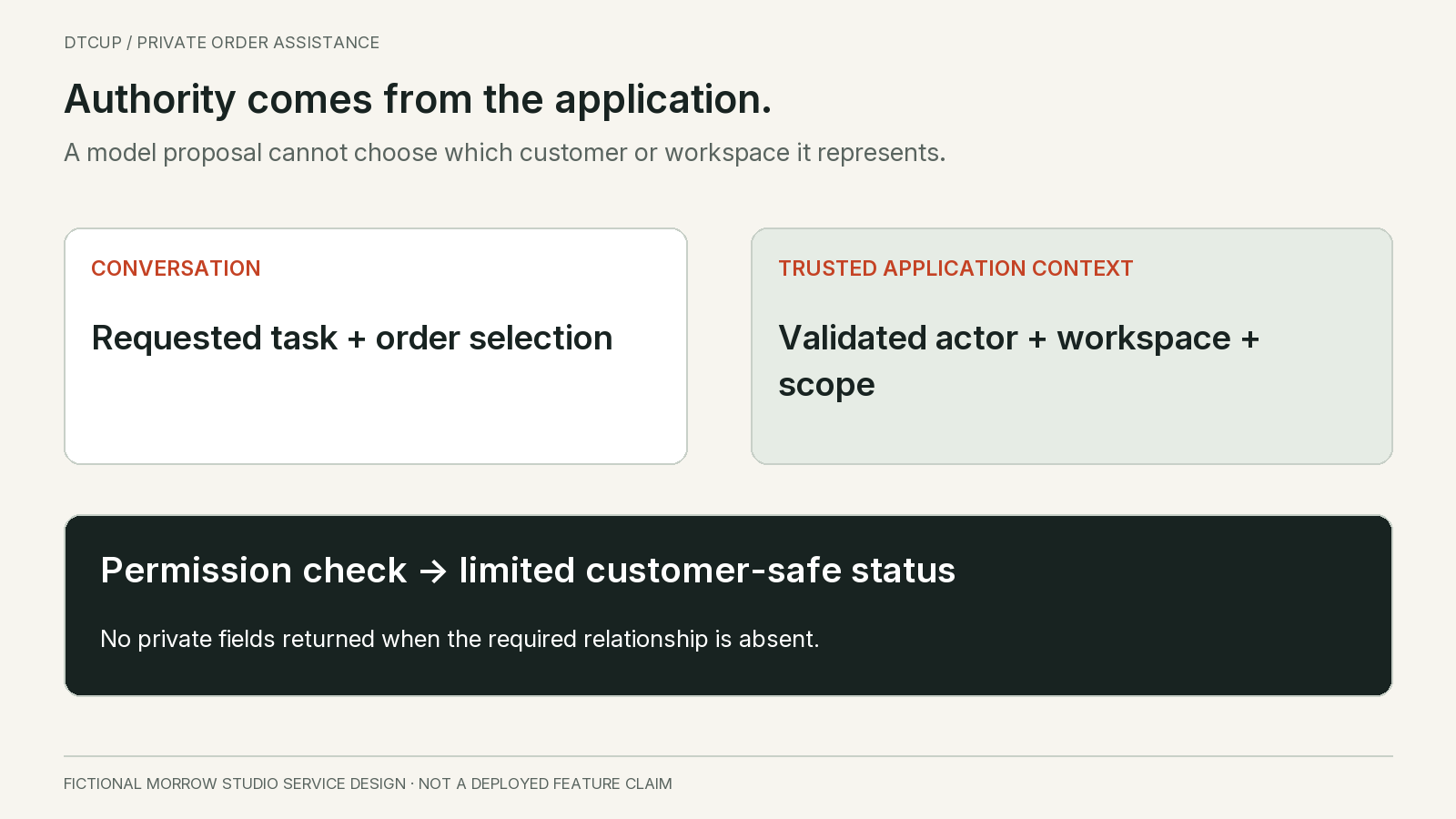
Imagine that a model proposes a status lookup containing an order reference and a customer identifier. The application should not accept the customer identifier merely because the model produced it. A model-generated field can be influenced by the conversation and by material the model has read. Trusted context needs to come from the application’s validated session or guest-verification state.
For Morrow’s proposed design, the model may suggest the user’s requested task and the order the user selected. The application supplies the current actor and workspace, checks the order relationship, and decides whether a customer-safe result may be returned. This keeps authority outside the text the customer can edit.
Workspace binding matters even when order numbers look unique in a demonstration. Two merchants can have the same visible order reference. A lookup that searches all connected merchants and returns the first match can cross a business boundary. The server should resolve the request inside the authorized workspace and connection before matching the order.
A tool’s service credential is another identity, distinct from the customer. The fact that the backend integration can access many records does not mean each visitor should inherit that reach. Treat the credential as the application’s means of executing a checked request, not as permission for the model to browse everything it can technically retrieve.
Keep the customer-facing tool narrow enough that unsupported operations cannot be requested through extra fields. A status lookup should not secretly accept address changes, arbitrary query text or a switch that expands the returned profile. The exact validation belongs in the implementation, but the business contract should already make those extras out of scope.
This design also helps when the model misunderstands a message. A mistaken order selection should lead to a denied or corrected request, not to unauthorized data in the model’s context. Good language understanding improves the experience; it should not be the only thing preventing a cross-customer response.
Make guest checkout a supported route, not an exception improvised in chat
Many real customers do not have an account. A design that handles only signed-in users can push support staff toward unsafe shortcuts when a guest asks a reasonable question. Plan the guest journey as a first-class product flow with a clearly bounded result.
For Morrow, the proposed guest journey uses the store’s approved verification interface outside the free-form conversation. The assistant explains the next step and directs the visitor there. The verification service decides whether to issue a limited access context for the order. The assistant receives the resulting permission state, not a transcript full of verification secrets.
The exact proof method needs to fit the business’s risks and existing account system. A link sent through an already established order contact route can be one design option, but possession of that route has limits, including forwarding and compromised access. It is not proof of every possible legal or personal relationship with the order.
Do not let a visitor replace the verification destination merely by typing a new email address in chat. That would turn a recovery problem into an alternate delivery route for private access. If the original contact route is unavailable, offer the business’s separate recovery process and explain that support must review the situation.
A guest access context should state its scope. In this example it permits the approved status view for one order, for a limited session, under current conditions. It does not create a general customer account, expose previous purchases or authorize a refund. The interface should make that distinction visible enough that customers are not misled about what has been verified.
Also provide a practical exit. A customer who cannot finish verification should still be able to reach a legitimate support channel. Collect only the information needed for the review and avoid asking for passwords, complete payment details or codes intended for another login. The handoff should carry the task and verification state without declaring the person verified when they are not.
Return the smallest status object that answers the question
Suppose an authorized order has two parcels. One is with the carrier and the second is still being prepared. A single shipped flag would be misleading, while the entire fulfillment database would be excessive. The task needs a deliberately designed summary that preserves the operational distinction without exposing unrelated information.
Morrow’s example response contains the authorized order’s display reference, customer-safe shipment statuses, the time those statuses were observed, permitted tracking routes and a flag indicating whether an estimate is available. It excludes the full address, payment information and internal notes because none is necessary for the initial status explanation.
The language model then works with a bounded result: one parcel has been dispatched; the second is still being prepared; no verified arrival estimate is available for the second parcel. It should not replace missing information with the ordinary shipping-policy range and present that range as a specific promise for this order.
Sometimes a structured component is better than prose. A shipment card can display the approved status and tracking action directly, while the assistant explains unfamiliar wording. This reduces the need for the model to reproduce sensitive or exact values and gives customers a stable place to check the information.
Tracking links deserve their own output review. A link can itself provide access to private shipment information. Use the route approved for the authorized customer and avoid embedding unnecessary personal fields in displayed text. Treat downloadable receipts and attachment links as part of the same disclosure surface, not as harmless extras outside the chat.
The test is whether each returned field improves the answer to the current task. If removing a field changes nothing useful, leave it out. This is a design recommendation for Morrow’s narrow status service, not a claim that every order-support task needs exactly the same fields.
Walk through a successful conversation and a refused one
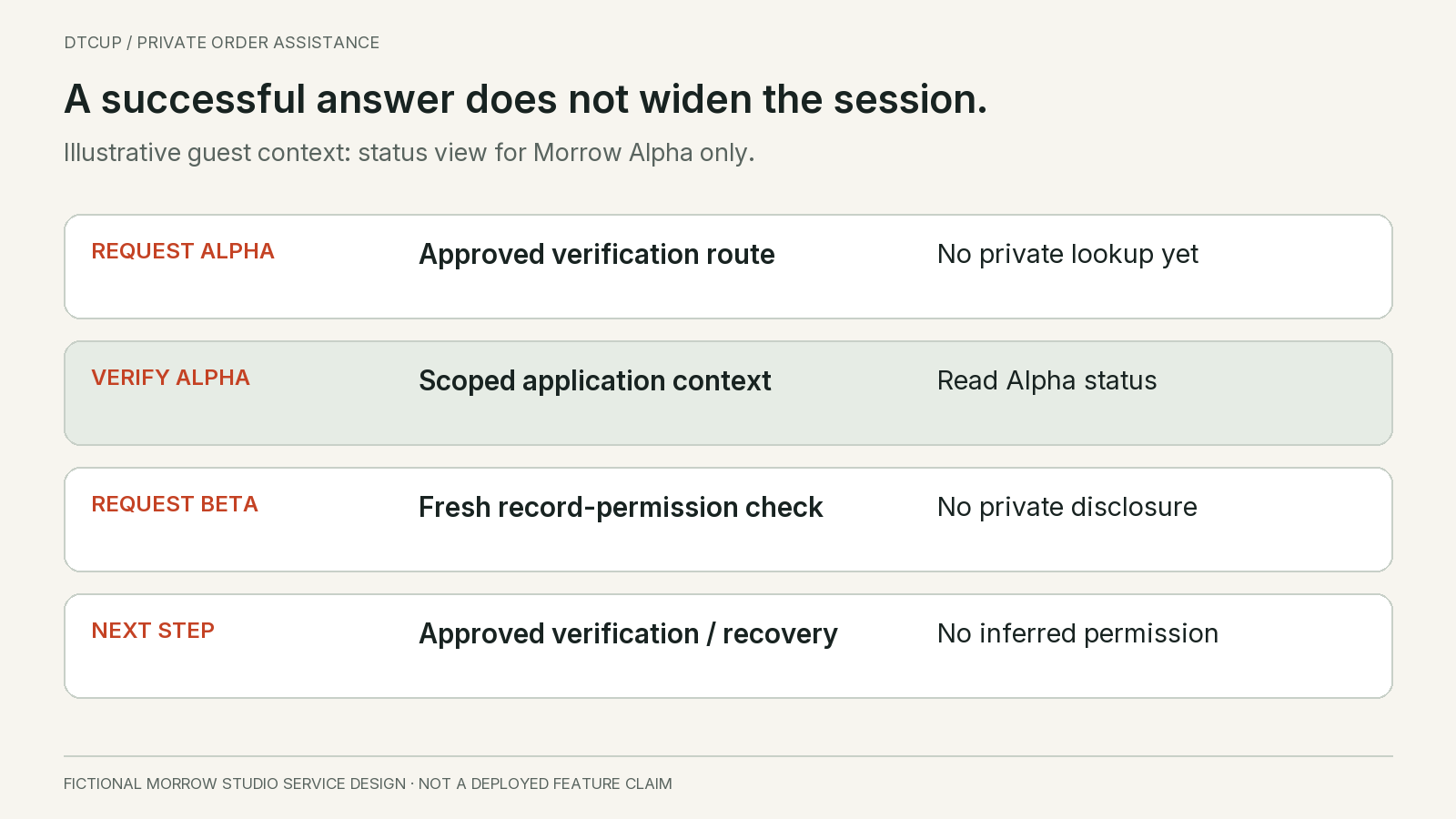
A visitor asks, Where is order Morrow Alpha? The assistant does not immediately retrieve private details. It offers the approved sign-in or guest-verification route and explains that this protects order information. Public guidance about what a tracking status means remains available while the visitor completes that step.
The application establishes a permitted context for Morrow Alpha. The visitor returns to the assistant, which requests the status. The application checks the context again, retrieves the limited status and returns an authorized result. The assistant explains that one parcel is dispatched and the other is being prepared, with the relevant update time.
The visitor next asks about Morrow Beta, which is outside the permitted relationship. The previous success should not carry over merely because both requests occur in one conversation. The application rejects the private lookup and the assistant offers the appropriate verification route without disclosing whether the requested order belongs to another customer.
A helpful response might say that the current session cannot show that order here and provide the next approved step. It should not explain the refusal by revealing the other customer’s name, address or purchase contents. A denial message can itself leak the information the access check was meant to protect.
Now the visitor says that the other order belongs to their partner and that the gift is urgent. The assistant can acknowledge the urgency and guide them to the business’s approved assistance route. It should not reinterpret a sympathetic story as a new access grant. Good service means a usable route through the boundary, not pretending the boundary has disappeared.
The answer, clarify or handoff framework helps distinguish a missing fact from a missing permission. Asking for more descriptive order details may improve lookup, but it does not necessarily provide the evidence required for access.
Treat an order change as a different service
After checking status, the customer may ask to change the delivery address. This is a different operation with different consequences. The read-only context should not become a write permission simply because the request is adjacent in the chat.
For Morrow’s initial release, the assistant directs address changes to a separate supported process. If the business later adds an automated change service, it should define the allowed actor, order state, fields, confirmation and result independently. A customer can be correctly identified while the order is already too far through fulfillment for the requested change.
A preview should show the meaningful proposed change in a trusted interface. The customer needs to know which order and which fields will change before confirming. A vague yes inside a long conversation can refer to several things, especially if the assistant has asked multiple questions or the user has edited a previous request.
OWASP’s transaction authorization guidance emphasizes clear acknowledgment of significant transaction details and an execution-time authorization gate. Applied to this proposed order workflow, a confirmation should refer to a specific change, and altered details should require a new review rather than inheriting approval for an earlier version.
Separate the result states too. A change may be proposed, confirmed by the customer, accepted for processing, completed or rejected because fulfillment progressed. These states are not interchangeable. The assistant should say the change is complete only when the authoritative system confirms that outcome.
For refund or cancellation requests, the relevant policy and current transaction state add further conditions. Do not bundle these into the first status tool merely because the integration exposes convenient endpoints. Expand the service only after the business can explain and test the new permission and state rules.
Handle the time between permission, action and confirmation
A request can be valid when a screen first opens and invalid by the time it is submitted. An order may enter picking, a customer session may end, or an employee’s role may change. The operation needs a current check at the point where the application uses the authority, rather than relying only on an earlier conversational decision.
Consider an address change preview created before dispatch. While the customer reviews it, the warehouse releases the parcel. A safe design should not report success just because the preview was valid. The execution result should explain that the order’s state changed and offer the supported next step.
Network uncertainty creates another difficulty. The assistant sends a request and the response times out. That does not prove that the action failed. Automatically repeating a side-effecting operation can create duplicate work unless the application has a suitable duplicate-prevention and reconciliation design.
For Morrow’s future change service, the proposal would include an operation reference that the application can reconcile. If the response is uncertain, the interface shows pending confirmation while the authoritative state is checked. The model is not asked to guess whether the database changed.
Read requests need clear freshness too. A previously authorized cached status may no longer be current, and a cache shared across customers can create an access problem even if the original query was correct. Bind private results to the appropriate context and review what happens when the session ends or permissions change.
These operational states matter to customer trust. Saying I could not confirm the change yet is less convenient than a confident success message, but it gives the customer a truthful basis for action. The surrounding interface should provide the next check or support route so uncertainty does not become a dead end.
Make refusal useful without revealing private facts
Customers should not have to decode an internal authorization error. Design a small set of understandable outcomes: verification required, current session cannot access this order, status temporarily unavailable, request pending confirmation and operation unavailable in the current order state. The exact wording should avoid revealing facts the requester is not allowed to know.
Distinguish a permission issue from a source outage internally, even if the public response must remain limited. Support and engineers need to diagnose the problem. The visitor needs a safe next step. Giving both audiences the same detailed error can disclose internal identifiers or create confusion.
Do not require a customer to repeat a long story after verification fails. Preserve the non-sensitive task description where appropriate and carry a clear verification state to the handoff. The next agent should know that the person wants delivery information and has not completed the required access process.
A human handoff is not an authorization bypass. Staff need their own access process and role boundaries. If the assistant is blocked from showing a private record, copying the record into an unverified support transcript does not fix the problem; it simply moves the disclosure to another channel.
Keep recovery routes visible and usable on mobile. A verification link hidden behind a chat overlay or a message that disappears on navigation can create repeated attempts. The customer should understand whether they are returning to the same task, starting again or waiting for review.
I would review failed journeys with support staff using fictional cases before release. Ask them to complete the task from the customer’s perspective, including an expired session and an inaccessible contact route. A secure boundary with an unusable recovery process will create pressure for informal workarounds later.
Test the boundaries, not only the happy path
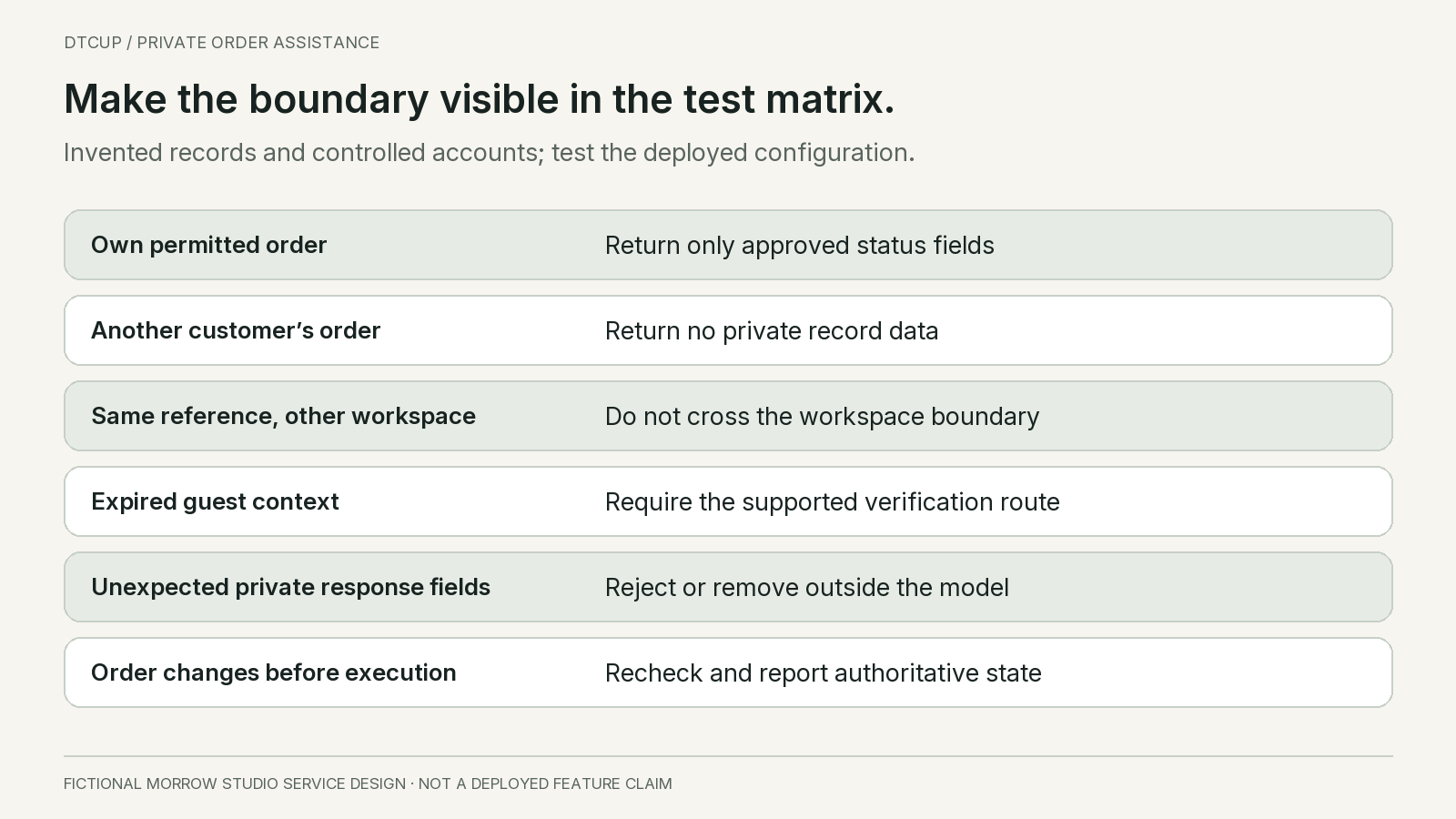
A successful own-order lookup is necessary but insufficient. Morrow’s test set should include a customer asking for another customer’s order, a guest context reused for a different order, a request from another workspace with the same display reference, and an expired context followed by a repeated lookup.
Use invented records and controlled test accounts. There is no need to expose real customer data to establish whether the intended relationships are enforced. Give the fixtures unmistakably different fields so a wrong-record response is obvious without containing sensitive information.
Test at more than one layer. Application tests should show that denied requests do not return private fields. Conversation tests should show that the assistant does not invent a status after a denial. Interface tests should show that the customer gets a usable verification or recovery route.
Also inspect side outputs. A denied lookup might still place the record into a log, a model trace, a cached tool response or an internal preview accessible to the wrong role. The intended boundary applies to the information flow, not only the final sentence displayed in the chat bubble.
For a proposed action tool, test a changed order state between preview and execution, a confirmation for one change followed by different arguments, a repeated request after timeout and a partial upstream failure. The expected outcome should specify whether nothing changes, the request remains pending or a confirmed result can be shown.
The guide on building an AI support test set explains how to preserve difficult cases across releases. Authorization cases should remain explicit release requirements rather than disappearing inside an average answer-quality score.
Decide what happens when the account relationship changes
Order access often becomes confusing after an ordinary account change rather than during an obviously suspicious conversation. A customer changes their contact email, a company removes an employee, or two duplicate profiles are merged. If the assistant relies on a remembered email string, it may continue using a relationship that the account system no longer recognizes.
For Morrow, I would use the account system’s maintained relationship to the order rather than a loose text match against whichever email appears in the conversation. The design review should specify who can change that relationship, which historical orders become accessible after an approved change, and what happens to existing guest sessions. These are business rules requiring explicit decisions.
A profile merge deserves particular attention. Combining two customer records may be useful for service, but it can also expand the set of orders visible through an account. Treat that expansion as a consequential change. A routine deduplication suggestion from a CRM should not automatically grant access to another person’s purchase history.
Business purchasing adds more relationships. The person who placed an order may leave the company while another employee becomes responsible for delivery. A company administrator may have a supported delegation process. The assistant should use that process rather than guessing authority from a shared email domain, a job title or a message that mentions the same company name.
Gift purchases need a different distinction. The recipient may reasonably need delivery assistance without being entitled to the purchaser’s billing details or other orders. A scoped gift-support route can serve that need if the business supports it. Granting the recipient the buyer’s whole account would solve the immediate conversation by creating a much larger problem.
Account recovery should therefore remain connected to the authoritative account process. The support assistant can explain available options and preserve the request context, but it should not invent new ownership rules. When staff make an approved exception, record the specific relationship and scope rather than leaving a free-text note that says trusted customer.
Conversation memory must follow these changes. A previous chat may contain an authorized summary, but that old context should not silently authorize fresh access after logout, reassignment or recovery. The customer-memory guide explains why remembered facts need scope and correction. Here, the crucial distinction is that remembered context is not a current permission grant.
Measure legitimate completion separately from boundary failures
A team can make the refusal rate look excellent by rejecting everyone. It can also make completion look excellent by removing verification. Neither outcome describes a useful service. Report whether eligible customers finish the intended task and whether requests outside the permitted scope remain contained.
Consider a wholly fictional review of two hundred controlled test journeys. One hundred and fifty are eligible own-order tasks and fifty intentionally lack the required relationship. Among the eligible tasks, one hundred and twenty reach a correct status result, twenty stop during verification and ten encounter a source outage. The eligible completion rate is eighty percent, not sixty percent of all two hundred cases.
Suppose all fifty out-of-scope cases return no private order fields. That is a successful result for those specific tests, not proof that every possible attack or configuration is safe. Keep the test scope and version visible. A single confirmed disclosure should be investigated directly rather than averaged away by many successful own-order conversations.
The twenty verification drop-offs and ten outages also require different work. Review the former for confusing navigation, inaccessible controls or broken account mapping. Review the latter for source reliability and recovery messaging. Weakening the permission check would not repair the outage, and changing the model would not necessarily repair either group.
In production, do not assume that every blocked request was malicious or every completed request was legitimate. The true intent may be unknown. Use carefully scoped review evidence, aggregate operational measures and controlled tests rather than assigning unsupported labels to individual visitors.
Finally, examine the customer effort after a failure. Did the person find the support route? Did they have to repeat verification unnecessarily? Did a pending request receive a later confirmed outcome? Those observations improve the experience while preserving the boundary. The operating goal is appropriate completion with explainable exceptions, not the smallest possible number of refusals.
Keep an audit record that can explain the decision
When support asks why a request was refused, the team needs more than the assistant’s final wording. A useful record identifies the task, the application context used, the operation requested, the permission decision, the source result state and the time. It should avoid copying unnecessary private content simply to make debugging convenient.
Morrow could retain a restricted event record saying that a scoped guest context requested a status operation for an order outside its permitted scope and was denied. The public transcript can contain the safe next-step message. These are different records for different audiences.
For a permitted request, record which response version or source timestamp supported the answer. If a customer later reports a wrong delivery statement, the team can distinguish stale source information from language-generation error or an incorrect access mapping.
For a proposed write operation, the record needs to connect the reviewed change, confirmation and authoritative outcome. A log that says tool called is not proof that the intended change completed. A useful audit trail can reconstruct what the system attempted and what the source actually confirmed.
Choose retention and access arrangements through the organization’s approved process. There is no universal period that fits every support record. Avoid making a public article’s example into a legal retention rule. The practical design point is to decide ownership and access before routine debugging creates uncontrolled copies.
Review both mistakes and friction. Unauthorized disclosure is a serious failure. Repeatedly blocking legitimate customers because of broken account mapping is also an operating problem. The remedy is to repair the mapping or recovery process, not to remove checks from the assistant because the refusal rate looks high.
Give the launch a clear acceptance contract
The first release should have a short statement of what it does, which private fields it can return and which operations remain outside scope. Support should know the escalation route. Engineering should know the trusted context and permission service. The business owner should know the conditions under which the feature will be disabled.
For Morrow, acceptance means an authorized customer can receive the limited status for the correct order and workspace, while unsupported relationships return no private order data and provide a usable next step. It also means the assistant does not convert unknown status into an invented delivery promise.
Review the exact deployed configuration, not only a local demonstration. A broader integration credential, an alternate endpoint or a debug response can change the boundary. The release evidence should correspond to the version customers actually use.
Begin with the smallest useful audience and observe both successful and failed journeys. Keep a way to turn off private order lookup while leaving public shipping guidance and human support available. This separates a failure in the new capability from the entire customer-service experience.
When adding a new operation, reopen the access table and test set. A tool that reads status, one that changes an address and one that issues a refund should not inherit permission merely because they share a conversation interface. Each needs a business decision about who may do what and under which conditions.
The best outcome is not an assistant that sounds authoritative about every order. It is a service that can explain the right private facts to the right person, clearly decline what it cannot establish, and preserve a reliable path to help.
Questions about AI order assistance
Is an order number plus an email address enough?
Those values may help locate a record, but typing them does not by itself prove control of the account or permission to see the order. Use the business’s approved verification and authorization flow. The required method depends on the task and risk; the language model should not invent a weaker alternative when the customer is frustrated.
Can the assistant ask for a verification code?
Prefer the approved verification interface for the specific flow and keep secrets out of the model conversation where possible. A customer should never be trained to share passwords or codes intended for a different service. The application should pass a verified, scoped result to the assistant rather than asking it to judge a code in free text.
Does read-only access need permission checks?
Yes. Reading can disclose personal and commercial information even when no record changes. Define the permitted order relationship and fields before returning data. A read-only service credential does not establish which individual customer may see each record.
Should the AI decide whether a customer sounds genuine?
No conversational impression should replace the required application checks. The assistant can identify the task, explain verification and guide recovery. A convincing story, familiar details or an urgent tone is not a reliable access grant.
What if the customer has already verified earlier in the chat?
Use the application’s current scoped context and check whether it still covers the requested order and operation. A previous successful lookup does not authorize another record or a new action. Expiry, logout, workspace changes and changed order state must have defined behavior.
Start with the permission question before choosing the wording of the answer. If the application cannot establish the right relationship and operation, a more eloquent response will not make the lookup appropriate. A trustworthy assistant is useful because its helpfulness remains inside a service boundary the business can explain and verify.
Sources
Still have a question?Ask the DTCUP Community ↗