
Build an AI Support Knowledge Base That Can Keep Its Promises
A practical knowledge design for accurate customer answers: owned facts, product scope, approval, audience permissions and a change process that reaches every answering surface.

7 years of experience building and operating brand websites, specializing in website development, paid advertising and SEO. Built a brand website from launch to US$10 million in annual sales.
The Short Answer
Build knowledge around customer decisions. Give each reusable rule an approved source, a clear scope, an owner and explicit audience permission. Separate stable knowledge from live customer or stock records, and verify that changes reach the article, retrieval index and any answer cache.
Key takeaways
- A large document collection does not establish which answers the business can support.
- Keep the approved fact separate from customer wording, internal notes and live transaction data.
- Approval, audience and permission to use knowledge in a public assistant are separate decisions.
- Test revisions and withdrawals across every relevant answering surface, not only the source document.

An AI knowledge base can contain thousands of documents and still fail on a simple question: “Will this replacement strap fit my bag?” The problem is often not a shortage of text. The system has several plausible answers, but no dependable way to tell which product version, customer situation, or published rule each answer belongs to.
I think of a customer support knowledge base as a collection of promises with boundaries. A promise might concern compatibility, an available service, a preparation step, or what happens after a customer submits a request. Its boundary says when the statement is valid, who may hear it, and which evidence gives the business confidence to say it. Without those boundaries, adding more documents can make the assistant more articulate without making it more trustworthy.
This article explains how to build that collection so a small team can maintain it. We will use a fictional travel-bag brand, Cedar Lane, to work through a compatibility change, conflicting sources, publication permissions, and a correction after release. All product names, dates, and operating examples below are invented for teaching. They are not real product specifications or DTCUP customer results.
The goal is a useful operating design, not a demand to buy a particular database. You can begin with a structured document or spreadsheet and move to a knowledge platform when the workflow requires it. What matters first is that the team can answer four questions: what do we know, where does it apply, who can approve it, and how will every answering surface learn that it changed?
1. Start with customer decisions, not your folder structure
Most companies already have plenty of material: product pages, supplier documents, support macros, order records, launch presentations, and old conversations. Importing everything is tempting because the progress bar moves quickly. Unfortunately, a completed import says very little about whether a customer can get a supported answer. A folder structure describes where employees stored information, not necessarily how customers ask for help.
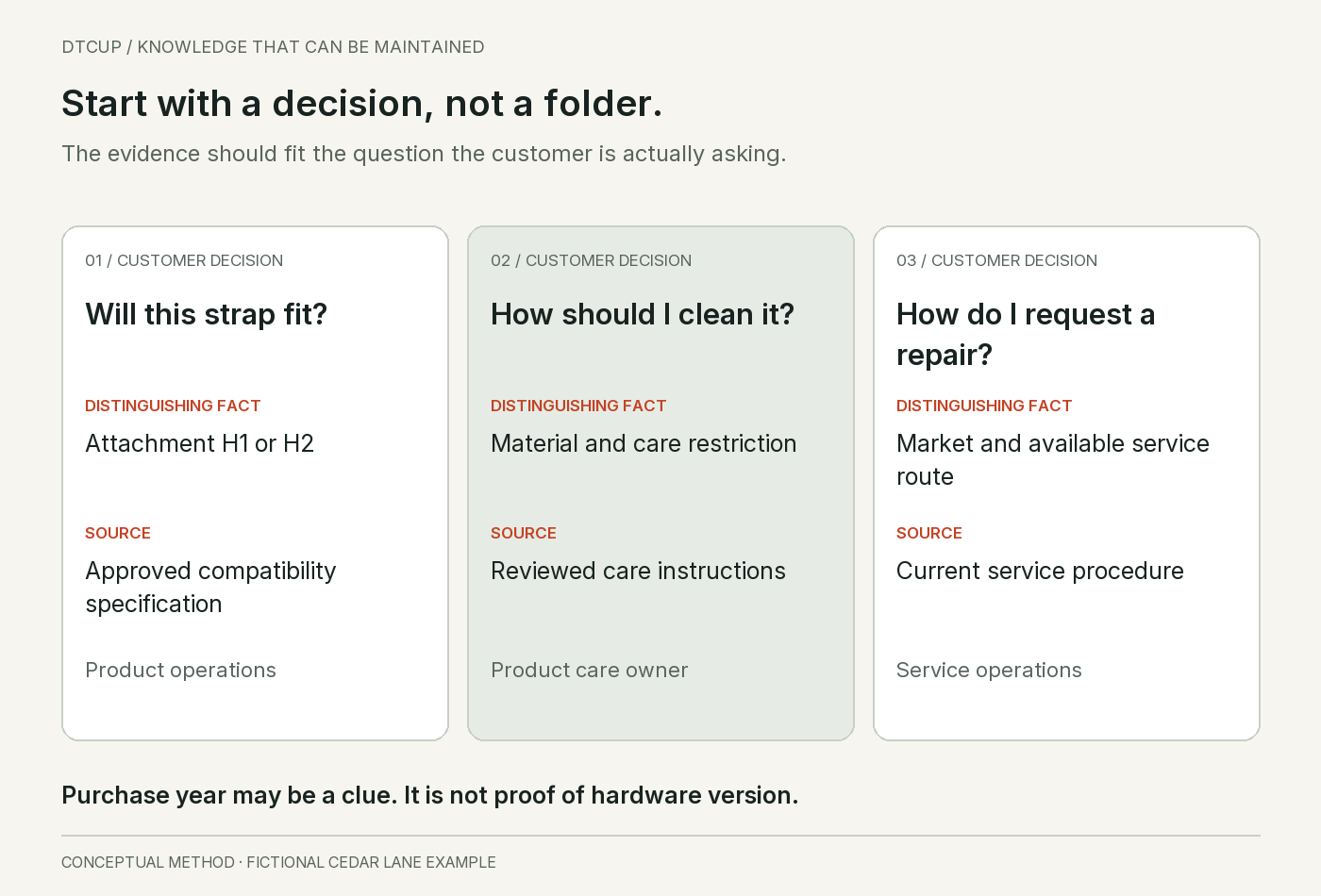
Begin with the decisions the assistant should help a customer make. Cedar Lane might choose three: identify a compatible replacement strap, prepare a bag for cleaning, and find the correct repair-request route. Each decision needs a different kind of evidence. Compatibility depends on product and hardware version. Cleaning depends on material and approved instructions. A repair request depends on the service offered in the customer’s market and the information required to start it.
For each decision, write the question in the customer’s language. “Is this the right strap for the bag I bought last year?” is more realistic than “Query accessory compatibility matrix.” Keep both the customer’s wording and the canonical product terms. The customer phrase helps discovery; the canonical identifiers prevent two similar names from being treated as the same item. Neither alone is enough.
Next, identify the minimum facts that change the answer. Cedar Lane’s fictional strap uses one attachment for bag version One and another for version Two. The year of purchase is a clue, not definitive proof of version, because older stock may still have been sold later. A label code or a clear description of the attachment may be a better distinguishing fact. The knowledge entry should tell the assistant which evidence is sufficient and what to ask when it is missing.
Resist turning this into an exhaustive questionnaire. A customer should not provide an order number, address, account details, and photographs merely to read general cleaning advice. Ask for information because it changes the decision or enables an authorized action. This keeps the knowledge design useful rather than transforming a friendly assistant into a customs declaration with a chat bubble.
After mapping the decision, locate the authoritative source. For compatibility, that might be an approved product specification maintained by the product team. For cleaning, it might be a reviewed care instruction. For the repair route, it might be the service operation’s current procedure. A search engine result, a supplier draft, or a persuasive old support message should not silently become the authority just because it contains a convenient answer.
The first deliverable is a short decision inventory: customer question, required distinguishing facts, approved source, responsible owner, and safe next step when the answer is unavailable. It exposes gaps before they become public replies. If nobody can identify an owner for a promise, that is a business issue to resolve before giving an assistant permission to repeat it.
2. Separate the fact from the wording used to explain it
A common maintenance problem begins with copying the same fact into several places. The product page says a strap fits version One. A support macro says it fits “older bags.” A help-center article says it fits all bags sold before a certain year. These statements may have started from one correct fact, but they are no longer equivalent. Editing one copy will not necessarily correct the others.
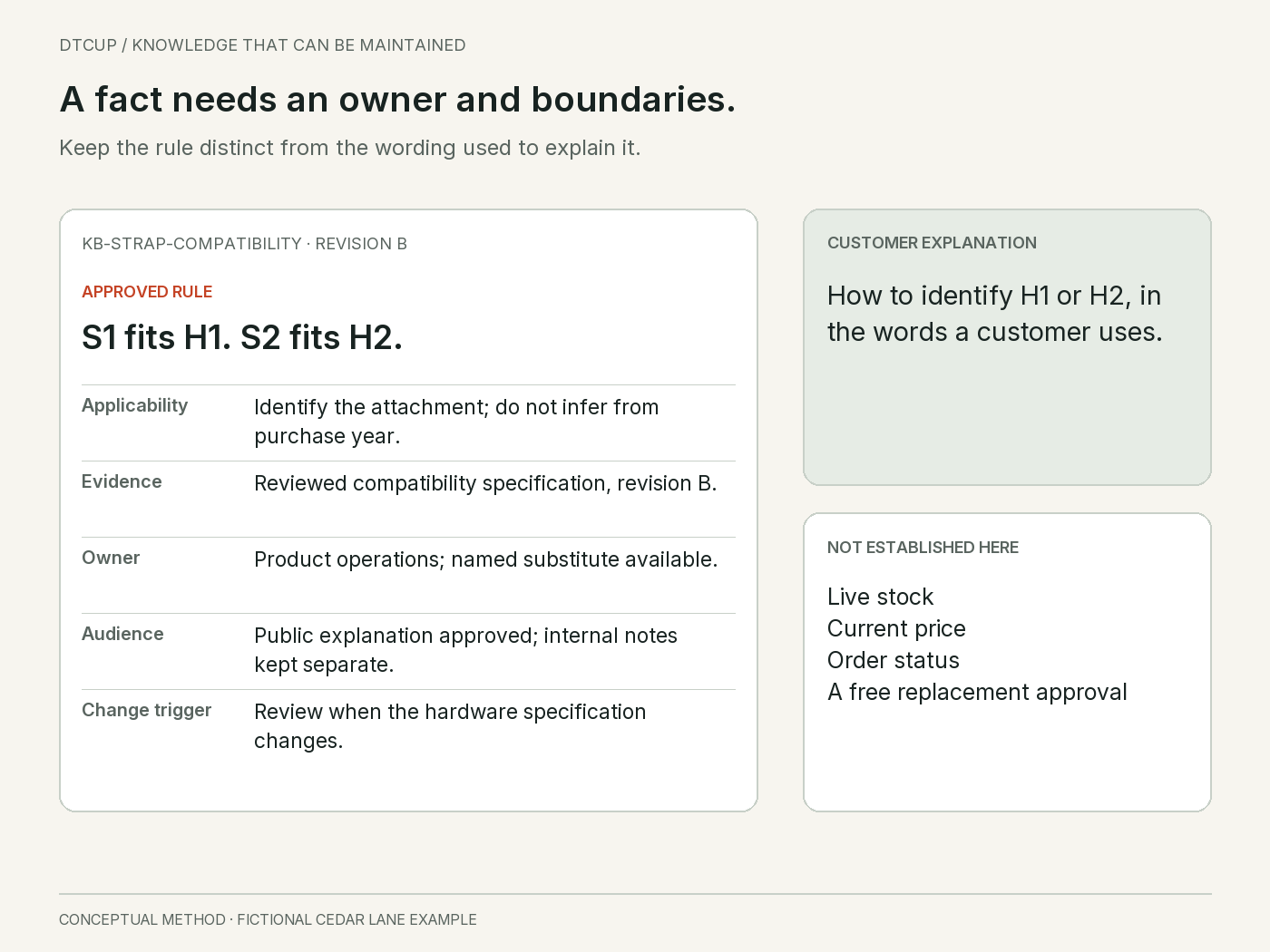
Create one owned record for the underlying compatibility decision, then let different surfaces explain it appropriately. In Cedar Lane’s case, the record might state that strap S1 is compatible with attachment H1 and not H2, supported by a named approved specification. The public answer can explain how to identify H1. The internal note can explain how an agent handles an unreadable label. Both should refer back to the same underlying fact.
This does not mean every sentence must become a database row. Over-atomizing knowledge can remove the context needed to understand it. “Fits H1” is too small if the assistant does not know what H1 is, how customers identify it, or which exception matters. A useful unit contains a complete answerable decision with its conditions. Make it small enough to own and update, but large enough to make sense when retrieved.
I would keep the approved fact and its explanation together but visibly separate. One section states the rule precisely. Another provides customer-friendly wording and identification help. A third records internal handling notes that must not be published. This arrangement lets an editor improve clarity without accidentally changing the rule, and lets a policy owner change the rule without having to hunt through decorative prose.
Distinguish facts, procedures, estimates, and exceptions. “S1 fits H1” is a compatibility fact. “Ask for the attachment code if the version is unknown” is a procedure. “The repair team usually responds within a stated range” is an estimate only if supported by an approved service statement. “An agent made a one-time exception for this customer” is a case event. Mixing these categories can turn an anecdote into a promise.
Keep transaction facts out of general knowledge unless there is a deliberate, safe reason to include them. The current stock of S1 belongs in an authorized live source, not in a help article that says “we have plenty available.” A customer’s repair status belongs in the appropriate case system. General knowledge should explain how those facts are checked and what an unavailable result means; it should not pretend to be the live record.
The same discipline applies to marketing copy. “Designed for years of travel” might be legitimate positioning, but it does not specify a warranty period or prove compatibility with every previous accessory. An assistant needs to know which statements are descriptive and which authorize a concrete customer expectation. If the distinction is unclear to a human editor, it will not become clearer simply because the text is embedded in a search index.
For teams preparing customer context as well as product knowledge, DTCUP’s guide to preparing customer information for AI addresses the adjacent data problem. Keep the responsibilities separate: knowledge defines reusable rules and explanations; customer records establish the particular facts of the case. The assistant needs both only when the customer’s question genuinely requires both.
3. Give each knowledge item enough structure to be maintained
A maintainable record needs more than a title and body. However, it does not need forty mandatory fields before anyone can fix a typo. Start with the fields that determine whether the information can support an answer. Add fields only when they change retrieval, approval, application, or maintenance. Otherwise, the system accumulates impressive-looking metadata that nobody trusts enough to use.
Give every item a stable identifier. A title such as “Replacement strap compatibility” can change as editors improve it; the identifier should remain stable. Include a canonical product or service reference where relevant, and a plain-language description of the question the item answers. This helps distinguish a new version of the same knowledge from an unrelated article that happens to use similar words.
Record the actual rule and its scope. Scope may include product variants, markets, channels, dates, or customer conditions, but do not assume every item needs every dimension. Cedar Lane’s cleaning guide may apply to one fabric across several bag sizes. Its repair collection process may differ by market. The structure should represent those differences rather than forcing both into an uninformative “global” label.
Attach an evidence reference that an authorized reviewer can inspect. A source URL alone may not identify the version that supported the decision, so include a document revision or a dated reference when needed. If the source is private, preserve a controlled internal reference rather than exposing the private link in the customer answer. Public citations and internal audit evidence serve different audiences.
Assign an owner and a substitute owner. The owner is responsible for the correctness of the knowledge, not necessarily the person who typed it. A product specialist may own compatibility while a support editor owns clarity. The substitute matters when the primary owner changes roles or is unavailable. “Ask the person who originally wrote it” stops working surprisingly quickly as a company grows.
Finally, record approval state, permitted audience, effective dates where relevant, and the next review trigger. The trigger can be an event rather than a calendar date: a hardware revision, a service-region change, a repeated support failure, or a supplier specification update. A periodic review remains useful for some information, but it should not be the only way the system discovers a known change.
| Field | Example | Why it matters |
|---|---|---|
| Stable identifier | KB-STRAP-COMPATIBILITY | Keeps links and versions attached to the same decision. |
| Rule | S1 fits attachment H1; S2 fits attachment H2. | States the approved relationship without relying on purchase year. |
| Required distinction | Attachment identifier or approved identification method. | Prevents a confident answer when the product version is unknown. |
| Evidence | Reviewed compatibility specification, revision B. | Gives the reviewer a concrete basis for the rule. |
| Audience | Approved public explanation; separate internal handling note. | Prevents internal notes from becoming customer-facing content. |
| Owner and trigger | Product operations; review on hardware revision. | Connects future changes to an accountable person. |
Notice what is absent: there is no model-generated confidence percentage that magically makes the rule true. An approval state reflects a defined review process and evidence. It should not be confused with how certain an AI model sounds. If the business cannot explain what “approved” means, the label is only a different kind of decoration.
4. Treat approval and audience as separate decisions
An accurate internal document is not automatically suitable for a public assistant. It may contain supplier costs, employee contact details, troubleshooting steps intended for trained staff, or notes about a pending product change. Conversely, a public article can be available on the website while still being too ambiguous to support an automated answer about a particular case. Visibility and answer readiness are different questions.
The Consortium for Service Innovation’s KCS article-state guidance distinguishes confidence, audience, and governance. That distinction is useful background for this design. Here, I recommend translating it into explicit operational permissions: who can read the item, who may change it, and which assistant or workflow may use it to support an external answer.
For Cedar Lane, a product engineer’s note about a prototype attachment could be accurate and approved for engineering discussion while remaining unavailable to customer support. A draft repair-service expansion might be approved as a project plan but not as an offer customers can use. Do not collapse all these meanings into one green “published” badge and expect a language model to infer the intended boundary.
Use a small set of understandable states. For example, a proposed item can be visible to its reviewers, an approved internal item can help authorized agents, and an approved public item can be eligible for the website assistant. A withdrawn item should no longer support new answers through that route. These are suggested operational states, not a universal taxonomy every product must implement exactly.
Make permissions effective before retrieval, not merely in the final prompt. If a public assistant receives confidential text and is told “do not reveal this,” the content has already crossed a boundary it may not have needed to cross. The safer design selects material the requesting user or answering surface is allowed to access, then applies additional rules about how it may be used.
Microsoft’s documentation on document-level access control in Azure AI Search describes mechanisms for limiting search results according to permissions. Specific implementations vary, and some capabilities depend on configuration or service support. The architectural lesson is to enforce access deliberately in the retrieval path rather than treating a polite instruction to the assistant as the permission system.
Test a denied case as carefully as an allowed case. A public question about an unreleased attachment should not reveal an internal prototype note. A support agent may be permitted to see that note without being permitted to promise a launch date. A person in another workspace should not retrieve either. Passing a public happy-path test does not establish these boundaries.
When information is unavailable to a public answer, provide an approved alternative where possible. The assistant might explain how to identify the currently sold attachment or offer an appropriate support route. It should not announce that a confidential document exists or quote its title as a reason for refusing. A good fallback respects the boundary while still helping the customer make progress.
5. Version the promise, not just the document file
Now suppose Cedar Lane introduces attachment H2. The product team updates the compatibility specification, while the help-center article still says “our replacement strap fits every Cedar Lane bag.” The assistant can retrieve both. The business has not merely created a duplicate document; it has created two conflicting customer promises. The maintenance process needs to resolve that conflict before the new source becomes another persuasive paragraph in the index.
First, identify whether the change corrects an old mistake or introduces a new rule. A correction means the previous statement should not have been used as written. A new rule may legitimately apply only to a new product version or date range. These situations require different handling of historical conversations. Do not rewrite the past by marking every previous answer wrong when the rule actually changed later.
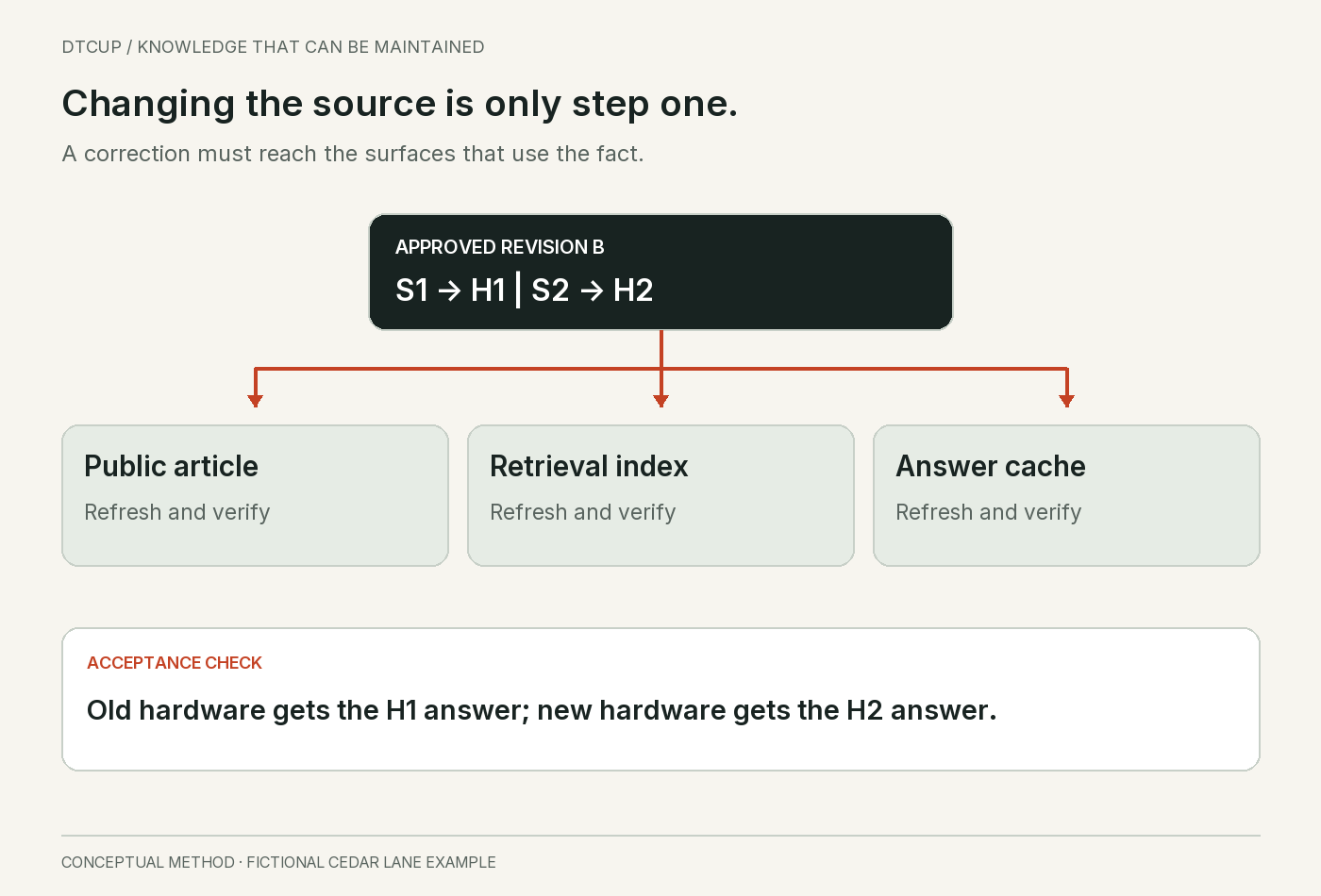
For the fictional strap example, compatibility follows hardware version rather than the date somebody asked the question. The new record should represent both valid relationships: S1 with H1, S2 with H2. It should explicitly remove the unsupported universal statement. A customer who bought H1 last year still needs the H1 answer after H2 launches. “Always use the newest product” would be an unhelpful shortcut.
Maintain a stable knowledge identifier with distinguishable revisions. Revision B can supersede revision A’s wording while retaining historical evidence of what A said and when it was used, according to your retention needs. Avoid creating a completely unrelated article every time a sentence changes. That makes citations harder to trace and encourages old copies to linger as apparently independent sources.
Record an effective date only when the business rule actually has one. Do not use the date the editor clicked Save as a substitute for the date a policy became applicable. Similarly, a “last reviewed” date should mean somebody performed the defined review, not that a scheduled job touched the record. Empty but honest metadata is better than a reassuring date with no event behind it.
Plan the downstream update. The website page, search index, internal agent helper, cached answer, and any exported support macro may refresh differently. List the surfaces that consume the fact and identify how each learns about a revision. A source has been corrected only locally until the relevant answering surfaces are checked. This is where many otherwise tidy knowledge projects lose the connection to actual customer experience.
For high-consequence changes, define a temporary response while propagation is incomplete. Cedar Lane might pause automatic compatibility confirmation and ask for an attachment check through support. The fallback should have an owner and an exit condition. Otherwise, a temporary uncertainty message can remain long after the corrected knowledge is available, creating unnecessary work and making the assistant feel permanently unfinished.
When investigating a wrong answer after a change, use the AI support failure diagnostic method to distinguish an old source, a stale index, an incorrect applicability decision, and a misleading final sentence. They can look identical to the customer, but they need different repairs. Version records make that distinction possible without relying on staff memory.
6. Write entries that remain understandable when retrieved
A human reading a complete manual can use its cover, headings, diagrams, and previous pages to understand a sentence. A retrieval system may supply only a fragment. Write important knowledge so the relevant conditions stay close to the claim. This does not require robotic prose. It requires enough context that a useful excerpt does not become misleading when separated from the surrounding document.
Compare “Yes, it fits” with “Strap S1 fits Cedar Lane bags with attachment H1. It does not fit attachment H2.” The second statement is less conversational in isolation, but it preserves the relationship the assistant needs. A customer-facing answer can still be warm and concise. The knowledge source should first be explicit about the fact, then provide any approved wording the assistant may adapt.
Keep exceptions beside the rule they limit. If the general compatibility claim appears near the top and the exception is buried in an appendix, retrieval may deliver only the attractive half of the truth. Where the source is long for a legitimate reason, use clear section boundaries and references that the system can preserve. Repeating the same full document in several formats usually adds maintenance burden without solving that context problem.
Include customer aliases carefully. People may call an attachment a clip, buckle, hook, or connector. Record useful synonyms, but do not declare different parts equivalent merely because customers use similar words. A retrieval query can use aliases to find candidate knowledge; the answer still needs to resolve which actual component the customer has. Discovery language should not silently replace product identity.
Use images when they remove an ambiguity that words handle badly. A labeled diagram of H1 and H2 could help a customer identify the attachment. The image needs an accurate caption and text alternative explaining the relevant distinction. Do not rely on an unlabelled visual alone, especially when the assistant cannot reliably inspect the customer’s photograph or the user cannot see the image.
Separate an identification method from a guarantee. If a photograph is too unclear to establish the attachment type, the correct result is unresolved. A sentence such as “it looks similar” should not become a definitive compatibility statement. The knowledge item can specify what a sufficient identifier looks like and what to do when it is missing. This makes uncertainty operational rather than embarrassing.
Be explicit about what the entry does not answer. A compatibility record does not establish stock availability, shipping time, price, or whether a free replacement has been approved for a particular customer. The assistant may need another source or an authorized tool for those questions. Stating the boundary prevents a correct answer to one question from being stretched into unsupported answers to four others.
Before approving an entry, ask a reviewer unfamiliar with the source document to answer a few representative questions using only that entry. If they repeatedly need unstated background, add the necessary context. If they cannot find the rule through the surrounding prose, simplify the structure. This is a useful human check before adding the uncertainty of automated retrieval and generation.
7. Build a path for conflicting and missing knowledge
No knowledge base stays perfectly complete. The practical question is what happens when an answer is missing or two sources disagree. Without a defined path, people often solve the immediate conversation by improvising, then leave the underlying conflict untouched. The assistant later retrieves the improvised answer, and a one-time workaround acquires the appearance of official policy.
For Cedar Lane, imagine an old public article says all straps fit all bags, while revision B of the product specification separates H1 and H2. The knowledge owner should determine whether revision B is authoritative and whether the public wording must be withdrawn. The assistant should not settle this dispute by choosing the longer document, the more recently crawled page, or the passage with the highest search score.
A retrieval score estimates a kind of matching relevance. It does not establish business authority. A source precedence rule can help when it is explicit and appropriate: for example, an approved compatibility specification controls the compatibility fact, while a service procedure controls the next support action. But precedence should not be used to hide a real unresolved conflict between equally authoritative owners.
Record the conflict as a work item linked to the affected knowledge identifiers. Include the competing statements, their scopes, the customer decisions affected, and a named decision owner. While it is unresolved, define which answering capability is restricted and what alternative remains available. This is more useful than putting a generic “under review” label on an entire knowledge base.
Missing knowledge needs a similar path. If a customer asks about an accessory combination the product team has never assessed, the assistant should not infer compatibility from visual similarity or from a neighboring model. Capture the unanswered decision for review, provide a suitable support route, and avoid collecting excessive customer data merely to make the handoff look thorough. The missing fact is about the product, not necessarily about the person asking.
Separate a knowledge gap from a service gap. The repair policy may clearly say the service is not offered in a region. That is an answer, even if it is commercially inconvenient. Writing more knowledge will not create the missing service. Conversely, if the service exists but staff cannot identify the correct process, better knowledge may solve a real operational problem. Treating both as “content gaps” leads to the wrong investment.
Do not reward the team solely for closing every gap with a published article. Some questions deserve a short clarification inside an existing entry. Others reveal a product defect or a process that should be simplified. A growing article count can indicate useful coverage, but it can also indicate that the business is documenting complexity it should remove. Review the customer decision before deciding that another page is the answer.
For a small operation, a weekly conflict review can begin with the few items that blocked actual customers or created risky promises. Assign decisions, update the owned records, and verify the relevant answering surfaces. The meeting should end with corrected facts or explicit next actions, not a larger pile of tagged documents waiting for somebody with unspecified authority.
8. Measure whether the knowledge helps decisions
The number of imported documents is a setup metric. It does not measure whether the knowledge is accurate, findable, usable, or maintained. A more useful review starts with a defined set of customer decisions and asks whether each has sufficient approved evidence. The denominator should be a real workload or a deliberately defined test set, not every imaginable question a customer could ask.
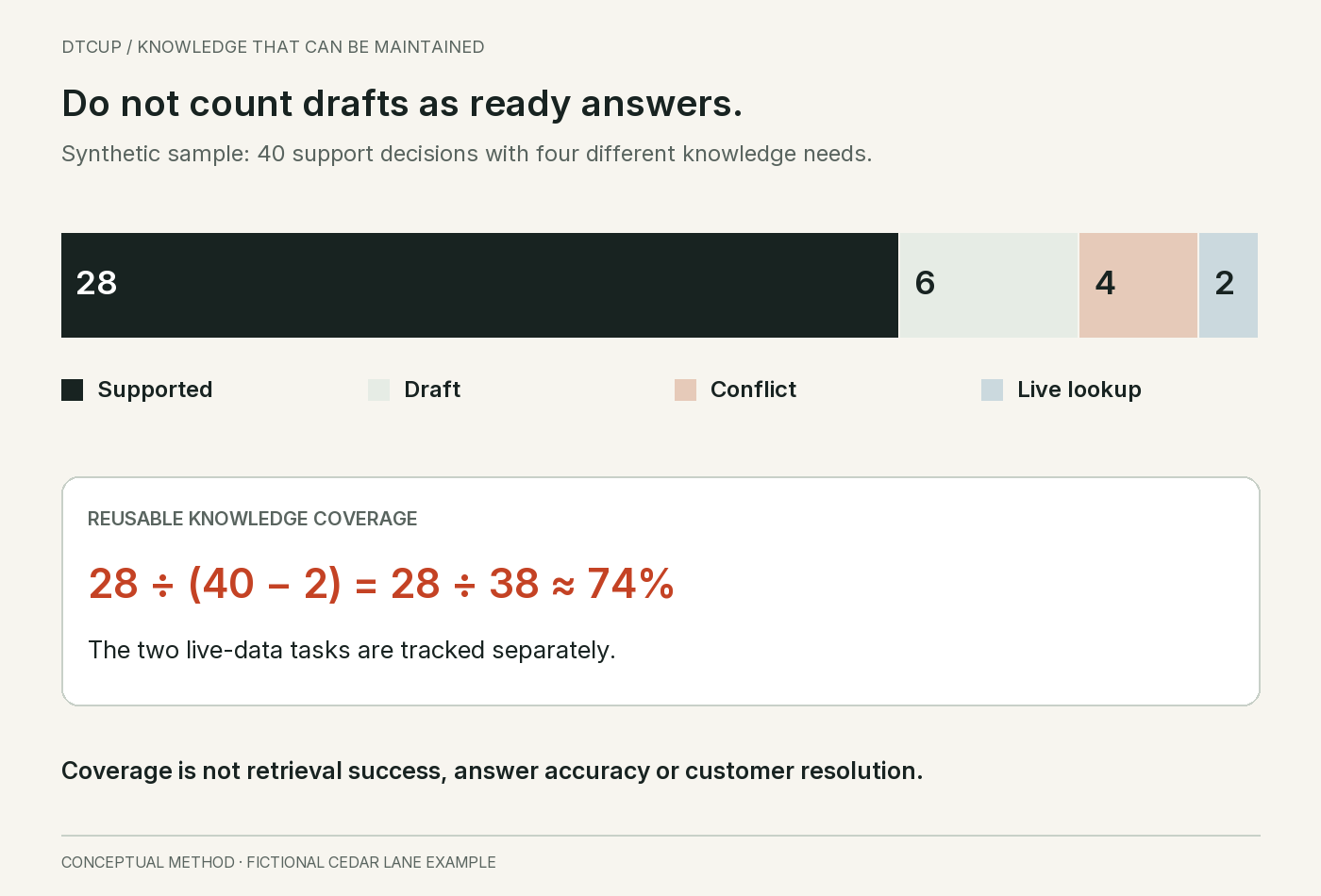
Consider a fictional sample of forty distinct support decisions from a period of operation. Twenty-eight have approved, applicable knowledge. Six have a draft answer awaiting review. Four involve unresolved conflicts. Two require a live transaction lookup rather than a general knowledge article. It would be misleading to report thirty-eight knowledge-covered decisions by counting drafts and conflicts as available answers. It would also be misleading to call the two live lookups missing articles.
Coverage is therefore not one flat percentage unless the categories are defined first. You could report twenty-eight of the thirty-eight decisions that should be answered from reusable knowledge as currently supported, while separately showing the two live-data tasks. That is about seventy-four percent in this invented sample. It is not a chatbot accuracy rate, and it says nothing by itself about whether retrieval found the supported answers.
Keep findability separate from source coverage. An approved article may exist but fail to appear for common customer language. Keep usability separate too: the retrieved article may omit the distinction needed to answer. Finally, track whether the customer received an appropriate result. These are connected measurements, but merging them too early makes it hard to identify whether the team should edit content, fix search, or change the service process.
Review maintenance signals as well. How long do consequential conflicts remain unresolved? Which frequently used entries have no active owner? Which source changes have not reached their consumers? How often do agents correct an answer without correcting the underlying record? These questions reveal whether the knowledge operation can keep up with the business, rather than merely proving it was tidy on launch day.
A review date that has passed is a signal to assess the item, not automatic evidence that the content is false. A newly edited article is not automatically reliable either. Prioritize using consequence, actual use, change frequency, and known events. A stable explanation of where to find a product label may need less attention than a service eligibility rule changed by an operational rollout.
Be wary of measuring individual writers by article volume. It can encourage splitting one coherent answer into many thin entries and discourages merging duplicates. Reward useful corrections, clear ownership, reliable reuse, and reduced customer effort instead. The person who removes a confusing duplicate may have improved the system more than the person who adds five attractive new pages.
For a founder or operations lead, I would summarize knowledge health in plain language: which important decisions are supported, which are blocked, what changed, and who is resolving the remaining issues. You can keep detailed diagnostics underneath. The top-level view should help allocate attention, not require a second analyst to explain why a green score hides a broken promise.
9. Make updating knowledge part of normal work
A knowledge base usually becomes stale because updating it is an extra activity disconnected from the event that changed the fact. Product operations revises a specification. Marketing publishes a new offer. Support discovers an ambiguous instruction. Each team finishes its immediate task, while the knowledge update waits for someone who was never included in the workflow.
Attach the update to the source event. A hardware revision should identify the affected compatibility records before release. A changed service route should identify its public explanation and internal procedure. A repeated support correction should create a linked knowledge issue. This does not mean every small business needs a formal committee. It means the person making a change knows which customer-facing statements depend on it.
Define a simple completion condition for each type of change. Cedar Lane’s H2 launch is not knowledge-ready until the compatibility fact is approved, the identification guidance is usable, the public assistant can retrieve the appropriate version, and the old universal statement no longer supports new answers. The exact implementation can be lightweight, but the condition should be clear enough that two people agree on whether it was met.
Give editors a way to make low-risk clarity improvements without waiting for a policy owner to approve punctuation. At the same time, distinguish those edits from changes to eligibility, compatibility, amounts, dates, or promised actions. The workflow should be sensitive to what changed, not merely to the fact that somebody touched a document. Otherwise, it becomes either dangerously loose or so slow that staff work around it.
Use change notes that explain the effect on answers. “Updated article” tells a support team almost nothing. “Removed the all-bags claim; S1 and S2 now require attachment identification” tells them which conversations to handle differently. Include the affected surfaces and any temporary fallback. This is a small writing habit with a large practical benefit: it translates document maintenance into service behavior.
When staff discover a better explanation during a conversation, let them flag or propose it where they work. Requiring a separate login, a long form, and an uncertain review queue will lose valuable corrections. Still, a proposed explanation should not bypass approval merely because it came from a helpful agent. Capture the evidence and distinguish a reusable improvement from a one-off customer accommodation.
Audit the handoff between knowledge and answering systems occasionally. Can the team withdraw an item and confirm that the public assistant stops using it? Can it identify the source version behind a disputed reply? Can it explain which items are internal only? These concrete exercises reveal more than a presentation describing an ideal governance process that nobody has tried.
If you are choosing the surrounding software, the build, buy, or configure decision guide can help frame the investment. Bring your knowledge workflow to the evaluation. A supplier should demonstrate how your approval, audience, revision, and withdrawal requirements work, rather than simply showing how quickly a PDF becomes searchable.
10. Start small enough to operate, but complete enough to trust
For a first implementation, choose one bounded support area with meaningful customer demand and an identifiable owner. Compatibility for a small product range can be a better starting point than every possible sales and support question. The area should be narrow enough to review properly, but varied enough to expose missing facts, exceptions, and changes. A demonstration that answers only one carefully rehearsed question will not teach you much.
Build the decision inventory, prepare the owned knowledge records, and choose the answering surfaces allowed to use them. Test an ordinary question, an exception, a missing identifier, an outdated source, and a request outside the approved scope. These cases exercise the knowledge operation, not just the wording of a prompt. Keep any live transaction action out of the initial scope unless you can authorize and verify it separately.
Then perform a complete change exercise. Introduce a fictional revision in a safe test environment, withdraw a previous statement, and confirm that the appropriate answers change while unaffected answers remain useful. This rehearsal is often where a team discovers that its website article, search index, and cached response follow different update paths. It is much cheaper to discover that during a controlled exercise than during a public product change.
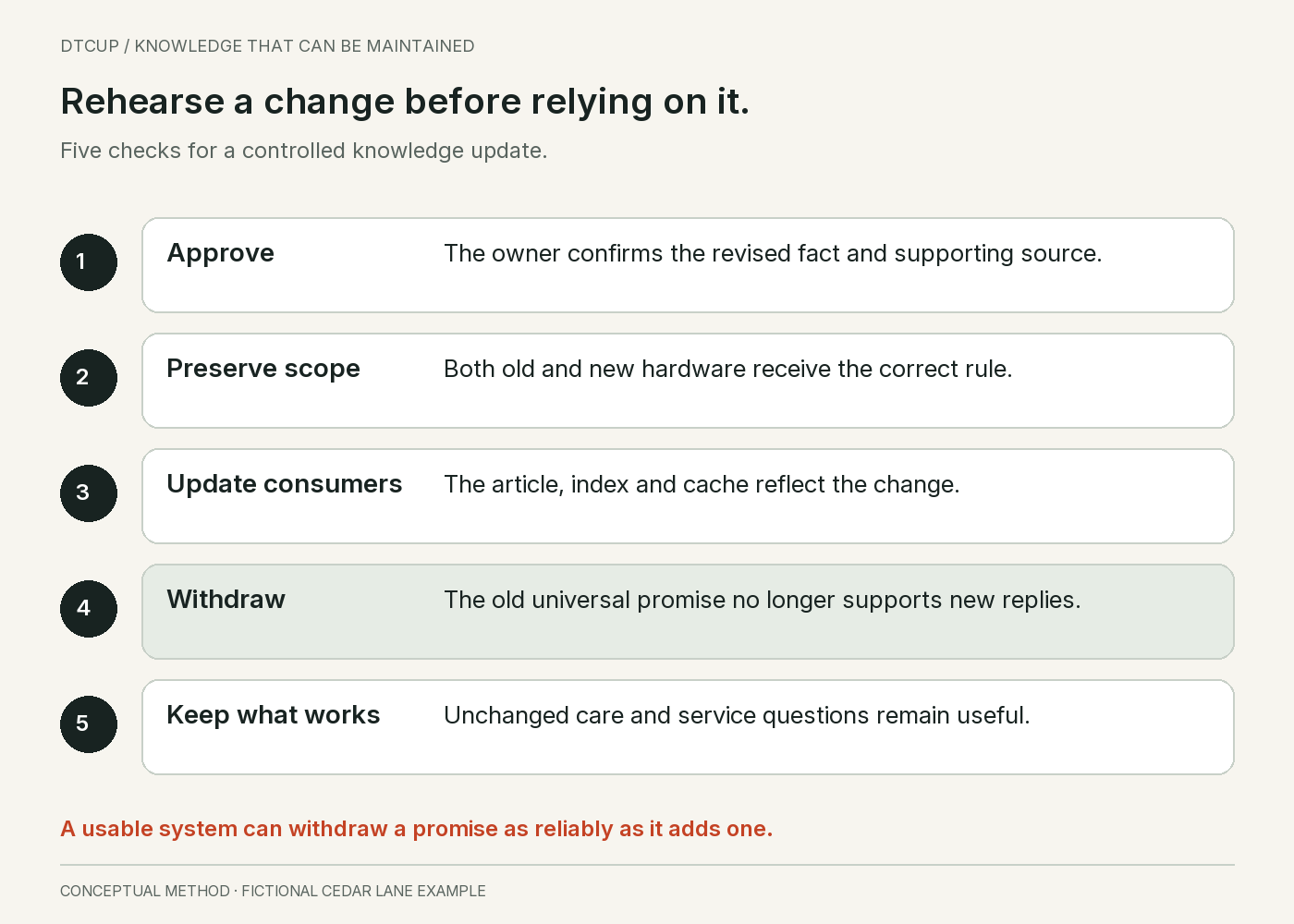
Before expanding, decide who will maintain the next area and what evidence makes it ready. If the current owner is already struggling to review a small collection, importing ten times as much material will amplify the bottleneck. Growth should follow operating capacity. Automation can help identify changes and propose drafts, but somebody still needs authority to decide what the business can truthfully tell a customer.
The standard I would use is deliberately practical: a colleague should be able to inspect an important answer and trace it to an approved, applicable record with an owner and a current source. If that record changes, the team should know how to update or withdraw it from the relevant answering surfaces. You do not need a grand claim about eliminating hallucinations to see the value of that capability.
A well-run knowledge base makes uncertainty visible early. It shows that a product version is unknown, a source conflicts, or a live status must be checked. That may feel less impressive than an assistant that always has something to say. It is considerably more useful when the answer determines what a customer buys, expects, or does next.
Sources
Still have a question?Ask the DTCUP Community ↗