
When Two Policies Disagree: Give AI a Source-of-Truth Rule
A newer document does not necessarily govern an older purchase. Work through a fictional campaign to resolve authority, scope, effective dates and overlapping exceptions before the assistant answers.

7 years of experience building and operating brand websites, specializing in website development, paid advertising and SEO. Built a brand website from launch to US$10 million in annual sales.
The Short Answer
Select approved records using verified transaction context before applying explicit precedence or amendment relationships. Keep publication time separate from effective scope. When eligible policies conflict without an approved relationship, request policy review rather than letting the model invent a rule.
Key takeaways
- Different windows may describe different scopes rather than a genuine contradiction.
- A campaign amendment can change one field while inheriting the remaining standard conditions.
- The latest publication is not automatically the policy applicable to an older purchase.
- Two eligible amendments require an explicit relationship; choosing the most generous number is not a safe default.
- A source correction must propagate through extraction, indexing, caches and the final answer path.

A customer asks whether a purchase can be returned. The help center says 30 days. A campaign page says 45 days. An internal note says final sale. The assistant finds all three and produces a confident answer. The problem is no longer whether the search system can find information. The business has failed to tell it which information governs this purchase.
My recommendation is to resolve policy eligibility before asking the model to explain the answer. Identify the transaction, market, product class and relevant dates; select approved rules whose scope actually matches; then apply an explicitly authorized relationship between those rules. If the relationship is missing or contradictory, preserve the conflict and route it to an owner. Fluency should never be the mechanism that settles a business disagreement.
This is an operating design for support teams and the people building their AI systems. It does not prescribe a return policy or determine legal rights. All businesses, dates, windows and customer situations below are fictional. A real policy owner must define the applicable commercial terms and account for relevant obligations before implementing the selection logic.
We will follow Northline Studio, a fictional home-office brand, through a campaign policy change. The important output is a resolution table the team can inspect, not a longer prompt saying “always use the correct source.” That table will make the assistant’s behavior explainable when the newest document is not the applicable document and when a valid exception changes only one part of a broader rule.
1. First decide whether the sources truly disagree
Two different numbers do not necessarily create a conflict. A 30-day standard window and a 45-day campaign window may describe different purchases. A consumer policy and a wholesale contract may serve different audiences. A policy for unopened products and a note about damaged deliveries may address different circumstances. Treating every difference as a contradiction produces unnecessary escalations and encourages people to remove useful detail.
A genuine conflict occurs when two eligible, authoritative statements govern the same decision and cannot both be satisfied under the approved interpretation. Before labeling one, compare the subject, scope, effective conditions and intended action. “You may request a return within 30 days of delivery” and “we usually process approved refunds within seven business days” refer to separate clocks. A model that merges those numbers has an interpretation problem, not an unresolved policy hierarchy.
Write the customer’s actual decision as a complete question. For Northline, it is not simply “what is your return policy?” It is “Can this customer request a change-of-mind return for this standard desk organizer, bought through this channel on this date and delivered on this date?” The fuller question reveals which facts the assistant needs and which policies might apply. It also separates a general explanation from an account-specific eligibility decision.
There are four useful outcomes at this stage. The sources can be consistent descriptions of the same rule, valid rules for different scopes, a general rule plus an authorized amendment, or an unresolved contradiction. These outcomes require different behavior. Consistent descriptions can be consolidated. Different scopes require selecting the right branch. An amendment requires a defined merge. A contradiction requires an owner, not an improvised compromise.
I would ask a reviewer to annotate the exact competing claims rather than flagging entire documents as contradictory. A long help page can contain one outdated deadline and many correct instructions. A campaign page may change the request window but say nothing about item condition, return shipping or approval. Identifying the claim keeps the correction precise and reduces the temptation to replace one whole document with another.
This distinction matters for customers as well. A reply saying “our policies conflict” is unhelpful when the system merely lacks the order date. Conversely, asking a customer for more details will not fix two approved records that both claim to govern the same order. Diagnose whether the missing information belongs to the customer context or to the business’s policy definition before choosing the next interaction.
2. Build a small register around decisions, not file names
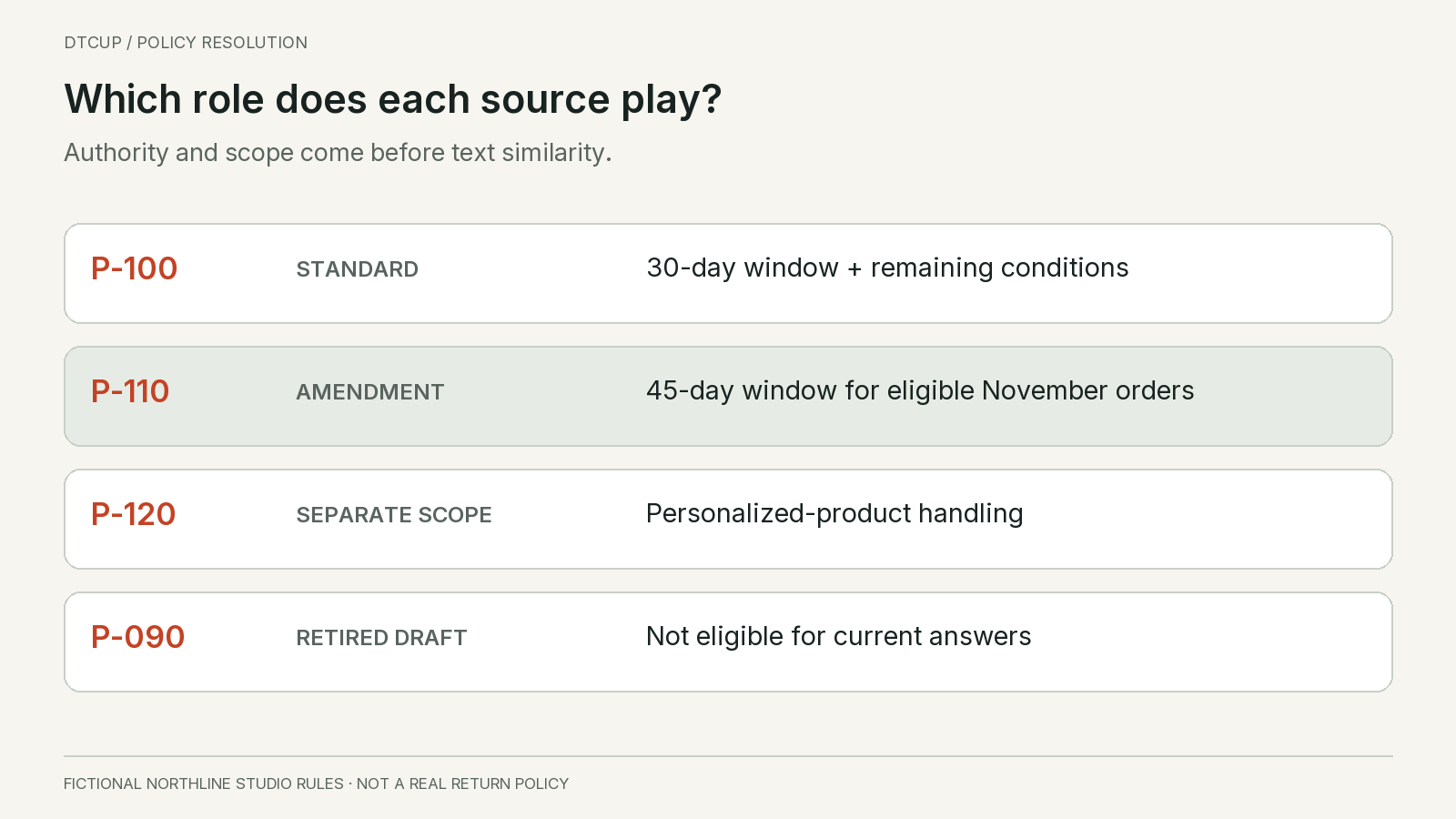
Northline begins with four records. P-100 is its standard commercial return rule for ordinary products bought through its own website. It allows a request within 30 calendar days after delivery, subject to stated condition requirements. P-110 is an approved campaign amendment for qualifying website orders placed from November 1 through November 30 in the fictional market Alpha. It extends that request window to 45 calendar days after delivery. The campaign amendment explicitly leaves the other P-100 conditions unchanged.
P-120 covers personalized products and is excluded from P-110’s campaign scope. It has its own approved handling instructions. P-090 is an obsolete draft of a previous campaign, never approved for the current offer. Its presence in a shared folder does not make it eligible evidence. These are teaching rules, not DTCUP policies or a recommendation that a real business use these exact windows.
Each record needs a stable identity. A file named “returns-final-v3-revised” is a weak identifier because people can copy or rename it. Assign a policy ID, a revision, an approval state, an owner and a source location. Record what decision it controls, who may use it, and which product, channel, market and transaction conditions make it applicable. The source text remains important, but the selection facts should be explicit enough to test.
Dates need names that describe their role. The approval date says when the owner authorized the record. The publication date says when it became visible. The effective condition says which transactions or events it governs. The review date says when someone must reassess it. These are not interchangeable. Publishing a correction today does not automatically make every previous purchase subject to a new commercial rule.
For P-110, the qualifying interval is based on order placement, while the request deadline is measured from delivery. That difference should be represented directly. A record that contains only “valid until November 30” leaves the assistant to guess whether a November purchase loses the extension on December 1. It also confuses campaign enrollment with the later period during which a customer can exercise the stated option.
The register should identify relationships between records. P-110 amends the request-window field of P-100 for its qualifying scope. It does not replace the whole standard policy. P-120 is outside P-110’s scope. P-090 is retired and ineligible for current answers. These relationships are business decisions. An embedding score, document recency or a model’s preference for a more specific sentence cannot create them.
A useful conceptual reference is the W3C PROV overview, which describes provenance through the things, activities and people involved in producing information. For a policy register, the practical implication is to retain who approved a revision, what it replaced or derived from, and the steps that made it usable. Provenance helps investigation; it does not itself prove that a policy is correct.
3. Walk one order through the rules
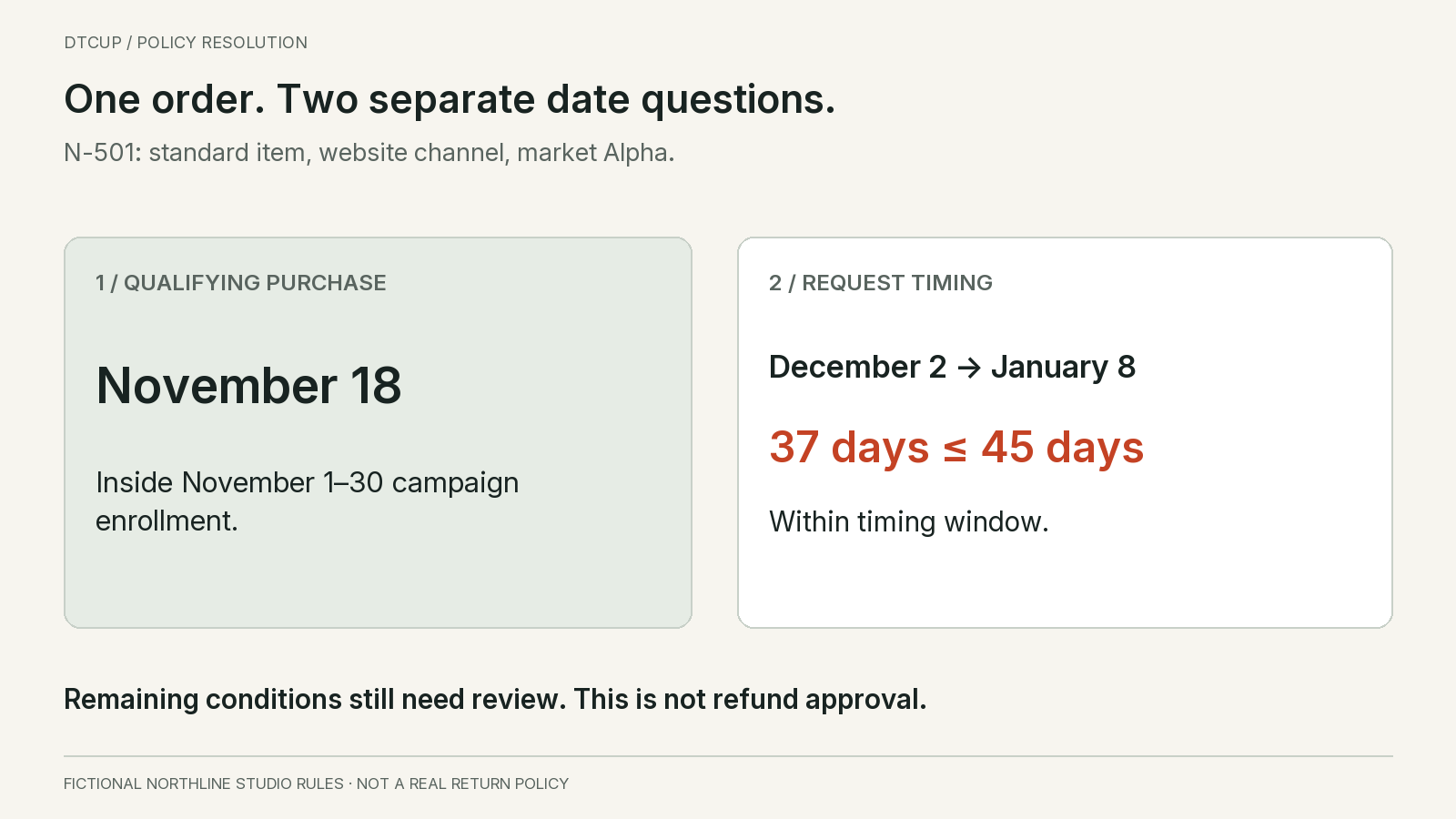
Consider order N-501. The verified record shows a standard, non-personalized desk organizer bought on November 18 through Northline’s website in market Alpha. Delivery occurred on December 2. The customer asks about a change-of-mind return on January 8. Assume the business’s approved date convention measures the request interval by elapsed local calendar days from the delivery date. Under that convention, January 8 is 37 days after December 2.
The assistant first establishes the task: explain whether the request is within the applicable time window. It does not yet approve a return, issue a label or promise a refund. Those actions can have additional conditions and permissions. Next, it checks that the order context is verified and sufficient for the rule. If it only has a customer’s free-text claim about the order, the system should distinguish that from authenticated transaction evidence.
P-100 is eligible because the purchase is an ordinary website product. P-110 is also eligible because the order date falls inside the November campaign interval, the market is Alpha and the product is not excluded. The relationship says P-110 changes the request window to 45 days while retaining other P-100 conditions. P-120 is ineligible because the item is not personalized. P-090 is ineligible because it is an obsolete draft.
The resulting answer is narrow: the request is within the fictional campaign’s 45-day timing window, with the remaining conditions still requiring the applicable review. A helpful customer-facing reply would explain that the November campaign applies to the order and identify the next step. It should not say “all returns are 45 days” or “your refund is approved.” The first overgeneralizes the rule; the second invents an action outcome.
Now change only the order date to December 3. P-110 no longer matches its purchase interval. The same delivery date and request date do not restore eligibility. The standard 30-day timing rule would be the relevant commercial rule in this simplified example, so a request at day 37 is outside that window. The assistant can explain the applicable process or route a requested exception, but it should not borrow the campaign benefit merely because the campaign page remains searchable.
Change only the product to a personalized organizer. P-110 explicitly excludes that class, so the assistant must select the corresponding approved handling rule rather than applying the extension. Change only the market to Beta, and the campaign also falls out of scope. These counterfactuals are valuable because they demonstrate that the selection depends on verified attributes, not on a general preference for the most generous answer.
Finally, remove the delivery date. The campaign may be applicable, but the system cannot calculate whether the request is timely. It should obtain that date from an authorized source or ask for the missing information through the proper process. Eligibility for a policy and satisfaction of a condition inside that policy are separate checks. Combining them into one yes-or-no score makes failures harder to diagnose.
4. Make precedence a business rule, not a ranking score
A common implementation instruction is “prefer the latest and most specific source.” It sounds sensible, but it bundles several assumptions. The latest source may be a draft. A highly specific note may describe one employee’s exception. A local FAQ may be detailed yet copied incorrectly from a broader policy. Specificity helps identify scope; it does not confer authority.
I would separate eligibility from precedence. Eligibility asks whether the record is approved for this audience, task and context. Precedence asks how multiple eligible records interact. First remove records that should not participate. Then use documented relationships between those that remain. This avoids a retired draft winning simply because its text contains more of the customer’s exact words.
There is no universal ordering that every business should copy. A signed customer agreement may control some commitments, while a campaign amendment changes a narrow field and an operational guide explains execution without changing terms. The responsible policy owner must define those relationships, including any constraints imposed by applicable obligations. The AI implementation should encode approved decisions rather than independently deciding which source has greater legal or commercial force.
Represent narrow amendments as narrow amendments. P-110 changes request_window_days from 30 to 45 within its scope. It leaves product-condition requirements unchanged. If the assistant instead replaces P-100 with the short campaign page, it may lose conditions simply because they were not repeated. If it combines both windows without precedence, it may invent a 30-to-45-day range. Both errors arise from an undefined merge.
Distinguish absence from an explicit override. A campaign page that does not mention shipping charges has not necessarily waived them. A field marked “inherit from P-100” is different from a blank field whose meaning is unknown. A field explicitly set to a new approved value is different again. These distinctions are particularly important when a language model turns sparse source text into a complete-sounding answer.
Do not use customer satisfaction as an implicit tie-breaker. A business may choose to honor a more favorable promise, but that choice needs an authorized process and recorded scope. The assistant should not quietly adopt “whichever rule benefits the customer” as a universal policy. Nor should it choose the strictest rule as a precaution. Either approach can create commitments the business never approved or deny an option that genuinely applies.
A resolution should therefore be reproducible. Given the same verified context, policy revisions and approved precedence relationships, the system should select the same governing fields. The language used to explain them can vary within reasonable limits. The substantive rule should not change because one model generation favored the campaign wording and another favored the help-center wording.
5. Treat overlapping amendments as an explicit exception case
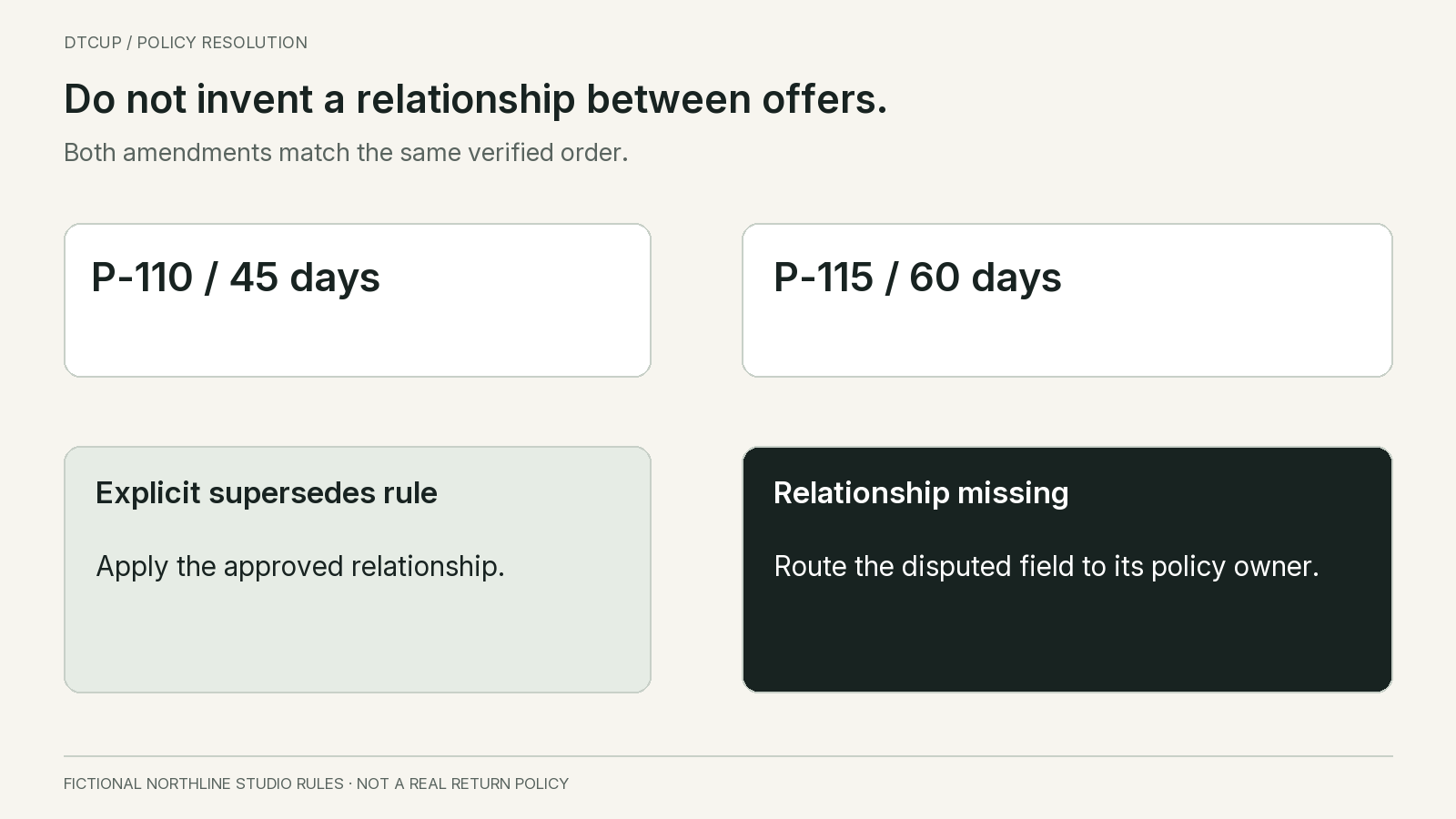
Suppose Northline adds P-115, an approved loyalty offer providing a 60-day request window for a defined member group during part of November. Order N-501 might now match both P-110 and P-115. If the records explicitly say the loyalty offer supersedes the campaign window for eligible members, the outcome is straightforward. If they say the offers cannot be combined and identify the governing choice, implement that choice.
If neither record describes the interaction, do not add 45 and 60, average them, choose the maximum, or trust a search ranking. The system has discovered a missing business rule. Mark the request-window field unresolved and send the relevant context and competing policy references to the designated owner. Other uncontested facts, such as the order’s delivery date, can remain available without pretending the disputed deadline has been settled.
A useful escalation packet is compact. It states the decision requested, verified qualifying attributes, candidate policy IDs and revisions, the exact competing field, and the missing relationship. It should avoid dumping an entire conversation or unrelated customer details into a general policy channel. The goal is to let the owner answer a precise question: which window governs this overlap, and for what set of orders?
The owner’s decision should become a reviewed rule, not remain buried in the ticket. If it applies to every member purchase in the overlap, add that relationship to the policy register and test it. If it is a one-time accommodation, record it as an order-specific exception without turning it into general knowledge. A one-off action and a reusable policy are different products of the review.
Set a safe interim response for unresolved cases. The assistant can acknowledge that the eligibility needs review and explain the next step without exposing internal document names or speculating about the outcome. If a deadline could matter, the business should define how the request is recorded and handled while review is pending. The AI should not invent a suspension of a deadline or a guaranteed exception.
Conflicts also provide useful management information. Repeated ambiguity between loyalty and campaign terms suggests the launch approval process is incomplete. A steady stream of market-scope conflicts suggests source metadata is weak. Track the type and cause of conflicts rather than merely the number escalated. The long-term fix may belong in how offers are designed, not in a more forceful assistant instruction.
6. Keep effective time separate from discovery time
Northline discovers on December 10 that a copied help-center paragraph still says the campaign window is 40 days. The approved campaign record has always said 45. Correcting the paragraph is a publication correction, not necessarily a new policy. The team should preserve the fact that the public copy was wrong, identify when it was visible, and decide how affected customer interactions will be handled. Silently overwriting the text loses evidence needed to understand earlier answers.
Now imagine a different event: the business formally changes its standard terms for orders placed on or after January 1. The new rule’s publication date may be December 15, but that does not make it applicable to an order placed on December 14. The governing transaction condition matters. The assistant should be able to explain the rule applicable to an older purchase even after the new public page becomes the default view.
These situations require two questions. What policy was intended to govern the transaction? What information was actually available to the support system when it answered? The first supports today’s eligibility decision. The second supports investigation of an earlier answer. A single updated_at field cannot answer both. At minimum, retain effective-scope information and the revision history of what the system used.
A policy can also expire for new purchases while remaining relevant to existing ones. P-110 stops enrolling new orders after November 30, but an eligible November order delivered in December can still have a later request deadline. Archiving the campaign from navigation may be sensible; removing every retrievable record before existing obligations end is not. The knowledge system needs a state that distinguishes “not available for new orders” from “no longer relevant to any supported transaction.”
The reverse is equally important. A draft future policy may be published internally for training before it applies. If the assistant searches the whole internal folder without eligibility filtering, it may prematurely promise the new rule. An effective date in the prose is useful, but relying on the model to notice it every time is weaker than excluding or clearly selecting records according to verified context.
Boundary conventions should be specified in ordinary language and tested. Does a qualifying period include both start and end dates? Which business timezone applies to an order near midnight? Is the request window based on calendar days or business days? What event starts the clock? The policy owner should settle these questions. The implementation should use a defined calculation rather than asking the language model to count days in free text.
For the Northline example, the November order interval includes local dates November 1 through November 30. The 45-day window is measured from the recorded delivery date under the stated elapsed-calendar-day convention. Those details are deliberately explicit so the test cases can produce an expected result. A real business may use another approved convention; the architecture should support its actual rule rather than assume the example’s convention is universal.
7. A translation or copied FAQ is a dependent source
Policy conflicts often arrive through distribution rather than deliberate policy changes. The central record is corrected, but a translated FAQ, chatbot snippet, PDF or campaign landing page still carries an older number. Each copy looks official to a customer. Treating all copies as independent authorities makes the retrieval system amplify the inconsistency instead of helping the team find it.
Record derivation where it matters. A translated paragraph should identify the governing policy ID and revision it represents. A short FAQ should identify the fields it summarizes. When the source changes, the system can then mark dependent material for review. This is more useful than hoping a global text search finds every version of “30 days,” because the same phrase may occur in unrelated policies and a translation may use different wording entirely.
Language must not silently choose market. An English-speaking customer can have a purchase governed by market Alpha or Beta. A French-language browser does not establish the applicable sales channel. Select the governing rule from verified transaction context, then communicate it in the customer’s language where supported. A translated answer should preserve the selected scope, dates, units and exceptions.
If a translation conflicts with its governing approved source, the business needs a defined handling path. It may be inappropriate to keep serving the incorrect localized copy, but it may also be inappropriate to dismiss a promise a customer actually saw. The assistant can identify the discrepancy and route the case; the policy owner must determine the response and remediation. “The English page wins” is not a universal rule that an AI engineer should invent.
Keep internal execution notes separate from customer-facing commitments. A warehouse guide may say “hold returns for inspection every Friday.” That describes an operational schedule, not a change to the customer’s request window. A support note may explain how to make an exception after approval. It should not become a public promise that every customer qualifies for that exception.
When reviewing distributed content, compare the decision-bearing fields first. A change in sentence style may be harmless. A changed number, missing exclusion, different clock or omitted approval condition can alter the outcome. This lets the team prioritize semantic differences instead of treating every text mismatch as equally important. It also creates a more useful review task than asking someone to read several long pages and report whether they seem consistent.
8. A policy correction must reach the answer path
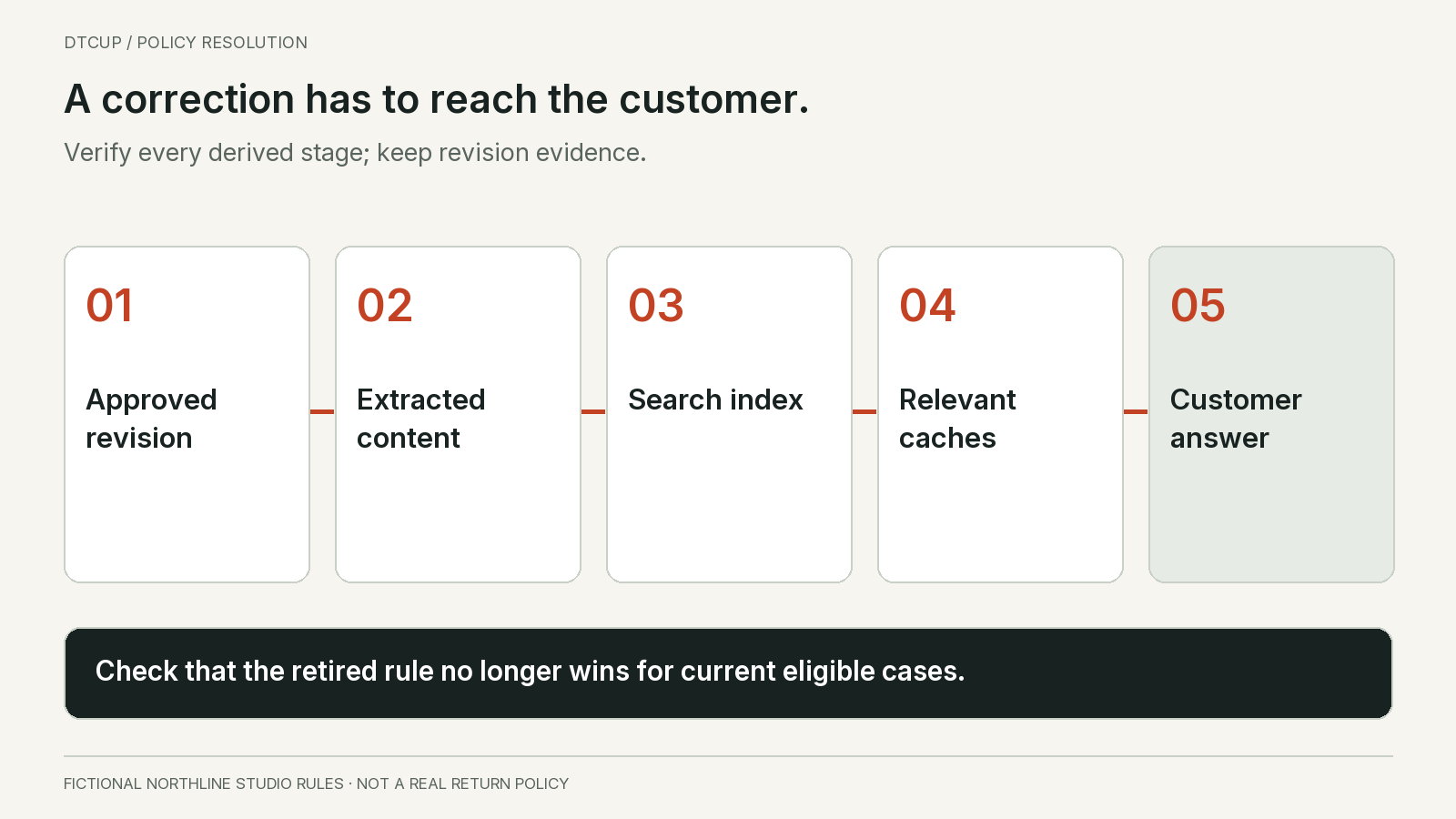
Editing the source is only the beginning of a correction. The assistant may use extracted text, search chunks, cached retrieval results, cached final answers and conversation memory. A corrected page can coexist with old downstream representations. If the team verifies only the editor screen, it may declare success while customers continue receiving the previous answer.
Map the path from approved record to final reply. Identify where the source is transformed, indexed, summarized or cached, and what version information survives each step. A compact revision identifier attached to derived material helps the team determine whether the answer used the new rule. Without that, a correct-looking reply can hide a stale path that will fail on a slightly different question.
For a material correction, I would first prevent the disputed field from being answered automatically if the system cannot guarantee the approved version is in use. Then publish the corrected source, rebuild or update the affected derived material, invalidate relevant caches, and run known cases through the actual customer path. Restore automatic handling when the evidence confirms the corrected route. The exact deployment mechanism depends on the system; the ordering should protect customers during the transition.
Cache keys need the context that changes the answer. A cached general response to “can I return this?” should not be reused across markets, product classes or transaction dates when those attributes govern eligibility. Adding a policy revision to a cache key helps with source changes, but it does not solve missing customer context. Sometimes the appropriate choice is not to cache a personalized eligibility decision at all.
Conversation memory creates another challenge. If an assistant already told a customer the wrong window, a later source correction may not erase that statement from the conversation. The system should be able to correct itself plainly and explain the next step without pretending the earlier answer never happened. The business should define which material errors require proactive review by its support team; the AI should not independently send unapproved messages or make compensating promises.
Do not confuse invalidation with deletion of history. Retiring a rule from current automatic selection is different from destroying the evidence of past versions. An investigation may need to know which revision supported a prior answer. Retain only the history needed under the business’s data practices and access controls, but preserve enough lineage to explain changes. An immutable public archive is not required for every record; an accountable internal revision history is often the practical starting point.
Verification should include a negative check. Confirm that the retired revision cannot still win for a current eligible query. Test a query using old phrasing and another quoting the outdated number. A system that answers correctly only when the user repeats the new wording may still be vulnerable to the stale content. The correction is complete when the actual selection behavior changes, not merely when a new document exists.
9. Give the system a resolution table and a clear output contract
A resolution table is a reviewable set of examples connecting context to governing rules and permitted outcomes. It does not need to begin as a complex rules engine. A spreadsheet with explicit columns can expose ambiguity before implementation. The columns should describe the decision, required context, eligible records, applied relationships, resulting fields and unresolved questions.
For Northline, one row represents N-501: standard product, website channel, market Alpha, November order, known delivery date, no additional member amendment. The expected governing set is P-100 plus P-110. The expected timing window is 45 days. Another row changes the order to December and expects P-100 alone. Another changes the product to personalized and expects P-120’s handling path. Each row changes a meaningful condition rather than merely paraphrasing the same question.
Add rows where no complete answer is possible. Missing delivery date should produce a request for verified context, not a fabricated deadline. Two applicable amendments with no defined relationship should produce policy review, not a chosen number. A source marked retired should not participate in a current selection unless the transaction context explicitly requires an archived governing revision. Unknown market should remain unknown until resolved.
The selection component can return a structured result to the language model. Useful fields include decision_type, governing_policy_ids, governing_revisions, applicable_window, calculation_basis, remaining_conditions and resolution_status. The exact names are implementation choices. The substantive requirement is that the model receives the selected rule and its limits, not an undifferentiated pile of competing documents and an invitation to improvise.
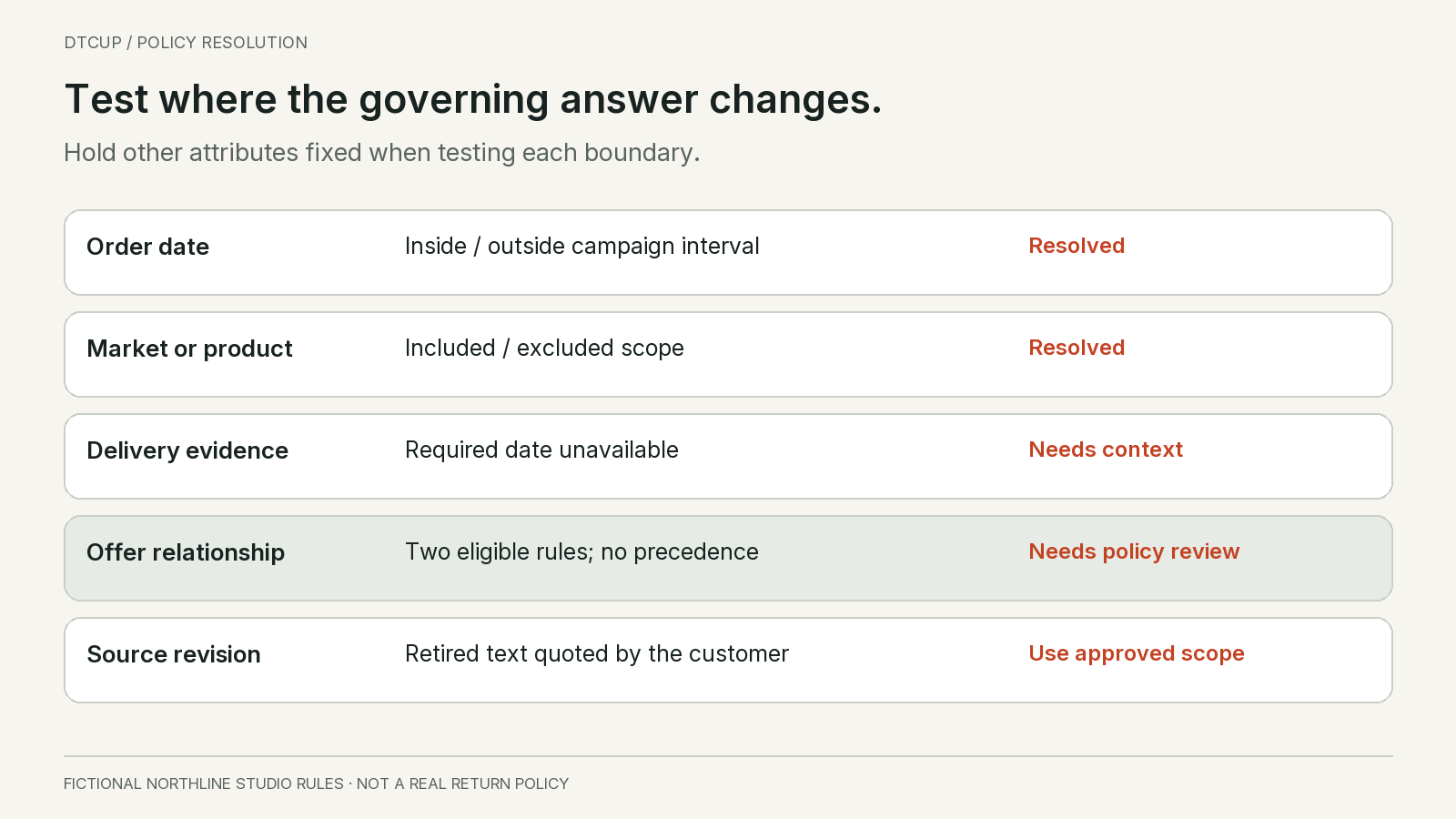
Use a small set of meaningful statuses. Resolved means the relevant policy field is determined for the available context. Needs context means a required transaction fact is missing. Needs policy review means authoritative eligible records remain inconsistent or their relationship is undefined. Outside supported scope means the task requires a process the assistant is not authorized to handle. These statuses should lead to different customer experiences and different internal queues.
Keep explanation and execution separate. A resolved timing window can support an answer, but issuing a return label or approving a refund may require further checks, authenticated access and a permitted action. Passing a policy selection test is not permission to mutate an order. The answer contract should state what has been established and what remains pending so a polished response cannot turn a partial decision into a completed transaction.
Customer wording can stay simple. For the qualifying example: “Your order falls within the November campaign’s 45-day request window. The item conditions still need to be checked; here is the return-request step.” For a missing date: “I need the delivery date to check the request window.” For a genuine conflict: “This order needs a policy review before I can confirm the window.” These are illustrative responses, and the actual process and promises must match the business’s approved service.
Internally, preserve the reasoning inputs rather than relying on a generated narrative of why the model decided something. Record the verified context used, the candidate and selected record IDs, revision identifiers, rule relationship and resulting status. A model-written explanation can be helpful to read, but it should not be the only evidence of what the system actually evaluated.
10. Test the boundaries where the answer should change
A dozen paraphrases of “what is your return policy?” will not adequately test this design. The dangerous failures occur where eligibility changes. Test the first and last qualifying dates, immediately outside those dates, the included and excluded product classes, the relevant markets, and the difference between a known and missing delivery date. Expected results should be approved before the assistant’s outputs are reviewed.
Use paired cases. Keep every attribute fixed except order date, and confirm the campaign enters or leaves the governing set as intended. Keep the order date fixed and change the product class. Add an applicable loyalty amendment first with an explicit precedence relationship and then without one. This method shows whether the implementation responds to the right condition instead of merely producing a plausible answer by chance.
Test the clock separately from the language. The date calculation should be deterministic under the approved convention. The model can explain “within the window,” but a reliable calculation should establish that result. Include delivery near month boundaries and a qualifying order near midnight in the business timezone. If business-day rules apply, the relevant calendar and holiday handling need their own verified specification rather than a free-text guess.
Also test hostile or misleading evidence. A user may paste an old campaign paragraph, claim a staff member promised an exception, or ask the assistant to ignore the current terms. Those inputs can be valuable context for human review, but they do not automatically become approved policy. The system should distinguish a customer’s claim from a verified governing record while remaining respectful and offering the appropriate next step.
Review failures by consequence. Quoting a slightly awkward sentence is different from selecting the wrong deadline, exposing an internal exception note, or issuing an unauthorized refund. The release decision should not hide a severe policy-selection error inside a high average answer score. A small test set cannot prove universal correctness, but it can establish whether known critical boundaries are handled consistently before wider use.
After a rule change, rerun both the newly affected cases and the older cases that should remain unchanged. If a November amendment correction accidentally changes ordinary December purchases, the update has escaped its intended scope. This regression check is especially important when derived summaries or shared prompts contain policy numbers that were assumed to be universal.
11. Assign ownership to the disagreement, not just the chatbot
Support, marketing, operations and engineering often each own a piece of the policy path. Marketing publishes the campaign. Operations implements the return workflow. Support explains it. Engineering builds the assistant. If nobody owns the relationship between those pieces, the chatbot becomes the place where the disagreement is first visible to customers.
Choose an accountable owner for each decision family. That person or team approves the governing fields and resolves scope conflicts. Engineering owns faithful implementation and evidence of behavior. Content owners maintain the public explanation and dependent copies. Support supplies examples of ambiguity and customer impact. These roles can be held by a small number of people, but the responsibilities should remain distinguishable.
Before a new offer launches, review its interaction with existing rules. Ask which fields change, which purchases qualify, which exclusions remain, how overlapping offers interact, and what happens after enrollment closes. Then produce the relevant resolution-table rows and source relationships. This is a more durable investment than waiting for the assistant to make a mistake and adding another warning to its prompt.
When a conflict occurs, record its cause and resolution. Was the governing rule missing, was a copy stale, was context unavailable, or did the selector ignore an explicit relationship? Those categories point to different fixes. A prompt edit is appropriate only if the failure actually belongs to response behavior; it cannot substitute for an owner deciding which commercial commitment applies.
For the broader knowledge structure, use the companion guide to building a maintainable AI support knowledge base. For a system that selects the wrong passage despite having clear approved rules, use the retrieval evidence diagnostic. These are adjacent problems, but they should not be collapsed into one generic “AI accuracy” project.
The central operating principle is simple: the business decides authority, scope and exceptions; the system applies those decisions to verified context; the model explains the result within its actual limits. When a policy relationship is missing, a visible unresolved state is more useful than an elegant invented answer. It tells the team exactly what must be decided before the next customer receives a promise.
Sources
Still have a question?Ask the DTCUP Community ↗