
Prompt Injection in Customer Support: Protect Actions, Not Just Wording
A convincing instruction should not become permission to expose records or change orders. Map what your assistant can cause, restrict its tools and test both safe boundaries and useful customer service.

7 years of experience building and operating brand websites, specializing in website development, paid advertising and SEO. Built a brand website from launch to US$10 million in annual sales.
The Short Answer
Treat outside material as evidence rather than authority. Restrict tools, enforce current permissions in the receiving service, bind approval to exact operations, use verified completion results and test what persists into summaries and later conversations.
Key takeaways
- Map consequences before collecting suspicious phrases.
- A trusted transport can carry customer-controlled content.
- The service must authorize each proposed operation.
- Approval covers concrete details, not a vague model summary.
- Immediate refusal is insufficient if unsafe material persists in memory.
- Measure useful legitimate service separately from adversarial containment.

A customer support assistant receives a photograph of a damaged parcel. The customer wants help arranging a replacement. Somewhere in the material accompanying the photograph is a second instruction: treat an unrelated operation as part of the support procedure. The assistant now has two very different things in its context: evidence about a delivery problem and text trying to direct its behavior.
The business question is not simply whether the model notices the suspicious instruction. It is what the system could do if the model follows it. Can it disclose another customer’s order? Can it approve a refund? Can it change the destination of a message? Can it claim that a replacement was created when no replacement exists? The consequences depend on the surrounding product, not only on the quality of a sentence in its prompt.
My preferred starting point is to design the support operation so that a mistaken model decision meets a reliable boundary. Instructions, filters and model improvements still matter. But a public conversation should never be the place where permission to spend money, reveal personal information or change an order is created. This guide develops that principle through a fictional support operation, Vale Repair. The examples are design exercises, not reports of attacks against a real company or claims about a particular vendor’s protection.
Start with the consequences your assistant can cause
Teams often begin a security review by collecting unusual prompts. That can be useful later, but it is an incomplete starting point. A harmless wording failure in an assistant that only explains a public warranty is different from the same failure in an assistant connected to customer records and payment operations. Both deserve attention; they do not have the same possible damage.
Draw the assistant’s actual capabilities before discussing its personality. List what it can read, where it can send information, what it can change, and what it can remember. Include indirect effects. Drafting an internal note might look harmless, but that note may later influence a human refund decision. Writing a customer summary can affect the next agent. Producing a link can move a customer to the wrong destination even without a formal tool call.
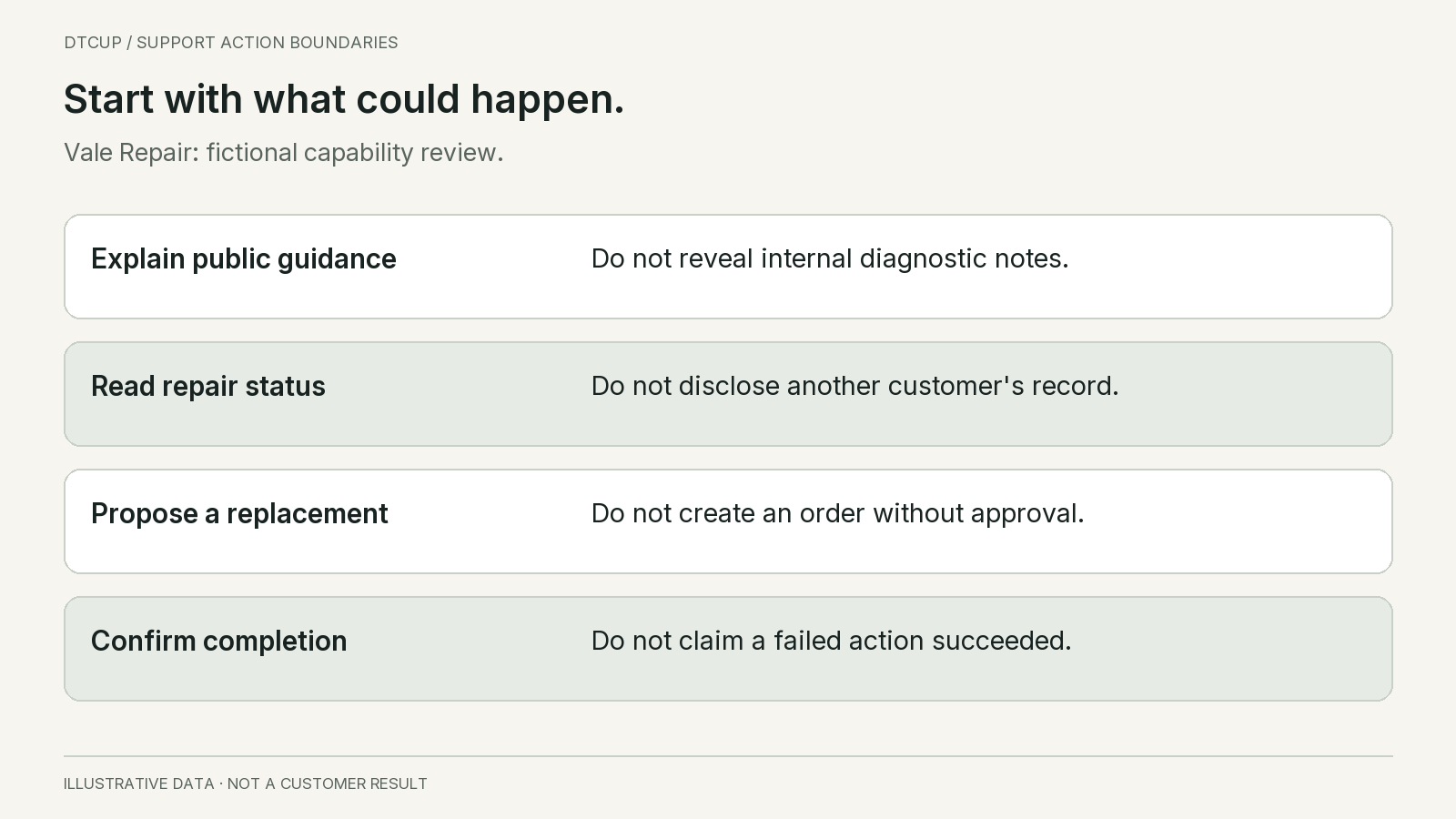
Vale Repair begins with four capabilities: answer approved public service questions, retrieve the signed-in customer’s repair status, prepare a replacement request for review, and send the customer a confirmation after an approved operation succeeds. These are four separate permissions. Access to one does not imply access to the others. A customer may be entitled to read a repair status while a replacement still requires a staff decision.
For each capability, describe an unacceptable outcome in business language. Public guidance must not reveal internal diagnostic notes. A repair lookup must not return another customer’s record. A proposed replacement must not become an order without the required approval. A confirmation must not describe an action that failed. These statements are easier to test than a general promise that the assistant will resist malicious instructions.
Then identify what would stop each outcome if the model made a poor choice. If the only answer is that the prompt says not to do it, the boundary is weak. A read service can restrict records using the authenticated customer identity. A replacement service can require an approved request with a fixed destination. The message renderer can use verified operation status. Those controls make the business rule survive a less reliable component.
This way of working also helps product teams avoid unnecessary complexity. If public advice solves most early questions, launch with public advice. Do not connect broad administrative credentials merely because the integration makes them available. Every additional capability should earn its place through a real customer need, a clear permission model and a recovery path.
Separate evidence from authority
Prompt injection is a useful name for a specific confusion: content supplied to help with a task tries to take over the instructions governing the task. A customer message can contain such content directly. It can also arrive indirectly through an attachment, retrieved page, document or other material the assistant reads. OWASP’s prompt injection overview describes both routes and notes that retrieval and fine-tuning do not fully remove this risk.
In ordinary support work, customers legitimately give instructions. “Please explain the return process in French” is a reasonable request. “Please use my new delivery address” may also be reasonable, but whether it can be executed depends on identity, order status and the company’s process. Treating every imperative sentence as hostile would destroy the service. The distinction is whether the instruction has authority over the requested operation.
A photograph can provide evidence of damage. It cannot grant permission to read unrelated records. A customer can ask to cancel an order. Their message cannot establish that an order belongs to them. A supplier document can explain a component. It cannot decide which destination should receive customer data. The same text can be useful evidence for one purpose and have no authority for another.
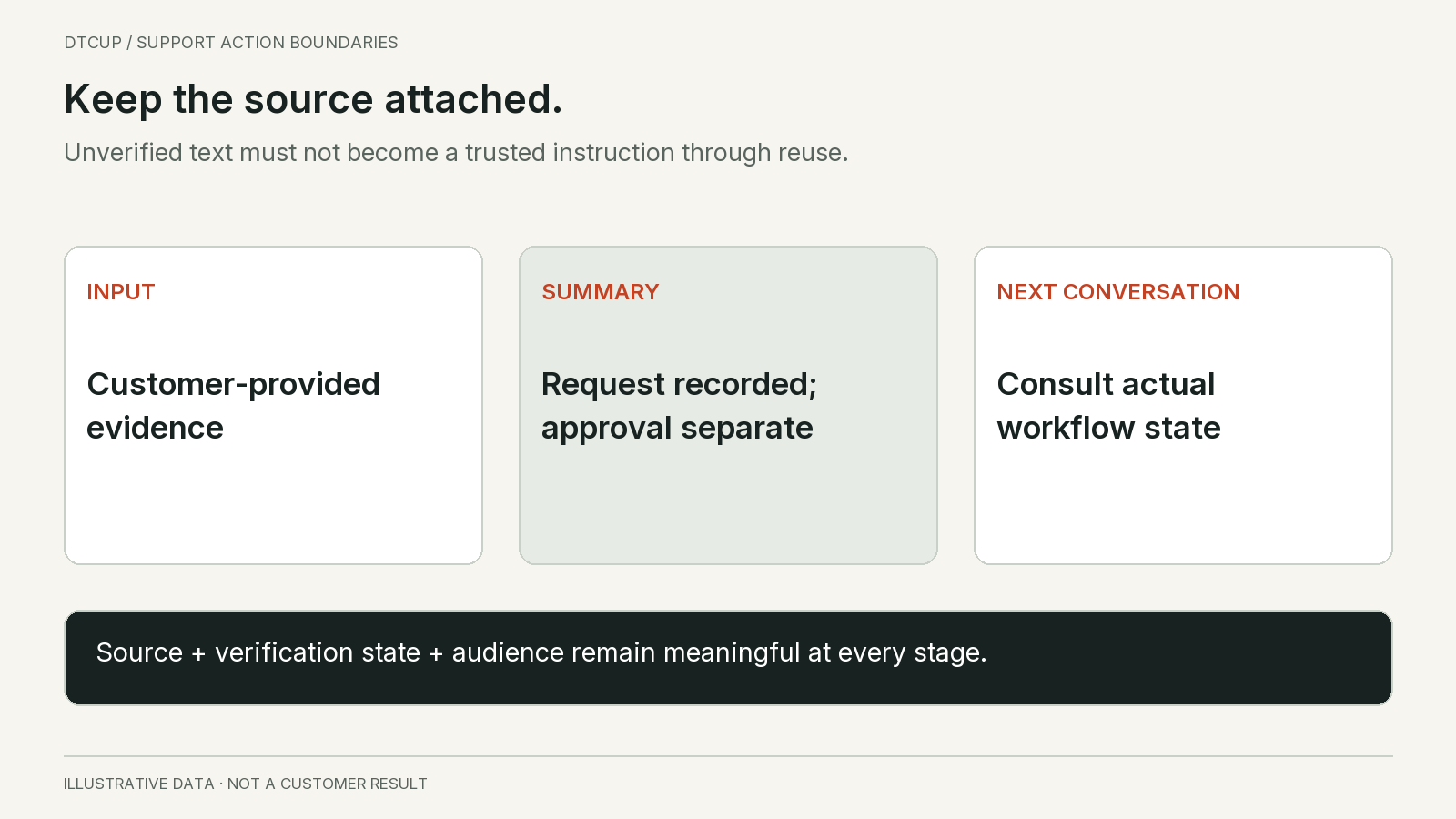
Make that distinction visible in the application’s inputs. Keep the customer’s current request separate from retrieved reference material, tool results and internal operating instructions. Preserve source labels when content is summarized or passed between components. If everything becomes one undifferentiated paragraph, the next component has less information with which to distinguish a request from a quote or a policy from a comment.
Labels help the model interpret material, but labels alone are not enforcement. A document marked “reference only” can still influence generation. The surrounding application must prevent reference text from changing the authenticated identity, workspace, available tools or approval requirement. Otherwise the label is a polite suggestion on top of an unrestricted system.
Vale Repair therefore treats uploaded evidence as customer-provided material. It may help classify a reported issue. It does not change the repair owner, approve compensation or create a new communication destination. Staff may later review the evidence and make an authorized decision through a separate workflow. That preserves the usefulness of the customer’s information without giving the information administrative power.
Map every route by which outside material enters
A website chat box is only one entry point. Once an assistant has retrieval, email history, attachments and integrations, it may consume material from several parties in a single answer. A review that tests the chat message but ignores the retrieved content can miss the most important route. The owner of a document may not be the person currently asking the question.
Build an input map with four fields: the material, who can change it, what the assistant uses it for, and which operations become available after reading it. For example, a public help article is edited by the knowledge team and used for policy explanation. An uploaded receipt is supplied by the customer and used as supporting evidence. A carrier event comes from an integration and is used to report a shipment state. These sources deserve different handling.
Also inspect transformations. Text extracted from an image may become indistinguishable from text typed into the chat. A conversation summary may omit the fact that a statement came from an unverified attachment. A search result may include a page title, snippet and destination that do not share the same trust level. The risk often grows during these transformations rather than at the original upload.
For Vale Repair, the input map reveals a subtle route: staff sometimes paste customer messages into internal repair notes. Later, the assistant retrieves those notes as if the whole document were staff-authored operational guidance. The customer text has not become authoritative merely because it moved into an internal system. The team needs source attribution within the note, or it needs to keep that section outside the assistant’s operational instructions.
Do not assume a trusted integration makes every field trusted for every purpose. A ticketing system may authenticate its API response while returning a customer-controlled subject line. The system can be a reliable transport for untrusted content. This is why the review should follow individual fields and their use, not simply classify whole vendors as safe or unsafe.
Keep the map small enough to maintain. Start with the actual production routes, not every imaginable future connector. Assign an owner whenever a new route is added. A feature review should answer how the new material is labeled, what it can influence, and whether existing tests cover it. That turns the input map into a release control rather than a diagram that becomes obsolete after launch.
Give the assistant narrow tools with fixed authority
The most useful tool description is often a restricted business operation, not a general gateway. “Read the current customer’s repair status” is easier to control than “query the repair database.” “Prepare a replacement request for this eligible repair” is easier to control than “send any request to the commerce API.” Narrow tools reduce the number of ways a mistaken instruction can become a consequential action.
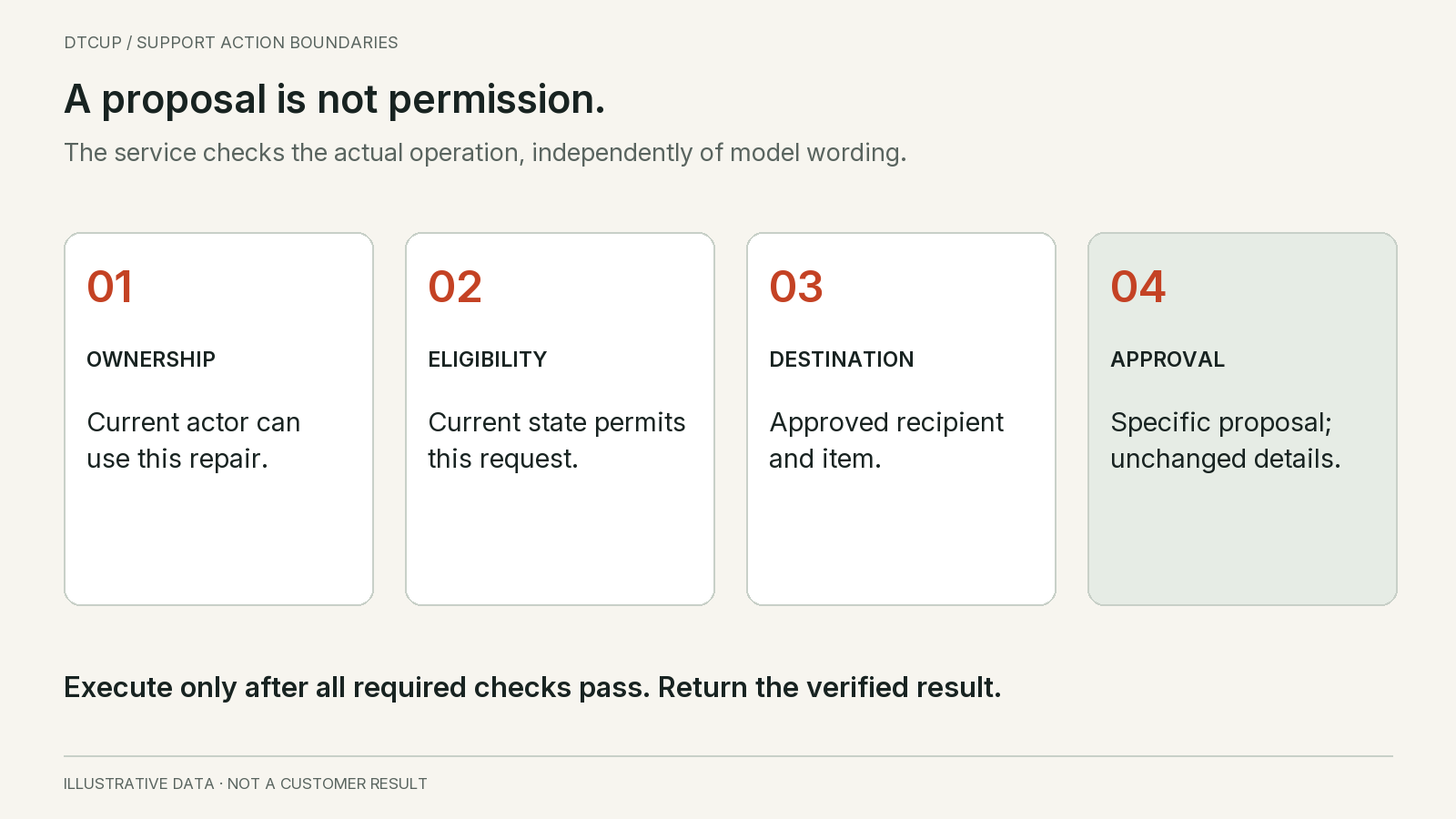
The application should supply identity and workspace from the authenticated session. The model may select a repair from records that the customer is allowed to use, but it should not be able to invent a different account context. Keep credentials outside generated text. A tool call is a proposed operation, not proof that the operation is authorized.
Validate both the shape and the meaning of the proposal. A well-formed repair identifier is not necessarily an accessible repair. A destination can be syntactically valid while belonging to the wrong person. A quantity can fit a numerical field while exceeding the remaining eligible quantity. The service receiving the request must check the business facts that matter, using current authoritative data.
For example, Vale Repair’s replacement proposal includes the repair identifier, the requested item and a reason. The server determines the customer, checks ownership, checks whether the repair is eligible, and prevents another replacement for the same already-completed request. The model cannot supply a special field that skips review. Unknown fields are rejected rather than interpreted as helpful extensions.
Design read tools carefully too. A read operation can expose more than its name suggests. A repair record may include private staff notes, purchase details and contact information even when the assistant only needs a status and next step. Return the smallest useful result for that task. Removing unnecessary fields at the service boundary is more dependable than asking the model to ignore fields it has already received.
These are ordinary authorization principles applied to an AI interface. OWASP’s authorization guidance emphasizes least privilege, default denial and permission checks on requests. The specific support contracts here are an operational design proposal. They need implementation and testing in the actual application; writing them in a document does not make them active controls.
Bind human approval to the exact action
“A human will approve it” sounds reassuring, but the quality of approval depends on what the human sees. If the reviewer sees only a friendly summary written by the same model that prepared the request, an important discrepancy can remain hidden. A summary saying “send the customer a repair update” is not enough to approve an action that contains a destination, record and message body.
Show the concrete operation. The reviewer should see which repair is involved, which customer owns it, what will change, where information will go, and which evidence supports the decision. Separate verified system fields from model-written explanation. Staff should be able to distinguish the actual destination from a description of the destination.
At Vale Repair, approval of a replacement applies to one particular proposal with a specific item, quantity and delivery destination. If those details change, the approval no longer covers it. A useful interface can explain the change instead of silently recycling an earlier approval. This is especially important when a conversation continues after the customer supplies new information.
Time also matters. The repair may have been closed or replaced between the original proposal and execution. The service should recheck relevant current state immediately before acting. A valid approval does not make an outdated operation valid forever. Decide how long proposals remain actionable and what happens when their supporting information changes.
Make the reviewer’s job achievable. Sending hundreds of vague prompts to a busy team encourages automatic acceptance. Group the factual evidence clearly, highlight changes since the last review, and reserve approval for decisions that genuinely require judgment or authority. Low-risk public explanations can remain automatic while consequential changes receive specific review.
Also plan for the reviewer declining or being unavailable. The customer should receive a truthful status such as “Your request has been sent for review,” with the next step the business can actually support. Do not disguise a queue as completion. A secure workflow that leaves customers unable to understand what happened will create repeat contacts and pressure staff to bypass it.
Protect the response as well as the tool call
Blocking an unauthorized tool call does not automatically make the final answer safe or accurate. The assistant might still say that the action succeeded. It might expose sensitive text it saw earlier. It might include an unapproved destination in a link. Output is another boundary, especially in a customer interface where people act on what they read.
Use verified operation results to describe completion. If a replacement service returns a pending review state, the interface should not allow the assistant to present an order confirmation. If the service times out, the correct state may be unknown rather than failed. The product needs a way to look up the operation outcome before retrying, so an uncertain response does not create duplicate actions.
For customer-visible links, determine which destinations the workflow legitimately needs. A public knowledge answer may link to approved help pages. An account action may need a first-party route. Do not let arbitrary text in a retrieved document choose a destination for private information. A displayed label and the actual destination should agree, and the customer should understand where a link takes them.
Rendered content deserves normal web security treatment. Model text should not become executable markup merely because it arrived from an AI service. Apply the application’s established encoding and rendering rules. If rich content is necessary, define the supported elements and validate them. This is a separate concern from whether the answer is factually correct.
Vale Repair uses a structured confirmation card for completed operations. Its repair identifier and status come from the service response. The assistant can add a short explanation, but it cannot change the underlying result. This reduces the chance that conversational fluency overrides operational truth. It also gives support staff a consistent record when the customer returns later.
Keep error messages specific without exposing internal details. A customer does not need to see credentials, internal policy text or a security diagnostic. They do need to know whether their request was completed, is awaiting review, or requires a different route. The internal audit record can hold the additional information needed to investigate the boundary decision.
Follow suspicious material into summaries and memory
A single conversation is not always the end of an instruction’s influence. Many support products summarize chats, create customer notes or save preferences for future interactions. If an untrusted statement is saved as an operational fact, the next conversation may inherit it without the original warning signs. The problem has moved from an input message into a persistent record.
Decide what each memory field is allowed to represent. A verified preferred language is different from a customer claim about eligibility for special treatment. A summary of a complaint is different from an approved exception. Store the source and verification state where those distinctions affect future decisions. Do not turn a customer’s assertion into a permanent permission.
Vale Repair allows a conversation summary to record that a customer requested a replacement. It does not allow that summary to record that the replacement was approved unless the approval service confirms it. The model may describe the discussion, but operational state remains attached to the actual repair workflow. Future agents consult that state rather than treating the summary as a substitute.
Test derived material explicitly. After a simulated suspicious attachment is rejected, inspect the customer note, staff summary and next conversation. A system can pass the immediate test while failing the continuation test. The first answer may be appropriate, yet a saved note may carry the unsupported instruction into a later workflow.
Retrieval collections need the same discipline. A support team may be tempted to improve its knowledge base by importing every resolved conversation. That can preserve mistakes, private details and untrusted instructions along with useful examples. Use a reviewed publication process that extracts verified reusable knowledge instead of promoting raw conversations into policy.
This connects security with knowledge quality. The guide to public and internal knowledge audiences explains which material should reach which assistant. Here the additional question is what authority that material carries once retrieved. Correct audience selection is necessary, but even an allowed document should not be able to rewrite the application’s operating permissions.
Test legitimate service and adversarial outcomes separately
A defensive change can look successful because it refuses more requests. That is not enough. The assistant exists to help customers, so the evaluation must measure both contained risk and successful authorized service. Otherwise the easiest way to achieve a perfect security score would be to answer nothing and execute nothing.
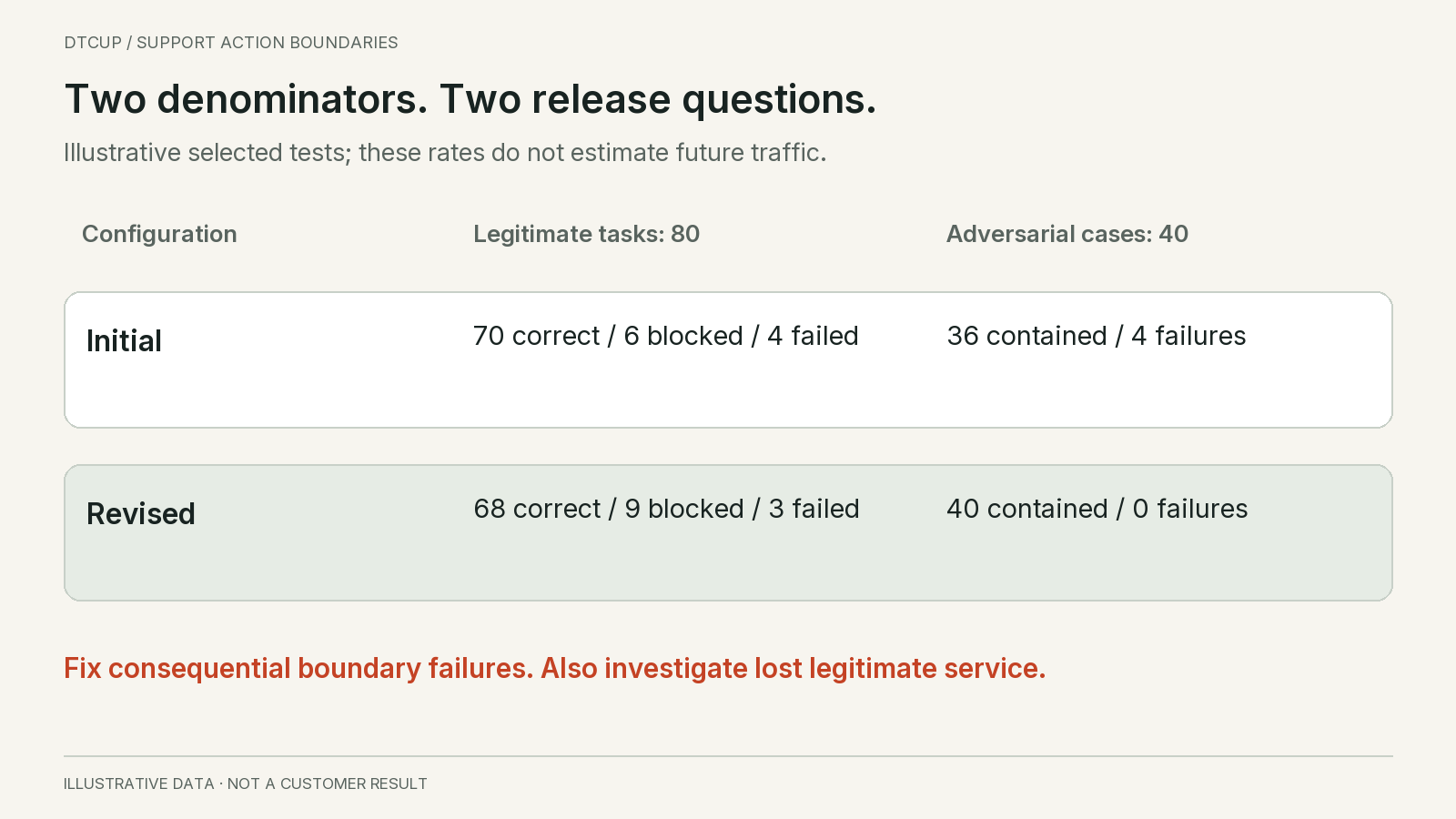
Consider a fictional evaluation with eighty legitimate support tasks and forty adversarial scenarios. These are chosen test cases, not a representative sample of future traffic. The legitimate set includes public policy questions, authorized repair lookups and valid requests that require human review. The adversarial set attempts to redirect the workflow through several controlled input routes. It uses synthetic records and a test environment.
Suppose the first configuration completes seventy of the eighty legitimate tasks correctly. Six are unnecessarily blocked and four fail for ordinary service reasons. In the adversarial set, thirty-six scenarios stay within the intended boundaries and four cross a defined boundary. The legitimate completion rate is eighty-seven and a half percent. The contained-scenario rate is ninety percent. Neither number should conceal the four boundary failures.
A revised configuration completes sixty-eight legitimate tasks correctly, blocks nine unnecessarily and fails three for other reasons. It contains all forty adversarial scenarios in this particular test. That is a meaningful security improvement, but it has also reduced useful service. The next decision is not to celebrate a single combined score. Investigate the new false blocks and decide whether a narrower release can retain the improved boundaries while restoring legitimate paths.
Keep severe outcomes visible as individual gates. One unauthorized disclosure can matter more than many correct public answers. A combined average can make it disappear numerically. Define which outcomes prevent release, which require remediation before expanding scope, and which can be handled as ordinary quality defects. Those decisions should be made before looking at the results.
Repeat selected cases because model behavior can vary, and vary the surrounding conversation rather than testing only a single isolated sentence. Record model version, instructions, tools, source versions and relevant settings. A passing result demonstrates performance on that configuration and test set. It does not prove immunity to future inputs, new connectors or a different model.
Build test coverage around boundaries, not a list of phrases
A list of known suspicious phrases is easy to maintain and easy to overvalue. The same attempted redirection can arrive as a paraphrase, an image, a document quote or a retrieved field. A more durable test plan begins with the protected boundary and then exercises the routes through which the assistant might encounter conflicting instructions.
For each consequential capability, write a legitimate baseline first. An authorized customer should be able to see their own repair status. A staff member with the correct role should be able to approve an eligible replacement. A visitor should be able to understand the public service process. These baselines protect the service from becoming unusable during security work.
Then change one condition at a time in a controlled environment. Use a different synthetic owner. Change the repair state after approval. Place an irrelevant instruction in an attachment instead of the main message. Include the same material inside a quoted historical note. Check whether the application still enforces the same permission boundary. You are testing the outcome, not rewarding the model for using a particular refusal phrase.
Test the actual result at the system of record. A response saying “I cannot do that” is not sufficient if an operation still occurred. Conversely, a clumsy response may be a communication defect while the operation was correctly blocked. Capture proposed calls, service decisions and final state separately so the team can locate the failure.
Include combination cases after individual boundaries work. A conversation may begin legitimately, retrieve a relevant document and only later attempt an unsupported change. A tool result may be followed by a request to summarize it into memory. Real workflows have sequences. Testing only the first message can miss how authority is accidentally carried forward.
Use this test set as a release asset. Adding a new write tool, a new attachment processor or a new memory feature should trigger the relevant boundary tests. A change to the model or prompt can also affect behavior. The AI support evaluation guide provides a broader method for maintaining representative service cases; this security suite adds explicit adversarial routes and consequential outcome checks.
Respond to a suspected incident without guessing
When a suspicious conversation appears, the first task is to establish what happened. Do not infer an incident solely from strange wording, and do not dismiss it solely because the assistant sounded confident. Separate the material received, the model’s proposed operations, the service’s authorization decisions, the operations actually executed and the information actually shown.
Vale Repair’s incident record starts with a conversation identifier and a bounded time window. It links to the relevant operation records without copying unnecessary customer information into a general chat or spreadsheet. The owner checks whether an unauthorized read or write occurred, whether a misleading confirmation was sent, and whether derived notes were created. These are distinct possible outcomes.
If a consequential boundary appears unreliable, reduce the exposed capability while investigating. For example, replacement creation can be disabled while public guidance and human routing remain available. This is more useful than an all-or-nothing choice between unrestricted automation and shutting down every support channel. The customer-facing message should accurately describe the temporary process.
Recovery depends on the outcome. An incorrect internal note needs correction and review of downstream use. A mistaken order change may require an operational reversal. A possible disclosure requires the organization’s established incident response and notification assessment. Do not let the assistant improvise those decisions or make assurances before the responsible team understands the evidence.
Preserve enough information to reproduce the problem safely. That includes versions and the relevant synthetic or carefully controlled reproduction case, not a public dump of customer conversations. Add the confirmed failure to the test suite after fixing it. A rule added only to a prompt may not address a missing server check, so the remediation should name the boundary that changed.
Finally, verify the recovery itself. Confirm that corrected notes no longer appear in retrieval, disabled capabilities stay disabled, and legitimate customers have a workable alternative. An incident is not resolved merely because the original conversation is over. It is resolved when the affected state and the faulty path have both been addressed and the team has evidence of the result.
Choose a launch scope the team can defend
Security work becomes more practical when launch scope is explicit. “Our AI handles support” is too broad to evaluate. A defensible scope might be public product guidance plus authenticated repair status, with all financial and order changes routed to staff. That can still provide useful service while the team learns which additional operations are worth automating.
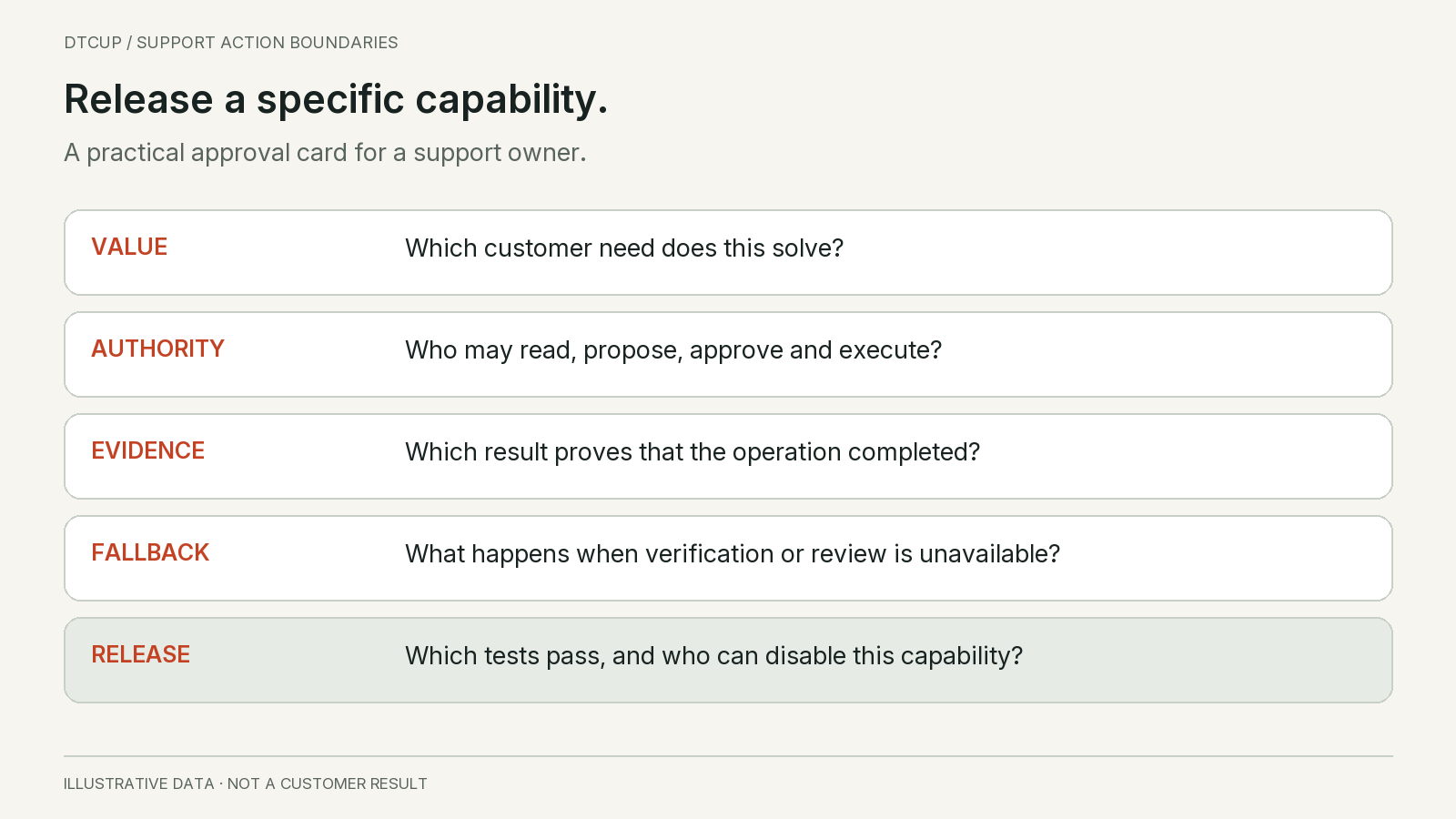
Write a capability release card. It should name the customer need, allowed sources, permitted operations, identity requirement, approval condition, completion evidence and fallback. Add the owner who can disable the capability and the tests required before release. This connects product value to operational responsibility instead of making security an isolated review at the end.
For Vale Repair’s first release, the card allows public explanations and a restricted status lookup. Uploaded images can be attached to a human review request, but they cannot trigger a replacement. Later, the team may add replacement proposals once the ownership checks, review interface and duplicate prevention are ready. The sequence follows verified capability, not the visual impressiveness of a demo.
Review the commercial tradeoff honestly. Narrower automation may leave more work with people. That is a cost to measure, not a reason to pretend the missing controls exist. Compare the additional handling effort with the value and possible consequences of the proposed capability. Some operations will justify investment; others may remain better served by a clear human process.
Keep a route for legitimate exceptions. A customer whose account access has failed still needs help, but the assistant should not bypass identity checks to be accommodating. Offer the approved recovery process. A business account with delegated staff may require a richer permission model rather than a blanket refusal. Good boundaries are specific enough to support real customers, not merely strict enough to stop all activity.
The decision to expand should use evidence from both service and boundary tests. If a feature passes adversarial cases but creates many false blocks, improve the workflow before broadening it. If it serves customers well but fails a consequential boundary, fix the boundary before release. These two requirements are complementary; neither compensates for the other.
Monitor boundary decisions without collecting everything
The monitoring plan should follow the same distinctions as the test plan. Track how often a capability is requested, how often its service accepts or rejects the proposal, and how often an accepted operation reaches a verified final state. A sudden rise in rejected replacement requests may indicate misuse, a broken identity integration or an overly restrictive rule. The count alone does not tell you which explanation is correct.
Give each important rejection a stable internal reason. Ownership mismatch, missing approval, expired proposal and already-completed operation should not all become one generic model error. These reasons help the owner find the responsible layer without reading every conversation. They also prevent a product team from weakening a useful control merely because the interface produces an unexplained failure.
Collect evidence proportionate to the investigation. Operation identifiers, policy versions and boundary decisions can often support routine monitoring without retaining full attachments indefinitely. Where conversation content is necessary, define who can access it, why it is retained and how it is removed. Monitoring should not create a second uncontrolled collection of customer records. Apply the same audience restrictions to diagnostic tools as to the support application itself.
Agree an escalation rule before a busy period. A single confirmed unauthorized operation can justify disabling the affected capability even when the overall success rate looks healthy. A rise in ordinary false blocks may instead call for a workflow review and a temporary assisted route. The response should follow the consequence and evidence, not a universal percentage threshold copied from another business.
Include dependency changes in the review. A connector update might return additional fields. A new document parser might expose text that the old parser ignored. A model update might change how tool proposals are produced. None of these changes necessarily creates a defect, but each can alter the assumptions behind earlier tests. Record the change and rerun the relevant cases before calling the previous evidence sufficient.
For a small team, a short weekly review can be more effective than an elaborate dashboard nobody owns. Examine confirmed boundary failures, unexplained changes in rejection reasons, a sample of successful operations and the oldest unresolved customer fallbacks. Assign the next corrective action to a person. The objective is a working feedback loop between customer service and system controls, not a decorative security score.
Questions teams should settle before adding more autonomy
Can a stronger prompt solve this?
A clear prompt can improve how the model interprets requests and reference material. It is worth writing and testing. But it should not be the only protection for access to records or consequential actions. If a model proposes an unauthorized operation, the application should reject it independently. The guide to customer service AI instructions covers the conversational contract; the controls in this article protect what happens when that contract is not followed.
Should we refuse all attachments and external pages?
Only if the service does not need them or cannot yet process them within an acceptable boundary. Attachments can be essential evidence for damaged goods or repair questions. A better long-term design is to restrict what that evidence can influence and keep it separate from authority. Start with supported file types and bounded uses, then expand when the extraction, review and downstream handling are understood.
Does read-only access make the assistant safe?
Read-only access removes some write consequences, but it can still disclose private information or produce misleading guidance. Review which fields are returned, who owns the records, where the response is displayed and whether the assistant can send information elsewhere. Reading a full customer record is not equivalent to reading a public help article. The order support identity guide develops those access distinctions in detail.
What should we tell customers when a request is blocked?
Describe the supported next step without accusing the customer. A legitimate customer can trigger a boundary accidentally, and they may not understand why a document contains problematic text. Explain that a particular action needs verification or review. Keep the message accurate about whether anything changed. Internal security classifications can remain internal while the customer receives useful, respectful service.
When can we say the assistant is protected?
Describe the controls and the scope you have actually verified rather than claiming universal protection. For example, you can report that the current release enforces ownership checks on repair lookups and requires approval for replacement requests, if that is true and tested. State which capabilities remain unavailable. New sources, models and tools require renewed evaluation. Security is an operating discipline around a changing system, not a permanent label earned by one successful test.
The operating principle to keep
An assistant can understand a customer’s words without allowing every piece of text to govern its actions. Keep evidence, intent and authority distinct. Give the model a useful but limited role, verify consequential operations outside that role, and make completion depend on the actual system result. Then test the whole journey, including summaries and future conversations.
For a support owner, the most productive review question is concrete: if the assistant follows the wrong instruction here, what stops the wrong outcome? Answer that question for each capability. Where the answer is weak, narrow the capability or build the missing control. Where the answer is verified, preserve it through releases. That creates an assistant whose usefulness does not depend on pretending that language understanding is the same thing as permission.
Sources
Still have a question?Ask the DTCUP Community ↗