
Unattributed Revenue Is a Data Gap, Not a Marketing Channel
Separate missing purchase events, broken order links, unknown sources and unmapped channels. A worked revenue ledger shows what evidence can repair and what must remain unresolved.

7 years of experience building and operating brand websites, specializing in website development, paid advertising and SEO. Built a brand website from launch to US$10 million in annual sales.
The Short Answer
Reconcile a commercial order cohort first, then locate gaps in purchase collection, identity links, source evidence and channel mapping. Repair only supported records, report coverage by revenue and orders, and keep unknown amounts separate from modeled scenarios.
Key takeaways
- Direct, Unassigned and a custom unattributed-revenue category have different meanings.
- One primary evidence status per order keeps the ledger additive.
- Verified repairs improve coverage without creating new sales.
- The missing portion may differ systematically from the observed portion.
- Segment coverage can reveal bias hidden by an overall percentage.
- Measurement changes need annotations before channel trends are interpreted.

The sales report says the business earned one hundred thousand dollars. The attribution report can connect only sixty thousand dollars to a recognized marketing source. Someone suggests spreading the remaining forty thousand across the visible channels in proportion to their reported sales. The chart becomes complete. The evidence does not.
Unattributed revenue is uncomfortable because it interrupts a story that marketers want to tell: this activity led to this customer and this order. But an incomplete story is more useful than an invented one. A missing connection can come from several different failures, and each failure calls for a different response. Some can be repaired from retained evidence. Some can be prevented next time. Some are limits the business must accept.
My recommendation is to manage attribution coverage as an operating measure alongside channel performance. Do not hide the unknown portion, and do not treat it as a channel with a budget. Build a ledger that explains the boundary between commercial records and marketing evidence. Then decide which improvement is worth making and which spending decisions remain defensible despite the gap.
This guide uses a fictional home accessories brand, Elm Harbor. All amounts, orders and scenarios are teaching assumptions. The example is a custom order-level analysis, not a claim that a particular analytics product automatically produces these classifications. Platform terms such as Direct and Unassigned have their own definitions, which should remain separate from the custom ledger.
Name the connection that is missing
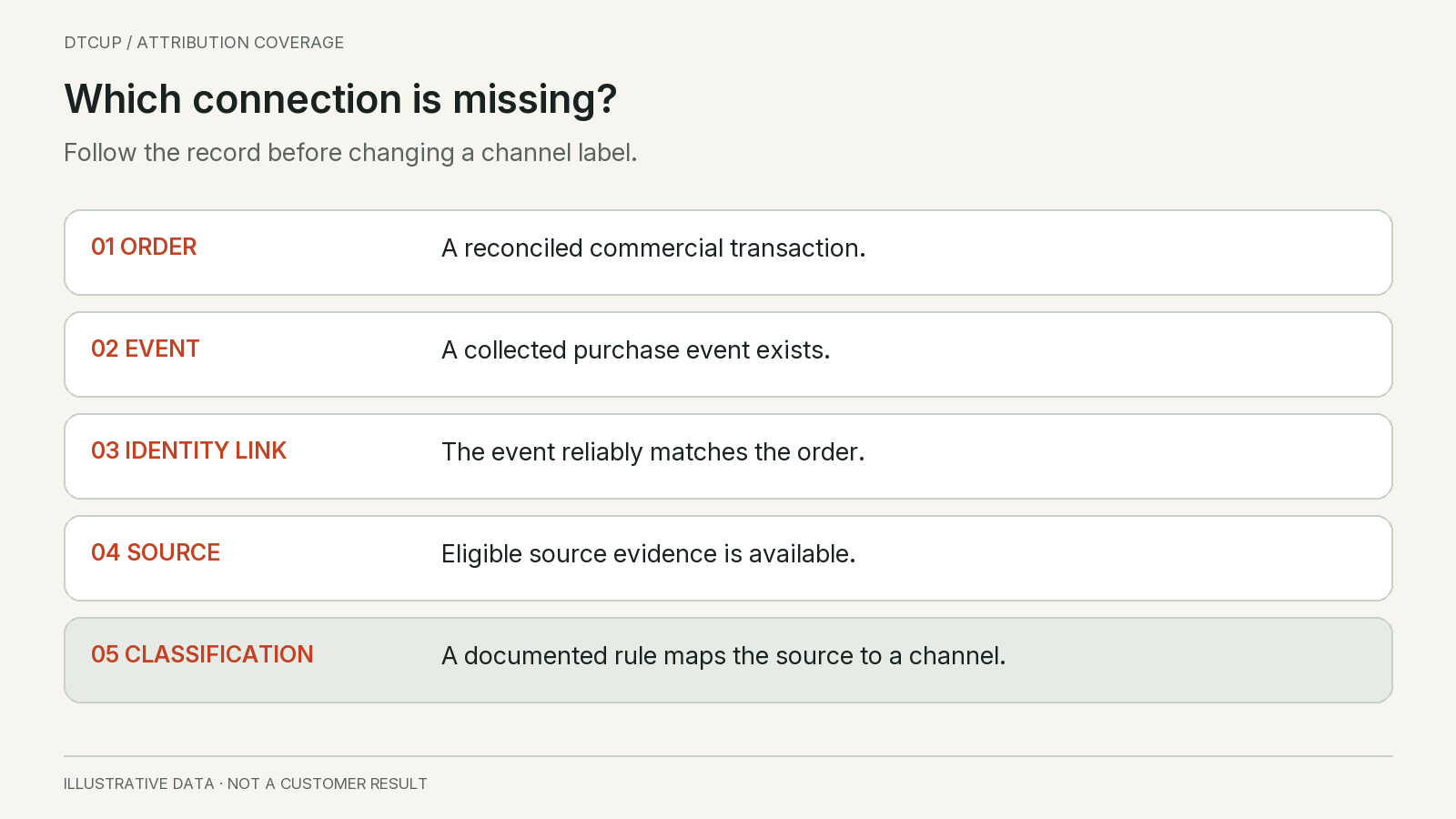
“We cannot attribute this order” is a conclusion with several possible meanings. The order may be absent from the analytics system. It may be present but lack a usable link to a visitor or session. A session may exist without a recorded acquisition source. A source may be present but fail the channel classification rules. A journey may be available but fall outside the selected model’s lookback window.
These are not interchangeable conditions. Fixing a channel mapping rule can classify a known source, but it cannot reconstruct a missing visitor history. Correcting an order identifier can connect a purchase event, but it does not prove which earlier advertisement caused the purchase. Extending a reporting window can reveal eligible recorded touches, but it cannot create touches that were never observed.
Ask a precise first question: what evidence would be necessary to make the statement we want to make? If the statement is that an order followed a tagged email visit, you need a valid relationship between that visit and the order under your identity rules. If the statement is that the email caused an extra sale, you need a different kind of evidence, such as an appropriate experiment. The missing connection depends on the claim.
At Elm Harbor, the initial task is modest. The team wants to know how much of a defined order cohort can be assigned to a recognized source under its existing last eligible recorded touch rule. It is not trying to reconstruct every exposure or estimate causal contribution. This narrower question makes the evidence requirement and the unknown remainder easier to explain.
Write the definition beside the report. Include the eligible order population, revenue basis, identity rule, channel mapping, observation window and data cutoff. Without those details, two teams can use the same phrase while discussing different gaps. The resulting argument often sounds like a disagreement about marketing when it is actually a disagreement about the denominator.
A useful label names the missing layer. “Purchase event missing,” “no eligible linked history” and “source recorded, channel unmapped” tell an owner what to investigate. “Other” tells them very little. You do not need dozens of labels on the executive dashboard, but the underlying review should retain enough detail to support action.
Do not equate Direct, Unassigned and unattributed revenue
In GA4, the source and medium combination “direct / none” describes traffic without a clear referral source. Google’s explanation of direct traffic lists several possible contexts, including direct visits and missing traffic information. The label does not prove that every visitor typed the address, and it does not prove that every visit was caused by brand awareness.
Unassigned is a different classification problem. Google’s tagging and channel guidance explains that it appears when traffic cannot be placed into the applicable channel rules. A source or medium may be present but not match those rules; missing identity information can also affect reporting. The practical implication is to inspect the underlying dimensions before deciding that the entire journey is absent.
Unattributed revenue in an internal report may mean something else again. It might include orders missing from the event collection entirely, orders with an unmatched identifier, or orders without an eligible touch under a custom attribution model. That is why a store’s unattributed revenue percentage should not be compared casually with the Direct percentage in a traffic acquisition report.
Report scope matters too. A first-user source, a session source and a source receiving credit for a purchase answer different questions. Before comparing two numbers, inspect the selected dimension and metric in each report. A returning buyer can have a known first acquisition source and a later purchase session with less information. Those observations can coexist without either report being broken.
For Elm Harbor, Direct remains a platform observation when the platform supplies it. The custom ledger instead uses a carefully defined category called “linked purchase, no eligible source evidence.” That avoids declaring that every order in the category was a direct visit. The business can show both reports, provided the labels and denominators remain visible.
This distinction changes the troubleshooting order. If a source is recorded but its medium does not match a channel rule, investigate mapping and naming. If no purchase event exists, investigate collection and reconciliation. If the relevant history was not observed, investigate coverage and its limits. Starting with the right layer saves time and avoids repairs that only make the dashboard look tidier.
Build the commercial denominator before calculating coverage
Begin with the system that records the business transaction. Decide which orders belong in the analysis and how revenue is measured. For this example, Elm Harbor selects one completed month of eligible online orders and measures net merchandise revenue after recorded discounts and refunds, excluding tax and shipping. It uses one currency and one reporting timezone. Those choices are illustrative, but the need to make them explicit is general.
Reconcile the selected cohort before joining marketing data. Remove test orders and canceled orders according to a documented rule. Preserve the original records and the reason for each exclusion. Do not remove an order merely because it lacks marketing evidence; doing that would improve coverage by shrinking the denominator around the records that were easiest to observe.
Refund timing requires a cutoff. An order placed in the month may be refunded later. The example uses refunds known at the review date and records that date. A later review can restate the cohort’s net revenue while preserving the earlier snapshot. Otherwise a changing commercial denominator can look like a sudden change in attribution quality.
Elm Harbor’s reconciled cohort contains one thousand eligible orders and one hundred thousand dollars of net merchandise revenue. The equal average is only an aggregate fact; individual groups will have different order values. The ledger does not assume every order is worth one hundred dollars. That detail becomes important when comparing order coverage with revenue coverage.
Use stable order identifiers, not just counts and totals. Two datasets can each contain one thousand rows while referring to different transactions. Check duplicates, missing records and unmatched identifiers. If an analytics export contains repeated purchase events, deduplicate according to a verified transaction rule before calling them additional sales. A row is not automatically an order.
Keep the commercial and attribution layers separate in storage or reporting logic. The order table establishes what happened commercially. The evidence table describes what can be linked to it. The attribution calculation applies a stated rule to the available evidence. This separation allows you to change a mapping rule without accidentally changing the store’s revenue history.
Create a coverage ledger that adds back to the total
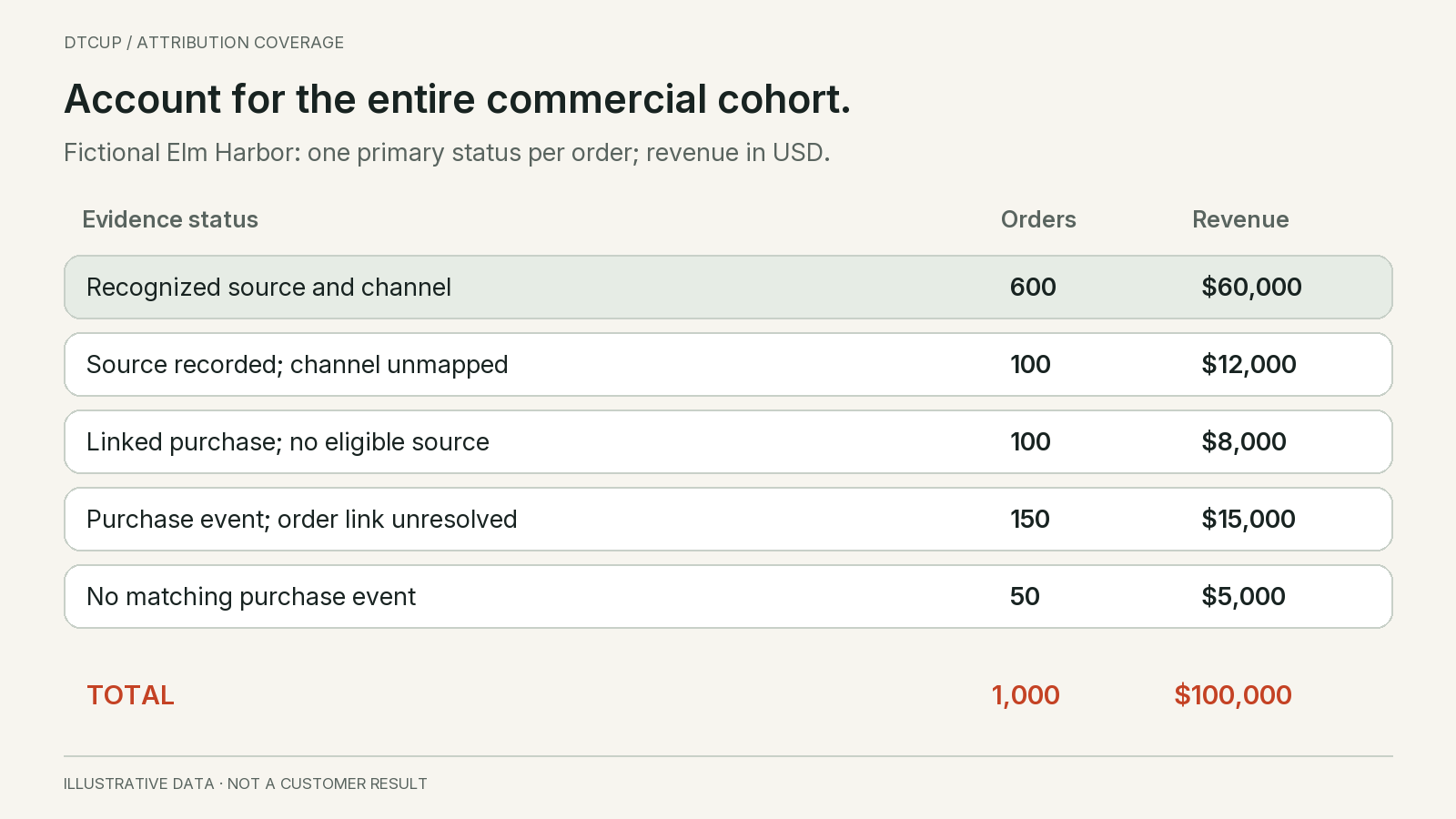
Elm Harbor divides its one thousand orders into five mutually exclusive groups for the initial investigation. Six hundred orders, worth sixty thousand dollars, have an eligible linked source that maps to a recognized channel. One hundred orders, worth twelve thousand dollars, have a linked source that does not yet map correctly. Another one hundred, worth eight thousand dollars, have a linked purchase but no eligible source evidence.
The remaining two groups sit earlier in the chain. One hundred fifty orders, worth fifteen thousand dollars, have purchase events that cannot be linked reliably to the eligible order records. Fifty orders, worth five thousand dollars, have no matching purchase event in the available collection. Together, the five groups account for all one thousand orders and all one hundred thousand dollars.
These groups use an explicit precedence rule. First check whether the purchase event exists. Then check whether the order relationship is valid. Then inspect eligible source evidence and channel mapping. An order can have several underlying issues, but it receives one primary ledger status so the totals do not overlap. Additional diagnostic flags can preserve secondary issues without being added to the revenue total again.
The initial recognized-channel revenue coverage is sixty percent. Order coverage is also sixty percent in this particular snapshot. That equality is coincidental. The unmapped-source group has a higher average order value than the group lacking source evidence. As repairs occur, order coverage and revenue coverage can move by different amounts.
The ledger is not a ranking of customer quality. An unattributed order is still a real order, and an observed journey is not necessarily more valuable. The ledger describes the evidence available for a specific analytical task. Do not turn a measurement status into a customer segment or use it to decide who deserves better service.
Show the total and the covered portion together. A channel report that displays only the sixty thousand dollars can be useful, but its title should make the scope clear. The commercial review should still carry the full one hundred thousand dollars. This prevents the marketing team from presenting observed-channel performance as if it described every sale.
Repair only what retained evidence supports
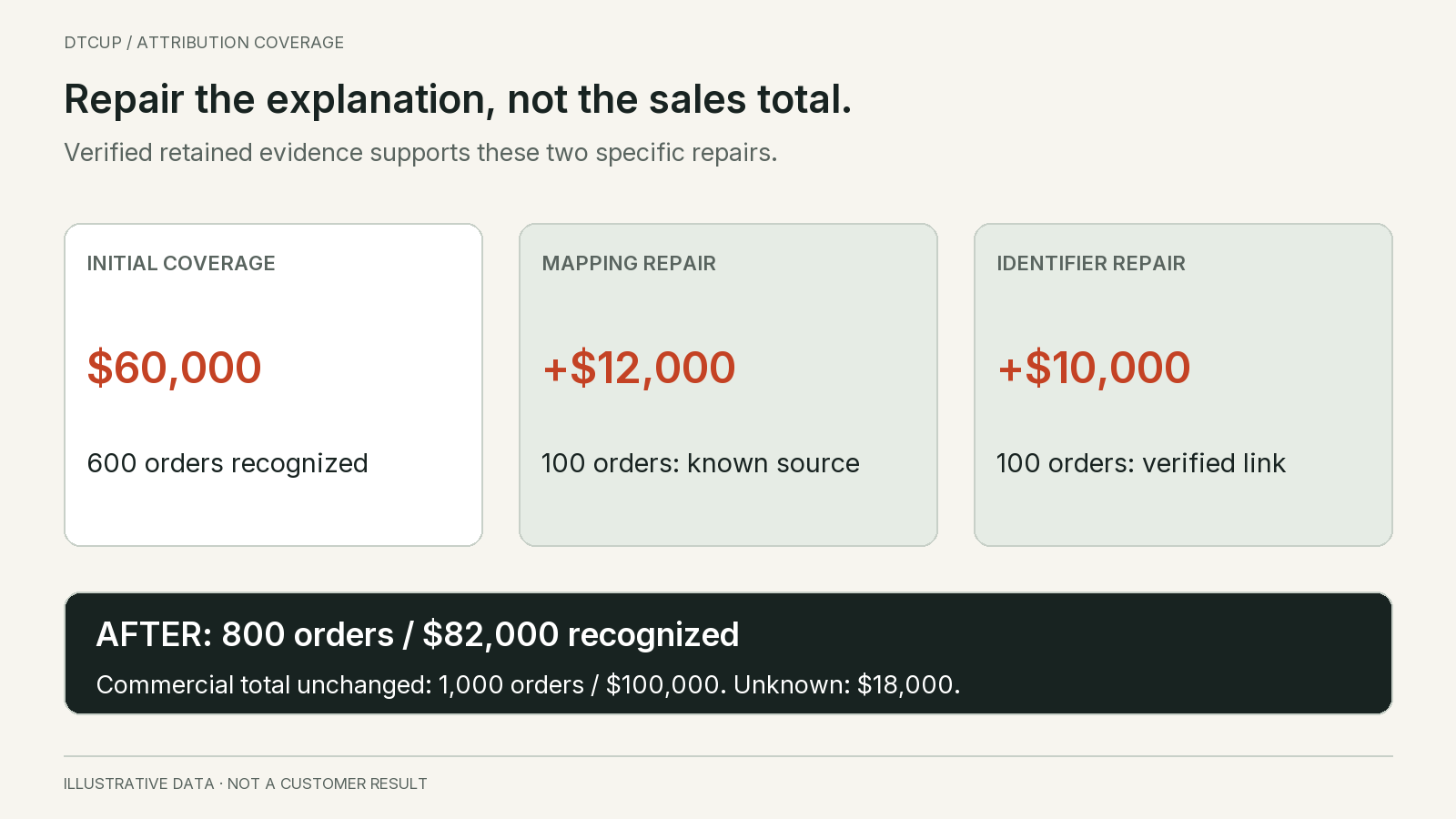
The first repair is a classification issue. Elm Harbor finds that the one hundred unmapped orders carry a documented campaign source and medium combination. The team verifies the actual distribution and updates its internal channel mapping. All twelve thousand dollars can now enter the recognized-channel group. The original raw values remain stored; the transformation is recorded as a mapping revision.
The second repair concerns identifiers. Of the one hundred fifty unmatched purchase events, one hundred orders can be linked using a verified transaction identifier correction. These orders are worth ten thousand dollars and also have eligible recorded source evidence. They can move into recognized-channel coverage. The other fifty orders, worth five thousand dollars, remain unmatched because the available evidence is insufficient.
After these repairs, eight hundred orders and eighty-two thousand dollars have a recognized channel under the stated rule. Order coverage rises from sixty to eighty percent. Revenue coverage rises from sixty to eighty-two percent. The remaining eighteen thousand dollars consists of eight thousand without eligible source evidence, five thousand still unmatched and five thousand without a collected purchase event.
Nothing about the commercial total changed. The business still earned one hundred thousand dollars on the defined basis. The repair changed what the team could explain using retained records. This distinction is important when someone sees a channel’s attributed sales rise after a tracking fix. The rise may be improved observation rather than improved marketing performance.
Preserve the before and after report. Record which rows changed, the evidence used, the rule version and the reviewer. A legitimate repair should be reproducible. If the team cannot explain why a specific order moved from unknown to a channel, it has probably made an assumption rather than repaired a record.
Do not extend a valid repair beyond its evidence. A corrected order identifier can link one recorded visit to a purchase. It does not prove every earlier touch in the customer’s history. Likewise, a campaign code can establish participation in a program without identifying the entire path to purchase. The affiliate order-matching guide explains why transaction linkage and journey reconstruction must remain separate.
Do not spread the unknown remainder across channels as fact
After repair, suppose Elm Harbor’s observed channel revenue is forty thousand dollars from paid search, twenty-five thousand from email and seventeen thousand from social. The known total is eighty-two thousand dollars. The remaining eighteen thousand is unknown under this analysis. Allocating it proportionally would produce a complete chart, but the result would depend entirely on the assumption that unobserved orders resemble observed ones.
That assumption may be false. Tracking loss can differ by device, browser, checkout route, market or channel. Email visits may be easier to connect for signed-in customers than some social visits. A new checkout flow may affect only one product group. Consent choices may vary across audiences. Missingness is often structured, which means the visible portion may not represent the invisible portion.
You can use explicit scenarios to understand decision sensitivity. One scenario leaves all eighteen thousand unallocated. Another explores what would happen if a defined share belonged to social. A third distributes it using a stated assumption. But these are analytical scenarios, not repaired attribution. Keep them outside the official observed-channel ledger and label them clearly.
Consider a simple budget question. Paid search spent twenty thousand dollars, so its observed revenue-to-spend ratio is two. Social spent ten thousand, so its observed ratio is one point seven. If all eighteen thousand unknown dollars were associated with social, social’s scenario ratio would be three point five. If none were, it would remain one point seven. The ranking is sensitive to a gap the report cannot currently resolve.
Those extremes are arithmetic bounds under deliberately simplified assumptions, not estimates of what probably happened. They do not account for margin, incrementality or capacity, and they should not become budget recommendations by themselves. Their purpose is to show that a confident channel ranking is not supported by the current evidence.
When a decision changes across plausible interpretations, buy better evidence or make a smaller, reversible decision. An appropriate channel experiment, a focused tracking repair or a limited budget test may be more valuable than arguing about the correct way to color the unknown slice. The attribution and incrementality guide explains how to move from credit allocation to a business decision without treating the two as equivalent.
Diagnose the actual customer journey in order
When a campaign appears to lose its source, inspect the route a real visitor takes. Start with the distributed link, then follow redirects, landing pages, consent behavior, domain transitions, checkout and the recorded purchase event. Testing only the original URL in a link builder misses changes introduced by the distribution platform or the site itself.
Use controlled test visits and test orders where the platform supports them. Record the intended campaign labels and the expected destination. Check what arrives at the landing page and what the analytics system actually records. Then verify whether the purchase event can be linked to the commercial order. A screenshot of a tagged URL is evidence of the link, not evidence of a completed measurement path.
Redirects deserve special attention. A campaign link can begin with correct parameters and finish at a page that no longer carries them. The correct repair is to understand and fix the actual redirect behavior, not to append campaign tags to every internal link. Internal tagging can create new interpretation problems and obscure the original acquisition context.
Test domain transitions with the supported configuration of the analytics product. Do not casually manufacture session or client identifiers to make a report join. A join that looks complete but connects the wrong records is worse than an honest gap. Keep implementation review with someone who understands the site’s actual collection and checkout architecture.
Compare mobile and desktop, and test the routes customers actually use. A checkout opened in a different context may behave differently from an ordinary page transition. A link in an email application may differ from a manually pasted URL. The aim is not to catalog every possible browser behavior; it is to locate the highest-volume or highest-value paths where the business currently loses evidence.
The existing campaign link guide covers naming and distribution checks. Use that work to prevent avoidable labeling errors. This article’s ledger then checks whether the correctly labeled invitation survives through the commercial outcome, which is a separate and more demanding question.
Respect observation limits instead of bypassing them
Some gaps are not implementation defects. A customer may decline optional measurement. A browser or application may limit the information available. Earlier visits may predate the integration or fall outside retained history. A purchase may follow an offline conversation that your systems never observed. These limitations should remain visible in the analysis.
Do not treat a missing identifier as permission to invent a new way to identify the person. Measurement changes must follow the business’s applicable consent and data-handling requirements. This guide does not prescribe a legal basis or a universal consent configuration. The operational principle is to improve permitted collection and honest reporting, not to circumvent a customer’s choices.
Modeled data can be useful, but its meaning must be preserved. An aggregate estimate produced by a platform is not automatically a recovered order-level journey. Keep observed records, modeled estimates and manual scenarios distinguishable. Otherwise a dashboard can quietly combine different kinds of evidence into a number that nobody can explain.
Historical gaps are especially easy to overpromise. Installing a connector today does not necessarily provide complete earlier visitor journeys. An order import may restore sales history without restoring marketing touches. Before showing a six-month attribution trend, check which parts of the history are actually available and comparable.
Elm Harbor marks the first month after its collection repair as a new measurement period. It retains earlier commercial sales but does not pretend the older marketing coverage is equivalent. The team can compare total revenue across months while showing a break in attribution coverage. This is more honest than presenting a smooth channel trend built from changing observation conditions.
Unknown does not mean unknowable forever, but it does mean not established now. Assign a reason where evidence supports one, retain uncertainty where it does not, and specify what future information could change the status. A good analyst makes the boundary of knowledge visible rather than turning every blank into a confident category.
Check coverage by segment before comparing performance
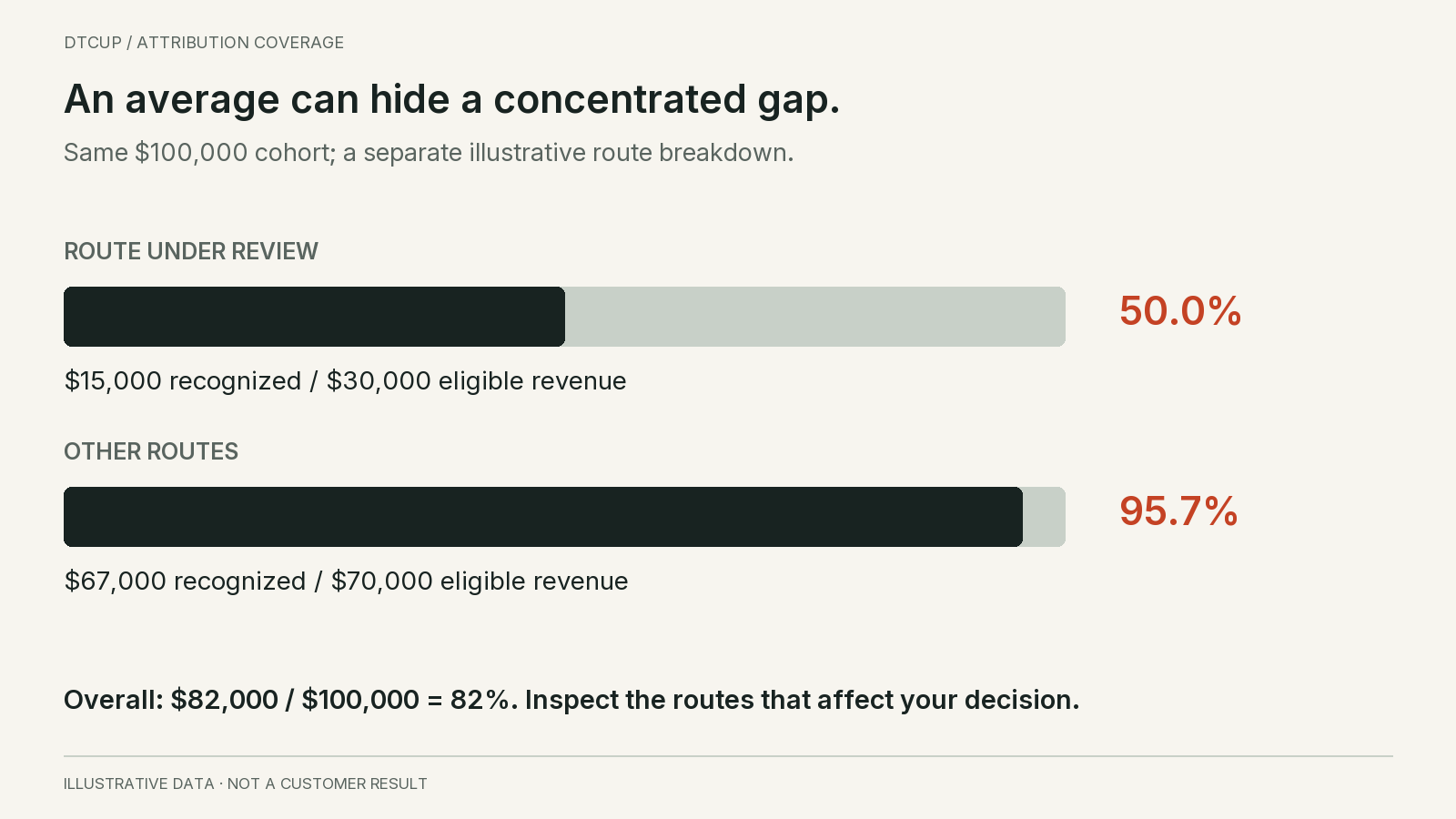
An overall coverage percentage can hide uneven observation. Eighty-two percent revenue coverage may look healthy, but it is less reassuring if one important market has much lower coverage than the rest. The team needs to know whether the missing portion is concentrated in the same segments it wants to compare.
Use a few operationally meaningful cuts: checkout route, device category, market, new versus returning customer when reliably defined, and the date of a tracking change. Choose segments that correspond to a plausible collection difference or an actual business decision. Do not create dozens of tiny groups merely because the reporting tool makes them available.
For each segment, show eligible revenue, recognized-channel revenue and the gap. Keep counts alongside revenue so a single large order does not appear to be a broad pattern. Where sample sizes are small, describe the observation rather than presenting unstable percentages as precise performance judgments.
Suppose one route accounts for thirty thousand dollars of Elm Harbor’s revenue but only fifteen thousand dollars of recognized-channel revenue. The other routes account for seventy thousand dollars with sixty-seven thousand recognized. Together they still produce the same eighty-two percent total coverage, but the first route has fifty percent coverage while the others have about ninety-five point seven percent. The aggregate conceals the concentration of the problem.
If that route is used disproportionately by a particular channel, the channel comparison is vulnerable to measurement bias. You still cannot assign the missing sales to that channel without evidence. But you have a concrete reason to prioritize the route investigation and to qualify the ranking in the meantime.
After a repair, compare the same segment definitions over a suitable review period. Separate the immediate technical test from the production trend. A successful test order proves that one controlled path worked. A stable production improvement across the affected route provides broader evidence. Both are useful, and neither should be described as the other.
Prioritize repairs by the decision they improve
Not every gap deserves the same investment. A small naming inconsistency may be cheap to correct and improve many recurring reports. A difficult historical reconstruction may consume weeks while changing no current decision. Rank repair work by the size of the affected commercial scope, the reliability of the proposed evidence and the decision that becomes better.
Separate prevention from recovery. Correcting future campaign links is prevention. Reclassifying retained source values is recovery. Repairing an identifier transform may do both. Each work item should state which outcome is expected. This prevents a team from promising that a forward-looking fix will magically fill an old reporting gap.
Estimate the practical benefit in plain language. “This fix should make the new checkout route’s purchase events reconcilable with orders” is clearer than “improve attribution by twenty percent.” The latter may be impossible to guarantee because future traffic mix and consent conditions can change. Commit to the control and the verification, then measure the resulting coverage.
Use an owner and a review date. Marketing may own campaign naming, engineering may own redirects and purchase events, and analytics may own joins and channel mapping. A shared gap often persists because each team assumes another team controls the entire path. Assign responsibility at the failing layer, with one person accountable for the end-to-end verification.
Keep rollback possible when changing collection. A tracking repair can accidentally duplicate events, break an integration or change a definition. Save the prior configuration and document the expected effect. Verify commercial totals as well as source coverage after release. Improving the channel field while doubling purchases is not an improvement.
The most valuable repair is not always the one that removes the largest visible unknown category. Sometimes the priority is a smaller gap in a high-stakes decision, such as a market expansion or a large recurring campaign. Use the ledger to connect data work to that decision, rather than treating a completely colored chart as the objective.
Write a measurement change note that prevents false growth stories
When a repair changes attribution coverage, record the event where future readers will see it. Include the implementation date, affected routes, old and new rules, validation evidence and known limitations. The note should explain whether historical data was restated or only future collection changed. This protects the team from comparing incompatible periods later.
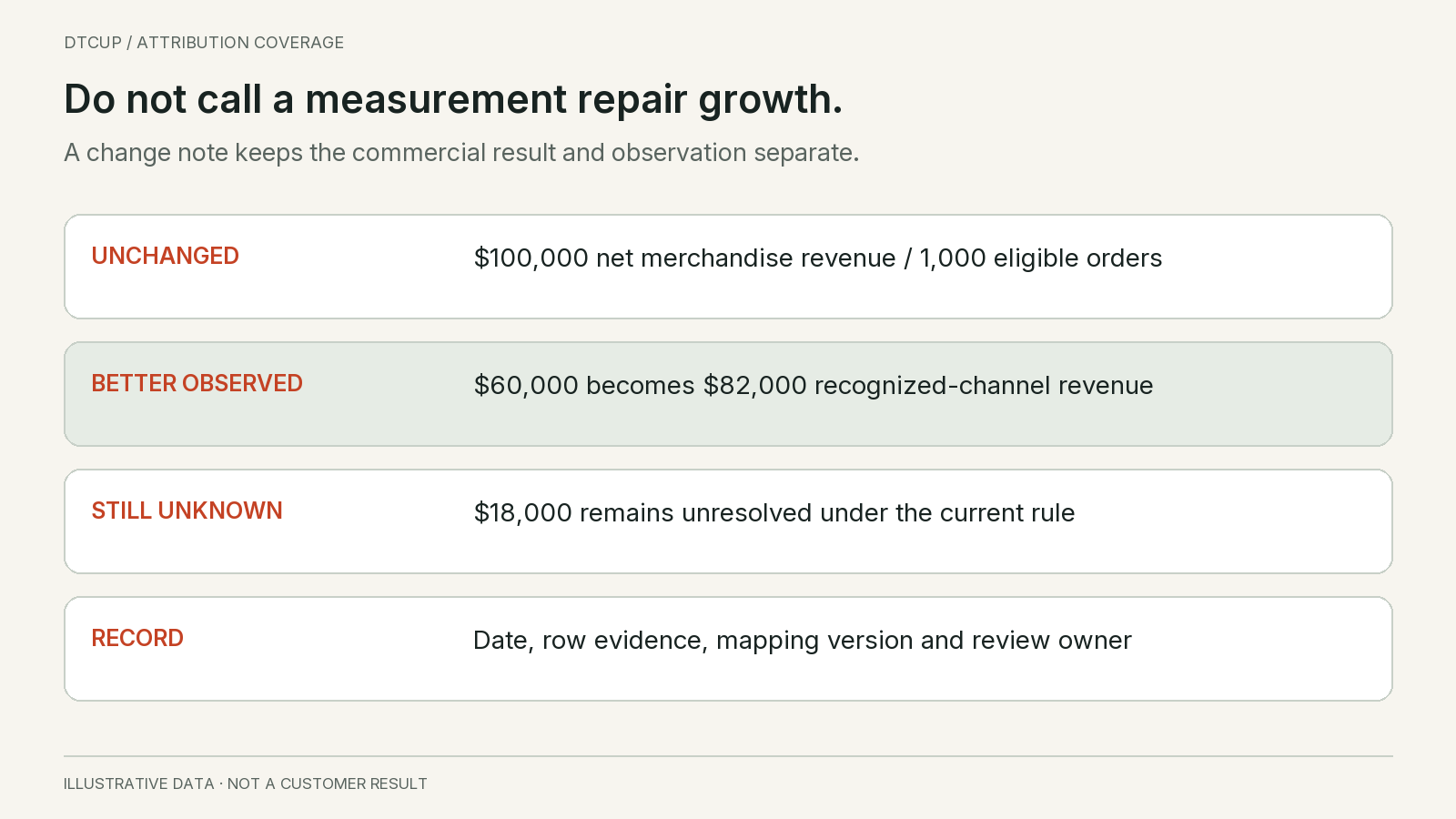
For Elm Harbor, the note says that the commercial cohort remains one thousand orders and one hundred thousand dollars. Mapping and verified identifier repairs increase recognized-channel revenue from sixty thousand to eighty-two thousand dollars. The remaining eighteen thousand is still unresolved under the current rule. No claim is made that marketing generated twenty-two thousand dollars of additional sales.
If a channel’s reported revenue increases after the repair, split the discussion into observed business change and measurement change. The same principle applies to conversion rates and return on ad spend. A more complete numerator can improve the reported ratio without any change in customer behavior. That does not make the repair unimportant; it makes the interpretation important.
Retain enough version information to reproduce the old report. For a custom analysis, that may include mapping version, attribution rule, source cutoff and join logic. For a platform report, retain the relevant settings and report definition. Screenshots can help communicate the result, but they are not a substitute for the definitions that produced it.
Discuss the change with the people who use the numbers. A finance colleague needs to know that commercial revenue did not change. A channel owner needs to know which comparisons are now more reliable. An executive needs to know whether the budget decision should wait for a comparable period. The same technical repair has different implications for each reader.
The report reconciliation guide covers broader differences between reporting systems. Here the emphasis is a change within one system over time. Both situations require the same discipline: explain the definition before explaining the trend.
Use the ledger in a budget meeting
A coverage ledger should improve decisions, not become a reason to postpone every decision until data is perfect. Begin the meeting with the commercial total, the observed-channel portion and the unresolved portion. Then state which proposed decisions are sensitive to the gap. Some may remain sensible under a wide range of interpretations; others may not.
For example, a broken landing page should be repaired even if the attribution ledger is incomplete. A campaign with a verified operational issue may need correction regardless of whether some sales are missing. But a large budget transfer based on a small difference between channel ratios deserves more caution when coverage differs sharply across the relevant routes.
Keep separate evidence streams available. Store revenue and contribution show the commercial outcome. Attributed journeys describe observed paths under a rule. Customer research can reveal motivations that are not captured in click data. Experiments can address incremental effect. None is a universal replacement for the others, and uncertainty in one stream does not justify inventing precision in another.
Choose a decision size consistent with the evidence. A limited, reversible budget adjustment with a defined review can be appropriate while a major tracking gap is being repaired. A permanent channel shutdown based only on incomplete attribution is harder to defend. Write down what result would support keeping, reversing or expanding the adjustment.
Do not assign a budget to the unknown category. It has no campaign to optimize and no owner who can buy more of it. Assign owners to the causes of missing evidence instead. A channel owner can improve link discipline; an engineering owner can repair a checkout event; an analyst can correct a verified mapping. Those are actions. “Grow unattributed revenue” is not.
End with a decision record that preserves uncertainty. It should say what the team believes, what evidence supports it, what remains unresolved and what will be checked next. That is a stronger form of accountability than a complete-looking attribution table that quietly assumes the answer to its most important question.
Sample unknown orders without claiming to solve the whole remainder
A manual review can be useful when the ledger identifies a large unresolved group. Select cases across the dates and routes that matter, then inspect the evidence available for each case. Write down whether the review found a recoverable link, a confirmed collection problem or no additional information. This can reveal an operational pattern worth investigating without requiring the team to reconstruct every order by hand.
Be careful about the sample’s limits. Reviewing the largest orders first may be commercially sensible, but it does not create a representative sample of all orders. Reviewing customers who contacted support may overrepresent people with delivery problems. The resulting findings can justify a targeted repair; they should not automatically become a percentage applied to the whole unknown revenue pool.
Customer answers can provide useful context too. A buyer may remember a creator recommendation or a conversation with a friend. Preserve that as self-reported discovery evidence, with its own question wording and collection date. It is not the same as a recorded click, and it may describe first awareness rather than the last interaction before purchase. Combining those fields without a clear definition produces another kind of attribution confusion.
For Elm Harbor, a review note might say that several sampled orders used the same checkout route and lacked a matching purchase event. That is a testable lead for engineering. It should not say that every missing order used that route unless the complete data supports it. Keep the distinction between a clue, a verified case and a population conclusion visible. Small investigations become valuable when they generate precise next checks, not when they manufacture certainty from a convenient handful of examples.
Questions that often derail the investigation
Does a high Direct share mean our brand is strong?
It may be consistent with people intentionally returning, but the label alone cannot establish that explanation. Direct can also reflect missing referral information. Use additional evidence such as customer research, branded demand trends and reliable returning-customer measures where available. Keep those as separate observations rather than relabeling all Direct traffic as brand-driven revenue.
Can we call the unknown portion dark social?
Only where the evidence supports that specific context, and even then the amount may remain uncertain. Private sharing is one possible source of unobserved acquisition. It is not a universal explanation for missing events, broken identifiers or unmapped campaign values. Calling every gap dark social replaces one unclear category with a more fashionable one without improving the analysis.
Should we add campaign parameters to every link?
Use a deliberate convention for external campaign distribution and test the resulting journey. Do not add acquisition labels mechanically to ordinary internal navigation. Choose an appropriate event or interaction measure for internal behavior. The goal is to preserve the meaning of the original invitation, not to create more campaign values than the team can interpret.
What is an acceptable attribution coverage percentage?
There is no universal threshold that makes every decision reliable. The distribution of the gap matters as much as its size. A smaller gap concentrated in a channel under review can matter more than a larger gap spread across unrelated activity. Define the decision, inspect the affected segments and assess how much the conclusion changes under explicit uncertainty.
Can DTCUP Intelligence recover all missing journeys?
No tool should promise to reconstruct observations it never received or cannot lawfully and reliably connect. Review the actual connected sources, available dates and identity coverage in the product. An imported order establishes a transaction, not a complete acquisition history. Use the available attribution views to compare recorded evidence, and keep historical gaps and unsupported connections visible.
Keep the unknown portion useful
The unknown remainder is not a failure of the analyst. It is a statement about the evidence. The failure would be hiding it, allocating it without disclosure or letting it become an excuse for never improving the system. A good coverage process does the opposite: it makes the gap specific enough to investigate and limited enough to reason around.
Start with a reconciled commercial cohort. Trace the evidence through collection, identity, source and classification. Repair only what retained records support. Show order coverage and revenue coverage separately, inspect the segments that matter, and annotate changes. Then make the marketing decision at a level of confidence the evidence can support. An honest incomplete map is a better operating tool than a perfect map of an invented journey.
Sources
Still have a question?Ask the DTCUP Community ↗