
Affiliate Attribution: Match Orders Without Inventing Customer Journeys
A partner code, a matched order and an approved commission tell different stories. Reconcile affiliate records, explain overlapping signals and make payment decisions without mistaking credit for incremental growth.

7 years of experience building and operating brand websites, specializing in website development, paid advertising and SEO. Built a brand website from launch to US$10 million in annual sales.
The Short Answer
Build separate views for transaction matching, contractual commission and incremental growth. Deduplicate deliveries, join orders with verified identifiers, preserve overlapping click and code evidence, and apply the agreed rule version before reconciling refunds and payment status.
Key takeaways
- Order matching does not reconstruct unobserved visits.
- Click and code groups can overlap on the same order.
- Commission rules should be explicit and versioned.
- Unmatched records need investigation rather than automatic rejection.
- Approved commission revenue differs from store net revenue for explainable reasons.
- A contractual winner is not proof of incremental customer demand.

A partner report says a creator generated ninety orders. Your store shows a matching order reference for each one. It is tempting to turn that match into a complete story: ninety customers discovered the brand through the creator, clicked the content and bought because of it.
The match does not establish all of that. It may establish a useful relationship between a partner conversion record and a store order. The evidence for a click, a coupon, a customer journey, a commission obligation and an incremental sale can be different. A reliable affiliate program keeps those meanings separate instead of allowing one confident dashboard label to stand in for all five.
I would build the analysis from the order ledger outward. First reconcile the records. Then apply the agreed credit and payment rules. Finally ask what the evidence says about the partner’s commercial role. That sequence protects both the brand and the partner: good work is less likely to be lost in broken tracking, and weak evidence is less likely to become an exaggerated growth claim.
This guide uses a fictional brand, Linden Works, and invented partner records to demonstrate the method. The quantities, rates and policies are teaching assumptions. They are not DTCUP customer results, industry benchmarks or a description of every affiliate platform’s implementation.
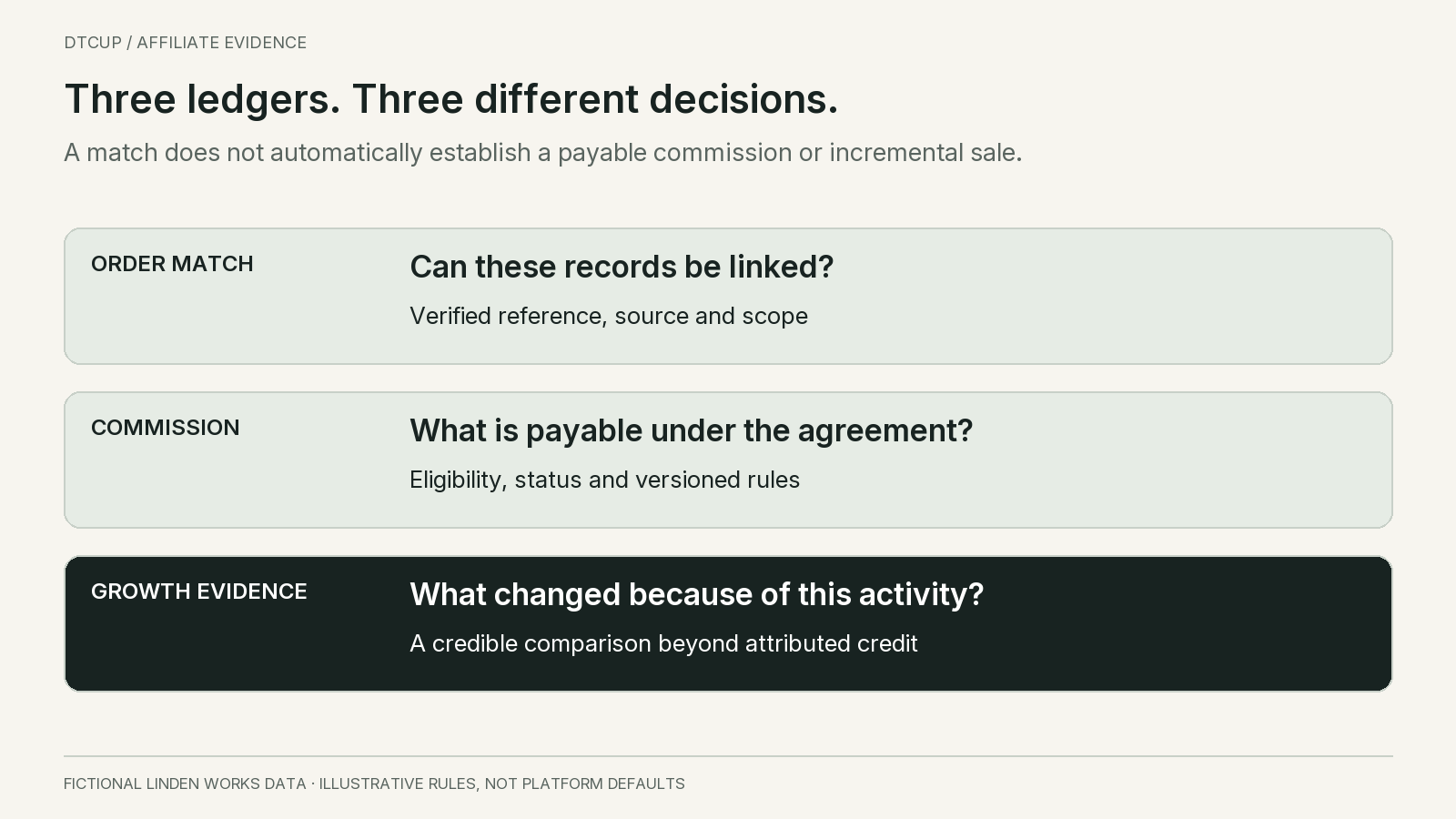
Keep the order, credit and contribution questions separate
The order question is whether a reported conversion corresponds to a real transaction in the defined store and event scope. That requires a stable reference, consistent event meaning and a way to handle duplicates, corrections and unmatched records. It is a data-reconciliation question.
The credit question is which partner should receive contractual recognition or payment under the program’s rules. That may depend on a qualifying click, a registered code, a window, a partner type, exclusions and the transaction’s later status. A valid store order does not automatically settle these conditions.
The contribution question is what would have happened without the partner activity or under a different program design. That is a causal business question. A perfectly reconciled commission report can still be unable to answer it. Payment may be correctly due even when the purchase was not entirely new demand.
These distinctions become useful in a disagreement. Finance may be asking why a payout changed after returns. Marketing may be asking why an affiliate receives credit for an existing customer. The partner may be asking why a confirmed sale is missing. Treating all three as an attribution-model debate wastes time because each needs different evidence.
Make the three views visible in the operating report. Show matched transactions, eligible credited transactions and the additional evidence used for investment decisions. Avoid a single column called generated revenue unless its meaning is precisely defined. The word generated often implies causation that the underlying tracking cannot establish.
The channel-by-channel attribution framework explains how to choose an allocation for a question. An affiliate ledger adds a contractual layer: an analytical model and a commission rule can be different without either being an error.
Say exactly what each piece of evidence establishes
An exact order reference can connect a partner event to a store transaction when the namespace and event definitions are correct. It does not reveal the customer’s earlier browsing history. It also does not prove that every partner claim attached to that reference is eligible.
A recorded affiliate click can show an observed interaction under the tracking system’s rules. Its usefulness depends on capture, time, scope and a supported link to the later conversion. It should not be treated as a complete account of every device, private message or offline recommendation the customer encountered.
A coupon used at checkout shows that the code appeared on the order. If the code is registered to a partner under a crediting rule, that may support partner attribution. It does not necessarily show where the customer obtained the code. A friend, a search result or a public coupon page could have supplied it.
A customer identifier can support a relationship within the system that issued it, but it is not automatically a universal person identifier. An order-level partner reference should not be stretched into a cross-device journey simply because both records concern the same purchase.
Keep these evidence types as separate fields. If click evidence is unavailable but code evidence exists, label the order code-linked rather than inventing a click. If the order reference matches but no qualifying attribution evidence is present, retain the match and mark the credit question unresolved.
For example, impact.com’s promo-code documentation distinguishes ordinary coupon ads from tracking codes with credit logic and describes interactions between code settings and credit groups. This is a useful reminder that a code’s meaning depends on configuration. It is not a universal rule that every code overrides every click.
Define the transaction join before importing a large file
Linden starts with a small sample and writes a join contract. The store reference is unique within the relevant store. The partner event identifies the program and event type. The join preserves the original reference, its normalized form, the event time and the source record. Normalization is documented rather than hidden inside a spreadsheet formula.
This matters because visible order numbers are not always globally unique. Two stores may both have an order displayed as one thousand and one. Different event types may refer to a sale, a lead or a renewal. A match on the visible number alone can connect the wrong business event.
Do not remove prefixes, punctuation or leading zeros indiscriminately. Sometimes they are presentation details; sometimes they distinguish records. Test the mapping against known examples and preserve the original value so a reviewer can reconstruct what happened.
Store the relationship as a link, not as a replacement for the source record. The partner action identifier and store order identifier serve different purposes. Keeping both makes it possible to process a correction, investigate a disputed claim or locate the original action without guessing which identifier a platform expects.
Awin’s transaction-report field guide lists the advertiser order reference separately from commission status, validation date, click time and voucher code. The separation is useful for report design: transaction identity, timing, evidence and payment state should remain distinguishable even when a single interface displays them together.
When a reference cannot be matched, leave it in an exception queue with a reason. Possible explanations include a formatting mismatch, a delayed store import, a different event scope or a test transaction. Do not force the nearest-looking order into the join merely to make the unmatched count reach zero.
Reconcile a fictional batch from raw messages to real orders
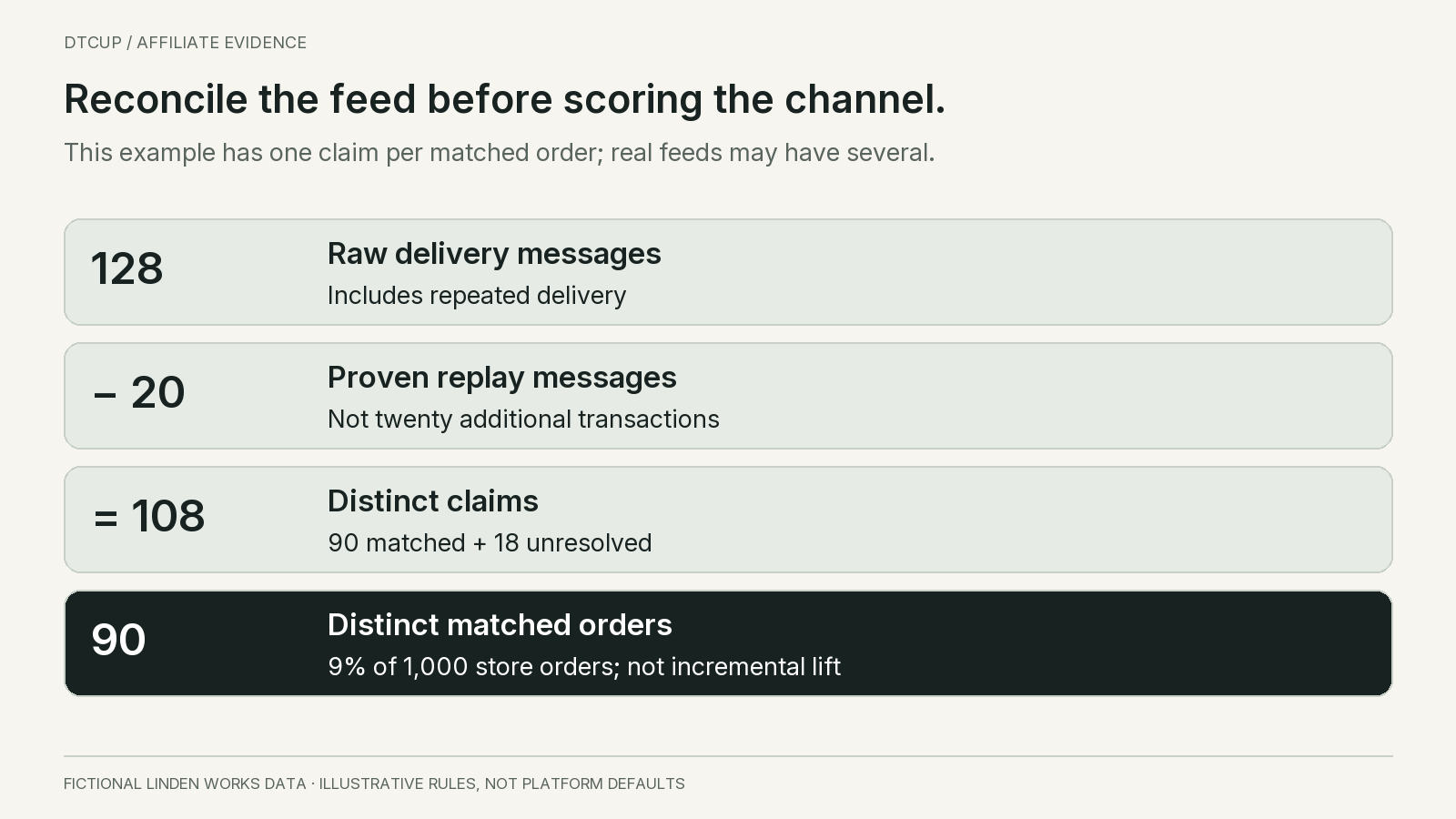
Linden receives one hundred and twenty-eight raw delivery messages from its partner reporting process. Twenty are exact replay deliveries of messages already received. After removing only those proven replays, the batch contains one hundred and eight distinct conversion claims.
Eighteen of those claims cannot yet be matched to a store order under the documented join. The remaining ninety claims correspond to ninety distinct store orders. In this constructed example there is one retained claim per matched order; a real program may need a further rule for multiple partner claims against the same order.
The reconciliation is therefore one hundred and twenty-eight raw messages minus twenty replay duplicates equals one hundred and eight distinct claims. One hundred and eight claims minus eighteen unresolved matches equals ninety matched orders. Each subtraction has an identifiable reason and a preserved record.
Do not call the eighteen unresolved claims invalid sales. They are unresolved in this reconciliation. Some could become valid matches after an import delay or mapping correction. A data-quality state is not the same thing as a contractual rejection.
Suppose the store has one thousand orders in the broader reporting period. The ninety matched partner orders are nine percent of that store cohort. This does not mean tracking has ninety-one percent missing affiliate data. Most store orders may have no relevant partner claim. Coverage needs a denominator that corresponds to the question.
For partner-feed reconciliation, ninety matched orders out of one hundred and eight distinct claims is about eighty-three point three percent matched. For the store-wide participation view, ninety out of one thousand is nine percent. Both can be correct because they describe different populations.
A report should show these denominators in plain language. Matched share of submitted claims helps diagnose an integration. Share of store orders with matched partner evidence helps describe observed participation. Neither is a measurement of incremental sales.
Count click and code evidence without duplicating the order
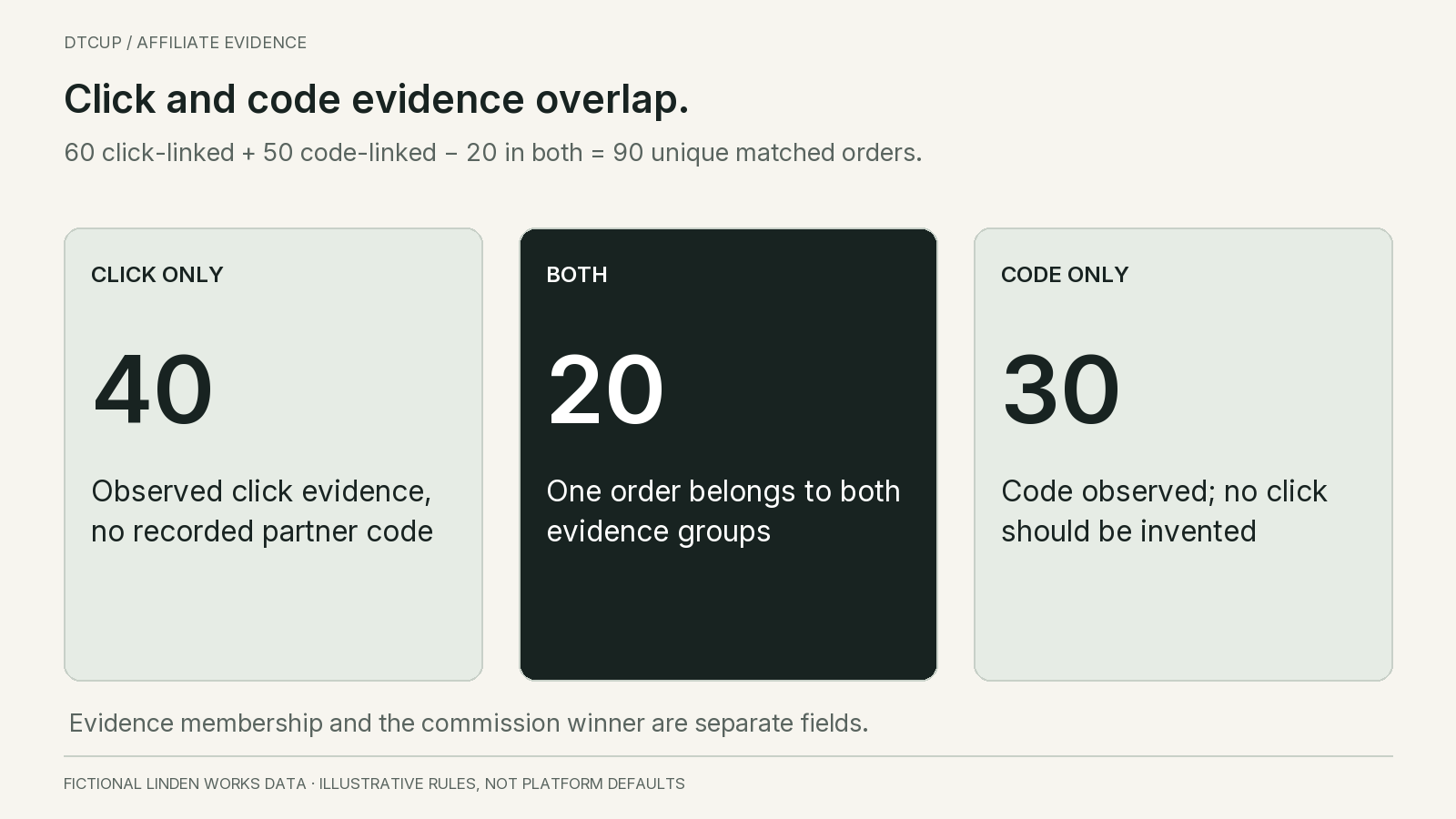
Within Linden’s ninety matched orders, sixty have supported click-linked evidence and fifty use a registered partner code. Twenty belong to both groups. The unique union is sixty plus fifty minus twenty, which equals ninety.
This produces forty click-only orders, thirty code-only orders and twenty with both evidence types. Adding the sixty and fifty as if they were separate sales would report one hundred and ten orders from a cohort that contains only ninety.
The overlap is informative. Click-only records may depend on link capture and conversion association. Code-only records may reflect offline recommendations, cross-device behavior, unobserved clicks or code sharing. The evidence alone does not tell you which explanation applies to each order.
Orders with both signals are not automatically stronger causal proof. A returning customer can click a coupon page and use a code immediately before purchasing something already selected. The two signals support an observed relationship but still do not reveal the counterfactual purchase decision.
Keep an order-level evidence table so the same transaction remains one transaction. Partner credit can then be assigned under the program rule, while the analytical view shows which signals were present. This is especially important when a code belongs to one partner and a qualifying click belongs to another.
Do not erase the losing signal after the commission decision. The program may pay one partner, but the observed path can contain several participants. Preserving the evidence allows later analysis without retroactively changing the agreed payout logic.
Version the credit rule instead of treating it as natural truth
A commission rule is a program choice. Linden might credit the last eligible affiliate click within an agreed window, subject to a code rule and exclusions. Another program may make a different choice. The important requirement is that the applicable rule can be identified for each transaction and understood by the people administering it.
Write down the qualifying event, time window, precedence between signals, eligible partner relationships and exclusions. Define what happens when there is no valid event, several claims or a code that has expired. A rule that only describes the easy case leaves the most contentious transactions to improvisation.
Preserve the rule version and effective dates. If the business changes how codes interact with clicks, comparing this month’s attributed revenue with last month’s can reflect a rule change rather than a change in customer behavior. The report needs that annotation before anyone interprets the movement as performance.
A financial obligation should follow the applicable agreement and approved program administration. Do not use a new analytical model to retroactively rewrite payments simply because another channel looks more persuasive. If the program needs different incentives, make a deliberate prospective change through the appropriate process.
Analysts can still compare alternative models for learning. A last-click view, a participation view and a code-linked view can illuminate different roles. Keep those exploratory calculations separate from the payment ledger and label them so a screenshot cannot be mistaken for an approved payout report.
The guide to reconciling attribution reports provides the broader method: align the order cohort and money definition, then change one rule at a time. A large difference becomes explainable when the relevant boundary is explicit.
Work one disputed order through the rules before changing the program
Consider a separate fictional order outside Linden’s batch arithmetic. The customer reads Partner Cedar’s comparison article, follows a tracked link and returns two days later. Just before paying, the customer visits Partner Stone’s offer page and uses a code associated with Cedar. The store records one hundred dollars of commissionable merchandise value.
Assume both clicks meet the program’s eligibility conditions and fall within its window. Under a simple last-eligible-affiliate-click rule with no code override, Stone would receive the credit. Under a different hypothetical rule that gives the registered code precedence, Cedar would receive it. The customer and order are unchanged; the allocation changes because the rule changes.
Neither outcome alone proves which partner caused the purchase. Cedar may have provided valuable comparison information. Stone may have helped close the decision, or may have met a customer who was already ready to buy. The observed record supports a sequence of interactions, while the causal role remains a separate question.
Suppose the approved program rule pays one winner at ten percent. The commission obligation for this example is ten dollars under that rule, allocated to the appropriate partner. If an analyst separately uses an equal-participation view, Cedar and Stone might each receive fifty dollars of analytical revenue credit. That analysis does not authorize two ten-dollar payments or redefine the original agreement.
This is why the payout export should name the program rule, while the analytical chart should name its model. Without those labels, a partner manager can mistake a learning view for a settlement record, and finance can mistake a settlement record for a complete marketing explanation.
When reviewing the dispute, reconstruct the eligible events, code registration, applicable dates and rule version. Then explain the result using that evidence. If the documented rule produces an outcome the business dislikes, that is a reason to review future program design, not a reason to quietly alter the evidence for this order.
A different case occurs when two integrations both submit the same sale. That is not necessarily a two-partner participation issue. It may be duplicate reporting of one event. The team needs to distinguish duplicated delivery, duplicated conversion claims and genuinely different eligible partner interactions before deciding what to remove.
Keep disputed cases as regression examples. A test order with two eligible clicks and a conflicting code can verify whether configuration behaves as the program owner expects. Use a controlled test environment or clearly identified test process, then follow the platform’s supported cleanup procedure. Do not create real customer purchases merely to make the dashboard look realistic.
Investigate code distribution without assuming every mismatch is fraud
A creator’s exclusive code appears on a public coupon site. Orders using it rise sharply, but clicks from the creator’s content do not. That pattern deserves investigation. It does not, by itself, establish that the creator intentionally broke the agreement or that every code-linked purchase lacks value.
Start with the facts you can verify. Where is the code visible? When was it observed there? What did the program allow? Which orders used it, and what other permitted evidence exists? Keep a copy of the relevant public placement and the applicable program rule rather than relying on a vague suspicion.
A customer can share a code with a friend without the partner controlling that action. A publisher can display an expired code because its content is stale. A code may also have been distributed more broadly by the brand’s own team. Trace the source and timing before assigning responsibility.
Operational responses should match the finding. Correcting a stale placement, changing future code distribution, reviewing a partner arrangement and fixing an internal campaign mistake are different actions. A blanket reversal can punish legitimate activity while leaving the underlying distribution problem unchanged.
Separate code validity at checkout from credit eligibility. A code might still apply a discount while no longer qualifying for partner payment under the relevant arrangement, or the reverse may be impossible in a particular setup. Confirm the actual configuration instead of assuming the shopping cart and affiliate system share one lifecycle.
Also examine the customer experience. A page promising a discount that no longer works creates confusion even if the attribution ledger is technically correct. The program owner needs a process for removing or correcting misleading placements, not only a process for reducing commission.
Move from matched orders to approved commission with a second ledger
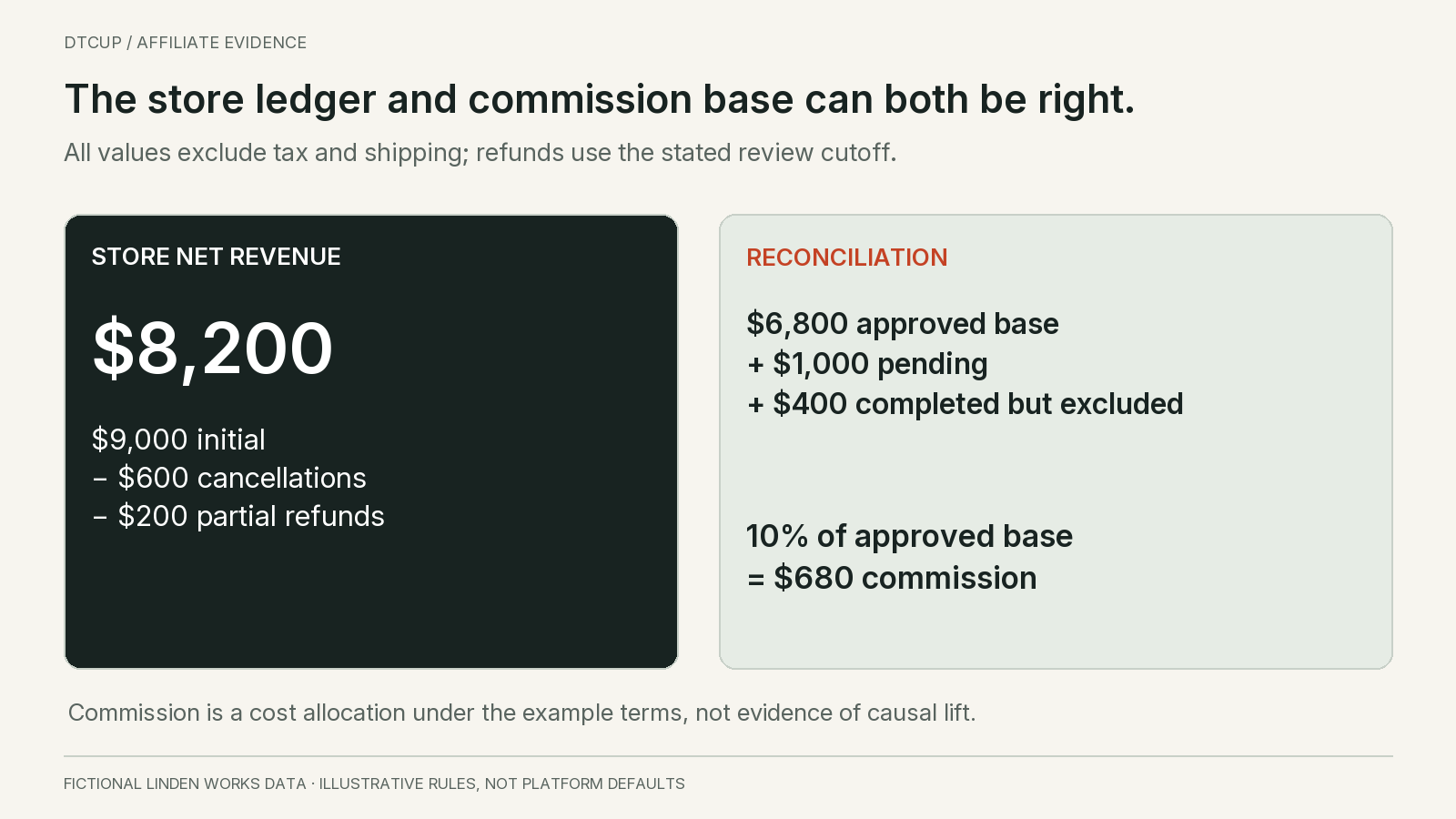
Return to Linden’s ninety matched orders. For a simple monetary example, each originally has one hundred dollars of post-discount merchandise value, excluding tax and shipping. The initial matched merchandise total is nine thousand dollars. This is a deliberately uniform teaching example, not a realistic assumption about every order.
At the review date, seventy orders are approved for commission, ten remain pending and ten are declined under the fictional program’s documented rules. The declined group contains six canceled orders and four completed orders excluded by the program rule. These are different reasons and remain separate in the record.
Five of the seventy approved orders each receive a forty-dollar partial merchandise refund. The approved commission base is therefore seven thousand dollars minus two hundred, or six thousand eight hundred dollars. Under the example’s flat ten-percent commission rule, the approved commission is six hundred and eighty dollars.
The ten pending orders still represent one thousand dollars of merchandise value under review. The four completed but contract-excluded orders represent four hundred dollars of store merchandise revenue without approved commission in this example. The six cancellations remove six hundred dollars from the initial matched merchandise total.
The store-side net merchandise total for these ninety orders is nine thousand minus six hundred in cancellations minus two hundred in partial refunds, or eight thousand two hundred dollars. That reconciles to six thousand eight hundred in the approved base, one thousand pending and four hundred completed but excluded.
Approved commission is therefore not ten percent of all eight thousand two hundred dollars. It follows the eligible base under the stated rule. Nor is the approved base the same thing as incremental revenue. The example has resolved a payment calculation, not the causal question.
impact.com’s reversed-action guidance describes pending actions, changes and reversals before the relevant locking point. Actual timing and permissions depend on the program. For an operating report, retain the original transaction, current status, reason and review date rather than overwriting history with an unexplained final number.
Design corrections as events, not invisible spreadsheet edits
A partner record may arrive before the store import, a refund may arrive after an initial report, and a previously unresolved reference may be corrected. If the report overwrites each prior state, reviewers cannot explain why last week’s approved total changed.
Keep the original claim and a sequence of relevant updates. Each update should identify the source, time, reason and affected value. The current view can show the latest supported state, while the history preserves how that state was reached.
Duplicates need their own treatment. An exact replay of the same delivery is different from a legitimate amendment to an existing action. A deduplication rule that drops every repeated order reference may accidentally discard a partial refund or status correction. Define which source event represents a new claim and which represents an update.
Partial changes need line or amount logic that matches the program. If one item is returned, reversing an entire multi-item order may be incorrect. Conversely, treating every return as a small adjustment can understate a full cancellation. The data contract should specify the supported granularity and what happens when detail is unavailable.
Keep currency and money definitions explicit. A partner feed in one currency and a store ledger in another cannot be reconciled by comparing raw numbers. Document the conversion basis if a common reporting currency is needed, and preserve the original amounts for payment and investigation.
Choose an as-of date for the operating view. A fresh cohort can contain many pending transactions that have not reached the review point. Compare similarly mature cohorts when assessing approval or reversal patterns. Otherwise, a recent period can look unusually good simply because returns have not yet arrived.
Do not manufacture a customer journey from a transaction match
Suppose Linden receives a partner action with an exact order reference and a code, but no usable click history. The brand can record that the action matches the order and that the code appears on it. It cannot fill the missing history with an imagined sequence of creator exposure, website visit and purchase.
This distinction matters when partner data is imported into a wider attribution product. A transaction-level association can support a separate evidence view without becoming a first recorded acquisition touch. If the system inserts a fabricated timestamp or channel interaction, other models may treat it as observed behavior and redistribute credit incorrectly.
Use a representation that preserves uncertainty. Code-linked order, partner-reported conversion and observed qualifying click are useful distinct labels. The absence of one signal does not erase the others, and the presence of one does not create the missing signals.
Likewise, do not infer a person-level ad view from aggregate creator impressions. A post with many views can be commercially promising, but the aggregate does not establish that the buyer of a specific order saw it. Audience estimates and transaction evidence belong in different parts of the analysis.
Customer surveys can add another perspective if designed and interpreted carefully. A buyer may remember a creator even when tracking is absent, or may report a channel that differs from the final click. That response is a reported recollection, not a replacement event log. Preserve its method and limitations rather than blending it silently into deterministic attribution.
The social and video measurement guide develops the same distinction between observed interactions and causal conclusions. Affiliate programs benefit from keeping that discipline even when a commission system requires one winner.
Judge the partner’s role before deciding what to improve
A review publisher may help customers compare alternatives long before checkout. A creator may introduce the product to an audience unfamiliar with the brand. A coupon publisher may meet customers at the final purchase step. These are plausible roles to investigate, not automatic descriptions of every partner in each category.
Look at the content and customer task. Does the placement explain a real product decision? Does the landing page continue the promise? Does it reach a relevant audience? Does it help existing customers find a useful offer? The commercial value can differ even when two partners have the same attributed order count.
Pair the quantitative view with a small reviewed sample of placements and journeys. A sudden rise in last-click orders may reflect a useful campaign, broader code distribution or customers searching for a discount after deciding to buy. The response should follow the evidence rather than the partner label.
Existing customers are not automatically worthless. A partner may help them discover another product or return after a long lapse. But a returning-customer order is also not automatically an incremental retention win. Use the customer definition and evidence available, and keep the investment question separate from contractual payment.
New-customer flags also need a definition. New to the store under the available order history is not necessarily new to the brand everywhere. Incomplete imports, guest checkout and account changes can affect the classification. Report the scope instead of presenting an uncertain label as a verified lifetime fact.
For a small program, I would prefer a handful of clear partner hypotheses over a elaborate score that conceals weak evidence. This partner helps explain the product to first-time buyers is a hypothesis that can guide content review and testing. This partner generated every matched dollar is often an unsupported conclusion.
Use incremental evidence for the next investment decision
Correct payment and future investment are connected but different decisions. The brand should honor the applicable program rules while evaluating whether a larger commission, a new placement or a different offer is likely to improve the business.
Where feasible, define a bounded comparison around the proposed change. The intervention might be an additional creator placement, a change in offer distribution or a new partner recruitment approach. The outcome should include the relevant store results and costs, not only the number of conversions the partner system assigns to itself.
Be careful with spillovers. Public codes can travel across audiences, and content can remain available after a planned campaign period. A comparison that assumes clean separation may be contaminated. Document how customers can encounter both conditions and whether that weakens the inference.
A before-and-after chart alone may reflect seasonality, price, inventory, other advertising or the brand’s changing popularity. It can support a hypothesis, but it should not be described as a controlled causal estimate without the appropriate design and evidence.
When a strong experiment is not feasible, make a smaller reversible decision and state the uncertainty. Review content quality, matched-order evidence, customer mix, net contribution and plausible substitution together. This does not transform weak evidence into certainty; it limits the cost of being wrong while the program learns.
Commission is only one cost. Include samples, production, fixed placement fees, discounts and the operating work relevant to the decision. An affiliate channel can look efficient when only variable commission is counted while the brand pays substantial fixed costs elsewhere.
Repair missing evidence without rewriting history
When matching falls, first identify where the evidence was lost. A landing link may carry the intended parameters while a redirect removes them. Checkout may create the correct order reference while the conversion message sends a display label from another system. The partner feed may be complete while the store import is several hours behind.
Use a controlled trace from the approved partner link to the source order and reported conversion. Record what each step actually emitted. The purpose is to find the first divergence, not to select the tool with the most flattering total. A screenshot of the final report cannot reveal whether the underlying event was duplicated or never received.
Once the cause is understood, separate prospective repair from historical correction. Fixing a redirect can preserve future evidence. It does not reveal which past customers clicked a link whose identifier was lost. Historical claims need their own supported evidence and the program’s correction process.
Do not reconstruct missing clicks from the code alone or assign every direct order during a creator campaign to that creator. Those shortcuts can make the reporting line smoother while making the history less truthful. A labeled gap is more useful than a fabricated event that later models treat as fact.
Historical order matching can sometimes be repaired legitimately. For example, a documented prefix mapping may resolve references that were previously unmatched. Preserve the mapping change, affected records and before-and-after counts. Re-run eligibility under the appropriate rule rather than assuming a newly matched record must immediately be approved.
Validate the repair on more than the happy path. Include an order without a partner interaction, a valid code without a click, a duplicate delivery, a canceled transaction and a partial refund. The repaired process should preserve their different meanings rather than turning every case into one generic conversion.
Finally, annotate the reporting break. A rise in matched partner revenue after a tracking repair may mean the system sees more of the same activity. It is not automatically evidence that the campaign became more effective. Keep measurement changes beside marketing changes so the next review can separate improved observability from improved performance.
Build a weekly review that protects both sides of the program
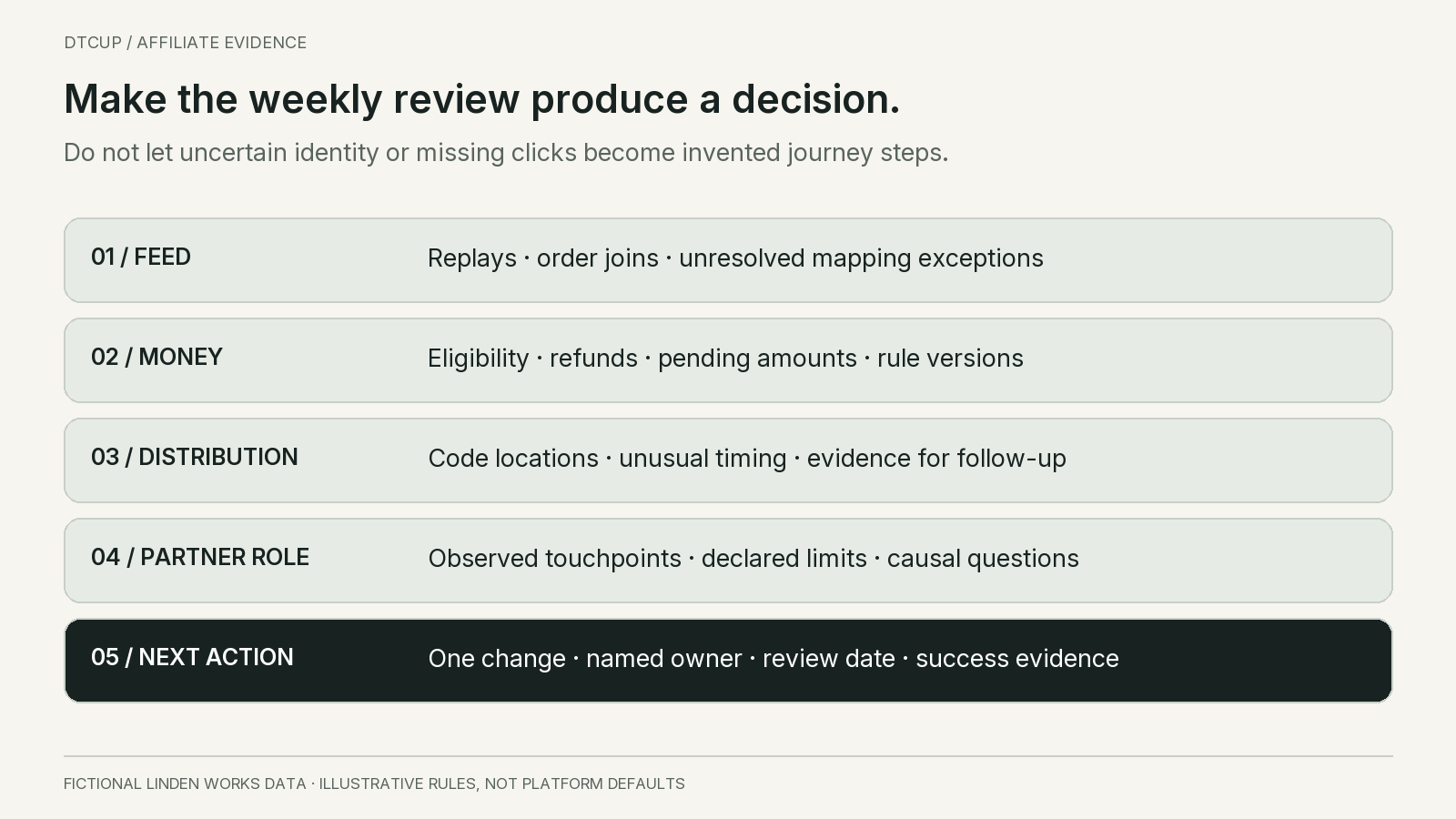
Start the review with feed health: new claims, proven replays, matched records and unresolved exceptions. Assign an owner to mapping failures. A partner should not lose visibility into a legitimate sale because two systems format an order reference differently.
Then review eligibility and money: pending, approved, declined, amended and the reasons behind changes. Show the cohort and as-of date. Separate cancellations from contractual exclusions so the business can understand whether a problem comes from customer behavior, product experience or program administration.
Next inspect unusual distribution patterns. A code appearing in a new public location, a sharp change in click-to-code mix or a rise in very short observed click-to-order intervals can justify a closer look. None should automatically become a fraud accusation without supporting evidence.
Finish with one program decision. It might be repairing an integration, correcting a misleading placement, testing a landing page or changing future terms through the approved process. State the intended effect, owner, review date and evidence that would support continuing or reversing the change.
Give partners a clear inquiry route. A disputed action should be traceable to a reference, applicable rule and current status. A generic message saying attribution did not match is not enough for either side to diagnose a problem.
The strongest program relationship is built on explainable records. You do not need to claim perfect tracking to be fair. You need to distinguish what is known, what is pending and which rule produced the current decision.
Before closing the review, ask another team member to reproduce one ordinary payment and one exception without help from the report author. Give them the source claim, matched order, status history and rule version. If they cannot explain the approved amount, the report is not yet operationally clear, even if every aggregate balances. This small exercise often reveals hidden assumptions about tax, currency conversion, refund timing or code priority that a polished dashboard conceals.
Record the explanation next to the decision rather than burying it in a meeting transcript. Future staff should be able to distinguish a deliberate program choice from an integration workaround. That distinction makes later corrections possible without turning every dispute into a fresh argument about what the numbers were supposed to mean.
Questions about affiliate attribution
Does a unique creator code prove that the creator caused the sale?
No. It can provide order-level code evidence and may trigger credit under the configured rule. It does not establish where the buyer obtained the code or what would have happened without the creator. Keep the contractual credit decision separate from the causal investment question.
Should click and coupon orders be added together?
Only after accounting for overlap. An order can contain both signals. Keep a distinct-order ledger and show click-only, code-only and both where useful. In the fictional example, sixty click-linked plus fifty code-linked minus twenty overlapping orders equals ninety unique orders.
Why does approved affiliate revenue differ from store revenue?
The commission base may exclude pending, canceled or contract-ineligible transactions and may reflect refunds differently at a given review date. Align the cohort, currency, money definition and status before diagnosing a discrepancy. A difference can be legitimate when the measures answer different questions.
Can an exact partner order reference recover missing website visits?
No. It can link the transaction records when the mapping is valid. It cannot reconstruct interactions that were not observed or supported by another source. Preserve the transaction association without inventing a click, identity connection or exposure time.
Should every unmatched claim be declined?
Not merely because the initial join failed. Investigate the reason and follow the applicable program process. Import delays, formatting differences and event-scope mismatches can create unresolved records. Keep data-quality exceptions distinct from a documented eligibility decision.
A useful affiliate report is not the one with the largest attributed number. It is the one that can explain how a claim became a matched order, how that order became an eligible payment and what further evidence supports the next commercial decision. Keep those steps visible and the program becomes easier to improve without inventing a customer journey.
Sources
Still have a question?Ask the DTCUP Community ↗