
Run a Weekly Inventory Review That Ends in Decisions, Not More Red Cells
Turn stock alerts into timely choices. A practical meeting method for evidence, priority, spending authority and follow-through, with three worked inventory exceptions.

7 years of experience building and operating brand websites, specializing in website development, paid advertising and SEO. Built a brand website from launch to US$10 million in annual sales.
The Short Answer
Prepare one dated stock-and-commitment snapshot, prioritize by the last feasible action time, compare verified options and record the authorized action. Track execution separately from whether the customer or economic risk has actually been resolved.
Key takeaways
- A threshold breach needs a consequence and decision deadline.
- Service, economic and data exceptions require different first responses.
- The live agenda should focus on material choices rather than every SKU.
- Approval, supplier acknowledgement and usable receipt are separate states.
- Closure requires evidence that the relevant risk has resolved.
- Recurring causes should change the monthly policy or upstream process.

A weekly inventory meeting can consume an hour without changing a single purchase, shipment or customer promise. Everyone looks at the same red cells. The buyer explains the supplier delay. Marketing explains the promotion. Finance asks why stock is high. The meeting ends with a request to keep watching the situation, and the same rows return the following week.
I would judge that meeting by a different output: did it resolve the decisions that could no longer wait? A useful inventory review turns a small number of material exceptions into authorized actions, with a deadline and evidence of completion. The dashboard is preparation for that work. It is not the work itself.
This guide describes an operating method a small or growing brand can run without a large planning department. It covers preparation, priority, decision rights, a worked meeting, follow-through and learning. The business and numbers below are fictional illustrations, not DTCUP customer results. Adapt the thresholds to your products, commitments, cash position and ability to recover.
Define the job of the meeting before inviting everyone
The weekly review should reconcile changes that affect the near-term inventory plan. A shipment moved. Demand exceeded the working assumption. A promotion changed the product mix. A quality hold removed usable stock. A slow product is about to cross a cancellation deadline. These events require decisions across people who control different parts of the system.
It should not become the place where the team reads every SKU aloud, rebuilds the annual strategy or cleans all source data in real time. Those activities have different preparation and participation needs. If an exception requires detailed investigation, assign that work with a decision deadline and preserve the temporary operating rule until the evidence is available.
Choose a review horizon that reaches far enough to expose the next meaningful intervention. For a locally replenished consumable, that might be a few weeks. For imported seasonal goods, it may need several months. The useful horizon is determined by action lead time, not by the width of a spreadsheet. A cancellation deadline next Tuesday matters even when the goods would arrive much later.
There are also events that cannot wait for the weekly meeting. An accepted order about to miss its promise, a serious quality concern or a shipment booking that expires today needs an immediate route. Define that route alongside the weekly cadence. Otherwise “we review every Friday” becomes an excuse to delay an action whose opportunity disappeared on Wednesday.
The meeting charter can fit in a paragraph: identify changes that threaten agreed service or stock economics, decide within named authority, record actions and verify previous commitments. Include what is outside scope and how it will be escalated. That simple boundary protects the meeting from becoming a general complaint session about every operational problem in the company.
An exception is a decision gap, not merely a red cell
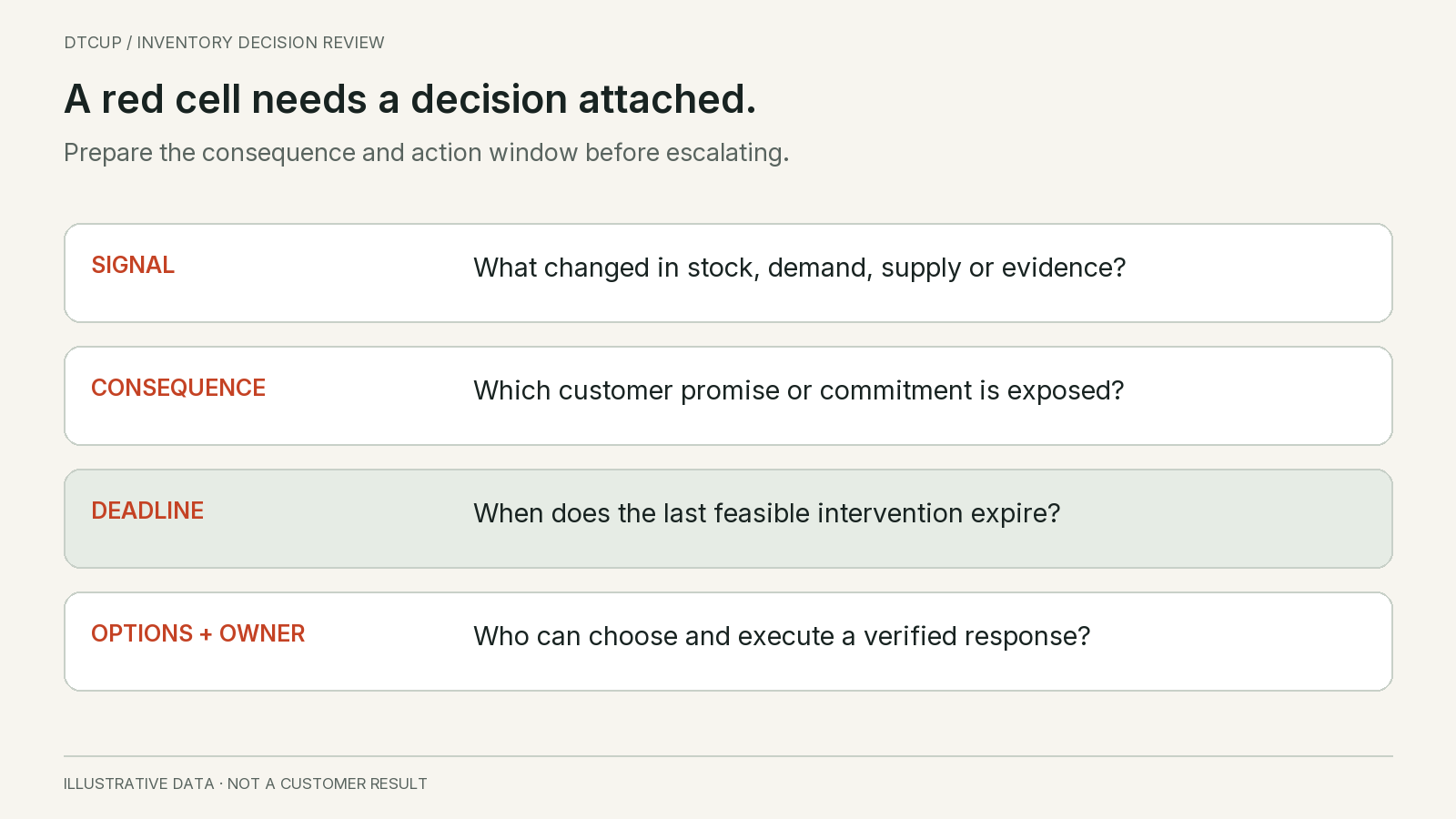
A metric crossing a threshold is a signal. It becomes a useful exception when the team can state what may happen, by when, to whom, and what choice remains. “Cover is low” is incomplete. “The current usable stock will not support the next planned demand before the confirmed receipt, and the transfer booking closes tomorrow” describes a decision.
Separate three broad classes. A service exception threatens an accepted or planned customer promise. An economic exception threatens cash, margin, shelf life or storage economics. A data exception means the evidence is too uncertain to authorize the intended action. They can overlap, but the first response differs. A stale stock feed may require a count before an urgent purchase.
Do not hide the data problem inside a larger safety buffer. Buying extra units every time records look unreliable can make the balance sheet absorb a preventable process failure. Likewise, do not assume a low stock number is wrong merely because the business wants more units to be available. The review must distinguish evidence from the outcome people would prefer.
Give an exception a stable identity. Repeated alerts about the same SKU, warehouse and shortage interval should normally update one decision record. Without that identity, a delayed receipt can appear as several independent shortages and generate duplicate expedites or purchase orders. Separate genuinely different needs, such as an immediate accepted-order gap and a later seasonal replenishment decision.
A short exception statement should contain the item and location, the affected period, the current plan version, the consequence, the latest safe decision time and the proposed owner. It should also say what has changed since the last review. If nothing material changed and an agreed action remains on track, that row may need monitoring rather than another full discussion.
Prepare one reconciled snapshot before the meeting
Participants should not arrive with unrelated exports taken at different times and spend the meeting arguing about whose number is newer. Establish a preparation cutoff, reporting timezone and source coverage. Record when warehouse stock, open orders, purchase orders and expected receipt dates were last refreshed. A current meeting date does not make an old source current.
The preparation owner should reconcile stock states for the affected items. Physical stock, usable stock, reservations, quality holds and expected receipts are not interchangeable. If the source’s available quantity already subtracts reservations, do not subtract them again in the planning sheet. A small sample of important lines is often more valuable than a large unexplained total.
Show dated supply and demand over the same periods. A receipt after the shortage interval does not prevent the earlier service failure. A warehouse total also does not prove the goods are in the right location or can travel in time. For the underlying mechanics, use the separate guide to uncertain inbound inventory and usable receipt dates.
Capture accepted orders separately from forecast demand that has not yet become an order. Explain whether the planning forecast is total demand or incremental demand beyond current commitments. Mixing those definitions can double count the accepted orders. The meeting packet should make the calculation traceable enough that another participant can reconstruct the projected gap.
Freeze the prepared snapshot for the meeting record while allowing material updates to be added visibly. If a supplier confirmation arrives halfway through the discussion, record the new evidence and its time. Do not silently replace the starting numbers. The team needs to explain both why the exception was raised and why the eventual decision differed from the initial recommendation.
Rank the agenda by the action clock and consequence
The item with the largest revenue number is not automatically the first decision. A moderate issue with an irreversible deadline today may deserve attention before a larger issue with several weeks of flexibility. I would first ask when the last feasible intervention expires, then evaluate the customer and commercial consequences of missing it.
Use a few explicit priority bands rather than a falsely precise score with many subjective inputs. An immediate band covers decisions that must happen before the normal meeting or threaten serious customer harm. A this-cycle band covers meaningful choices that expire before the next review. A monitor band covers issues with an owner, sufficient time and no immediate change required.
Within a band, compare the number of affected commitments, plausible contribution at risk, recovery options and uncertainty. Do not equate forecast revenue with guaranteed loss. Some demand may wait, substitute or never materialize. Accepted customer orders create a different obligation from a sales target. The meeting should expose those distinctions instead of collapsing them into one “lost sales” estimate.
Confidence also matters, but low confidence is not always a reason to push a row down the list. If uncertainty concerns a large, irreversible purchase, verifying the missing evidence may be urgent. If a low-impact item has unreliable history and an easy recovery route, a bounded monitoring action may be sufficient. Priority is about the decision consequences, not only the confidence score.
Make the reason for priority visible beside the row. “Supplier cancellation right expires Tuesday” is more actionable than “high priority.” If every row is high priority, the team has not made a prioritization decision. Limit the live agenda to the decisions the group can actually resolve, and route the rest through named asynchronous owners with appropriate escalation.
Put the people with authority in the room
A buyer may be able to request an earlier delivery but not approve the additional freight. Marketing may be able to change a campaign but not alter a customer promise already accepted. A warehouse lead may identify usable stock but not authorize its removal from a protected channel allocation. These boundaries need to be known before the recommendation is presented.
Define decision rights by action type and size. Routine replenishment within the approved plan may belong to the buyer. Spending above an agreed threshold may require finance. Reallocating committed units may require an operational escalation and a customer communication decision. Quality release should remain with the authorized quality owner; commercial pressure should not turn a meeting vote into inspection evidence.
For each agenda item, distinguish the person preparing evidence, the person recommending an option, the person approving the commitment and the person executing it. One person can hold several roles in a small team, but the responsibilities should remain clear. “Operations owns this” is too vague when nobody knows who must send the supplier instruction.
Invite only the people needed for the decisions and let specialists join for their items. A recurring attendee who cannot contribute evidence or make a decision may be better served by the written record. Conversely, excluding the warehouse or customer-service owner can produce a financially attractive plan that fails during receiving or creates promises the team cannot honor.
If the approver is absent, record whether a delegate has authority. Do not label an option approved because nobody objected in a meeting where the required decision-maker was missing. The result can be “recommended, awaiting approval by noon,” with a temporary rule and escalation route. That is an honest operating state and is more useful than a misleading green status.
Work through a fictional review with three different decisions
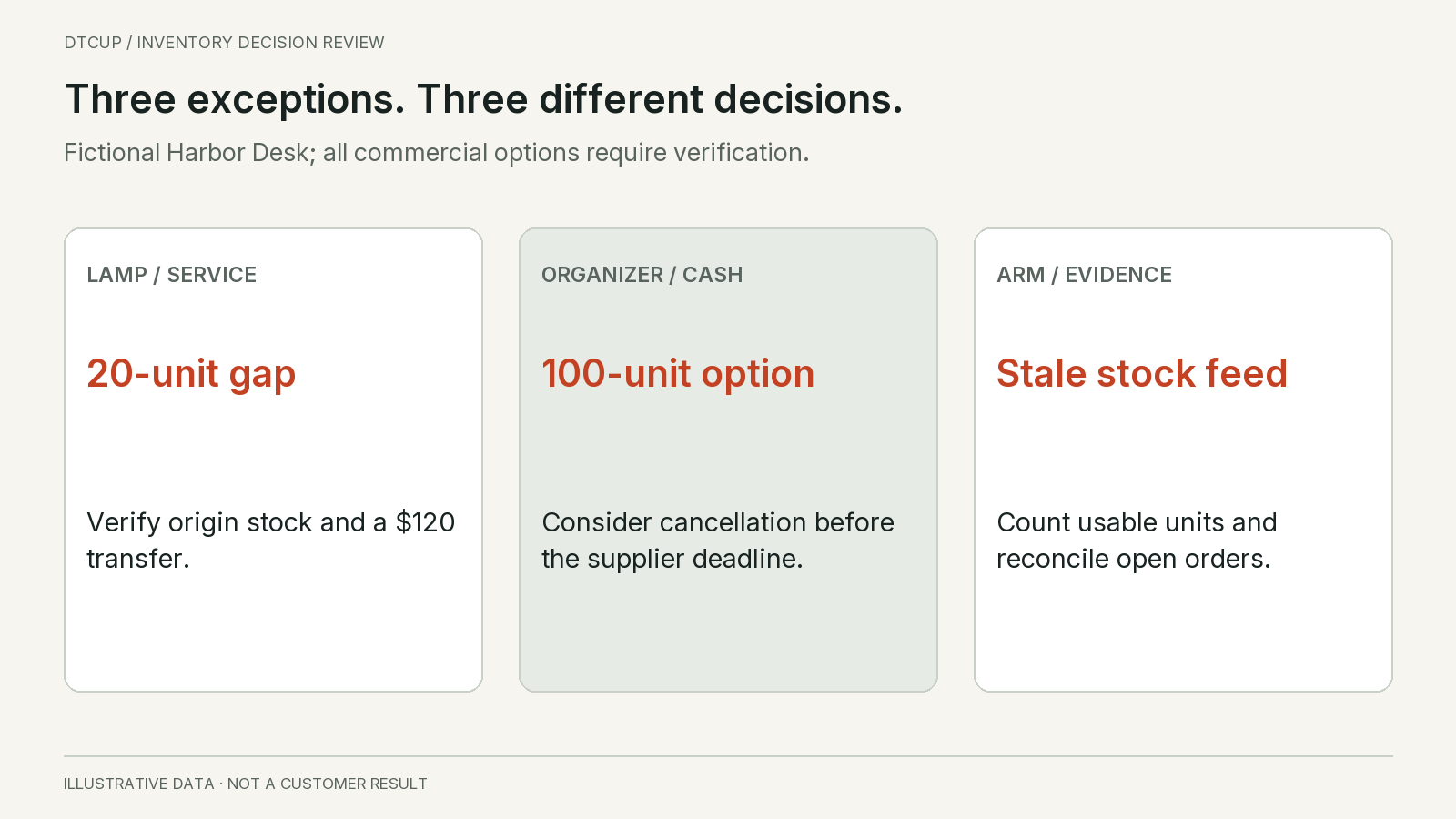
Consider Harbor Desk, a fictional home-office brand reviewing inventory on Monday morning. Its preparation packet contains three exceptions: a lamp receipt delay, a slow-selling organizer with an approaching cancellation deadline, and a monitor arm whose stock feed has stopped updating. The examples are deliberately different because a good review should not treat every red row as a request to buy more.
The lamp has eighty free units after accepted-order reservations have already been deducted. The remaining forecast for the next five selling days is twenty units per day, or one hundred units. A receipt previously expected during that interval is now confirmed too late to help. Under that single stated scenario, the projected gap is twenty units. The buyer has verified the free-stock definition and has not subtracted the accepted orders twice.
An alternate warehouse can send twenty units in time, subject to a booking that expires Tuesday morning. The all-in transfer cost is $120. The team estimates $15 contribution per additional fulfilled unit before that transfer cost, giving $300 for twenty units and $180 after the transfer. These are illustrative planning estimates. They assume all twenty units sell and that moving them does not displace a more valuable commitment at origin.
The source warehouse owner must therefore confirm that the units are genuinely uncommitted and can leave without creating another shortage. If ten of them would otherwise fulfill equally valuable orders at origin, the proposal needs a different comparison. The meeting cannot count the destination benefit while ignoring the origin loss. This is where channel and warehouse allocation logic enters the decision.
The organizer is a different problem. There are three hundred usable units and a working twelve-week demand estimate of sixty. Another two hundred units are ordered for later delivery. The supplier permits cancellation of one hundred units without a fee only if instructed by Tuesday; those terms have been verified for this fictional case. At $18 per unit, cancellation would avoid a future $1,800 purchase payment, but it does not create $1,800 of profit or recover cash already tied up in existing stock.
The monitor arm has a source-data problem. The report shows fifty units, but the last successful warehouse update was Thursday. The meeting cannot tell whether that quantity remains available. Rather than approve an expedite from an unreliable shortage calculation, it assigns a same-day count and order reconciliation. The temporary selling rule follows the brand’s existing promise policy and is explicitly owned until the evidence arrives.
Require an option comparison, including doing nothing
For the lamp, the options might be a verified transfer, a more expensive supplier expedite, a temporary promotion change or accepting a bounded shortage with clear customer communication. The comparison should show feasible quantity, arrival timing, cost, dependencies and what would remain unresolved. An option that arrives after the critical interval is not a solution to that interval.
Doing nothing belongs in the comparison because it reveals the actual cost of intervention. It should not be written as a caricature. State the likely outcome under the current plan, including the possibility that customers wait or demand is lower than expected. Then compare how the intervention changes that outcome. Otherwise every additional freight charge can be justified against an exaggerated worst-case loss.
Use a sensitivity check when the recommendation depends on one uncertain assumption. At $15 contribution per fulfilled lamp and a $120 transfer cost, eight incremental units cover that cost under the simplified example. Fewer than eight would not. This does not prove the transfer should happen; it shows which demand assumption the approver must judge and what origin opportunity cost is still excluded.
For the organizer, compare cancellation, postponement, keeping the order and changing the offer only if those options are actually available. A supplier’s willingness to reschedule is evidence to obtain, not an assumption to put in the approved plan. A discount campaign may reduce inventory but weaken unit economics or pull forward demand that would have occurred anyway.
Do not allow the largest spreadsheet to win by default. A one-page comparison with verified constraints can be more decision-ready than a complex forecast whose source and commercial terms are unclear. The purpose of analysis is to expose the tradeoff the owner must accept, not to make a discretionary choice appear mechanically inevitable.
Run a short agenda that produces a written decision
Begin with the previous meeting’s due actions and any material failures. This is not a ceremonial status update. If a promised transfer did not ship, the starting inventory plan is different and today’s decisions must reflect that. Confirm which actions are complete, which are late and which no longer address the current risk.
Next, review the source-health summary and material changes since the preparation cutoff. Keep this concise. The aim is to prevent decisions based on an invalid snapshot, not to turn the room into a live data-cleaning workshop. A data exception that blocks a large decision should receive an owner and a rapid evidence deadline.
Then work through the prioritized decision items. For each one, the preparer states the change and deadline, the recommender presents feasible options, affected owners challenge dependencies, and the authorized person records a choice. The recorder reads back the action, quantity, cost limit, owner, deadline and contingency before moving on.
Reserve the final part for cross-item conflicts. Two individually sensible expedites may compete for the same receiving slot or cash budget. Cancelling one supplier order may remove a freight consolidation assumption used by another. The meeting needs to check the combined plan, not merely approve a series of isolated rows.
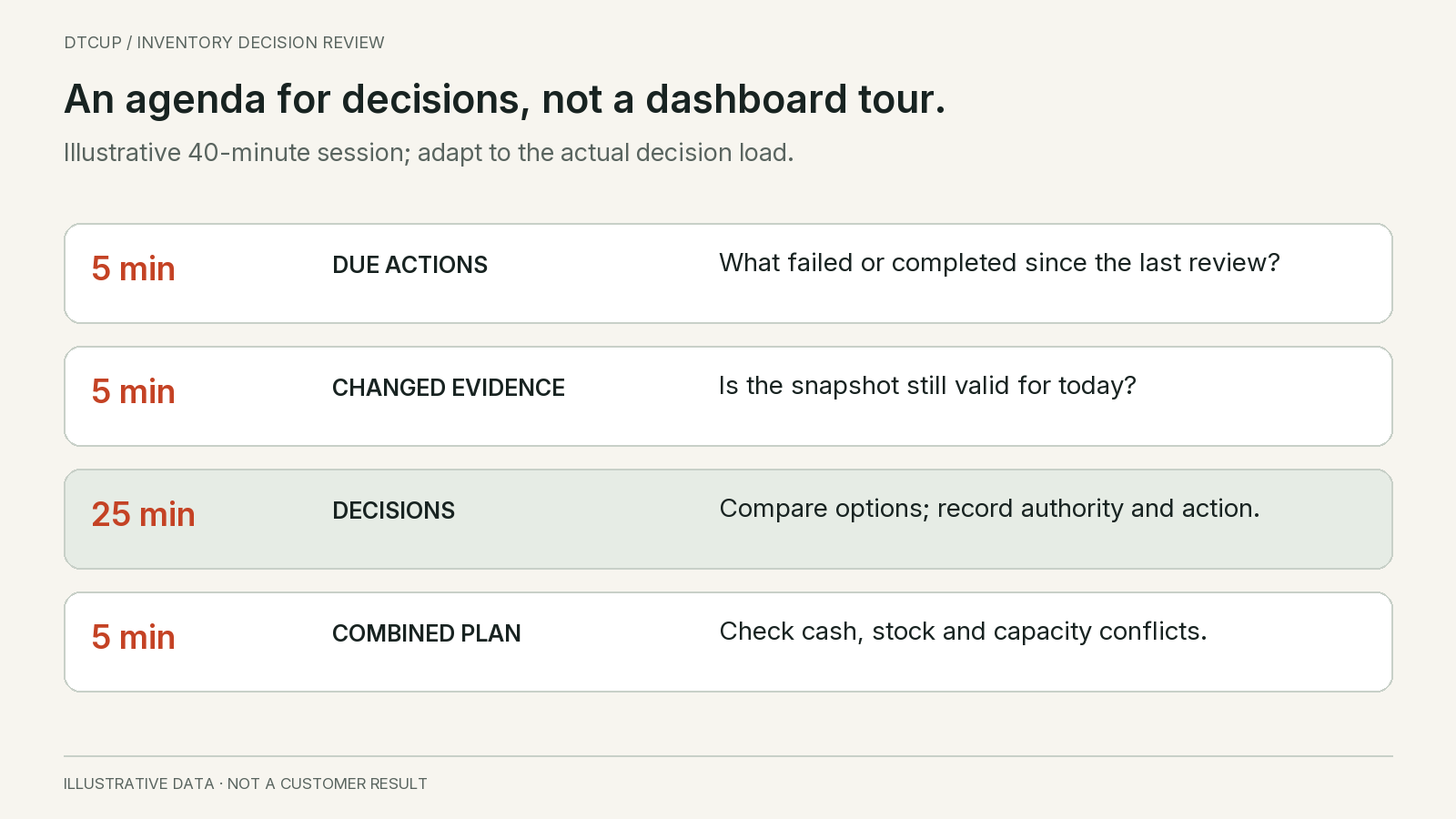
A forty-minute session might spend five minutes on due actions, five on source and assumption changes, twenty-five on the highest-priority decisions and five on the combined commitments. Those durations are an example, not a standard. If the team consistently cannot resolve the prepared agenda, reduce the number of live items or improve preparation instead of permanently extending the meeting.
Write the decision so someone absent can execute it
A useful record is more specific than “expedite lamps.” It says which SKU and source location, which twenty units, where they must arrive, what counts as usable receipt, the authorized maximum cost, the owner and the booking deadline. It also states the evidence on which the decision depends and what should happen if that evidence changes.
For Harbor Desk, the record might authorize the warehouse lead to book the verified twenty-unit transfer at no more than $120, provided the origin reservation check passes and usable destination receipt remains feasible before the shortage interval. If either condition fails, the owner returns to the named approver rather than quietly spending more or moving a different product.
For the organizer, record the cancellation instruction as a request until the supplier acknowledges it under the agreed terms. The planning system’s reduced incoming quantity should not become the commercial source of truth before that acknowledgement. A note that someone emailed the supplier is evidence of an action attempt, not proof that the purchase obligation disappeared.
The monitor-arm record should name the count scope, accepted-order reconciliation, responsible person and the time the selling rule will be revisited. “Check stock” is too broad. If the count confirms only thirty-two usable units, the next action may be a revised promise or replenishment review. If the count confirms fifty, the connector still needs repair even though the immediate shortage concern is reduced.
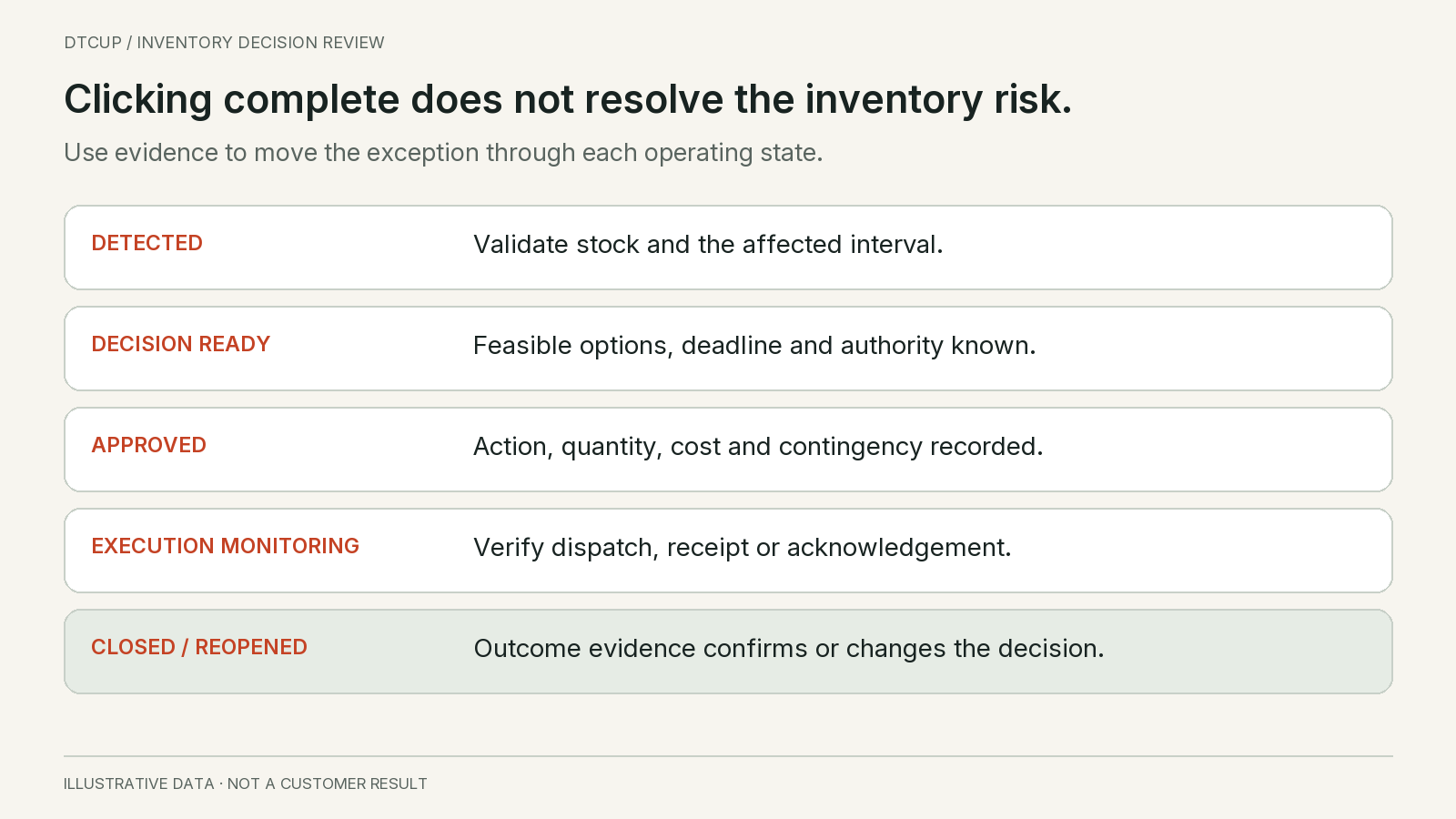
Keep the decision and its execution events linked. Approval, instruction sent, supplier acknowledged, goods dispatched, goods received and inspection released are different states. The team should be able to answer both “what did we decide?” and “what has actually happened?” without reconstructing the story from several private chat threads.
Close an exception when the risk is resolved, not when the task is clicked
The lamp transfer booking does not close the service exception. It changes the next evidence to watch. The goods may still miss dispatch, arrive damaged or wait in receiving. The exception can move from decision required to execution monitoring, with the next checkpoint tied to the event that matters.
Define closure for each class. A service exception may close when the affected commitments have a feasible fulfilled or revised promise under the agreed policy. An economic exception may close when the purchase change is accepted and reflected in the commitment ledger. A data exception may close when the source is restored, the missing interval is reconciled and dependent decisions are rechecked.
Do not close a shortage simply because demand fell. That may legitimately remove the immediate risk, but record the reason. The unneeded expedite, if already booked, may create a new economic exception. A system that erases the original alert loses the opportunity to learn whether the response was timely and proportionate.
Similarly, reopening is not automatically failure. New evidence can invalidate a previously reasonable decision. Preserve the original rationale, the change and the new owner action. The unhealthy behavior is suppressing a reopened issue to protect a completion metric or creating a new record so the age of the unresolved risk appears shorter.
Use separate fields for action status and exception status. The action can be complete while the risk remains open. An investigation can also demonstrate that the signal was invalid, closing the exception while generating a data-quality improvement task. Those distinctions keep operational reporting honest and make the next meeting shorter because the status has a clear meaning.
Handle disagreement by identifying the assumption that changes the choice
Marketing may expect demand to rise while the buyer sees slowing orders. Finance may oppose an expedite that customer service considers essential. These disagreements are not solved by asking everyone to agree with one forecast. Ask which assumption would change the preferred action and what evidence can resolve it before the deadline.
For the lamp, the useful question may be whether at least eight incremental units will sell in the protected interval, given the simplified transfer economics. For the organizer, it may be whether a documented upcoming campaign is likely to consume enough stock before the additional receipt. Each question is more focused than debating whether the business is generally optimistic or conservative.
Where evidence cannot arrive in time, the authorized owner must choose under uncertainty. Record the range considered, the consequence of being wrong and the contingency. A smaller reversible commitment may be preferable to a large irreversible one, but only if that option actually exists and its additional cost is understood.
Keep promises and quality boundaries outside informal bargaining. A commercial team should not waive a required inspection because an optimistic scenario needs the units. An accepted customer commitment should not disappear from the calculation because a more profitable prospective channel is attractive. Escalate a genuine policy conflict to the appropriate owner rather than hiding it in an adjusted spreadsheet.
After the outcome is known, review the decision against information available at the time. A good decision can have a poor outcome under uncertainty, and a weak decision can be lucky. This distinction encourages staff to surface uncertainty early. Punishing every adverse outcome teaches people to conceal risk until the choices are already gone.
Measure the quality of the review without rewarding easy closures
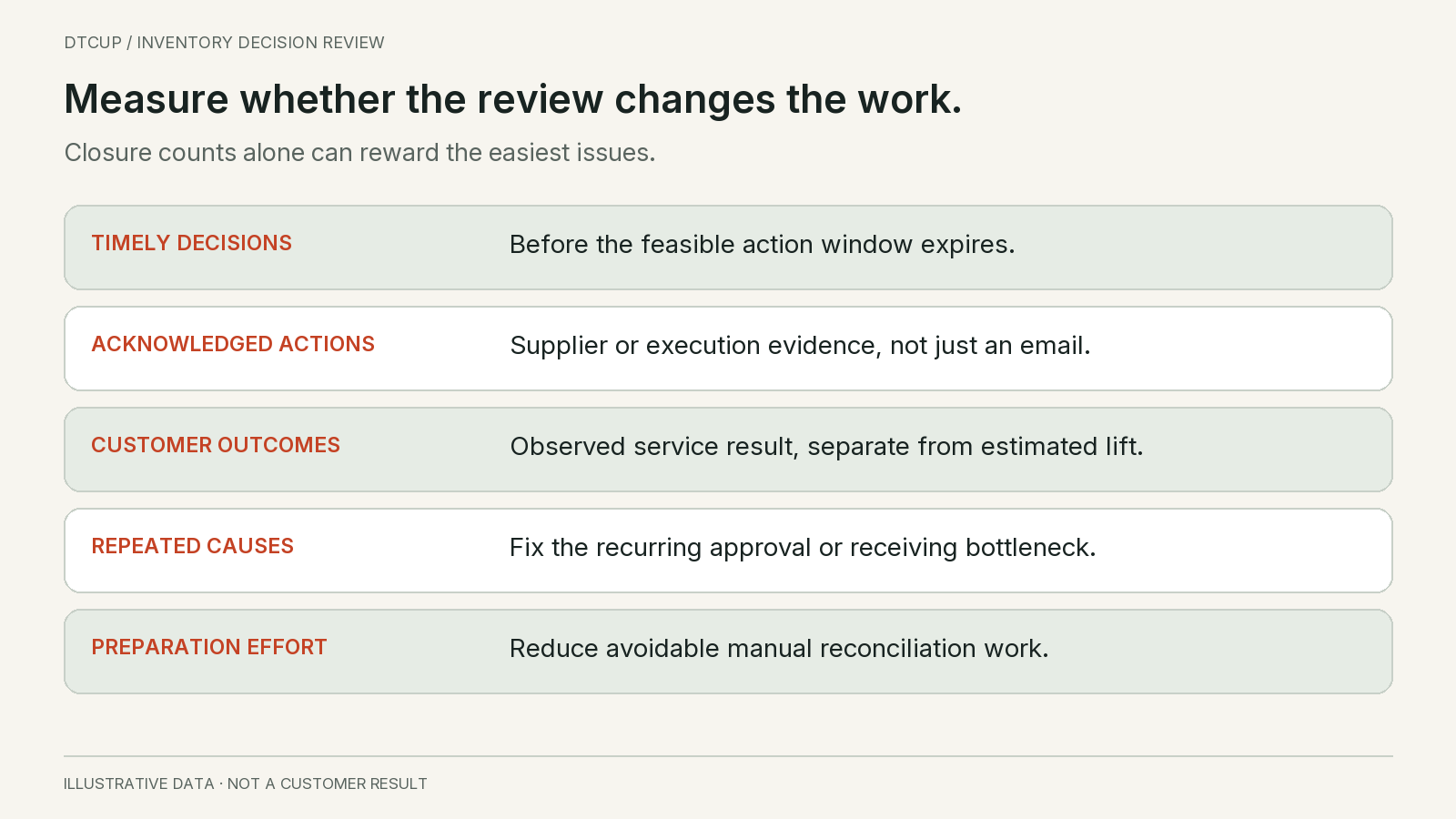
Count the decisions made before their action deadlines, not just the number of alerts closed. Track how many approved actions received the required acknowledgement, how many missed the next checkpoint and how many exceptions reopened because a dependency was ignored. These measures describe the operating process rather than merely the appearance of a tidy board.
Pair them with outcomes: affected commitments fulfilled or responsibly revised, expedite cost, avoidable excess commitments and time spent resolving source defects. Keep definitions consistent. “Stockout prevented” requires a defensible counterfactual estimate and should not be claimed merely because a transfer occurred. Report the action and observed service result separately when the alternative outcome is uncertain.
Look at age by exception class and action window. A five-day-old data issue blocking a purchase may be more serious than a four-week-old monitored seasonal risk with no decision due yet. A single average age can encourage teams to close difficult records prematurely or spend time on easy low-value cases.
Review repeat causes, not just repeat SKUs. If several items become urgent because approvals take too long, changing reorder buffers may conceal the real delay. If every late receipt is caused by missing receiving appointments, the next improvement belongs in inbound coordination. The weekly meeting should generate a small number of process fixes that reduce future exceptions.
Do not set universal targets from this article. Establish a baseline over several cycles, identify the most consequential failure mode and improve that first. The objective is a more reliable decision process, not a dashboard full of percentages that participants cannot connect to actual orders, shipments or commitments.
Reduce alert noise without hiding the underlying risk
As the assortment grows, simple threshold alerts can create hundreds of rows. Start by grouping signals that share a cause and decision. One delayed container may affect many SKUs; the meeting may need a container-level intervention plus a small set of item-level exceptions where customer consequences differ. Do not force the group to repeat the same discussion for every line.
Suppress duplicate notifications while a valid decision is open, but continue updating the evidence. Suppression should have an expiry and a reason. If the projected shortage deepens, the receipt changes again or the action deadline approaches, the record should become visible at the appropriate priority. Muting an alert forever is not exception management.
Use materiality carefully. A low-value part can block a high-value bundle or an important service replacement. Revenue rank alone may exclude the component whose absence causes the largest customer disruption. Include dependency information so the team can see when a small SKU carries a larger operational consequence.
Review thresholds after both missed risks and noisy alerts. A threshold that triggers too late needs a different lead-time or action-clock assumption. A threshold that repeatedly flags harmless variation may need a better segment or demand horizon. Keep the previous rule and the reason for the change so the team can assess whether the adjustment improved decisions.
Automation should prepare and route evidence before it automatically commits money. Start with duplicate detection, freshness checks, due-action reminders and draft exception packets. A tool can help calculate the gap, but the business still needs verified constraints and authority for purchases, transfers or promise changes. Do not represent a proposed workflow as an existing DTCUP feature unless it has actually been implemented and verified.
Connect the weekly review to the monthly plan without mixing their jobs
The weekly review handles exceptions to an operating plan. Repeated exceptions may reveal that the plan itself needs revision: a service target is unaffordable, supplier lead time is structurally different, the assortment is too broad or the sales plan exceeds available cash. Those questions deserve a broader planning decision, not repeated emergency treatment.
Keep a small escalation list for that monthly discussion. State the pattern, the evidence across several cycles, the policy decision required and the temporary rule in force. “We expedited this family three times because the approved lead time excludes inspection” is a more useful escalation than “supply chain needs improvement.”
Once the policy changes, update the relevant planning assumptions and tell the weekly team which old exceptions it should retire or reinterpret. Otherwise the strategic meeting approves a new service policy while the operating dashboard continues using the previous thresholds. The same company then runs two incompatible plans without realizing it.
The distinction between planning, feasible supply and exception visibility is also reflected in SAP’s published planning capabilities. The practical method here is an independent operating recommendation, not a requirement to buy that software or a claim that a particular system will solve the organizational handoffs.
For a smaller brand, a well-maintained shared record may be enough to start. Its limitations should be explicit: access control, concurrent edits, source freshness and acknowledgement tracking. Move to more integrated tooling when those limitations materially damage the decisions, rather than assuming a larger platform will create ownership that the team has not agreed.
Pilot the process on one manageable assortment
Choose a product family with meaningful decisions and accessible evidence. Do not begin with every SKU in every market. Prepare the first packet manually if necessary so the team understands each field before automating it. The first objective is to make one complete decision traceable from signal to outcome.
During the first cycle, test whether participants can agree on the stock and commitment definitions. During the next, focus on option quality and decision rights. Then examine whether actions actually receive acknowledgements and whether closure evidence is clear. These are learning priorities, not mandatory weekly phases; fix a blocking issue as soon as it appears.
Keep a record of preparation effort. A meeting that saves thirty minutes but requires an analyst to spend two days manually reconciling avoidable source inconsistencies is not yet an efficient process. Identify which reconciliations are necessary controls and which can be automated or eliminated through better upstream records.
After several cycles, ask participants to reconstruct one completed exception without private explanations. Can they identify the original evidence, decision, authority, action, outcome and unresolved uncertainty? If not, improve the record before expanding the process. A readable audit trail is also a practical handover tool when someone is absent.
Only then extend to more categories or locations. Preserve the shared decision fields while allowing different horizons and thresholds. A spare part, a seasonal launch and a repeat consumable should not be forced into identical alert rules merely because they appear in the same inventory system.
Use the following cycle to test the decision record
Return to Harbor Desk a week later. Suppose the lamp transfer arrived on time, but only twelve of the twenty transferred units sold during the protected interval. The observed contribution before transfer cost is $180 under the illustrative $15 assumption, leaving $60 after the $120 transfer. That is lower than the original $180 projection. It is still not proof that all twelve sales were incremental: some customers might have waited or purchased another product without the transfer.
The review should therefore report three separate facts. The transfer executed as authorized. Twelve units sold in the interval. The causal value of preventing the shortage remains an estimate. Check what happened to the eight remaining units and whether the source warehouse suffered any displacement. This follow-up is more informative than marking the action successful merely because the delivery arrived.
Suppose the supplier also acknowledged cancellation of one hundred organizer units before the deadline. The purchase commitment has genuinely reduced by $1,800 under the example terms, so that action can close after the planning and finance records agree. Existing stock still needs its own commercial plan. Cancellation prevented an additional commitment; it did not solve the three hundred units already sitting in the warehouse.
Finally, suppose the monitor-arm count found thirty-two usable units and the missing source updates were restored. Reconcile the intervening transactions before accepting the corrected balance. Then review whether any orders were promised against the stale quantity. Repairing the connector closes the technical task, but any affected customer commitments still need an operating resolution. This is why the meeting should follow consequences across departments instead of treating each completed task as an isolated success.
Questions about weekly inventory reviews
Should every SKU be reviewed every week?
Every relevant SKU can be monitored under an appropriate rule, but the live meeting should concentrate on material decisions and changed evidence. Routine items can remain in an asynchronous view. Use separate rules for critical components, low-volume service stock and seasonal commitments so a simple sales rank does not hide important risks.
What if we do not trust the forecast?
Use explicit scenarios and identify the action that remains sensible across them. If the choice changes sharply with a small demand difference, make that uncertainty part of the approval. Also investigate whether the problem is limited history, stockout-constrained observations, a promotion assumption or missing data. “The forecast is wrong” is too broad to guide a corrective action.
Who should run the meeting?
Choose someone who can maintain the evidence standard and move decisions to the right owner. They need not personally approve every purchase. The facilitator’s job is to prevent unresolved assumptions, vague actions and missing authority from being mistaken for decisions. In a small business, the operator or founder may initially hold this role.
When should an issue be escalated outside the weekly review?
Escalate when its safe action deadline occurs sooner, when it crosses the agreed spending or promise authority, or when a serious quality or customer consequence requires immediate attention. The escalation should carry the same concise evidence and options as a normal meeting item. Urgency does not remove the need to identify what is known and who can authorize the response.
Keep the decision record accessible to the people covering absences. A supplier deadline should not depend on the one colleague who remembers a private conversation. An agreed substitute owner and a visible next checkpoint can prevent an otherwise sound decision from failing during handover.
A useful inventory review leaves fewer decisions ambiguous. The team knows which stock is usable, which promise is threatened, what it has chosen to do and what evidence will confirm the result. That is a stronger operating capability than a perfectly formatted report whose red cells survive unchanged from one week to the next.
Sources
Still have a question?Ask the DTCUP Community ↗