
Refunds Change Attribution Value: Build a Ledger That Explains the Revision
An order can look valuable on purchase day and different a month later. Reconcile discounts, refunds and exchanges before distributing the revised value across marketing channels.

7 years of experience building and operating brand websites, specializing in website development, paid advertising and SEO. Built a brand website from launch to US$10 million in annual sales.
The Short Answer
Attach each commercial adjustment to its original order and preserve its components and dates. Reconcile current eligible value first, then allocate it under a named model. Keep transaction-period, acquisition-cohort and cash views separate.
Key takeaways
- A cash refund may include components outside the selected revenue basis.
- Adjustments need their original order identity and their own event identity.
- Order-cohort and adjustment-period reports answer different questions.
- Fixed channel weights can distribute a merchandise reversal consistently.
- Commercial revisions and attribution-model revisions need separate bridges.
- Missing or delayed refund data should remain visible as coverage uncertainty.

A campaign can look profitable on the day customers order and much less attractive after cancellations, discounts and refunds are attached to those orders. That does not necessarily mean the attribution model changed. The model may be distributing a different amount of value. Before debating which channel deserves credit, the team needs to agree which value is being credited and how it changes after purchase.
I would build a versioned order-value ledger beneath the attribution report. It should retain the original commercial events, link later adjustments to the right order and expose at least two views: what happened during the reporting period and what eventually happened to the orders acquired in that period. Those views answer different questions and should not be forced to match every week.
This guide uses fictional Cedar Trail orders to show how the ledger works. The examples are operational analytics models, not accounting advice or claims about a real business. Your finance owner should determine statutory revenue recognition and reporting treatment. The marketing task is narrower: preserve a defensible commercial value for each eligible order before assigning channel credit.
Name the value before calling it revenue
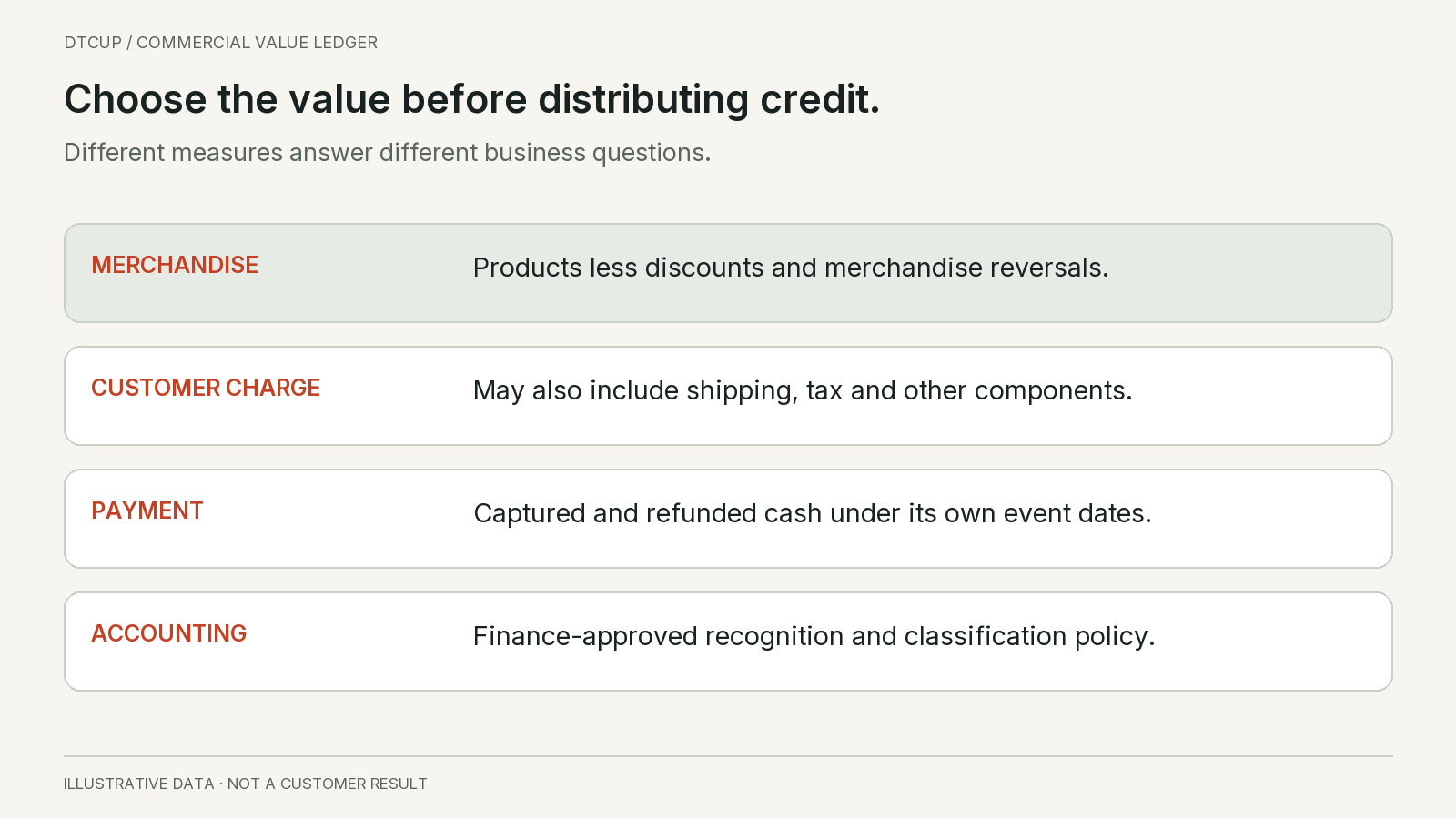
A checkout can contain product value, discounts, shipping, tax, duties, fees and different payment methods. A marketing report may use product sales after discounts, while a store dashboard displays a broader customer charge. Neither number is automatically wrong. They become misleading when both are labeled revenue and compared without their definitions.
Start with a plain-language contract. Cedar Trail chooses net merchandise value for one internal attribution view: eligible product value after discounts and linked merchandise reversals, excluding tax and shipping. It keeps shipping and tax in separate fields. This is a deliberate analytical basis for the example, not a universal prescription for every business or platform.
Another team might include shipping income because it wants a broader commercial measure. That is possible if the associated shipping costs and refunds remain visible in subsequent profitability analysis. The key is consistency. Do not include shipping in one channel’s value and exclude it from another because their exports have different defaults.
Platform terminology also changes. Shopify’s sales-report documentation distinguishes sales measures from payment movements and describes sales reversals that include more than physical returns. Read the current field definitions used by the export. A column historically called returns may not mean that goods physically came back to the warehouse.
Keep a separate label for the amount charged and for payment status. An order can exist before funds are captured, and a partial refund can change collected cash without changing every component of the merchandise record in the same way. The attribution view needs a clear eligibility rule, while the finance reconciliation needs its own chain of payment evidence.
Preserve changes instead of overwriting the original order
An order record often changes after creation. Items can be added, quantities reduced, discounts corrected or refunds issued. If the reporting system stores only the latest total, it can answer what the order is worth now but struggle to explain why last week’s report changed. Retain the events or reliable revisions that connect the original state to the current state.
The minimum record needs a stable order identifier, event or revision identifier, event type, effective time, ingestion time, currency, value components and source reference. Effective time describes when the business event occurred. Ingestion time describes when the reporting system learned about it. Both are useful when an adjustment arrives late.
Do not invent a new logical purchase every time the order is updated. A post-purchase edit may change the order’s value without representing another acquisition. Conversely, a genuinely separate repeat purchase should not be merged with the first merely because the customer is the same. Identity at the order level is essential before identity at the customer level becomes useful.
Preserve the source’s semantics. Some systems expose incremental adjustment events; others expose a revised cumulative total. Adding every cumulative total as if it were a new sale inflates value. Subtracting a full revised total as if it were a refund can create negative revenue that never happened. The ingestion process must know which kind of record it is receiving.
A simple check is to replay one order from its source history. The original value plus legitimate adjustments should equal the agreed current value. If it does not, investigate the event mapping before distributing the difference across marketing channels. An unexplained balancing adjustment called other makes the chart add up while hiding the cause.
Follow one order through a partial refund
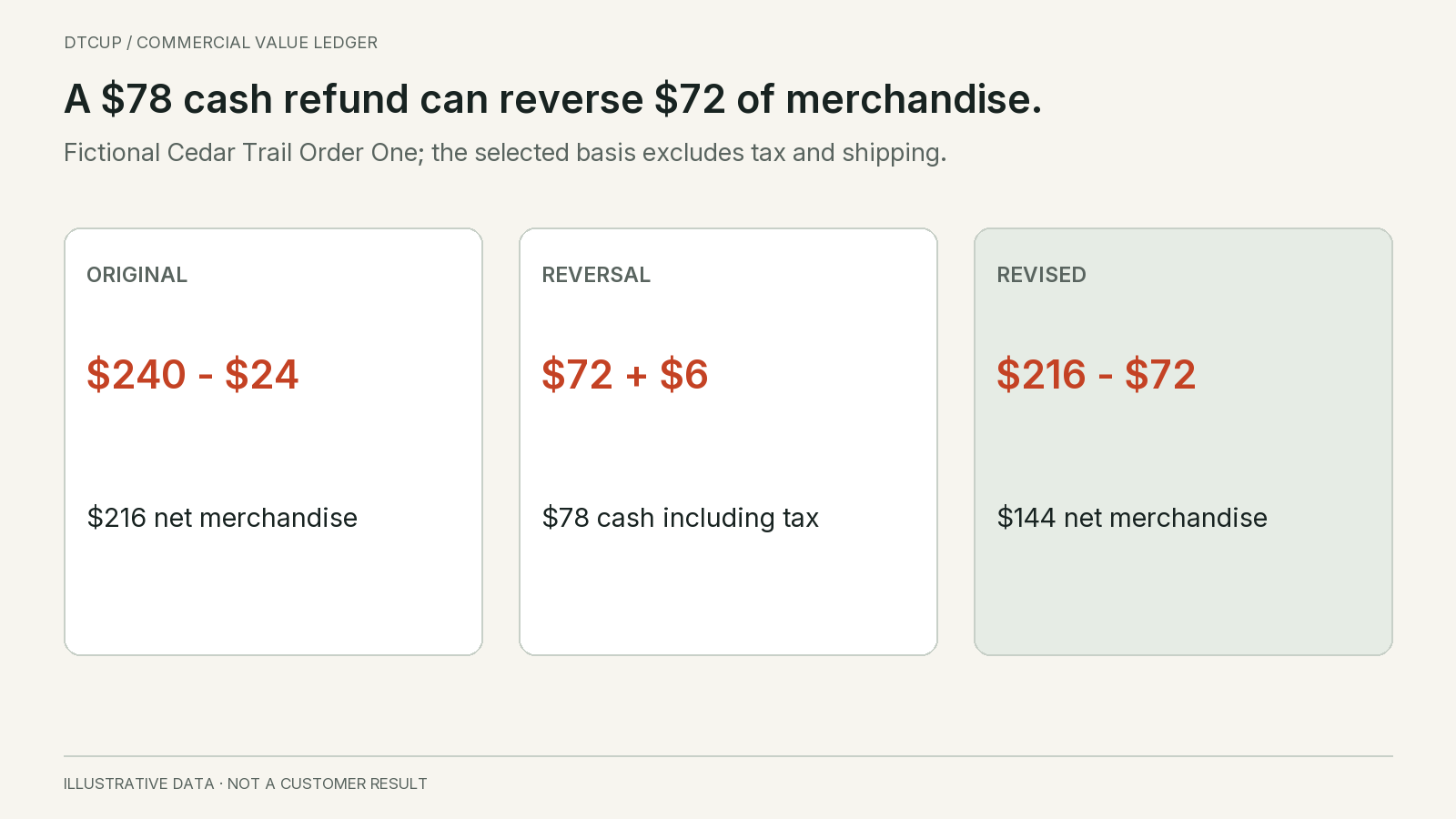
Cedar Trail’s Order One contains two items with an original combined product value of two hundred forty dollars. An order discount reduces merchandise value by twenty four dollars, leaving two hundred sixteen. Shipping is twelve dollars and tax is eighteen, so the initial all-in customer charge is two hundred forty six dollars in this simplified example.
For the chosen attribution basis, the initial value is two hundred sixteen dollars, not two hundred forty six. The extra thirty belongs to shipping and tax fields. Assume the order is eligible under Cedar Trail’s explicit commercial status rule and all amounts are in the same currency. There are no duties, fees or other adjustments in this example.
One of the two items has a pre-discount value of eighty dollars. Under the example’s proportional discount allocation, it carries eight dollars of discount and therefore seventy two dollars of net merchandise value. When that item is fully reversed, the merchandise adjustment is negative seventy two, not negative eighty. The remaining merchandise value is one hundred forty four dollars.
If the refund also returns six dollars of tax, the customer receives seventy eight dollars. Shipping remains unchanged in this scenario. The merchandise ledger decreases by seventy two while the payment ledger records a seventy eight dollar cash refund. That difference is explained by tax; it is not missing attribution revenue.
Using the pre-discount eighty-dollar price as the merchandise reversal would overstate the reduction by eight dollars. Deducting the full seventy eight dollar customer refund from merchandise value would overstate it by six. The example shows why a single undifferentiated refund amount is not enough for a reliable net-merchandise attribution view.
Keep the adjustment date and the original order date
Order One is placed in September and its partial refund occurs in October. A transaction-period view shows the sale in September and the negative adjustment in October. An acquisition-cohort view revises the eventual value of the September order. Both can be useful. One explains this period’s movements; the other evaluates the quality of the orders acquired earlier.
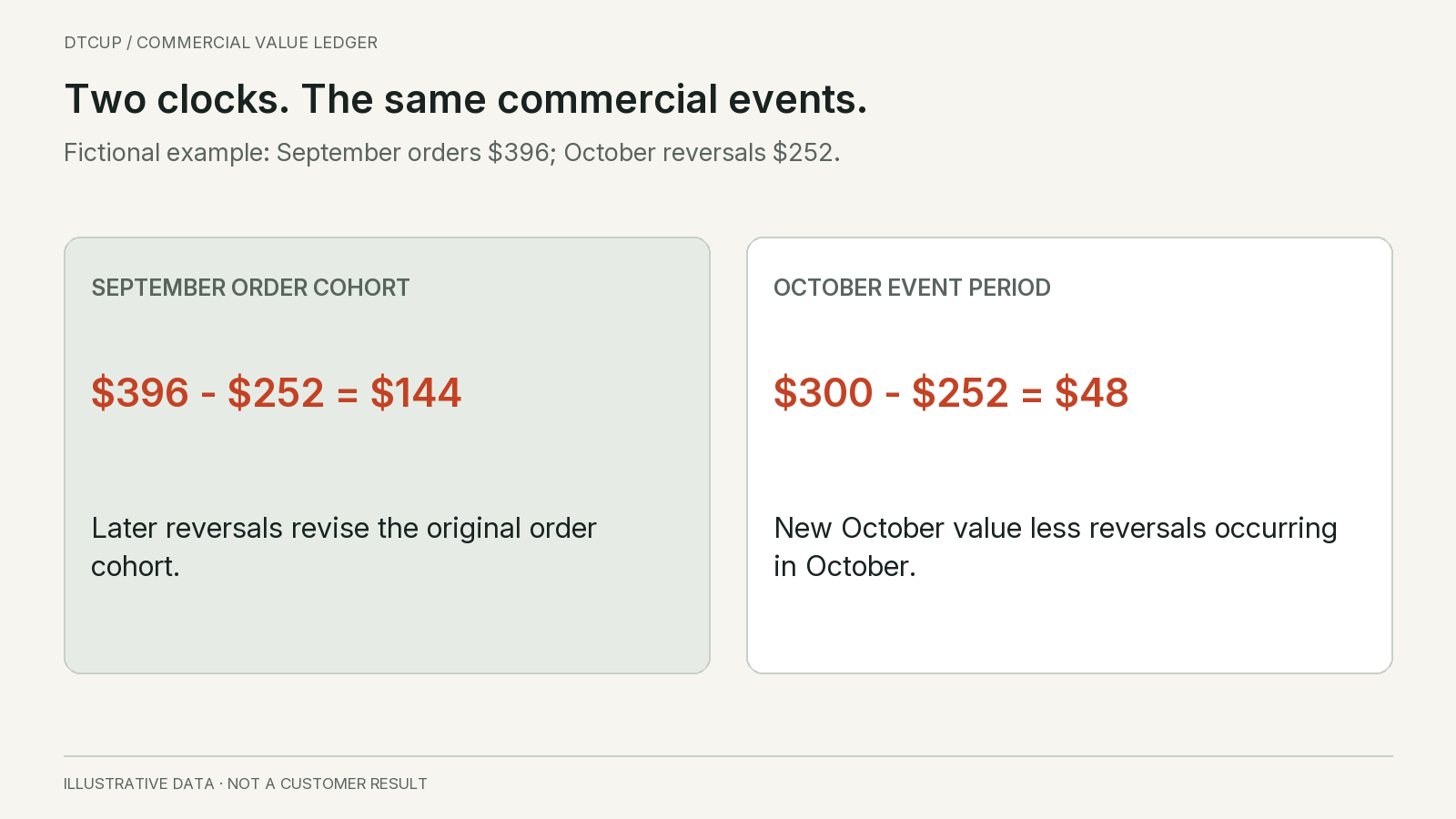
Suppose September contains two eligible orders with initial merchandise values of two hundred sixteen and one hundred eighty dollars. The cohort starts at three hundred ninety six dollars. October brings the seventy two dollar partial reversal on the first order and a full one hundred eighty dollar reversal on the second. September’s updated cohort value is then one hundred forty four dollars.
October also contains a new order worth three hundred dollars. Under a simplified transaction-period merchandise view, October shows three hundred of new value minus two hundred fifty two of adjustments, or forty eight dollars. Under an October acquisition-cohort view, the new cohort begins at three hundred dollars, with later adjustments still unknown. Those totals differ because they answer different questions.
Do not interpret the forty eight dollar transaction-period result as proof that October’s campaign acquired poor orders. Most of the negative movement came from September’s orders. Equally, do not ignore the September revisions when judging the earlier campaign. Keep both clocks so current operations and acquisition quality can be discussed without mixing them.
Our existing sales, payments and bank reconciliation guide follows the separate cash chain. This article focuses on how commercial adjustments revise the value that attribution distributes. A payout date should not replace either the original order date or the adjustment date in that analysis.
Attach the reversal to the order before revising channel credit
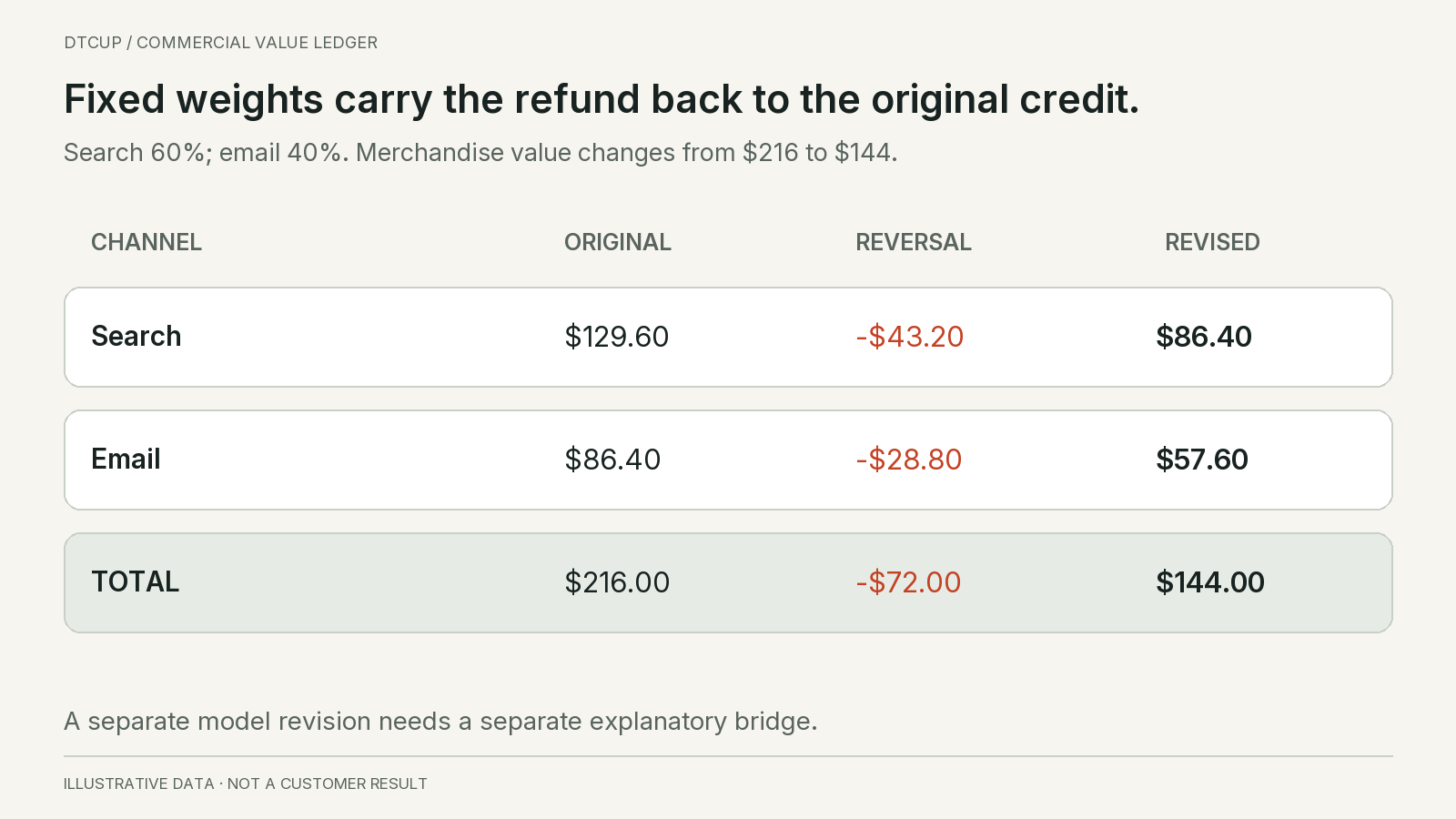
Assume Order One’s original attribution weights are sixty percent search and forty percent email under Cedar Trail’s selected model. Its initial two hundred sixteen dollars produces one hundred twenty nine dollars and sixty cents of search credit and eighty six dollars and forty cents of email credit. The weights sum to one.
The seventy two dollar merchandise reversal reduces search by forty three dollars and twenty cents and email by twenty eight dollars and eighty cents if the company retains those original weights. The revised one hundred forty four dollar order therefore leaves eighty six dollars and forty cents with search and fifty seven dollars and sixty cents with email.
The refund itself should not be attributed to whatever channel the customer used to contact support. A return request sent by email does not turn the original purchase into an email-acquired sale. The original order identity links the adjustment to the appropriate value and attribution record. Support contact channel is a different dimension.
There is a separate question about model revision. If the business changes the attribution model or receives valid late journey evidence, it may recompute weights. Record that as a model or evidence revision distinct from the commercial-value revision. Otherwise, a channel’s credit can change for two reasons at once and nobody can explain how much came from refunds versus allocation.
For operational reporting, I would keep the original published weights and value version available alongside the latest approved view. That allows a reviewer to reproduce the earlier decision and understand the bridge to the current result. It does not require freezing all learning forever; it requires making revisions visible.
Separate cancellations, returns, goodwill and chargebacks
A canceled unpaid order, a returned product and a goodwill refund are not the same event. They may reduce a particular analytical value, but they reveal different business problems. A cancellation can indicate payment failure or changed intent. A return can reflect fit, quality or customer preference. A goodwill refund can compensate for a service issue without any product returning.
Retain a reason and component breakdown where the source provides one. Do not infer that inventory became sellable because money was refunded. Physical receipt, inspection and restocking belong to the inventory process. Likewise, do not infer that a returned product has already been refunded merely because the warehouse received it.
Chargebacks and disputes need their own records and finance interpretation. A pending dispute is not always a final loss, and a final financial loss may not be represented in the store’s ordinary sales reversal field. The marketing ledger should disclose whether those events are included in its chosen net-value measure and which source supplies them.
For campaign diagnosis, show the adjustment reasons alongside the value change. A campaign attracting customers to the wrong product may produce a different pattern from a warehouse delay affecting all channels. Attribution identifies which orders received credit; it does not establish that the channel caused every later refund.
A useful investigation compares product, market, promotion, delivery and customer mix before blaming acquisition. If one channel sold mainly a problematic batch, its high refund rate may reflect the batch rather than the channel’s traffic quality. The right response could be a product or fulfillment correction instead of cutting the campaign.
Treat edits and exchanges as connected commercial changes
An exchange can remove one item and add another while leaving the total customer charge unchanged. A report that counts the added item as a fresh acquisition but ignores the removal overstates value. A report that counts only the removal understates the continuing relationship. Preserve the linked events and the final merchandise basis.
For an illustrative exchange, a customer replaces a net seventy two dollar item with a net ninety dollar item and pays the eighteen dollar difference. Under a net-merchandise cohort view, the original order’s value increases by eighteen after the reversal and replacement are both included. Whether the platform represents the replacement under the same order or another linked record, the analytical rule should prevent double counting.
A separate repeat purchase is different. If the customer later independently buys another product, that is another commercial event with its own eligible journey. Do not merge it into the first order merely to simplify lifetime value. Keep the order ledger intact and build a customer-level cohort view above it when that is the question.
Post-purchase upsells also require an explicit rule. An upsell attached to the original checkout may be part of the order’s final value, while a later campaign-driven purchase may be a separate order. The team should document how the source system identifies these events and whether the attribution model can distinguish them. Avoid pretending that a timestamp alone reveals the customer’s motivation.
For every edit type, test the event sequence with a small real or controlled example before deploying the mapping across history. Record the source order, line items, before-and-after totals and adjustment references. A one-line rule that works for ordinary refunds can fail on exchanges, partial cancellations or manual corrections.
Keep currency and conversion rules with the value
Never add unlike currencies because the column contains a familiar symbol. Store the amount and currency together, then preserve the reporting conversion method. A shop currency, customer presentment currency and settlement currency can differ. The attribution report should state which one it uses and how conversions are dated.
A refund can occur when exchange rates differ from the original sale. If the acquisition-cohort analysis reverses the original reporting value, it may differ from the current cash conversion of the refund. That difference needs a currency bridge rather than a manual correction to channel revenue. Finance should determine the treatment appropriate to financial reporting.
Choose a consistent analytical policy for the cohort view and keep the original transaction currency available. If a model compares channel economics across markets, currency movement should not silently become an apparent marketing improvement. Show the effect of conversion separately when it is material to the decision.
Rounding also matters at scale. Store sufficient precision, calculate on the agreed basis and round for display according to a consistent rule. If fractional channel credit creates a small residual, allocate or disclose it using a deterministic method. Do not let each dashboard independently round every intermediate step and then demand identical totals.
The policy should be simple enough that another analyst can reproduce a sample. The goal is not to build a complex currency engine in a spreadsheet. It is to avoid a report where the same order changes value because two exports used different currencies without telling the reader.
Prevent duplicate purchases and duplicate corrections
A page reload, retry or second integration can send the same logical purchase more than once. Stable transaction identifiers help, but they are not a substitute for testing the complete delivery path. The collector, destination and reporting model may each have different deduplication behavior.
Google’s transaction-ID guidance documents purchase deduplication for web streams and warns against empty or reused identifiers. Its ecommerce implementation guide describes linking refund events to the relevant transaction. These are destination-specific requirements. Do not assume that every event type or platform applies the same protection.
Your internal ledger should also distinguish a repeated delivery of one refund from two legitimate partial refunds. The order ID alone cannot do that because an order can have several real adjustments. Use a stable adjustment reference or a documented source revision strategy, and make repeated ingestion safe without discarding valid later events.
For example, two separate thirty-dollar refunds on the same order should reduce the relevant value by sixty dollars if both are legitimate. Receiving the first thirty-dollar refund twice should still reduce it by thirty. Matching only order ID and amount cannot reliably distinguish those cases. Preserve the event identity supplied by the source.
Late-arriving events require the same care. A refund received today may have occurred yesterday. Reprocessing the affected period should update the intended view without creating another reversal. Keep the source event, ingestion time and processing version so the team can investigate whether a difference came from business activity or pipeline behavior.
Reconcile value before distributing it across channels
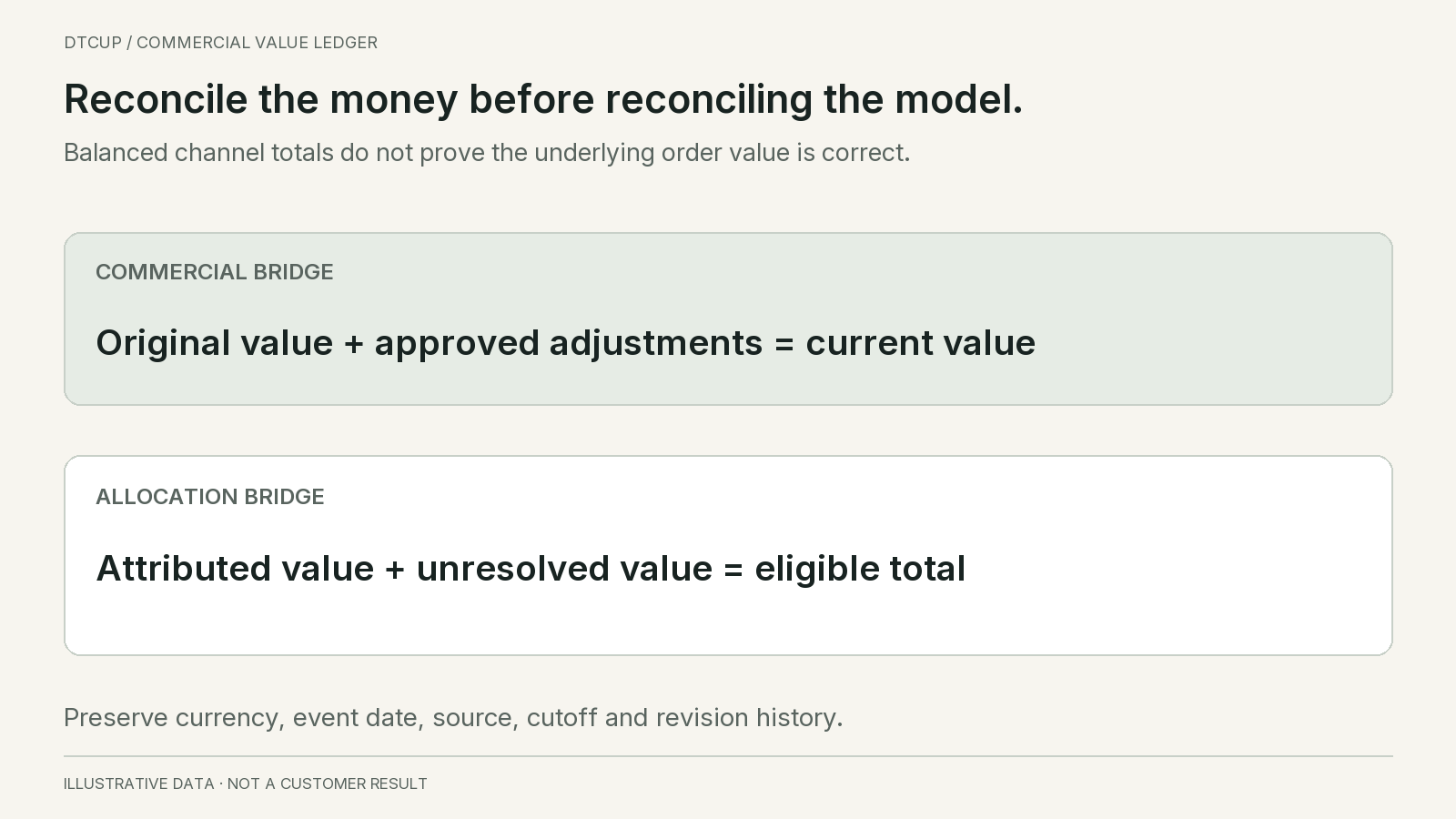
At the chosen reporting cutoff, verify that original eligible merchandise value plus included adjustments equals current eligible merchandise value. Then verify that attributed value plus unresolved value equals that same total under the model’s scope. These are two different reconciliations: one commercial, one allocative.
If an order has no usable journey, its value does not disappear from the commercial ledger. Keep it in an unresolved or unattributed bucket with the appropriate reason. Distributing it proportionally across observed channels makes the totals look complete but adds evidence the system does not possess.
If the commercial total changes because a refund arrives, the model should show the value revision. If the commercial total is stable but channel shares move because new journey evidence is processed, show the attribution revision. If both happen, produce a bridge in a deliberate sequence so that the effects are not confused.
Our guide to channel participation and fractional credit explains why participating-order counts overlap while allocated value should reconcile under a defined model. Here, the additional requirement is that the order value itself has a traceable history. A perfect allocation of the wrong value is still a wrong business report.
Keep exclusions visible. Test orders, ineligible payment states, deleted source records and unsupported channels should each have a stated treatment. Do not silently alter the eligible set between the original report and the revised report. A scope change should be identifiable separately from an adjustment to an existing order.
Compare cohorts at the same stage of maturity
A campaign launched yesterday has had little time to accumulate returns. A campaign from six weeks ago has had much more. Comparing their current net value without an age adjustment can make the newest campaign appear superior by construction. Keep the time since purchase visible when evaluating acquisition quality.
One practical view compares cohorts at fixed ages, such as the same number of days after purchase, chosen to fit the business’s actual adjustment pattern. Another shows a maturity curve from initial value through successive review points. The exact intervals should follow observed behavior and policy, not a universal calendar copied from another brand.
Do not forecast a final refund rate from a tiny early sample and present it as an observed result. An estimate can help planning if it is labeled, its basis is recorded and its uncertainty is visible. Keep actual adjustments separate from expected future adjustments so later reviews can test the estimate.
Segment maturity by product or market when the adjustment timing genuinely differs. A category with a long delivery or trial period may mature later than a simple accessory. A blended correction factor can penalize one campaign merely because it sold a different product mix. Compare the relevant commercial context before concluding that channel quality changed.
For decisions that cannot wait, use the best current evidence with a review trigger. The team can make a cautious budget change while committing to revisit the cohort after more outcomes are observed. Uncertainty should influence the size and reversibility of the decision, not force the business to pretend the latest number is final.
Preserve what was known when the decision was made
A useful attribution report carries an as-of timestamp, source coverage, value definition, model version and observation window. Save a reviewable snapshot when a material budget decision is approved. Without it, a later refund can change the historical chart and make the team appear to have ignored information that did not exist at the time.
Keep a latest-known view as well. Historical snapshots support accountability; current revisions support better decisions. The two should coexist. A frozen report that never incorporates refunds overstates current understanding, while a constantly overwritten report destroys the evidence of how understanding evolved.
When a cohort changes materially, explain the bridge. Separate new commercial adjustments, late source events, corrected implementation errors, eligibility changes and attribution-model changes. The explanation should identify amounts and affected scope, not merely say that the data refreshed.
For Cedar Trail’s Order One, a reviewer should be able to see the initial two hundred sixteen dollar merchandise value, the seventy two dollar reversal and the resulting one hundred forty four dollars. If the original sixty-forty weights stay fixed, channel credit changes mechanically. If the weights change too, that second change needs a separate record.
This is especially important when incentives depend on reported revenue. A team should not be rewarded for a temporary gross-value view while another team absorbs all later reversals without a shared rule. Agree how provisional and mature results are used in internal reviews before the results become contentious.
Test the ledger with a small pack of difficult orders
Start with an ordinary paid order, an order-level discount, a partial merchandise refund with tax, a shipping-only goodwill refund and a full cancellation. Add an exchange, multiple partial refunds, a duplicate delivery and an event crossing the date boundary. These cases should exercise the definitions, not merely prove that the happy path produces a positive total.
For each case, write the expected merchandise value, customer charge, payment movement and attribution adjustment before running the implementation. Keep the expected result independent of the code being tested. If the test simply copies the same formula as the implementation, both can repeat the same misunderstanding.
Inspect the source event and the final rendered report. A correct source payload can be transformed incorrectly later, while a visually plausible report can hide missing events. Verify the stable identifiers, currency, timestamps and component amounts at the relevant boundaries. Do not circulate unnecessary customer details while investigating.
Include a correction procedure. If a refund was ingested twice, the system should be able to repair the derived ledger while preserving the original audit evidence. Avoid changing the actual customer order or issuing a financial action just to make an analytics test pass. Reporting corrections and commercial actions require different authority.
Once the sample is correct, reconcile a bounded historical period and investigate exceptions. Expand only when the exception categories are understood. A large import is not evidence of completeness if unsupported records were silently skipped. Publish coverage and unresolved counts with the result.
Use the revised value to ask a better channel question
A net-value ledger can reveal that two campaigns with similar initial revenue produce different retained commercial value after adjustments. That is useful evidence, but it is the start of the explanation. Examine product mix, discount depth, delivery experience, customer expectations and the timing of returns before deciding what the channel caused.
For example, a campaign may accurately attract customers to a product whose delivery promise is unreliable. Cutting the campaign reduces exposure to the problem, but it does not repair the fulfillment issue. Another campaign may overstate fit in its creative and create avoidable returns. The ledger helps locate the orders; the diagnosis determines the action.
Keep margin analysis above the value layer. Net merchandise revenue is not contribution profit. Product cost, fulfillment, payment fees, return handling and marketing spend can change the economic ranking again. Do not call a channel profitable solely because its adjusted revenue remains positive.
The operating advantage is a clean sequence: establish eligible commercial events, preserve adjustments, reconcile current value, distribute credit under a stated model, then evaluate economic and causal questions. Skipping the first steps makes sophisticated attribution fragile because every downstream conclusion inherits an unstable number.
Explain a changing channel total with a revision bridge
A manager opens last month’s saved report and sees paid search credited with $129.60 for Cedar Trail Order One. Today’s report shows $86.40. Without a revision bridge, the natural suspicion is that tracking broke or the attribution model changed. In this example neither happened. The commercial value fell by $72, and the unchanged sixty percent search weight reduced search credit by $43.20.
Write the bridge in the same order every time: prior published credit, commercial adjustments under the prior model, newly available or corrected journey evidence, model-policy changes, and the resulting current credit. Not every line will have a value. A zero is useful when it confirms that a possible explanation was checked. An unexplained residual belongs in an investigation queue rather than in an optimistic narrative.
Now imagine a separate evidence correction changes the approved weights to fifty percent search and fifty percent email. Apply that revision to the already adjusted $144 merchandise value. Current credit becomes $72 each. The commercial adjustment accounts for the move from $129.60 to $86.40 for search; the weight revision accounts for a further $14.40 reduction. Email moves from $86.40 to $57.60 after the refund, then gains $14.40 from the weight revision.
The order of the bridge matters. Applying the weight change to the original value and then displaying the refund under different weights can still produce the same final answer, but the explanatory components will differ. Choose and document a convention. For operational review, resolving commercial value first and then applying evidence or policy revisions often makes the explanation easier to follow. It is a reporting convention, not a discovery about which channel caused the refund.
Save the previous report’s cutoff, weights, value definition and version before replacing it. Otherwise the team can reproduce today’s total but cannot explain the number used to authorize last week’s budget. That historical evidence is necessary for fair decision review. A decision made with a reasonable earlier estimate should not be judged as if the final refund information had already been available.
Resolve discounts at the item level before subtracting a refund
Order-level totals can conceal an allocation problem. A customer may buy several products, receive a basket discount and return only one item. Subtracting the returned item’s undiscounted list price would overstate the merchandise reversal if the customer never paid that amount. Subtracting the entire cash refund can create a different error by including tax or shipping outside the selected sales measure.
In the fictional Order One example, the $24 discount was allocated proportionally across $240 of products. The item with an $80 gross price therefore received $8 of discount and contributed $72 of net merchandise value. Its $78 cash refund contains that $72 plus $6 of tax. The attribution ledger reverses $72 from its merchandise basis and preserves the $6 tax movement in the appropriate component. The payment ledger explains the full $78.
Real promotion rules can be less tidy. A discount may apply to one eligible item, the cheapest item in a bundle, or an entire basket only while a threshold is met. A return may cause the order system to revise that eligibility. Use the approved commercial record and its actual allocations. Do not invent proportional allocation merely because the formula is convenient. When the source cannot explain the adjustment, flag the order for resolution rather than calculating a confident substitute.
Preserve quantity and currency precision as well. If a three-unit purchase receives a discount that cannot divide evenly into currency minor units, the line allocations must still sum to the recorded order discount. A later one-unit reversal should follow the source allocation or a documented reconciliation rule. Small rounding differences repeated across many orders can otherwise become a recurring channel discrepancy that nobody owns.
A useful acceptance check starts at the bottom: do line-level net amounts reconcile to the order merchandise total, do adjustment components reconcile to the revised order, and do channel shares reconcile to that revised basis? Passing the final channel sum alone is insufficient. A perfectly balanced distribution of the wrong merchandise amount is still wrong.
Give unmatched adjustments an owner and an expiry for investigation
Not every refund arrives with a clean reference. Legacy imports, manual credits, payment-provider disputes and replacement orders can produce events that do not immediately match an eligible purchase. Do not drop them because they complicate the dashboard. Keep their value, currency, source, event time, received time and matching status in a separate exception queue. Avoid exposing unnecessary customer details in the reporting surface.
Assign each exception a reason such as missing order reference, ambiguous duplicate, unsupported currency mapping or adjustment outside the imported history. The owner should know what evidence could resolve it. A missing reference may need an order-system lookup; an adjustment outside historical coverage may need an explicit scope exclusion instead. Those are different problems and should not share an indefinite “pending” label.
During review, show both the count and value of unresolved exceptions. Ten tiny rounding cases and one large unmatched cancellation demand different attention. Establish a materiality threshold for decisions, but retain the smaller records for reconciliation. The threshold determines escalation, not whether inconvenient data exists.
When an exception is resolved, link the correcting event to the original record and record the report version affected. Do not silently overwrite the queue history. If the revised value changes a prior campaign conclusion materially, bring that decision back for review. If it does not, document why no budget action follows. The purpose of this process is to make commercial uncertainty manageable, not to make every late adjustment trigger another round of channel optimization.
Also distinguish a delayed event from a failed connector. An occasional adjustment arriving late is a normal reporting revision. An entire source stopping for several days is a coverage problem. A freshness indicator should show the latest successful import and the period actually covered. A dashboard that says “updated today” merely because its page refreshed can hide a stale refund feed. Before interpreting an apparent improvement in retained revenue, verify that the adjustment pipeline is still receiving records. If it is not, label the affected cohort incomplete and postpone consequential reallocations until the missing period is restored and reconciled.
Questions about refunds and attribution value
Should refunds reduce the current month or the original campaign month?
Maintain both views when they serve different decisions. A transaction-period view records the adjustment when it occurs. An acquisition-cohort view revises the value of the original orders. Label the date basis and avoid comparing one view with the other as if they should have identical monthly totals.
Should a refund change the channel that receives credit?
The commercial adjustment should first attach to the original order. Under fixed attribution weights, it reduces the value allocated to those channels proportionally. A separate model or evidence revision can change weights, but that should be recorded independently. The channel used to request support is not automatically the channel that acquired the order.
Why does the cash refund differ from the merchandise reversal?
The customer refund may include tax, shipping or other components excluded from the chosen merchandise measure. Preserve those components and reconcile the payment separately. Do not subtract an all-in cash amount from a narrower revenue basis without checking what the refund actually contains.
Can we estimate net value before all returns arrive?
Yes, as a clearly labeled estimate with an observed basis and a later review. Keep actual and expected adjustments separate, compare cohorts at similar ages and avoid claiming certainty from a small early sample. The estimate should support a proportionate decision, not erase the uncertainty that still exists.
A reliable attribution discussion begins with an order that can be explained from its original value to its latest approved state. Once that foundation is stable, disagreements about channel credit become easier to isolate—and much less likely to conceal a basic commercial data problem.
Sources
Still have a question?Ask the DTCUP Community ↗