
Is Your Brand Ready for Marketing Mix Modeling? Start with the Decision and Evidence
More data rows do not guarantee a useful model. Assess the budget question, historical variation, competing explanations and operating ownership before commissioning an MMM pilot.

7 years of experience building and operating brand websites, specializing in website development, paid advertising and SEO. Built a brand website from launch to US$10 million in annual sales.
The Short Answer
Assess one actionable budget question against coherent data, informative variation, defensible assumptions and a team able to maintain the analysis. Commission a bounded pilot with uncertainty and decision-sensitivity checks; narrow or defer claims the evidence cannot support.
Key takeaways
- Readiness depends on the decision, not a universal revenue threshold.
- Long histories can still fail to separate channels that move together.
- Observed and allocated geographic data are not interchangeable.
- Experiments need a scope-aware translation before calibration.
- Good historical fit does not prove every causal channel estimate.
- A pilot can succeed by identifying a narrower supported action.

Marketing mix modeling is attractive when the usual channel reports disagree. It promises a wider view of the business without requiring a complete record of every customer’s clicks. That is a useful direction, but it is easy to turn a measurement problem into an expensive modeling project before checking whether the available evidence can support the decision.
I would not begin by asking whether a brand has reached a particular revenue level. I would ask what budget decision the team needs to make, what variation exists in its history, what else changed during that history and whether the team can maintain the evidence afterward. A larger business can still have poorly identified channel effects. A smaller one may have a narrower question that can be studied responsibly.
This article is a readiness assessment for operators considering marketing mix modeling, often abbreviated MMM. It uses a fictional homeware brand, Alder Living, to show where a pilot can help and where it should stop. The examples are designed to support a conversation with a qualified analyst, not to certify a model or promise a particular return.
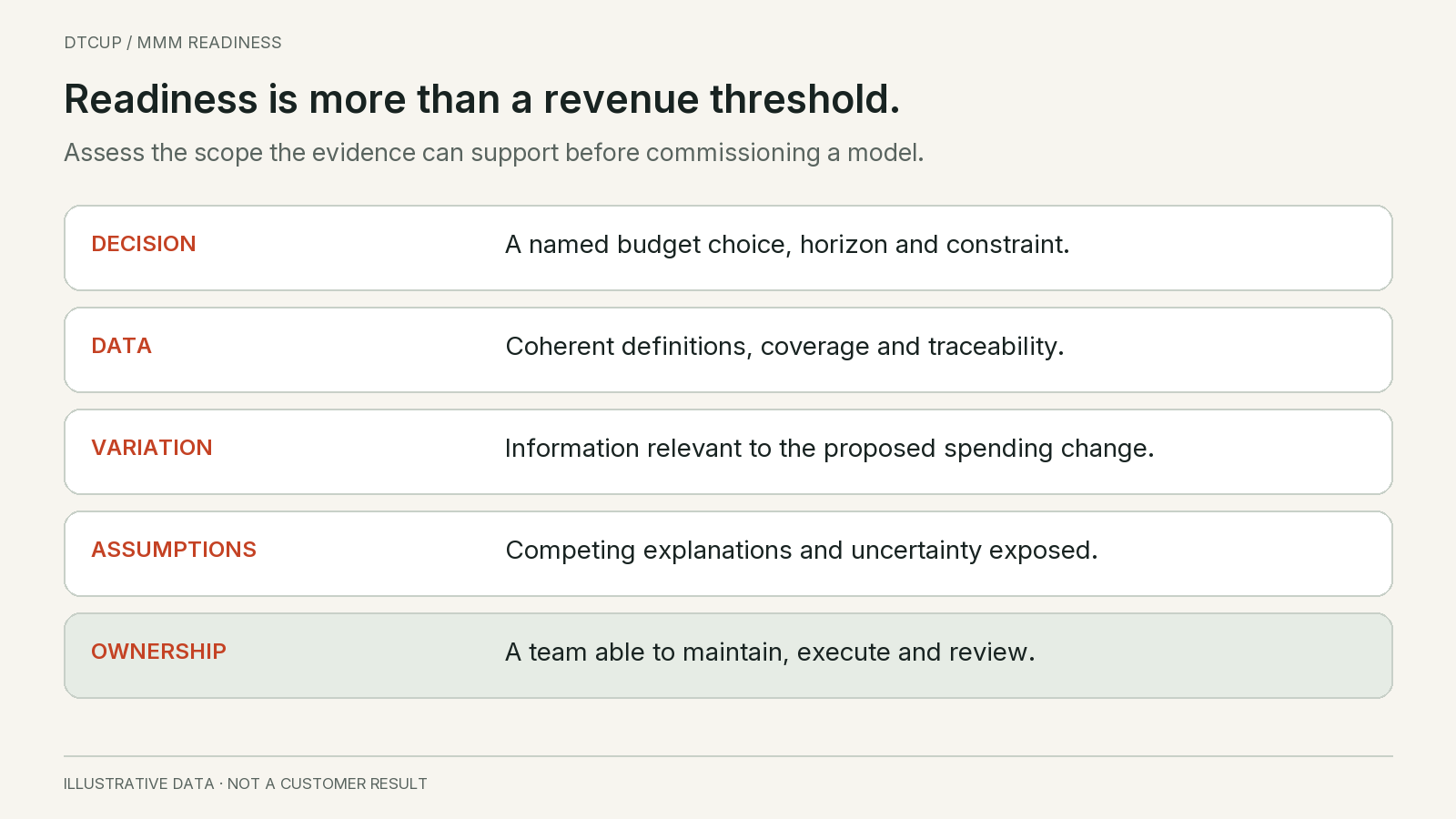
Name the budget decision before commissioning a model
Write down the action the model is expected to inform. “Understand marketing” is too broad. “Compare a modest transfer from paid social to online video for next quarter, while holding the total budget within an approved range” is more useful. It identifies a choice, a horizon and a constraint that can be assessed against the available data.
Also state what the model is not expected to decide. A broad channel allocation study is different from choosing tomorrow’s creative, diagnosing a broken checkout or determining which email subject line performed better. Those questions operate at different levels and often need different evidence. Forcing them into one model usually creates false confidence or unnecessary complexity.
Alder Living has several channels and a quarterly planning process. Its team wants to know whether the next increment of acquisition spending should remain in paid social or move partly to video. The decision is commercially meaningful, but the team does not need a separate causal estimate for every campaign, audience and creative variation.
The business also needs to distinguish a total-budget decision from a reallocation decision. More spending can be worthwhile in one channel while moving money into it is unattractive because the funding channel loses more value. The marginal budget allocation guide explains this economic distinction.
Finally, ask what the team would do with an uncertain answer. If the only acceptable output is a confident ranking that confirms an existing preference, the project is not ready for honest analysis. A useful model may identify a range of plausible actions, show that two options cannot yet be distinguished or recommend a targeted experiment before a large move.
Understand what the model is trying to separate
At a broad level, an MMM relates an aggregate business outcome over time to marketing activity and other relevant conditions. The difficult part is deciding how much of the observed outcome can reasonably be attributed to a change in marketing rather than to factors that moved alongside it. A chart can fit the past well while remaining uncertain about that separation.
Think of Alder Living’s holiday quarter. Advertising increases, discounts deepen, more products become available and customers are already more likely to buy gifts. Revenue rises. The observation is real, but the increase does not identify how much each factor caused. The team needs more than a visually persuasive line connecting spend and sales.
This is why an MMM should not be presented as a machine that recovers an unquestionable hidden truth from messy exports. It is a structured estimate conditional on data, definitions, assumptions and model choices. The value comes from making those conditions explicit and testing whether the resulting decisions are robust enough to use.
It also does not replace every other measurement method. Order reconciliation establishes what happened commercially. Channel reporting helps diagnose delivery and observed response. Experiments can provide evidence for specific interventions. An MMM can contribute a broader allocation perspective when its scope and evidence are appropriate. These roles can complement one another without producing identical numbers.
The attribution decision framework is useful before commissioning the project. If the current problem is a mismatch between order revenue and platform conversion values, reconciliation may be the first job. A more elaborate model should not become a way to avoid fixing a basic definition problem.
Audit the meaning of the data, not just whether it exports
Build a data inventory before fitting anything. For each field, record the source, owner, unit, period, geography, coverage and known changes. A successful export only proves that a system returned data. It does not prove that the values mean the same thing across the history or that they align with the outcome being modeled.
For the business outcome, decide whether the study uses eligible orders, net merchandise revenue or another clearly defined measure. Keep currency and refund treatment consistent. If a reporting definition changed midway through the period, either reconstruct a comparable series or preserve the discontinuity with an explicit analytical treatment.
For media, keep spend and the selected exposure measures aligned. A billing period is not always a delivery period. Different account timezones can place activity into different weeks. A channel reclassification can make one series disappear while another suddenly grows, even though the underlying activity continued.
Google’s Meridian data guide describes a coherent dataset containing the outcome, media information and relevant controls, with compatible dimensions. It also warns that spending can be an imperfect proxy for exposure when media costs change. The operating implication is to review what each field represents before treating it as an interchangeable measure of marketing activity.
Alder Living discovers that one agency report includes fees while another contains media spend only. It also finds that a past channel export used the account’s local week while revenue used the store’s week. These are repairable problems, but they should be repaired before a model turns them into apparent channel behavior.
Keep a reconciliation bridge from source exports to the modeling table. Show exclusions, currency conversions, regrouping and adjustments. If the final input cannot be traced back to its source totals, the team will struggle to explain a surprising estimate or reproduce the analysis after the person who built it leaves.
More historical rows do not automatically mean more information
There is no useful universal rule that a particular turnover or row count makes a brand ready. The relevant question is whether the data contains enough information for the effects the model is trying to distinguish. A long history with channels moving together can be less informative for a specific allocation choice than a shorter history with a credible, well-understood change.
Meridian’s data sufficiency guidance explicitly treats its advice as directional. Model complexity and spend variation matter, and geographic observations are not independent repetitions in the way a simple row count might imply. More history can help, but older periods can also become less relevant. The practical assessment requires fitting and examining uncertainty rather than passing a single numerical threshold.
For Alder Living, the archive contains about three years of weekly information. That sounds substantial until the team asks what it wants to estimate. If it requests many separate channels, numerous controls and flexible time effects, the available history may be asked to support far more distinctions than it can explain reliably.
Reducing scope can be a responsible response. Combine activities only when the combined category still answers a useful business question and has a coherent interpretation. Do not merge channels merely to create an attractive result, and do not remove an important competing explanation because it makes the model less convenient.
Adding older data also requires judgment. If the brand changed its product range, distribution model and pricing strategy, a distant period may describe a different business. A model can still use historical information with appropriate treatment, but the team should ask how much the recommendation depends on conditions unlikely to recur.
The readiness deliverable should therefore describe usable history and its limitations, not just total rows collected. It might say that the recent period is comparable but shorter, while an earlier period contains a major channel and product transition. That is more informative than a green checkmark beside “three years of data.”
Look for variation that can answer the proposed choice
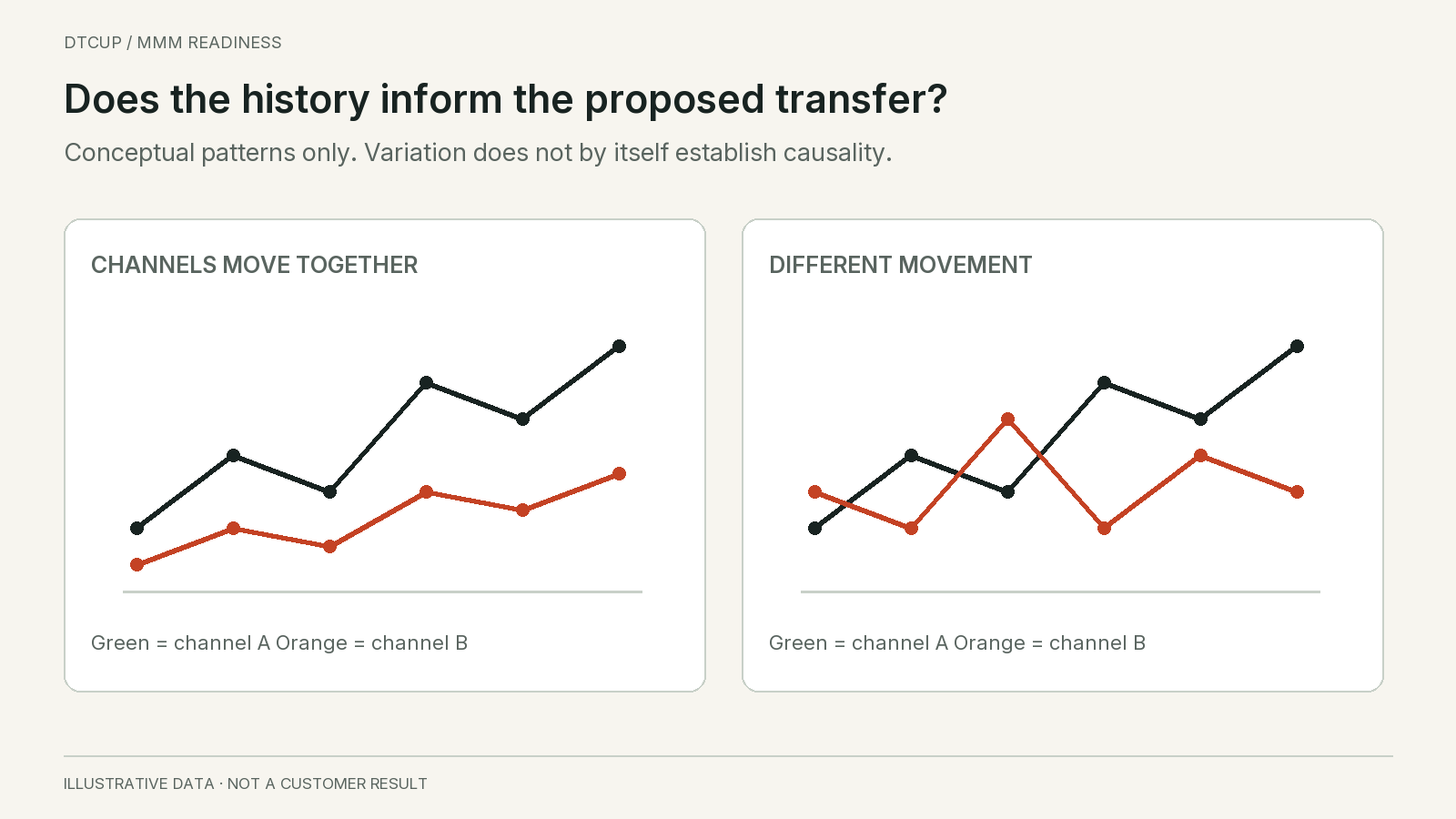
Suppose paid social and video always increased together in the same fixed proportion. Revenue changes may help explain the combined activity, but they provide little direct evidence about what happens when one channel increases while the other decreases. The exact reallocation the team wants to make may be poorly represented in the history.
Draw the actual activity series and annotate major changes. Ask why spending changed: a planned test, budget exhaustion, an agency decision, stock availability or a forecast of strong demand. The reason matters because a brand may deliberately spend more when it already expects more customers. That behavior can make a simple association look like a stronger marketing effect.
Alder Living finds that video only ran during two large launches, both supported by paid social, new products and discounts. The team cannot responsibly treat those launches as clean evidence for an independent video effect. It may need a narrower combined estimate, stronger external evidence or a designed future test.
Do not manufacture variation by splitting one weekly total into arbitrary daily values or copying national spending across regions. More cells do not create new observations. They can make a dataset look richer while preserving exactly the same information and introducing misleading assumptions about where or when activity occurred.
Equally, do not create uncontrolled business disruption merely to make a model easier to fit. Deliberate tests should have their own commercial rationale, design, loss limits and operational safeguards. The goal is to learn about a valuable decision, not to generate movement in a spreadsheet at any cost.
Record which proposed actions are supported by observed variation and which require extrapolation. A small adjustment near historical operating levels is different from doubling a channel that has barely changed. The recommendation should make that difference visible even when the output presents both scenarios with equally polished charts.
Map the competing explanations before choosing controls
A useful readiness workshop brings marketing, finance, merchandising and operations together around the business timeline. Ask what could move both marketing decisions and the outcome. Promotions, availability, product launches, pricing, distribution changes and demand conditions are common areas to investigate, but their exact roles depend on the business.
Do not turn that workshop into a hunt for every correlated column. A variable can be associated with revenue without being an appropriate control for the question. Some measures may sit on the path through which marketing affects customers. Others may reflect decisions made in response to expected demand. The analyst needs a defensible causal account, not simply a large collection of dashboard fields.
For Alder Living, a stockout period is especially important. Advertising continued, but the promoted product could not be purchased for part of the month. If availability is ignored, weak revenue may be interpreted as weak media response. If the period is simply removed without explanation, the model may lose evidence about how the business actually operated.
Another complication is branded search. It can reflect existing demand, previous marketing and customer intent. Treating it as a straightforward independent input or control without discussing its role can change what the model estimates. The right treatment should follow the question and analytical assumptions, not a universal instruction copied from another account.
The operator’s job is to supply a truthful timeline and challenge implausible interpretations. The analyst’s job is to explain the model structure and why particular variables belong in it. Neither role can substitute for the other. A technically correct implementation of a poorly understood business story can still lead to a bad decision.
Save unresolved explanations in a visible risk register. If a major promotion calendar is incomplete, name that limitation and the decisions it weakens. A missing factor does not become unimportant because the team cannot export it easily. It may be the reason to narrow or defer the project.
Use geography only when the underlying evidence supports it
Geographic detail can add useful variation, but the detail must be real and compatible. Revenue based on delivery location is not automatically aligned with media exposure based on a platform’s reporting geography. Customers can travel, order gifts elsewhere or be exposed outside the eventual shipment region.
Start by defining the geographic unit and mapping every source to it. Check missing regions, boundary changes, small cells and whether the outcome is consistently assigned. If one source supports only a national total, distributing it across regions using revenue shares can create a relationship by construction rather than reveal an observed one.
Alder Living has reliable shipment-region revenue but incomplete historical regional media data for one important channel. The readiness review should not mark the geographic dataset complete merely because all revenue rows have a region. The analyst must decide whether a national scope, a narrower channel scope or another defensible treatment is appropriate.
Also consider whether the regions differ in ways relevant to the model. Product availability, pricing, distribution and campaign targeting may not be comparable. A region with a different commercial offer is not just another copy of the same national market. Those differences need evidence and a reasoned treatment.
Privacy and access requirements still apply to source handling. Aggregation changes the analysis level; it does not give the team permission to collect or share arbitrary customer records. Use the approved data route and share only the information needed for the study. The model vendor does not need unrelated private customer details to receive a well-defined aggregate dataset.
The practical rule is to prefer a smaller truthful dataset over a larger synthetic-looking one whose cells were filled by convenience. If a field is estimated, preserve the estimation method and uncertainty. Do not allow a tidy table to conceal the difference between observed and allocated data.
Treat experimental calibration as translation, not a stamp of approval
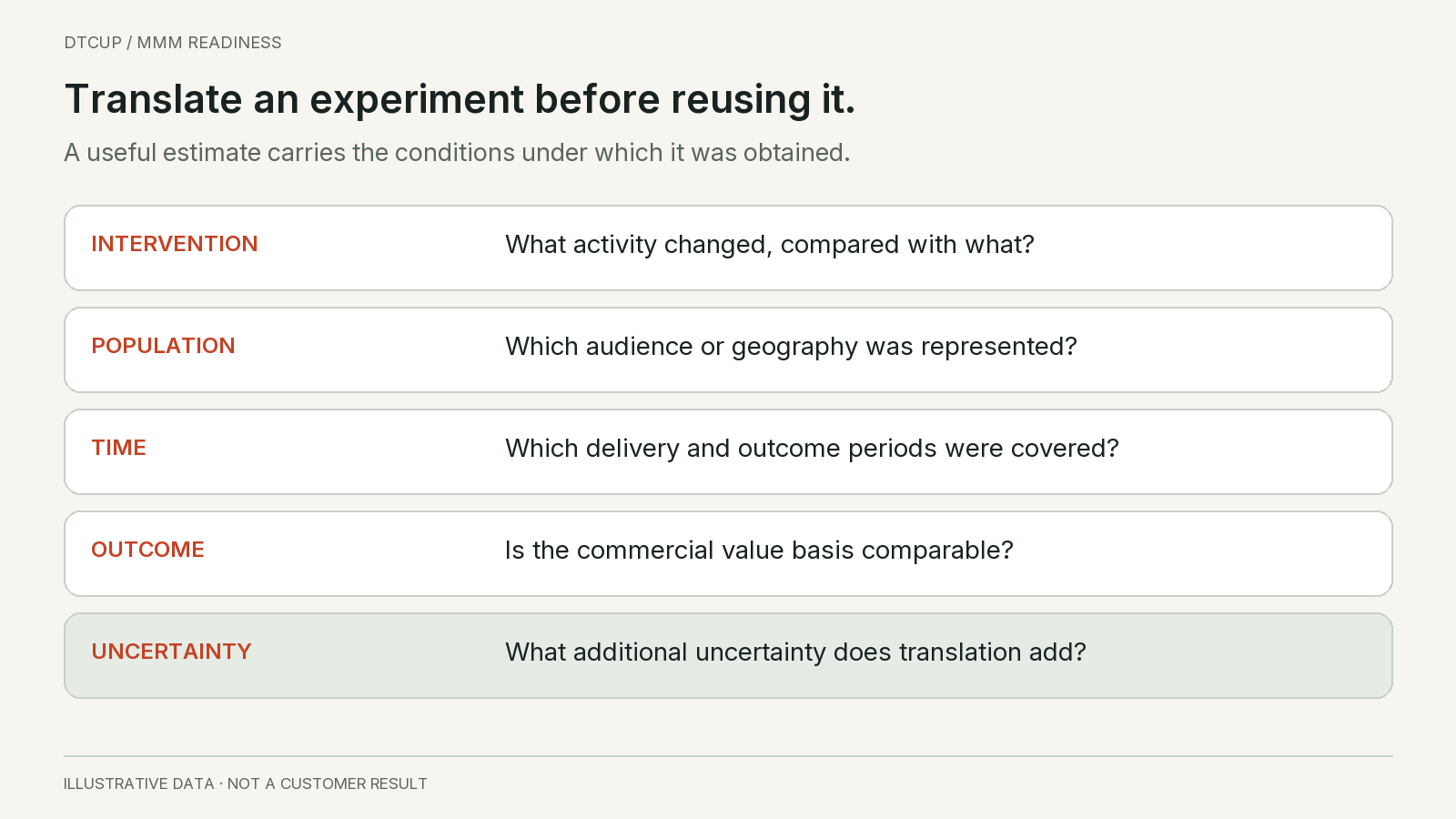
An experiment can provide valuable evidence, but its result belongs to a particular intervention, audience, period and outcome. Before using it to inform a broader model, compare those conditions with the modeling question. A test of one campaign during a launch is not automatically a precise estimate for an entire channel throughout the year.
Meridian’s calibration guidance explains that experiments can inform prior assumptions, while differences in population, timing, duration and the effect being measured add uncertainty. The translation is not simply copying a reported return into a model field. Evidence should be relevant to the modeled scope, and its uncertainty should remain visible.
For Alder Living, imagine a regional video test with an estimated positive effect but a broad uncertainty range. The team should preserve the test design, spend change, eligible revenue definition and outcome window. If the MMM uses a different revenue basis or a different counterfactual, the analyst must explain the conversion rather than treating the two numbers as directly interchangeable.
A useful calibration file includes what the experiment can and cannot support. It might provide stronger evidence near the tested spending level while saying little about a much larger expansion. It may cover a specific audience whose response differs from the broader population. Those boundaries are part of the evidence, not inconveniences to remove before presenting the result.
Watch for circular validation. If the model was strongly informed by an experiment, agreement with that same experiment is not an independent confirmation of accuracy. It may still be a sensible consistency check, but the review should say that the information was already used. Keep genuinely separate validation evidence distinct.
When no suitable experiments exist, record that fact without inventing a substitute. The project may still proceed with appropriately justified assumptions, but the uncertainty and sensitivity work become especially important. A preference held by the channel owner should not be relabeled as experimental evidence.
Commission a bounded pilot with explicit acceptance criteria
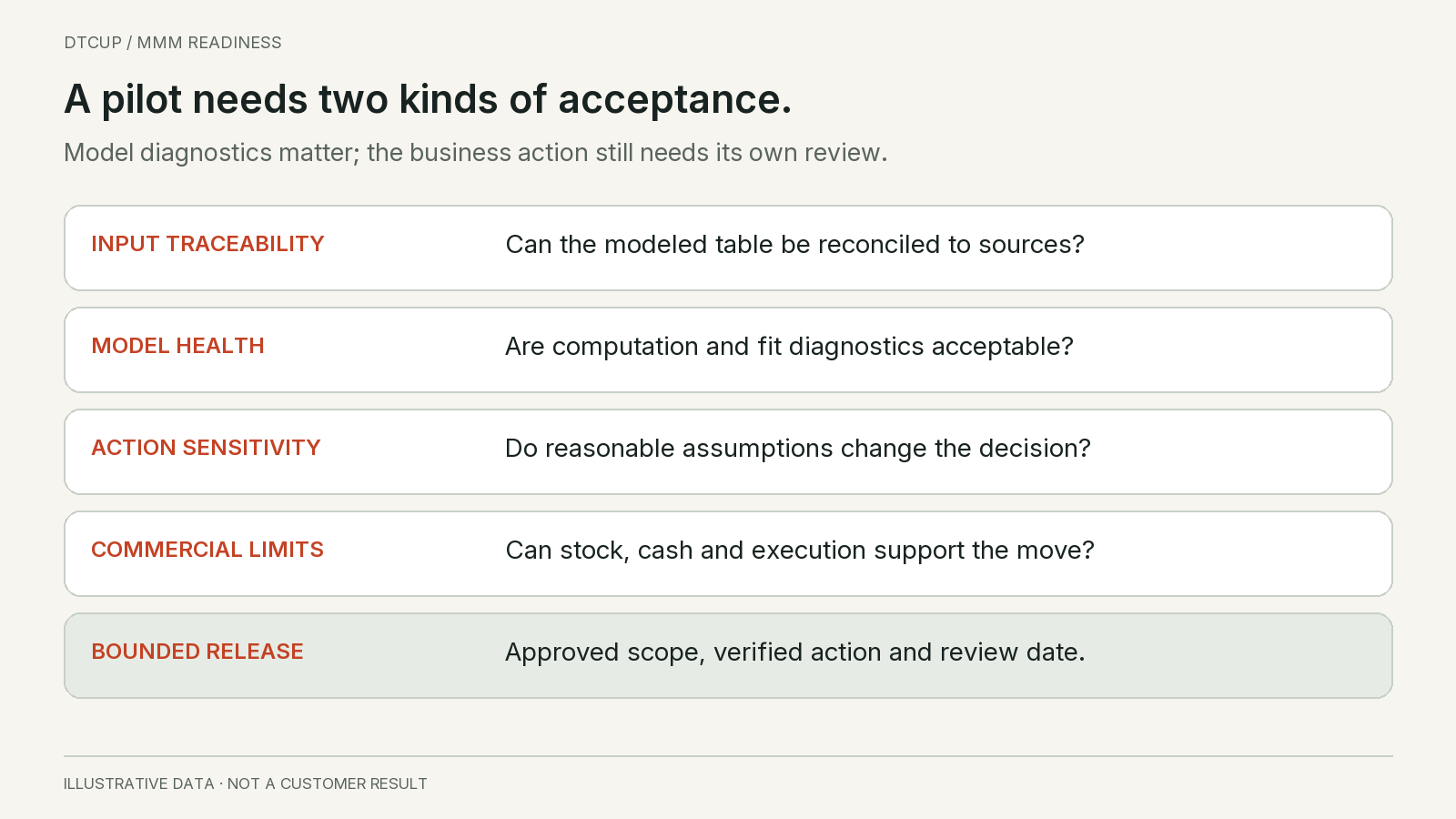
A readiness assessment should lead to a scoped pilot rather than an open-ended promise of optimization. Define the dataset, channels, decision horizon, deliverables, limitations and review process before work begins. Include a stopping condition if the evidence cannot support the requested distinction.
Require an input audit and a model specification that a competent reviewer can understand. The business does not need every mathematical detail in the main presentation, but it should know what outcome is modeled, what activity represents each channel, what competing factors are included and where assumptions have the greatest influence.
Ask for uncertainty and sensitivity results alongside point estimates. A ranked channel table without ranges can conceal that several alternatives are practically indistinguishable. A pilot should explain whether reasonable changes in assumptions alter the recommended action, not merely whether they alter a statistical score.
Specify what counts as a useful result. For Alder Living, it could be a defensible range for a modest next-quarter allocation change, a clear explanation of unsupported larger moves and a proposal for the next experiment. It could also be a documented conclusion that current data cannot distinguish paid social from video sufficiently for the proposed transfer.
Do not define success as proving that the new model produces different numbers from the old attribution report. Different methods can disagree because they ask different questions. Success is a better-supported decision with understandable limits. Sometimes that decision is to preserve the current allocation while collecting more informative evidence.
Make ownership and exit practical. The business should retain its approved input definitions, transformation logic, model version, review notes and exported results within the agreed arrangement. A pilot that leaves only a presentation deck is difficult to maintain or challenge when the next quarter behaves differently.
Judge model health separately from decision usefulness
The analyst should inspect whether the model computation behaves appropriately and whether it represents the observed outcome reasonably. Those checks are necessary, but they do not answer every commercial question. A healthy estimation process can still leave a particular channel effect too uncertain for the decision the business wants to make.
Google’s diagnostics documentation separates convergence and fit checks and notes that fit metrics describe predictive performance. For the operator, a good historical fit should therefore be treated as one diagnostic, not as proof that each channel’s causal contribution has been correctly identified.
Ask the analyst to show where predictions miss systematically and whether those misses align with known business changes. Review whether a channel estimate is driven by a small number of unusual periods. Ask what happens when a questionable source period is treated differently under a defensible alternative specification.
Then translate the uncertainty into the actual decision. If two allocations produce very similar expected contribution relative to their uncertainty, the operationally simpler option may be preferable. If a recommendation requires a dramatic spend increase outside observed conditions, a bounded test may be more responsible than implementing the full modeled optimum.
Consider a fictional result in which allocation option one has estimated incremental contribution between negative two thousand and positive eight thousand dollars, while option two ranges from negative one thousand to positive seven thousand. Those ranges alone do not establish which option is better; their dependence and the full model output matter. The important operating lesson is that a narrow point-estimate lead should not be presented as a certain commercial advantage.
Ask for a plain-language recommendation with a boundary: what change is supported, what exposure is acceptable, what would invalidate the recommendation and when it should be reviewed. This is where modeling becomes useful to management. The business still owns the consequences of the action.
Make the readiness decision for Alder Living
Put the findings together. Alder Living has a meaningful quarterly allocation question, a largely reconcilable revenue series and several years of weekly data. It also has incomplete regional media history, two channels that frequently moved together and launch periods in which promotions, product availability and advertising changed at once.
A careless assessment would declare the brand ready because it has enough revenue and years of data. A more useful assessment says that it may be ready for a constrained national pilot, subject to repairing definitions and reviewing the channel grouping. It is not yet ready for confident granular recommendations across every campaign and region.
The first work package repairs spend scope and calendar alignment, reconstructs the launch and availability timeline and documents the comparable history. The second evaluates a model scope that matches the evidence. The third assesses whether the resulting uncertainty can support the modest transfer under consideration.
If the channel distinction remains weak, the next action is not to demand a sharper answer from the same evidence. The team can design a suitable experiment, narrow the recommendation or maintain a bounded allocation while improving future data collection. That preserves the value of the work instead of turning uncertainty into a cosmetic reporting problem.
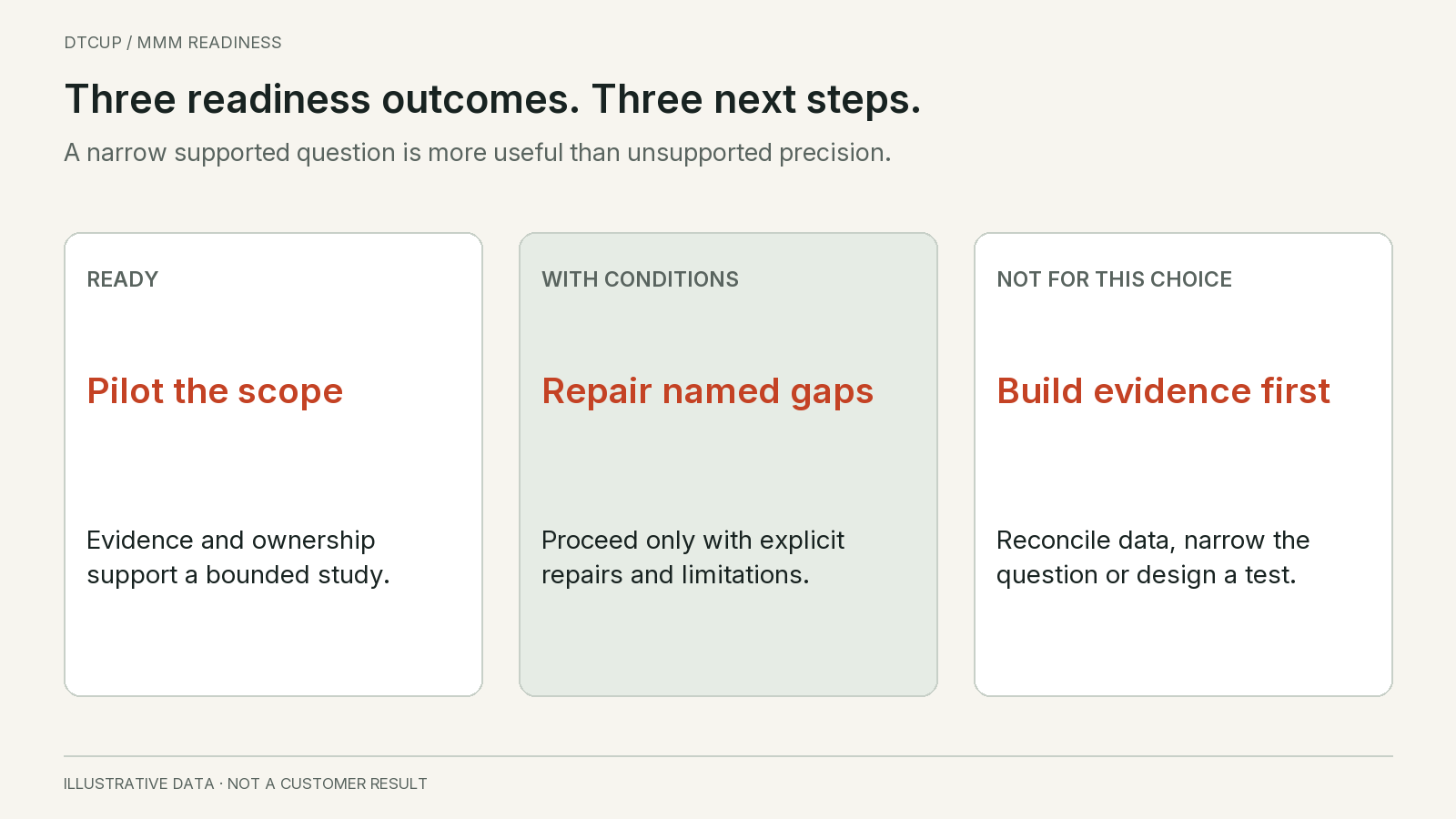
Record three readiness outcomes rather than a simple pass or fail. Ready means the proposed scope can be piloted with adequate evidence and ownership. Ready with conditions means specific repairs or limitations must accompany the pilot. Not ready for this decision means the current evidence cannot support the requested action responsibly, even if another narrower question might be feasible.
This distinction helps management allocate effort. A brand may be ready to improve channel reporting today, ready to run an experiment next month and ready for a broader MMM later. Measurement maturity is a sequence of useful decisions, not a competition to deploy the most advanced method first.
What to do now if the brand is not ready
Start by making the commercial outcome trustworthy. Reconcile eligible orders, revenue components, refunds, currency and time periods. Create a small metric dictionary and preserve changes. This work supports current decisions and later modeling, so it remains valuable even if the MMM is deferred.
Maintain a business-change calendar. Record major offers, product launches, stock constraints, distribution changes, tracking releases and unusual events with dates and owners. The purpose is not to explain away every disappointing result. It is to preserve context that becomes difficult to reconstruct after several people and agencies have changed roles.
Save channel data at a useful, consistent grain through approved sources. Preserve delivery dates, spend definitions and relevant exposure fields. Do not assume a platform will retain every historical breakdown indefinitely or that a future export will use today’s definitions. A controlled archive reduces avoidable gaps.
Use bounded experiments where they answer a consequential question and can be designed credibly. Choose the intervention and comparison before looking at the result. Keep the commercial and operational constraints visible. The attribution and incrementality guide explains how to interpret experimental evidence alongside channel reports.
Build a record of decisions and outcomes. For each meaningful budget change, save the before and after settings, rationale, expected effect, execution evidence and review date. Annotate other changes that could affect interpretation. This does not turn every adjustment into a causal experiment, but it gives future analysis a more truthful account of what happened.
Finally, appoint an owner for measurement quality. A model cannot compensate for a process in which definitions change silently, source gaps remain unresolved and nobody knows whether a recommendation was executed. The foundation is organizational as much as technical.
Review a vendor recommendation before committing the budget
A proposal can sound rigorous while leaving the hardest commercial questions unanswered. Ask the prospective analyst or vendor to walk through one decision using a small sample of your actual approved aggregate data. The point is not to obtain a free finished model. It is to understand whether the team can identify limitations and explain how its work would change an action.
Start with the output, not the interface. Ask what a recommendation will contain beyond a channel ranking. A useful answer should include the spending range considered, the outcome definition, uncertainty, constraints and the assumptions most likely to change the decision. If the demonstration jumps straight from uploaded data to a precise optimal budget, ask to see the reasoning between those steps.
Next, ask how the provider handles a channel with insufficient independent variation. The responsible answer may involve grouping, a narrower claim, additional evidence or a deferred decision. A promise that every channel will always receive a stable estimate is a reason to inspect the process more carefully. Software can always display a number; the question is what supports it.
Ask how data repairs are documented. Suppose Alder Living discovers that an agency fee was included in one year’s spend but excluded in the next. The provider should be able to show the correction, its source and its effect on the analysis. A silent replacement of an input file makes later comparisons difficult and can leave management believing that a changed estimate reflects new market behavior.
Discuss the commercial cost of maintaining the model. Include source preparation, analytical review, business interpretation, experimentation and the staff time required to act. A low software fee can sit inside a high-maintenance process. Conversely, an expensive initial audit may create reusable definitions and transformations that reduce later effort. Evaluate the full operating arrangement rather than the license price alone.
Agree what happens if the pilot does not support the original question. The contract should not create an incentive to produce a confident allocation regardless of evidence. A valuable result may be a narrower supported scope and a specific plan to resolve the remaining uncertainty. Define the deliverables for that outcome so the business does not pay for a vague conclusion that simply asks for more data.
Request a sample of how the provider communicates disagreement. If channel reporting suggests a strong result while the model is cautious, the explanation should compare definitions, windows and assumptions. It should not dismiss all existing evidence as obsolete. Likewise, the provider should be willing to examine a credible experiment that challenges the model rather than protecting the model’s authority.
Finally, clarify who owns the implementation decision. The analyst may recommend a range, but someone in the business must approve the actual spending change and confirm that it was executed. Without that handoff, the next review can mistakenly evaluate a recommendation that never reached the advertising account. The evidence trail must connect analysis to a real action before anyone attributes a later outcome to the recommendation.
Turn an uncertain result into an appropriate next action
Uncertainty should influence the size and reversibility of the action. It should not be a paragraph hidden after the recommendation. When the evidence strongly supports a modest change near familiar conditions, the business may approve that bounded move with monitoring. When the same evidence weakly supports a large expansion, the sensible next step can be a smaller learning intervention.
Consider Alder Living deciding whether to move ten thousand dollars between two channels. If the analysis cannot distinguish the expected contribution of the alternatives within a commercially meaningful range, the team should inspect other consequences: creative readiness, contractual restrictions, stock support and the cost of reversing the move. Those factors do not prove one channel is more effective, but they can help choose a prudent action while uncertainty remains.
A third option is to preserve part of the budget and use a limited amount to obtain more informative evidence. That choice needs its own decision objective. The team should state which future allocation the test could change, what result would be actionable and what loss it is prepared to accept. Calling any small campaign a test does not make the information useful.
Make the next review conditional on evidence maturity, not merely a calendar reminder. Some outcomes arrive later, some commercial adjustments remain provisional and some channels require a longer observation window. An early checkpoint can monitor execution and guardrails while a later checkpoint assesses the outcome. Separating those reviews prevents urgency from turning immature data into a final verdict.
Plan maintenance before the pilot becomes a recurring report
An accepted pilot creates an ongoing obligation. Data sources change, products and prices move, channels launch or disappear and the business expands into new markets. The team needs a process for deciding when the old model remains appropriate and when the question or specification must be revisited.
Define a refresh cadence that matches the decision cycle and available information. More frequent model runs do not necessarily create more useful evidence. If the input period barely changes, repeated rankings can encourage reactions to noise rather than meaningful updates. A quarterly decision may need a different rhythm from operational delivery monitoring.
Version inputs, transformations, assumptions and outputs together. When a recommendation changes, show whether the change came from new data, a repaired source, a revised definition or a different model choice. Otherwise management may interpret a methodological revision as a sudden shift in customer behavior.
Give the business a route to challenge results without demanding a preferred answer. A merchandiser may know about an unrecorded availability problem. Finance may identify a revenue revision. The analyst should evaluate that evidence and document the response. The challenge process should improve the model rather than become a negotiation over which channel owner receives more credit.
Retain practical spending constraints when converting outputs into recommendations. A modeled increase can collide with creative capacity, stock, contractual commitments or cash. The allocation model estimates a commercial response under assumptions; it does not automatically know every operational limit. Those limits belong in the final decision review.
The recurring output should remain a short decision memo supported by inspectable analysis. It states what changed, what action is supported, where uncertainty remains and what evidence will be collected next. That keeps the model connected to management rather than allowing it to become another impressive dashboard no one is accountable for using.
Questions about MMM readiness
Does losing user-level tracking automatically make MMM appropriate?
No. Aggregate modeling addresses a different evidence structure, but it still requires coherent inputs, meaningful variation, defensible assumptions and a decision the estimates can support. Lost tracking is a reason to review measurement, not proof that a particular model is ready.
Can the model tell us which creative to run tomorrow?
That is usually a different level of decision from a broad channel allocation study. Use suitable creative and delivery evidence for short-term execution. Ask the analyst to keep the model’s granularity aligned with the information available and avoid interpreting broad estimates as precise campaign instructions.
What is the most useful first deliverable?
A readiness memo tied to one budget decision: usable data, unresolved gaps, supported scope, assumptions, required expertise and pilot acceptance criteria. It should explain what the business can learn and what would cause the project to narrow or stop.
A brand is ready for marketing mix modeling when it can support a meaningful question with credible evidence and an operating process that respects the answer’s limits. The model is valuable when it improves judgment. It is much less valuable when it merely replaces an uncertain dashboard with a more complicated source of certainty.
Sources
Still have a question?Ask the DTCUP Community ↗