
Paid Search Attribution: Separate Brand Demand from New Demand
A brand click, a first purchase and an incremental sale are different observations. Examine query intent, customer history and alternative routes before deciding what branded search deserves in the budget.

7 years of experience building and operating brand websites, specializing in website development, paid advertising and SEO. Built a brand website from launch to US$10 million in annual sales.
The Short Answer
Classify actual query intent and customer purchase history separately. Use attribution to describe measured routes, then examine what customers could do without the paid placement. Judge a defined coverage or budget change with total business outcomes, substitution, uncertainty and an explicit contribution threshold.
Key takeaways
- Campaign names do not prove the intent of delivered queries.
- A first-observed purchaser can arrive through a brand search.
- High attributed ROAS does not establish incremental customer acquisition.
- Organic and direct substitution can move credit without equal sales loss.
- Audit all relevant campaign coverage before interpreting a test.
- A decision about current coverage does not establish the return on unlimited extra spend.

A brand search campaign often looks like the safest place to spend money. People type the company’s name, click an ad and buy. The reported return can be far higher than the return from generic category searches. It is tempting to conclude that the brand campaign deserves more budget and the category campaign deserves less.
That conclusion skips the central question: how much of the purchase decision existed before the search ad appeared? A person may already know the brand from a recommendation, a video, a previous purchase or an offline experience. The search ad can provide a useful route to the website without having created all the demand credited to it.
The opposite shortcut is equally weak. “They searched our name, so the ad is unnecessary” assumes customers would reach the same destination and make the same purchase without it. Competitors, resellers, search results, device layout and the customer’s immediate task can change that alternative path. Brand search deserves a specific operating decision, not an automatic defense or automatic shutdown.
This guide uses Harbor Carry, a fictional bag brand, to build that decision. All query examples, order counts and financial assumptions are constructed. They illustrate how to separate search intent, customer history, attributed credit and incremental value. They are not results from a real advertising account.
I would use last-click reporting to understand the route customers took, customer records to describe who bought, and a credible comparison to assess what paid coverage changed. Keeping those three questions separate makes brand and nonbrand search easier to manage together.
1. Name the budget decision before comparing ROAS
There are several different brand-search decisions. One is whether to maintain any paid coverage on the brand name. Another is how aggressively to bid for the top position. A third is whether to cover product-specific brand searches, comparison queries or retailer-related searches. A fourth is whether the next increment of budget belongs in brand search or somewhere else.
These decisions have different comparisons. Turning all brand ads off tests a larger change than reducing bids. Adding product-specific copy tests a different intervention from expanding geographic coverage. A result from one comparison should not be presented as the answer to all the others.
Write the decision in a sentence. Harbor’s initial question is: “Should we keep our current paid coverage for own-brand purchase-intent searches in the existing market, given the other routes customers can use?” That wording identifies a scope and an alternative. It does not ask whether all search advertising is valuable or whether the brand should stop investing in awareness.
Then identify what must remain available to customers. A brand search can be a route to support, store information or an order page, not only a purchase. If the proposed advertising change would make an important service destination harder to find, that belongs in the review. The goal is not to maximize a purchase ratio by ignoring legitimate customer tasks.
Specify the commercial outcome. Harbor uses qualifying order contribution after defined variable costs and advertising spend for the worked decision. A real team may also examine new-customer contribution or another approved outcome. The important requirement is to define it before seeing the result and to keep the same basis across alternatives.
Record constraints such as stock availability, geographic service coverage and the maximum acceptable exposure during a test. These are not excuses to avoid evidence. They determine which comparison the business can responsibly run. A low-volume brand may need a narrower change or a longer learning period rather than a dramatic all-or-nothing experiment.
Finally, separate the reporting task from authorization to change an account. An article, an audit or a high ROAS screenshot does not itself approve a budget change. The operator needs a specific scope, implementation plan and review condition. Clear ownership makes it possible to learn without leaving a temporary change running indefinitely.
2. Classify the query, not the campaign name
A campaign called “Nonbrand” can still receive branded searches. A brand campaign can contain people seeking support or comparing a rival. Campaign names describe an operator’s intention. Search queries, where available, provide evidence about the customer’s expressed task. Use the latter to audit the former.
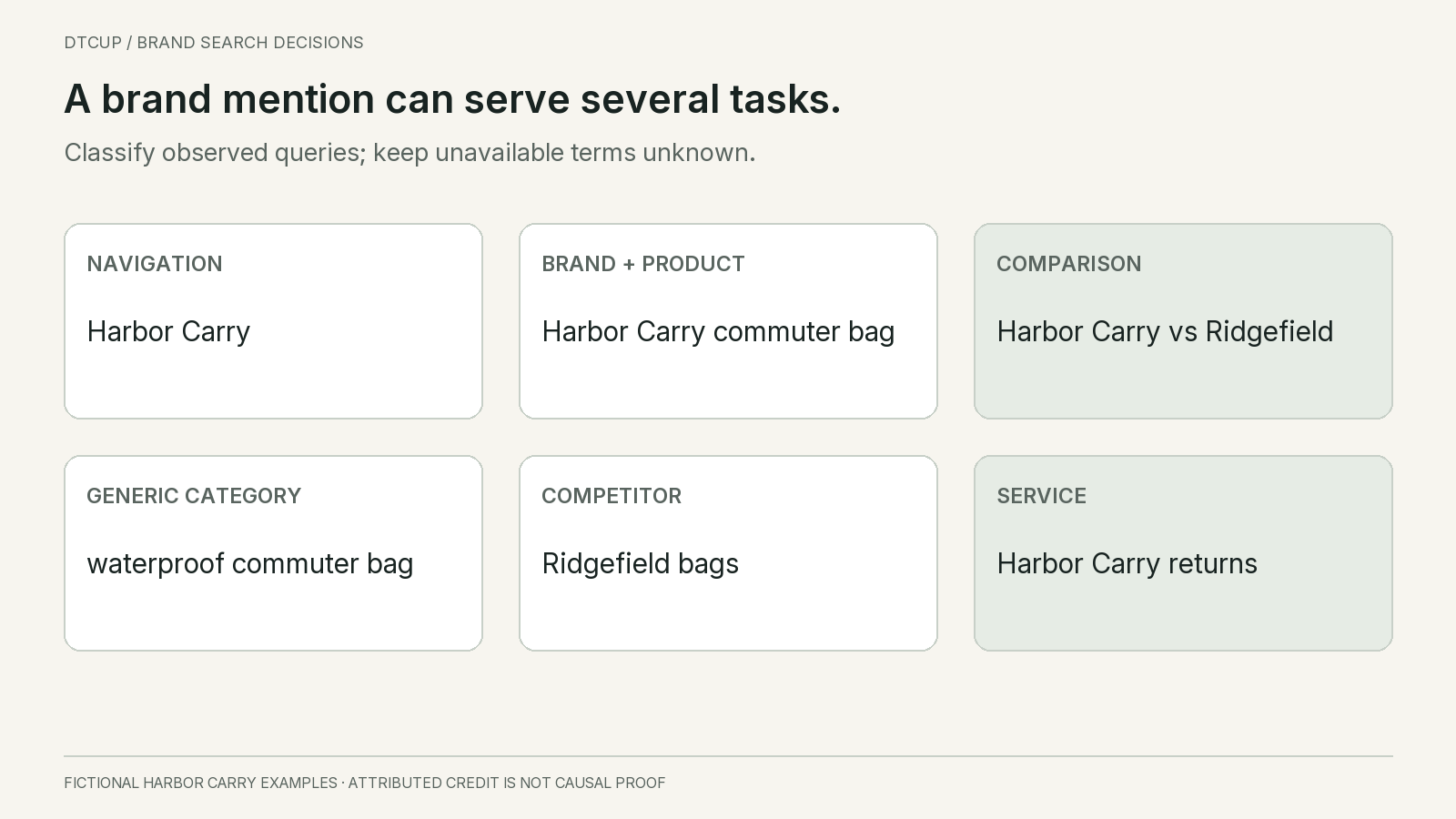
Harbor starts with six practical query groups. Pure own-brand navigation includes the brand name and obvious variants. Own-brand product intent includes a known product line or product type alongside the brand. Comparison intent includes the brand with a competitor or an explicit alternative question. Generic category intent names the need without the brand. Competitor intent names another brand. Service intent concerns support, returns, repairs or account access.
These groups are not a universal taxonomy. They are a workable way to prevent unlike searches from being averaged together. A query such as “Harbor Carry returns” should not be evaluated as if it were “waterproof commuter bag.” One is likely a service task; the other expresses a product need without identifying this fictional brand.
Mixed intent deserves its own label. “Harbor Carry versus Ridgefield bags” mentions the brand but also signals comparison. Treating every query containing the brand string as pure navigation would hide a customer who may still be choosing. Likewise, a branded product name can become ambiguous if it resembles a common category phrase.
Create a small query dictionary with examples, spelling variants, product names, exclusions and an owner. Review ambiguous cases manually before extending a rule. A substring match is a useful first pass, but a short brand name can appear inside unrelated words. The classifier should explain why a query belongs to a group.
Retain an unknown group for unavailable or unclassifiable search terms. Do not distribute hidden queries into brand and nonbrand merely to make the chart add to a preferred story. Show the coverage share of the classification and, where possible, compare the classified and unclassified populations on observable dimensions.
Audit actual delivery after configuration changes. Brand settings and negative keywords are controls, while the query ledger is evidence of what happened. They serve different purposes. A campaign can be configured with a reasonable rule and still require review for variants, mixed intent or inventory outside the intended scope.
Keep this classification separate from match type. A broad-match keyword is not automatically nonbrand, and an exact-match keyword is not automatically a customer ready to buy. Match type describes targeting behavior. Query intent describes the expressed search. Confusing the two can make a performance report sound more certain than its evidence permits.
For a retailer selling several manufacturers, specify whose brand is being discussed. A search for the retailer’s name is different from a search for a manufacturer stocked by many retailers. Both are branded in ordinary language, but only one directly names the store. Combining them can make a retailer’s own-brand campaign appear to serve much more navigational demand than it actually does.
Product names create a similar boundary. A proprietary product line may identify Harbor even when the company name is absent. A generic descriptive product title may not. Maintain a reviewed list of distinctive product names and label uncertain cases separately. Do not assume that every catalog phrase belongs in the own-brand bucket merely because the website sells an item with that title.
Preserve these distinctions in the report even if the account uses a simpler campaign structure. Reporting can classify retailer brand, manufacturer brand, proprietary product and generic need without forcing an immediate rebuild. The first benefit is a more accurate interpretation of current spending; architecture changes require their own case.
3. Separate a brand query from a returning customer
A first-time buyer can search a brand name. A returning customer can search a generic category. Search intent and customer history are different dimensions. Using “brand” as a synonym for “existing customer” makes the acquisition discussion inaccurate before the attribution model even enters it.
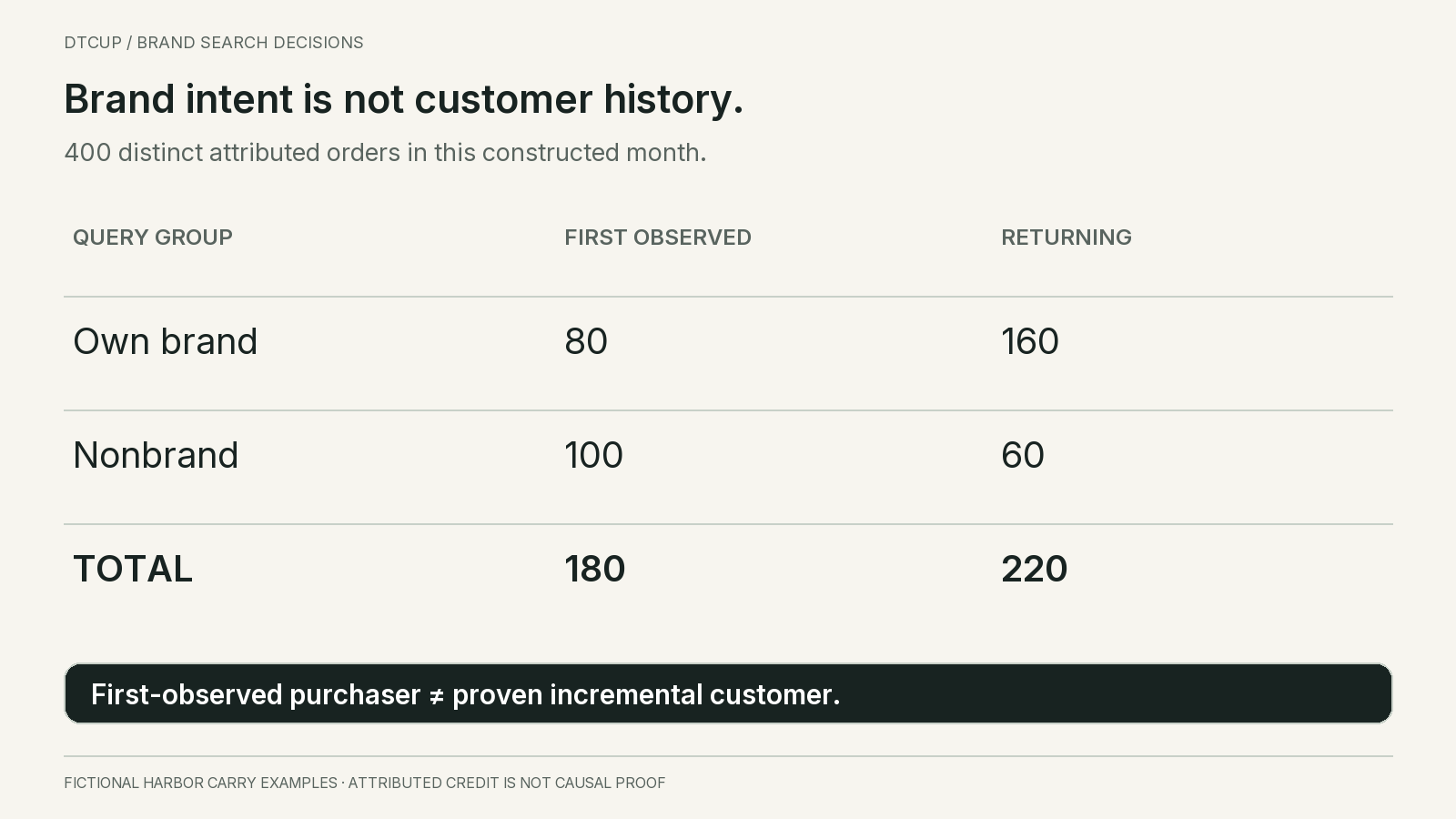
In Harbor’s constructed month, paid search receives credit for 400 distinct qualifying orders. Two hundred forty follow an own-brand query and 160 follow a nonbrand query. Within the brand group, 80 orders belong to first-observed purchasers and 160 to returning purchasers. Within nonbrand, 100 are first-observed and 60 returning.
The resulting two-by-two view contains 180 first-observed purchasers and 220 returning purchasers. It shows that brand search participates in first purchases and nonbrand search participates in repeat purchases. It does not establish what either group would have done without the advertising.
Use “first observed” when the available history cannot establish a customer’s entire relationship with the business. A new email address, an imported account or an order outside the current data source can make a returning person appear new. State the identity rules and history coverage rather than implying perfect customer knowledge.
Do not solve missing identity by guessing from a name or loosely matching addresses. Incorrectly merging customers can be worse than leaving a status unknown. Use approved identifiers and preserve uncertain records. A clean-looking new-customer rate is not worth introducing false relationships into the CRM.
Also define the timing of customer status. The customer is first-observed before the qualifying purchase, not after it has created their account record. If the reporting system checks current status without reference to the purchase date, every purchaser may eventually look returning. Historical status needs a time-aware definition.
Interpret the first-purchase brand segment carefully. Those 80 customers may have discovered Harbor through a creator, recommendation, physical event or prior unpaid research. The brand ad can be part of completing their purchase. It does not follow that it created all 80 first purchases or that the earlier discovery activity was irrelevant.
The practical use of the matrix is to improve questions. If brand search is mostly returning customers seeking support, the landing page and spend decision may need attention. If a product launch drives many first-observed brand searches, investigate how launch activity and search coverage work together. The matrix describes the audience; causal evidence is still needed for a claim about added sales.
4. Read attribution as a journey description
Suppose every order in the worked month has 100 dollars of defined order revenue. Brand search receives 24,000 dollars of attributed revenue on 1,200 dollars of spend, a reported ROAS of twenty. Nonbrand receives 16,000 dollars on 4,800 dollars of spend, approximately 3.33. Together they produce 40,000 dollars of credit on 6,000 dollars of spend, approximately 6.67.
Those calculations are internally consistent. They still do not establish that moving budget from nonbrand to brand will produce more total revenue. Brand searches may be limited by existing demand for the name. Additional spend can change which paid position captures that demand rather than creating a proportionate increase in the number of people who want the product.
Even restricting the report to first-observed customers does not solve causality. Brand’s 80 first-observed orders represent 8,000 dollars of attributed revenue, while nonbrand’s 100 represent 10,000. Dividing spend by those counts gives fifteen dollars and forty-eight dollars per attributed first-observed purchaser. These are descriptive acquisition-reporting ratios, not experimentally established incremental customer acquisition costs.
Last-click attribution is useful for identifying the final measured route. If customers repeatedly finish through a branded search, the brand should ensure that route leads to the right page with the right message. It may reveal friction in navigation, a useful product query or a common comparison. That is valuable operating evidence even when it does not prove causal lift.
Earlier-touch reporting asks another question: which observed interactions preceded the purchase? It can reveal that brand search often follows social, email or category research. But redistributing credit to earlier touches does not automatically reveal which interaction caused the sale. The model changes the accounting rule, not the historical counterfactual.
Use consistent attribution windows when comparing views, and allow cohorts to mature. A brand click close to purchase and a category click weeks earlier can be affected differently by a short lookback period. The attribution-window guide explains why changing eligibility can move credit without creating additional revenue.
Do not add platform-reported revenue across channels as if it were a partition of the order ledger. More than one platform may claim involvement in the same purchase. Start from distinct qualifying orders when reviewing total business outcomes, then inspect the channel views as separate descriptions. A high combined total of claims is not extra money.
The useful discipline is to label the conclusion at the level of the evidence. “Brand search is the last measured interaction for many first purchases” is supportable from a correctly defined journey report. “Brand search created those first purchases” requires a different comparison. Keeping the language precise protects both the channel’s real value and the budget decision.
5. Map what customers could do without the brand ad
The relevant alternative is rarely “the customer sees nothing.” They may click the organic result, use a saved link, select a retailer, search again or choose a competitor. A brand-search decision depends on those alternatives. The same paid placement can have different value in different search environments.
Inspect representative results by market, device and important query type. Record the date and context because search results change. Look at the organic destination, reseller visibility, competing offers and the clarity of the route to the official website. One personalized screenshot is not a complete market audit, but it can reveal a concrete customer obstacle worth investigating.
Evaluate the destination as well as the position. An organic homepage may be adequate for pure navigation but poor for a specific product or service question. A paid ad that leads directly to an in-stock product page can reduce effort. That benefit should be tested or observed rather than assumed from the presence of a sitelink.
Competitor presence is a reason to examine substitution risk, not proof that every brand click is incremental. Some customers will remain loyal despite another ad; others may compare. A competitor appearing above the organic result can matter differently for a well-known repeat purchase than for a first-time buyer evaluating an unfamiliar product.
Consider the retailer relationship. A customer who buys the same product from an authorized retailer may create a different commercial outcome from a customer lost to a competitor. The direct website’s order count alone may not capture the full brand outcome, while the advertising budget may be owned by the direct channel. Define which business boundary the decision serves.
Separate service searches from acquisition searches. Paying to route existing customers to a useful support page may be an intentional service choice, but it should not inflate the acquisition story. Conversely, excluding all service-related brand terms without checking discoverability may leave customers with a worse route to help.
Map the likely alternatives before choosing an experiment or a budget adjustment. The map helps identify the outcomes to monitor: total qualifying orders, organic and direct substitution, retailer effects if observable, service access and competitor-related losses. It also makes clear where the available data cannot observe the complete response.
Do not demand perfect visibility before making any decision. Instead, identify which uncertainty could materially change the conclusion. A missing retailer feed may matter greatly for a brand-wide decision and less for a narrowly defined direct-channel contribution decision. The scope should make that limitation explicit.
6. Use a substitution ledger to interpret a coverage change
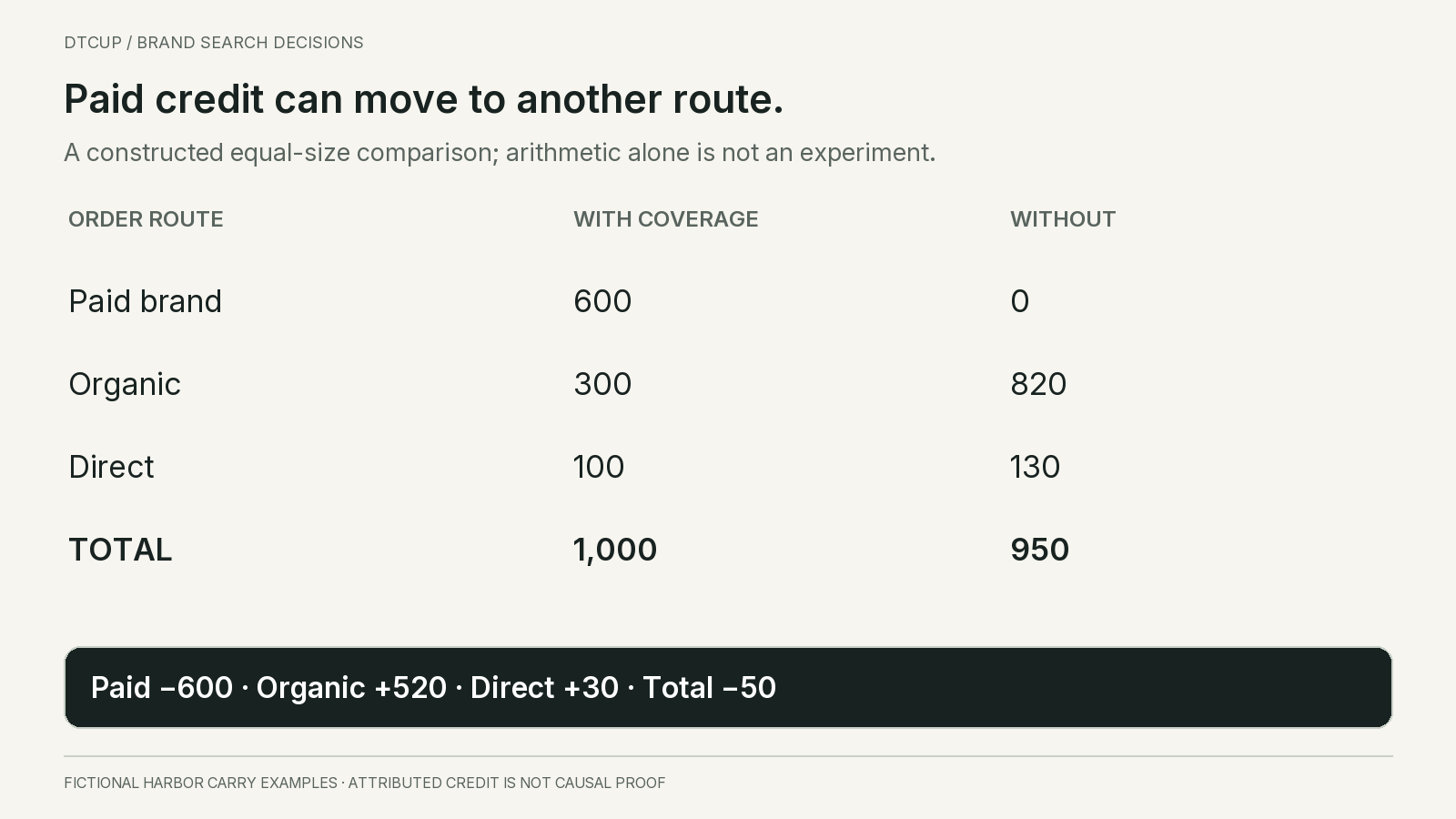
Consider a separate constructed illustration with equally sized, credibly comparable groups. Under the current brand-paid coverage, there are 1,000 qualifying orders: 600 assigned to paid search, 300 to organic search and 100 to direct. Under a condition without that specified brand-paid coverage, there are 950: zero in that paid category, 820 organic and 130 direct.
The paid category falls by 600 orders, but the total falls by only fifty. Organic gains 520 and direct gains thirty, a combined 550. This accounting shows why the loss of attributed brand orders can be much larger than the change in total orders. It does not mean the remaining fifty can be established from a casual before-and-after comparison.
The example assumes a comparison design capable of supporting the intended interpretation. The arithmetic alone does not create that design. Real studies need appropriate assignment or modeling, delivery checks, uncertainty and a defined observation period. The existing incrementality testing guide covers those requirements in detail.
Use the ledger as a diagnostic layer around the main total-outcome comparison. It helps explain how routes changed, but the channel movements themselves are not necessarily causal estimates. Attribution labels may change because the last measured interaction changed. The total qualifying outcome remains the primary business measure for this example.
Assume the fifty-order difference represents 5,000 dollars of revenue at the example’s 100-dollar order value, and maintaining paid coverage costs an additional 2,000 dollars. At an assumed forty dollars of contribution before advertising per additional order, fifty orders contribute 2,000 dollars. Under these invented assumptions, the central arithmetic is break-even before any other relevant costs or benefits.
That is a very different conclusion from the campaign’s reported ROAS of twenty in the earlier descriptive month. The two examples are not a calibrated model of the same dataset; one illustrates attribution and the other substitution. Their purpose is to show why a strong attributed ratio cannot substitute for the commercial effect of the actual spending difference.
Keep uncertainty in the decision. A real estimate might leave open outcomes below or above the fifty-order break-even point. Do not divide a noisy order difference into spend and present the resulting cost as precise. Ask which economically relevant effects the evidence can distinguish and which remain plausible.
Also preserve the scope. A result from removing current coverage does not establish the return from the next increase in bids, from a new product launch or from another country. It describes the tested difference while the rest of the marketing system remains in place. The brand’s alternatives and demand conditions can change later.
7. Use research to improve the question, not to copy a verdict
The well-known eBay paid-search field experiments by Blake, Nosko and Tadelis are useful because they demonstrate how strongly nonexperimental attribution can differ from a causal comparison. The 2014 working-paper abstract reports no measurable short-term benefit from brand-keyword ads in that setting, with differing responses to nonbrand ads across customer groups. The work was subsequently published in 2015.
That finding should make an operator question whether observed clicks are being confused with added demand. It should not become a universal instruction to stop brand bidding. The advertiser, customer familiarity, organic presence, competitive environment and study period are part of the result. A modern smaller brand can face a very different set of alternatives.
The useful transferable lesson is methodological: people who are likely to buy may also be likely to click, so their purchases cannot automatically be credited as caused by the ad. The business needs a comparison that addresses that selection. The specific size of the effect must come from evidence relevant to the current decision.
Apply the same caution to agency case studies. A claim that brand ads produce a high return may describe attributed revenue rather than incremental contribution. A claim that turning them off had no effect may rely on a short period with limited sensitivity. Ask what changed, what remained, how outcomes were measured and what uncertainty the design could resolve.
Do not treat a statistically inconclusive result as proof that paid coverage has zero value. A study can fail to distinguish a commercially important effect because the available data is noisy or the comparison is weak. Conversely, a positive point estimate does not guarantee that the activity clears the economic threshold.
Research can also help identify heterogeneity worth examining. New and frequent purchasers may respond differently, but those groups need reliable definitions and adequate evidence. Avoid slicing a small result into many segments until one appears persuasive. Prespecify the important distinctions where possible and label exploratory findings.
For Harbor, the research changes the meeting from “brand ROAS is highest, so increase it” to “what role does this coverage play for these customers under these search conditions?” That is a more useful question even before a formal test is feasible. It creates a path from observation to a bounded decision.
8. Audit coverage across campaigns before interpreting a test
Removing one brand campaign may not remove paid brand coverage. Another Search campaign, Shopping activity or Performance Max configuration may continue reaching related queries. If the intended comparison is broader than the actual change, the result will answer a different question from the one in the brief.
Map every relevant source of coverage. Record campaign type, intended query scope, brand controls, geographic reach and the destinations being advertised. Keep a before-state record. The aim is to understand the delivered treatment, not to force every account into one preferred campaign architecture.
Google’s current brand-exclusion documentation describes controls for Search and Performance Max, including Search and Shopping coverage and an option to retain Shopping exposure for excluded brand terms. Verify the actual campaign configuration and current interface; the control’s name alone does not establish which inventory remains eligible.
Inspect whether shared budgets or automated allocation move spend elsewhere when coverage is changed. If money removed from one campaign is immediately spent in another, the comparison includes that reallocation. This may be the intended business decision, but it should be described as such rather than called a clean test of one ad placement in isolation.
Keep brand inclusions, exclusions and ordinary negative keywords distinct in the implementation record. They may overlap in purpose without being interchangeable in scope. Query classification should be checked after the change rather than assuming a control captures every spelling, product name or mixed-intent search exactly as the editorial taxonomy expects.
Verify delivery over the study period. A saved setting is evidence of configuration at one moment. It is not proof that coverage, spend and query mix stayed within the intended conditions. Look for accidental reactivation, new campaigns, changed markets or a competitor event that materially changes the interpretation.
Avoid changing several unrelated things at once. If bids, landing pages, promotions and creative all change alongside brand coverage, the result concerns the combined intervention. Combined changes can be valid business tests, but they provide a less specific answer about the value of the brand ad itself.
Plan the ending. Restore the approved baseline or apply the agreed next configuration, then verify it. A temporary exclusion or budget cap should not persist simply because the person running the study moved to another project. The final decision record needs both the interpretation and the confirmed operating state.
9. Choose a proportionate action from the evidence
There are more useful options than “keep everything” and “turn everything off.” A brand can maintain limited navigational coverage, separate comparison intent, improve a product landing page, reduce excessive bids, exclude clearly irrelevant service traffic from an acquisition campaign or investigate a specific market. The choice should follow the observed mechanism.
If organic substitution is strong and the economic effect of current paid coverage appears small within a credible comparison, a bounded reduction may be reasonable. Keep the scope and review condition explicit. Watch total outcomes and customer access, not only the paid campaign’s reported conversions, which are expected to fall when paid coverage is reduced.
If the evidence suggests paid coverage protects a meaningful purchase route under active competition, maintaining it may be justified. That does not automatically justify bidding more aggressively. The marginal value of a higher position or more complete coverage can differ from the value of having some coverage at all.
If the result is uncertain, ask why. Missing order data requires a measurement repair. A weak comparison requires a design change. Insufficient volume may require a more limited claim or a longer learning plan. None of these problems is solved by choosing the most favorable attribution model.
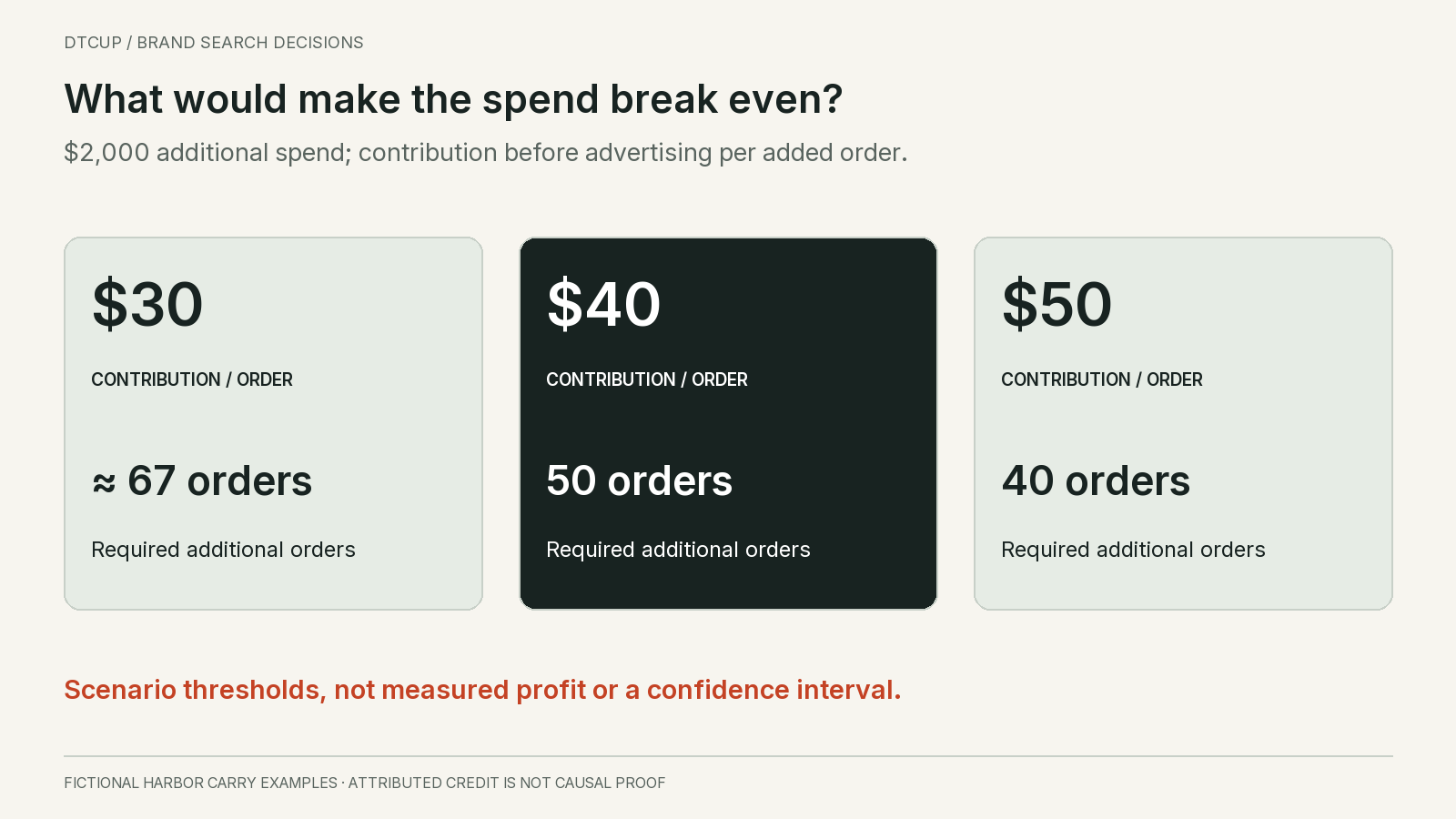
Use a break-even calculation to make the uncertainty concrete. In the substitution illustration, 2,000 dollars of additional spend and forty dollars of contribution per additional order require fifty additional orders to break even. If contribution is thirty dollars, the threshold rises to approximately sixty-seven whole orders. If it is fifty dollars, the threshold falls to forty.
These are scenario thresholds, not claims about actual profit. The contribution basis must reflect the relevant product mix and variable costs. Returns, discounts or fulfillment differences can change it. A brand should not insert optimistic future customer value merely to rescue a weak immediate result without separate evidence for that value.
Also distinguish a total-spend decision from a next-dollar decision. The current campaign can be worth keeping while an extra thousand dollars is unproductive. Conversely, a small underfunded segment may deserve a test even when the blended campaign looks mediocre. Budget decisions concern the response to a specific change, not an unlimited extrapolation of historical average ROAS.
Write the decision as a bounded operating statement: retain, reduce, reallocate within a defined scope, or investigate further. Include what evidence would trigger reconsideration. That makes the action reversible and prevents a one-time study from becoming a permanent belief about the channel.
10. Manage brand and nonbrand as connected demand routes
Brand and nonbrand search are reporting distinctions inside a wider customer journey. Generic research can introduce a product need, while later brand searches help the customer return. Social, content, referrals and offline experiences can also create name recognition. Treating the final brand click as the sole source of demand undervalues those earlier influences.
Do not respond by assigning all brand conversions back to awareness channels through an arbitrary rule. That would replace one unsupported causal story with another. Preserve observed paths, compare attribution sensitivity and use appropriate experiments for the decisions that need causal evidence.
Watch branded-query volume as a diagnostic signal, with limitations. It can change because of awareness, customer service needs, publicity, seasonality or existing-customer activity. An increase is not automatically an advertising success. Read the query composition and broader context before using the trend as evidence that a particular campaign created demand.
For nonbrand search, distinguish problem discovery, product category, comparison and immediate purchase intent. A broad category query may require an explanatory landing page, while a specific product requirement may need direct evidence of fit. Comparing all nonbrand traffic with pure brand navigation can hide useful opportunities inside an unfavorable average.
Evaluate creative and landing pages within the relevant task. A brand-navigation ad should make the official route clear. A comparison query needs credible distinctions and tradeoffs. A service query needs a usable help destination. The same promotional message is unlikely to serve all three equally well.
Coordinate the marketing calendar. A launch or creator campaign may increase later branded searches. If search budgets cap out during that period, customers may encounter a different route than usual. That observation can support a capacity or coverage review without proving that every extra branded purchase was caused by the search ad.
Keep the channel-by-channel attribution framework as the broader reference. Brand search is one example of matching a measurement view to a decision. The durable habit is to distinguish observed participation, allocated credit and experimentally supported change across every channel.
A coordinated team can therefore value both demand creation and demand capture without pretending to know the causal contribution of every touch. It uses attribution to find patterns, operating evidence to repair customer routes and controlled comparisons to answer selected spending questions. That is more practical than forcing one model to solve all three.
11. Write the decision memo before the next budget meeting
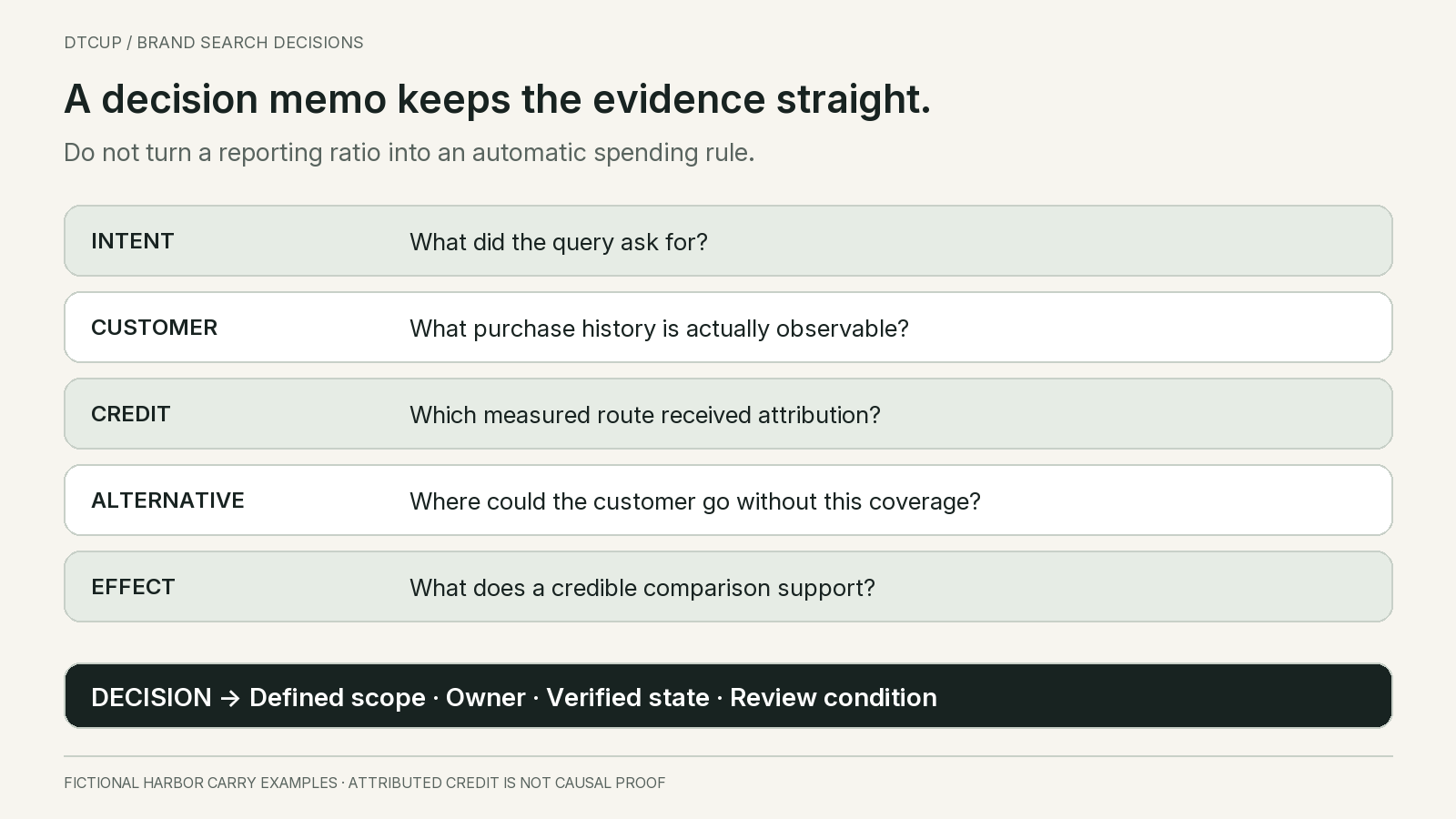
Use a concise memo with a defined question, current coverage, query composition, customer-history coverage, attribution view and economic threshold. Attach the underlying evidence rather than filling the memo with screenshots of high ratios. The reader should be able to tell which statements are observed and which are interpretations.
Describe the alternative customer route. Include organic visibility, relevant competing destinations and known gaps in observation. If retailer sales are outside the data, say so. If query coverage is partial, show the unclassified share. These limitations affect the decision and should not be buried in a technical appendix.
Summarize any comparison evidence within its actual scope: markets, dates, customer population, coverage difference and the other activity that remained in place. Report uncertainty and the commercial threshold together. A point estimate becomes more useful when the manager can see whether plausible outcomes lead to different actions.
List the action, owner and review condition. For a bounded bid reduction, specify the affected scope and the measures that would prompt a reversal or further investigation. For no change, record what evidence is missing and whether obtaining it is worth the cost. Maintaining the current setting can be a deliberate decision rather than an absence of thought.
Keep the original and final settings in the execution record when a real change is authorized. Verify delivery afterward. A recommendation is not an executed change, and an executed change is not yet a proven improvement. The memo should distinguish those states so future reviewers do not inherit a false success story.
Return to the memo when conditions change materially. A new competitor, a different organic result, a product launch or a changed distribution model can alter the value of paid coverage. The earlier evidence remains useful history, but it does not remove the need to reconsider the current customer route.
The best outcome of this exercise is not a clever verdict about branded keywords. It is a repeatable way to decide whether a specific paid route earns its place in the business. That requires enough skepticism to question attribution and enough humility to avoid declaring every navigational click worthless.
12. Questions that often lead to the wrong decision
Does a high brand-search ROAS prove the ads are valuable?
It proves only that the reported credit is high relative to spend under the stated measurement rules, assuming the data is correct. The ads may be valuable, but added business value depends on what customers would do under a credible alternative. Use the ratio to understand the route, then match the budget question to stronger evidence where needed.
Are brand-search buyers always returning customers?
No. First-time purchasers can learn the name elsewhere and search it before buying. Returning purchasers can use generic queries. Keep customer status and query intent separate, and describe incomplete purchase history as first-observed status rather than claiming certainty about every customer’s entire relationship with the brand.
Should a first organic position mean we stop brand ads?
Not automatically. Inspect the actual customer route, query type, competing destinations, device experience and economics. Strong organic substitution can reduce the additional value of paid coverage, but a ranking alone does not quantify that value. A bounded comparison is more useful than a universal rule based on one search screenshot.
Can we pause the campaign for a week and compare sales?
That can produce an observation, but it may not isolate the effect of the pause. Demand, promotions, availability and other campaigns can change at the same time. The duration also may not allow delayed purchases to mature. Choose a design that can answer the economic question and state uncertainty rather than calling any before-and-after difference incremental.
What if a formal experiment is not feasible?
Improve the query and customer-status reporting, inspect alternative routes and make a proportionate decision with explicit limits. Avoid both a sweeping shutdown and an unlimited budget increase based only on attributed ROAS. A smaller, reversible action with a clear review condition can be sensible while the business develops better evidence.
Sources
Still have a question?Ask the DTCUP Community ↗