
Beauty Brand Launch: An Illustrative 0–1 Shopify Delivery Story
An illustrative beauty-brand Shopify launch showing how positioning, product education, subscriptions and measurement can operate as one DTC system.

7 years of experience building and operating brand websites, specializing in website development, paid advertising and SEO. Built a brand website from launch to US$10 million in annual sales.
Related context: Conversion: A Practical Audit Framework, Conversion: What to Measure Every Week, Acquisition: The Lean Team Playbook, Creative: How to Build the Business Case.
Beauty Brand Launch: An Illustrative 0–1 Shopify Delivery Story explains how DTCUP connects strategy, customer experience, Shopify engineering, growth operations and measurement around one commercial roadmap. A founder-led skincare concept has strong product expertise but no shared system for claims, routines, merchandising, replenishment, support and measurement. Launch pressure can easily turn that gap into a fragile theme and a stack of disconnected apps.
The business situation
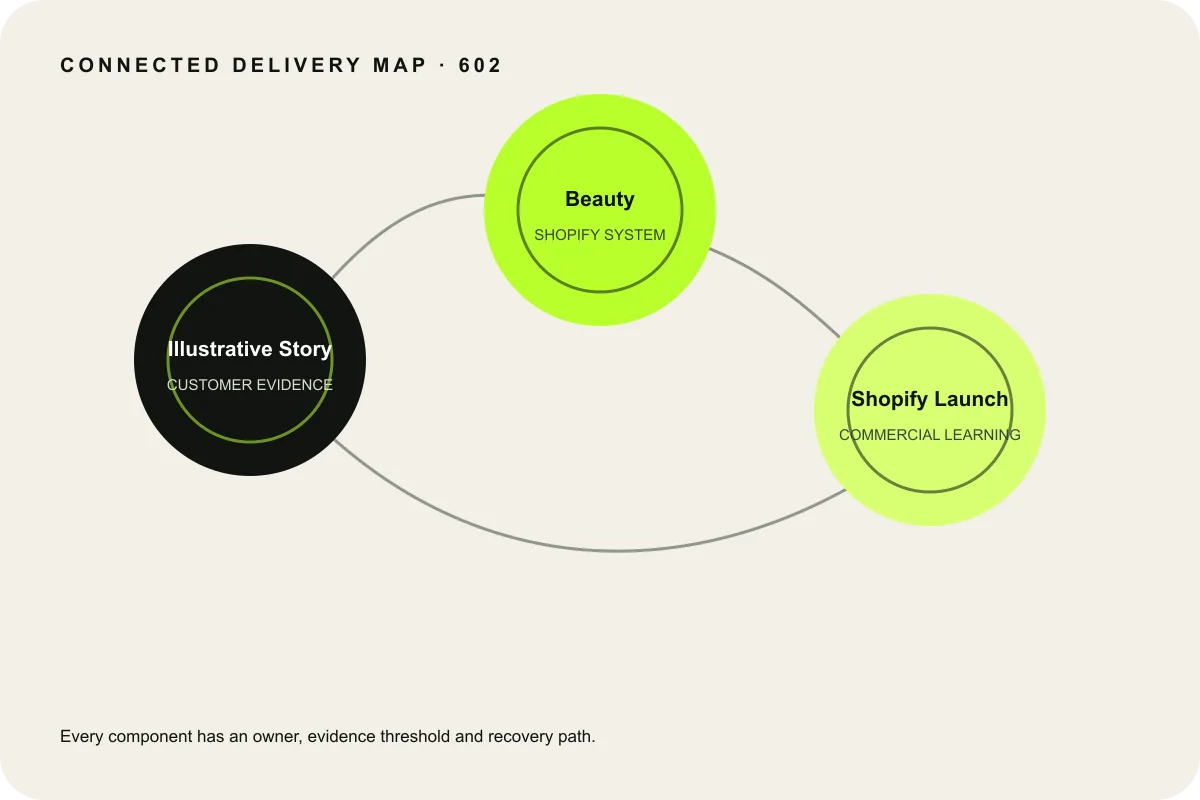
A founder-led skincare concept has strong product expertise but no shared system for claims, routines, merchandising, replenishment, support and measurement. Launch pressure can easily turn that gap into a fragile theme and a stack of disconnected apps. The visible website is only one layer of the problem. Product facts, customer language, inventory, service promises, permissions, analytics and team ownership determine whether the experience stays coherent after launch. DTCUP begins by documenting those relationships before committing to a page list or technology stack.
The discovery team maps the highest-value customer tasks and the moments of uncertainty that prevent progress. Analytics provides direction, while support contacts, search queries, reviews, interviews and journey testing explain why behavior occurs. Commercial context includes margin, returns, delivery cost, service workload and repeat behavior. This creates a shared decision statement instead of a long collection of feature requests.
From evidence to an operating blueprint
This composite story demonstrates how DTCUP would connect positioning, product truth, information architecture, a modular Shopify build, lifecycle flows, subscription decisions, analytics and release QA. It is representative of the delivery pattern rather than a claim about a named client. The blueprint names sources of truth, Shopify capabilities, required apps or integrations, editable theme modules, permissions, analytics events and failure recovery. It separates what must exist for launch from what should wait for evidence. Every important decision has an owner, an acceptance criterion and a reversal path.
Information architecture follows customer decisions rather than internal departments. Product and educational content use structured fields so the same fact can support product pages, comparisons, FAQs, lifecycle communication and future discovery surfaces. Reusable Online Store 2.0 sections let the team change content without turning every campaign into an engineering request. Design rules protect hierarchy, accessibility and performance as the library expands.
The 0–1 delivery foundation
Architecture and ownership before launch
- Customer journey and commercial constraint map.
- Product, policy and content source-of-truth model.
- Accessible modular Shopify storefront architecture.
- Integration, permission and app-dependency register.
- Analytics taxonomy connected to decisions, consent and QA.
- Launch checklist, rollback plan and owner-based operating documentation.
The initial build is organized in small vertical slices: a real customer task, the content it needs, the Shopify logic behind it, the analytics event and the operational exception. That approach reveals missing product facts and integration assumptions earlier than a page-by-page design sequence. It also lets stakeholders review something commercially meaningful without mistaking a static mockup for a tested service.
Quality controls that protect the customer
Each release is checked on representative mobile devices, keyboard navigation, reduced motion and slower networks. The team tests long content, missing media, unavailable variants, consent changes, declined payments, translated copy and vendor failure where relevant. Automated checks support the process but do not replace complete task testing. Known limitations are documented with an owner and a target decision date.
Performance is treated as a budget shared by theme code, images, fonts, analytics and apps. Accessibility is built into component acceptance criteria. Privacy copy must match actual data flows, and optional tracking must fail safely when consent is withheld. Release notes connect every change to the evidence that justified it and the metric that will be reviewed.
Building from 1–10 without fragmenting the system
A governed backlog for the next commercial constraint
After the foundation is stable, growth work moves through a governed backlog rather than unrelated campaigns. Opportunities are ranked by customer severity, commercial value, confidence, effort, dependency risk and reversibility. The team chooses the smallest intervention that can answer the next important question, then records the result so future work starts with accumulated evidence.
Apps are evaluated as operating dependencies, not installed as isolated features. The review covers permissions, performance, accessibility, support, data export, failure behavior and removal. Native Shopify is preferred when it satisfies the need; custom engineering is reserved for distinctive rules or integrations with durable value. This discipline keeps the stack understandable as the business grows.
Measurement and the meaning of progress
The measurement framework combines a primary commercial outcome, leading customer behaviors, trust guardrails and operating-health indicators. Results are segmented by meaningful customer and product contexts before they are explained. Attribution is reconciled with orders, finance and experimental evidence where possible. A conversion lift does not qualify as progress if cancellation, returns, service cost or performance defects move in the wrong direction.
The intended outcome is a maintainable launch system: customers can understand routine fit and evidence, the team can publish without breaking layout, and every release produces learning that informs the next commercial decision. The practical standard is not a perfect dashboard. It is enough trustworthy evidence for a named owner to decide whether to keep, revise, stop or expand the work. That decision record is part of the product because it prevents the same debate from restarting every quarter.
What this delivery pattern demonstrates
- Strategy is expressed as customer and commercial decisions, not presentation language.
- The storefront remains editable without sacrificing component standards.
- Growth, content, lifecycle and Apps share product truth and measurement rules.
- Quality controls cover accessibility, performance, privacy and failure recovery.
- The team receives documentation and ownership clarity, not dependency on undocumented agency knowledge.
- Every phase creates evidence that makes the next phase more precise.
DTCUP’s role is to make the system easier to understand and improve as the business changes. A strong 0–1 foundation reduces avoidable rework; a disciplined 1–10 operating cadence turns customer evidence into better releases. Together they create compounding growth capability without pretending that one redesign, campaign or application can solve every constraint.
Choose the next useful step
Review the related DTCUP service system, explore solutions organized by business constraint, or start a project conversation with the context, evidence and decision you already have.
Continue the decision
Try a related toolBeauty Brand Launch: An Illustrative 0–1 Shopify Delivery Story ↗
Help with implementationBeauty Brand Launch: An Illustrative 0–1 Shopify Delivery Story ↗
Still have a question?Ask the DTCUP Community ↗