
Ecommerce Event Taxonomy: Future-Ready Playbook
A practical future-ready playbook for Shopify analytics event taxonomy, connecting customer evidence, Shopify delivery, quality controls and commercial measurement.

7 years of experience building and operating brand websites, specializing in website development, paid advertising and SEO. Built a brand website from launch to US$10 million in annual sales.
Related context: Contribution Margin Systems: Customer Questions Answered, Contribution Margin Systems: Troubleshooting Guide, Shopify Discovery and Roadmapping: Measurement Framework, Online Store 2.0 Content Modeling: A Founder’s Decision Guide.
Ecommerce Event Taxonomy: Future-Ready Playbook is a field guide for the operations director responsible for a growing home & living brand on Shopify. It shows how to build durable capabilities without betting the roadmap on speculation while improving consistent decision-ready behavior data. The objective is a system the team can understand, operate and measure—not a collection of disconnected deliverables.
Begin with the commercial constraint
Write the decision in plain language before discussing tools: which customer is affected, what are they trying to do, where does the current journey fail and what commercial consequence follows? For Shopify analytics event taxonomy, combine behavioral direction with customer examples and operating evidence. A dashboard pattern becomes useful only when the team can reproduce it in an actual journey and explain what decision would change.
Review the path by device, market, product group, acquisition source and customer status. Read support contacts, search queries, reviews, returns, cancellations and release notes beside the funnel. Separate facts, interpretations and assumptions. This prevents a familiar interface idea from being mistaken for a diagnosis.
Map the complete Shopify system
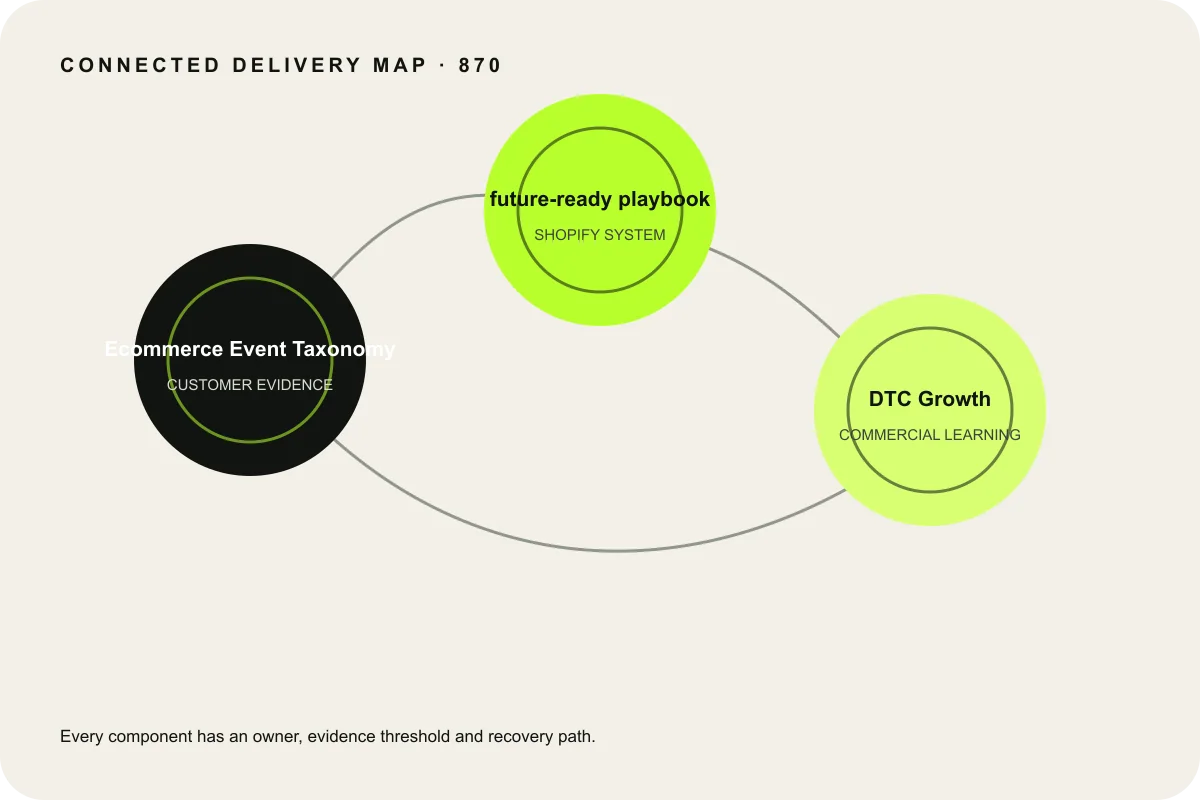
Ecommerce Event Taxonomy depends on events, properties, identity, consent, destinations, QA and documentation. Mark the source of truth, responsible owner, customer-facing component, app or integration, manual handoff and realistic failure state. Show where consent is checked, how analytics identify the event and how operations recover when the automated path does not complete. The system map is valuable because it exposes duplicated rules and invisible work before implementation expands them.
The central risk is tracking everything without defining the decision each event supports. Pair consistent decision-ready behavior data with contribution margin, customer effort and an operational-health measure. Include product cost, discount, shipping subsidy, payment fees, returns, service work, subscriptions and maintenance where relevant. A local metric lift is not a durable result when cost or friction simply moves to another team or a later point in the relationship.
Future-Ready Playbook: the working sequence
1. Establish a decision-ready baseline
Record the current consistent decision-ready behavior data and the leading behaviors that explain it. Annotate promotions, inventory, campaigns, pricing, content, policy, tracking and release changes. Reconcile storefront reporting to orders and finance closely enough to establish direction, and label known gaps rather than presenting false precision. A useful baseline can be repeated by another team member and includes the exact query, filters, dates and exclusions.
2. Observe the full customer task
Complete the journey on a small mobile screen, a slow network and a keyboard-only session. Use long content, unavailable inventory, translated copy, consent changes, declined payments and vendor outages when they are relevant. For each issue, capture trigger, customer context, system response, recovery path and business consequence. A screenshot without context is an opinion; a repeatable task with evidence becomes a finding.
3. Rank opportunities by evidence and reversibility
Score opportunities on customer severity, commercial value, confidence, delivery effort, dependency risk and reversibility. Choose the smallest intervention that customers can perceive and the team can assess within 21 days. A copy change, configuration, manual concierge or bounded component can answer the commercial question before a broad rebuild. State what evidence would stop the work as clearly as what would support expansion.
4. Define acceptance criteria before building
Translate the requirement into observable behavior across events, properties, identity, consent, destinations, QA and documentation. Specify responsive layout, keyboard behavior, labels, focus, loading, empty results, errors, permissions, consent, analytics and vendor failure. Name the source of truth for every important value and the owner for every exception. The release is complete when customers and operators can recover from realistic problems, not merely when the happy path works.
5. Release with a decision date
Instrument the primary behavior before development finishes, then QA duplicate events, identifiers, consent states and reporting joins. Release to a bounded audience when risk warrants and monitor errors, customer contacts and operating workload. Schedule the review before launch. That review should end with keep, revise, stop or investigate rather than an open-ended request for more dashboard time.
What the team should leave with
The core output is a no-regret capability roadmap. Keep it concise enough for planning and release review, attach evidence to findings and assign every action an owner and date. A colleague who missed discovery should be able to understand the customer problem, commercial boundary, implementation logic and measurement standard. That is how Shopify analytics event taxonomy becomes an operating capability rather than a one-time project.
- Customer scope: segment, task, need and current behavior.
- Commercial scope: consistent decision-ready behavior data, contribution margin and a trust guardrail.
- System scope: the relevant parts of events, properties, identity, consent, destinations, QA and documentation.
- Evidence: direction, examples, confidence and known gaps.
- Delivery: owner, dependency, acceptance criteria, rollout and rollback.
- Learning: review date, decision thresholds and the next question unlocked.
Choose native Shopify, an app or custom engineering
Use native Shopify configuration when it satisfies the need, remains maintainable and produces adequate evidence. Choose an app when the capability is mature and speed matters, after reviewing permissions, performance, accessibility, support, data export and removal behavior. Use custom engineering when the rule is strategically distinctive or integration depth creates durable value. Compare three-year ownership and exit cost rather than the first invoice.
Ask vendors to demonstrate edge cases and uninstallation, not only the polished happy path. Test in a duplicate theme, document injected scripts and app embeds, verify data export and define the customer experience during an outage. Give configuration an owner after launch. A sound architecture decision stays reversible because the team knows how to remove the dependency without losing customer history or critical business rules.
Measure the complete outcome
Review one primary outcome, a small set of leading behaviors, a customer guardrail and an operating-health measure. Segment before explaining because blended averages can conceal opposite movements across new and returning customers, devices, products or markets. Use holdouts, phased rollouts, switchbacks or credible comparisons when a conventional A/B test is impractical. Low-volume teams should combine quantitative direction with customer and operational evidence instead of treating an underpowered result as proof.
Write commentary beside every chart: what moved, what else changed, how confident the team is and what happens next. Reconcile attributed revenue with incremental evidence and contribution margin. Monitor cancellation, returns, customer contacts, accessibility, privacy and speed beside conversion. This keeps consistent decision-ready behavior data connected to the entire customer and business result.
Build the no-regret foundation
Reliable product facts, explicit ownership, accessible components, documented rules, trustworthy events and customer permission remain useful even as channels and technology change. Do not create more surface content or automation before the underlying facts and operating promises are dependable. When AI is involved, define allowed actions, evidence it must expose, the confidence threshold for human review and the correction path for the customer. The competitive advantage is a faster feedback loop with better controls, not an impressive interface disconnected from operations.
Questions for the final review
- Can the problem be stated without naming a preferred tool?
- Is consistent decision-ready behavior data connected to margin and a customer guardrail?
- Are owners and dependencies across events, properties, identity, consent, destinations, QA and documentation visible?
- Will the release create evidence that changes a decision?
- Have accessibility, privacy, performance and failure states been tested?
- Can the change be reversed safely if the assumption is wrong?
Ecommerce Event Taxonomy: Future-Ready Playbook should leave the brand with more than a shipped feature. It should create a reusable way to understand customers, choose a proportionate intervention and judge the complete commercial effect. That combination of customer clarity, technical discipline and honest measurement turns isolated improvements into a compounding DTC capability.
Continue the decision
- Migration SEO for Shopify: A Practical Audit
- Conversion Research Repositories: Build, Buy or Configure?
- Incrementality Testing for Acquisition: A Founder’s Decision Guide
- SMS Consent and Value Design: Build, Buy or Configure?
- Release QA for Shopify: Technical Blueprint
- Explore brand and growth strategy advisory
Try a related toolEcommerce Event Taxonomy: Future-Ready Playbook ↗
Help with implementationEcommerce Event Taxonomy: Future-Ready Playbook ↗
Still have a question?Ask the DTCUP Community ↗